
Cannabis Training Techniques
Shape your plants for maximum yield and light penetration — from gentle bending to advanced canopy management.
Key Takeaways
Shape your plants for maximum yield and light penetration — from gentle bending to advanced canopy management.
- Why Train Cannabis Plants?
- LST (Low Stress Training)
- Topping & FIM
- SCROG (Screen of Green)
1. Why Train Cannabis Plants?
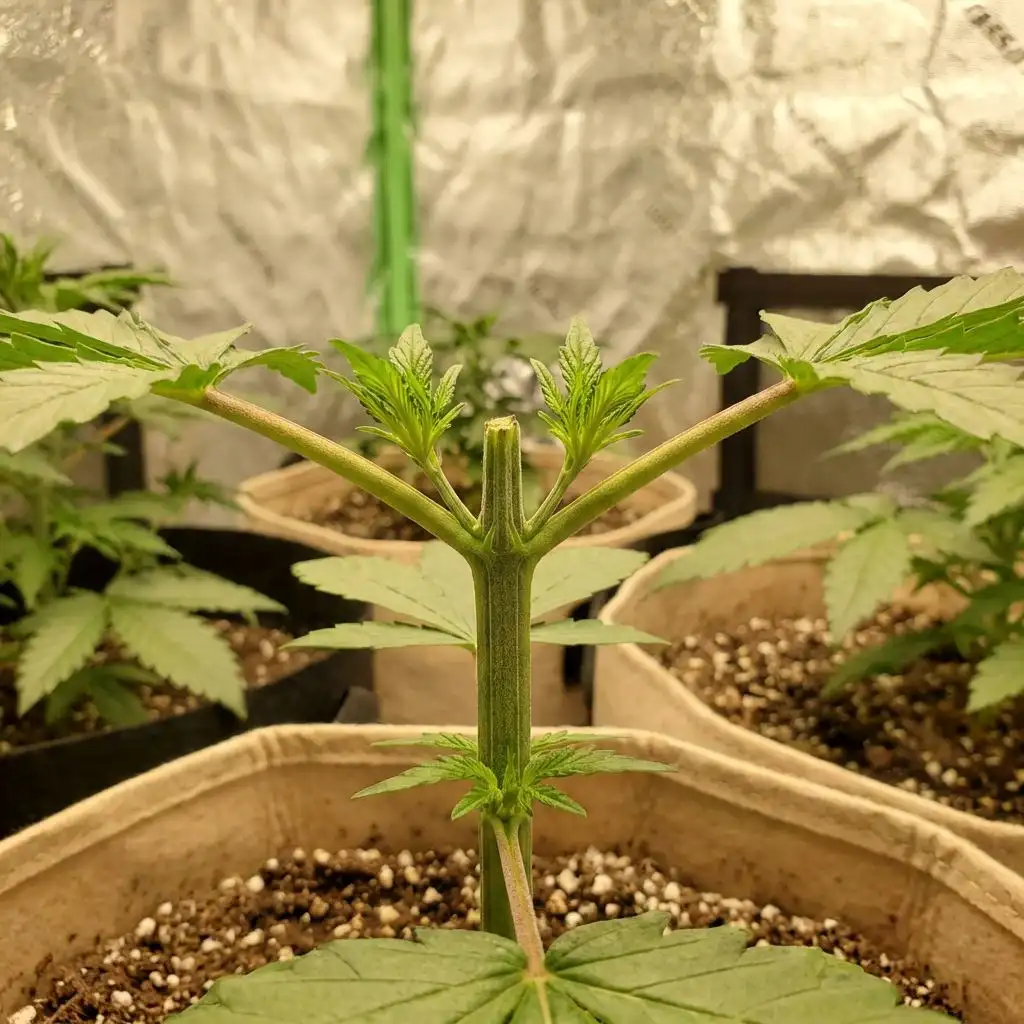
Cannabis naturally grows in a "Christmas tree" shape — one dominant central cola with smaller side branches that receive progressively less light. This is fine in nature, but in an indoor grow with a flat light source overhead, it means only the top 10–15% of the plant receives optimal light intensity. Everything below is shaded, producing airy, underdeveloped buds.
Training techniques solve this by reshaping the canopy to be flat and even, so every bud site receives similar light levels. The result is dramatic: instead of one large cola and many popcorn buds, you get multiple large colas of consistent quality. Most growers see yield increases of 20–40% from training alone, with some advanced techniques pushing gains even higher.
Training also lets you control plant height — critical in tents with limited vertical space. A well-trained plant in a 4-foot tent can produce as much as an untrained plant in a 7-foot space, because you are maximizing the efficiency of every photon your light produces.
2. LST (Low Stress Training)
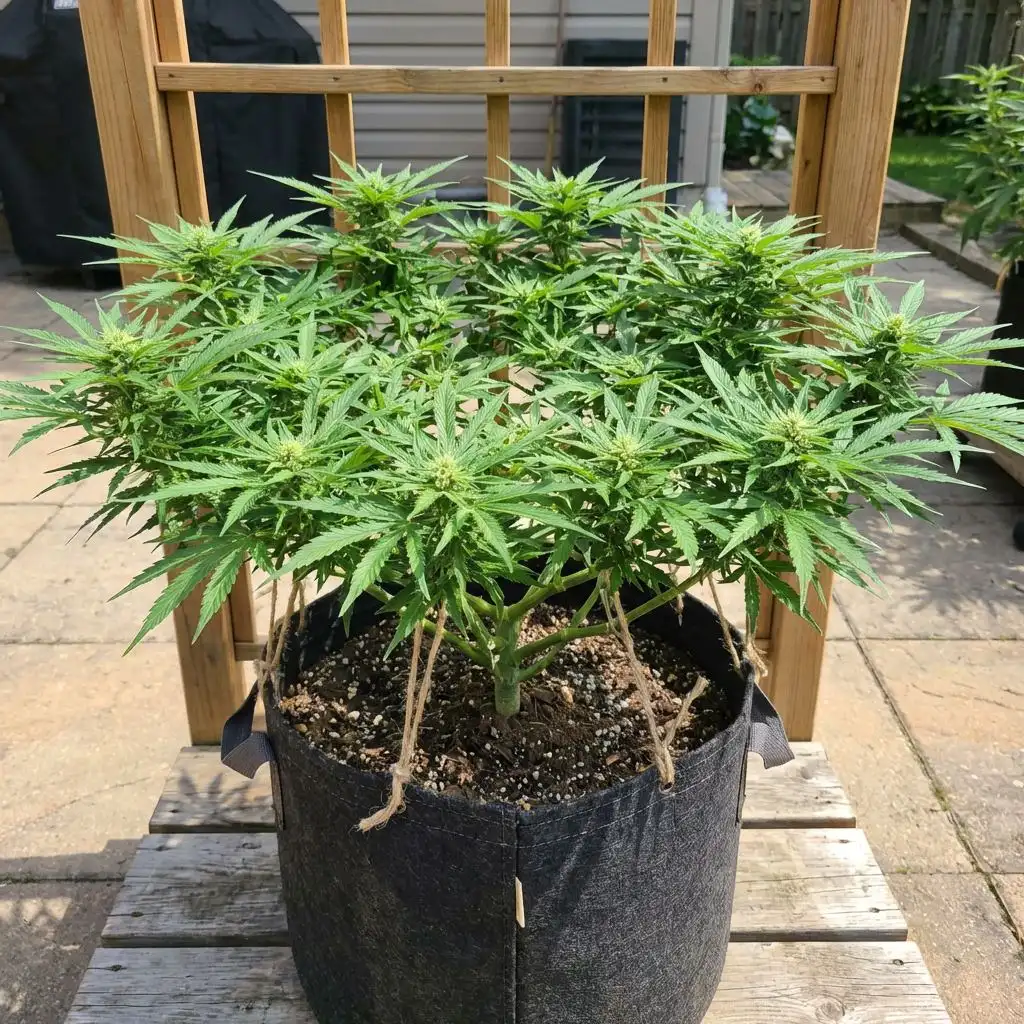
LST is the gentlest and most beginner-friendly training method. You simply bend the tallest branch down and away from center, securing it with soft plant ties, pipe cleaners, or garden wire to the pot rim. This breaks apical dominance — the plant's natural tendency to prioritize the highest growing tip — and signals all lower branches to grow upward toward the light.
Start LST when your plant has 4–5 nodes. Bend the main stem to roughly 90 degrees, tying it to the edge of the pot. Over the following days, the side branches will begin reaching upward. Continue bending and tying new growth every 2–3 days to maintain an even canopy. The goal is a flat, wagon-wheel shape where all branches are the same height.
LST causes zero recovery time because you are not cutting or damaging tissue. This makes it ideal for autoflowers, which cannot afford days of stunted growth on their fixed timeline. You can begin LST as early as week 2 from seed and continue all the way into early flower.
3. Topping & FIM
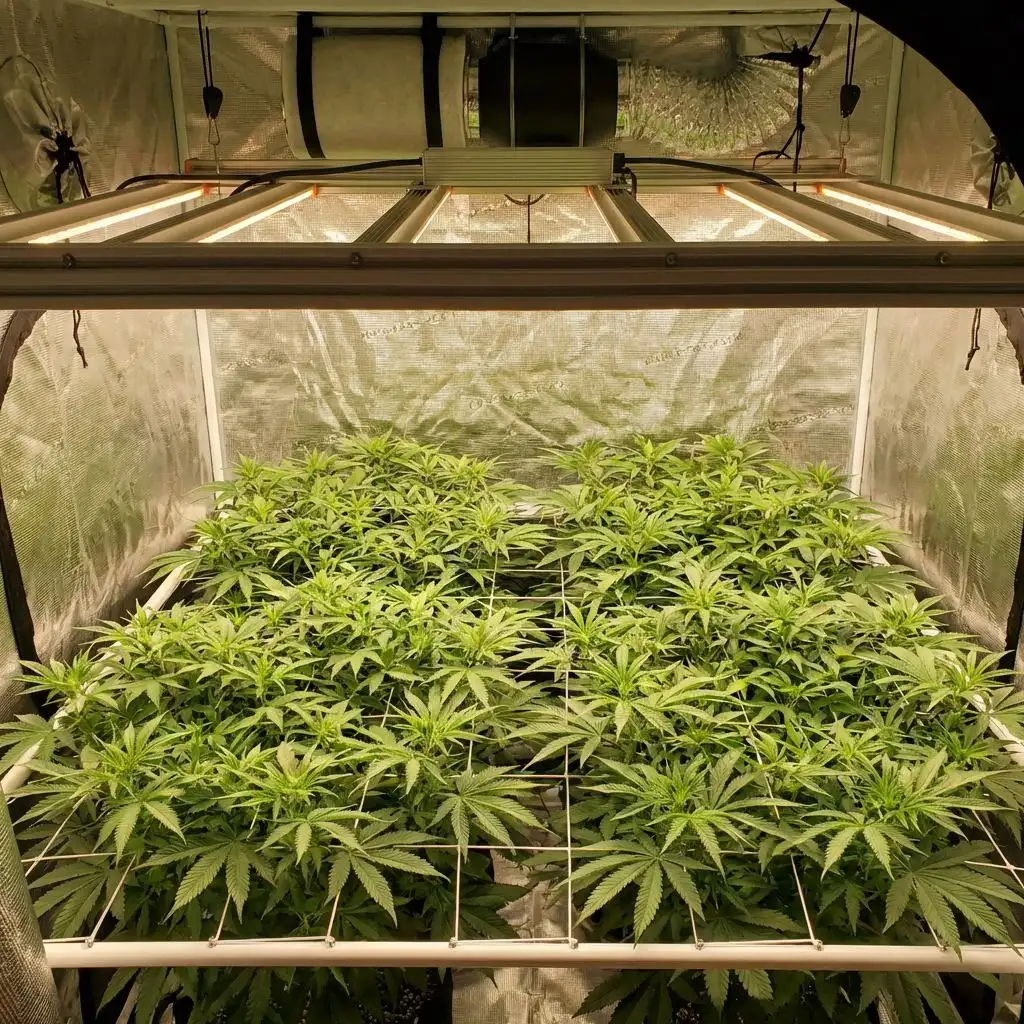
Topping is the most popular high-stress training technique. You cut the main growing tip (apical meristem) cleanly with sterilized scissors just above a node, typically the 5th or 6th. This splits one cola into two equal branches, each of which becomes a main cola. Top those two branches again, and you have four. Most growers top 1–3 times during veg, creating 2–8 main colas.
FIM (F***, I Missed) is a less precise cousin of topping. Instead of cutting the entire growing tip, you pinch or snip roughly 75% of the new growth, leaving a ragged edge. This can produce 3–4 new growing tips instead of the two you get from topping, though results are less predictable. FIM causes slightly less stress than topping, with a shorter recovery period of 3–5 days versus 5–7 days for topping.
Both techniques require your plant to be healthy and actively growing. Never top a stressed, nutrient-deficient, or recently transplanted plant. Wait until the plant has at least 5–6 nodes and is growing vigorously. Perform cuts in the morning when the plant is fully hydrated, and avoid any additional stress for at least 5 days afterward.
| Technique | New Tops | Recovery Time | Stress Level | Best For |
|---|---|---|---|---|
| Topping | 2 (predictable) | 5–7 days | High | Photoperiods, indoor |
| FIM | 3–4 (variable) | 3–5 days | Medium | Growers wanting more tops |
4. SCROG (Screen of Green)
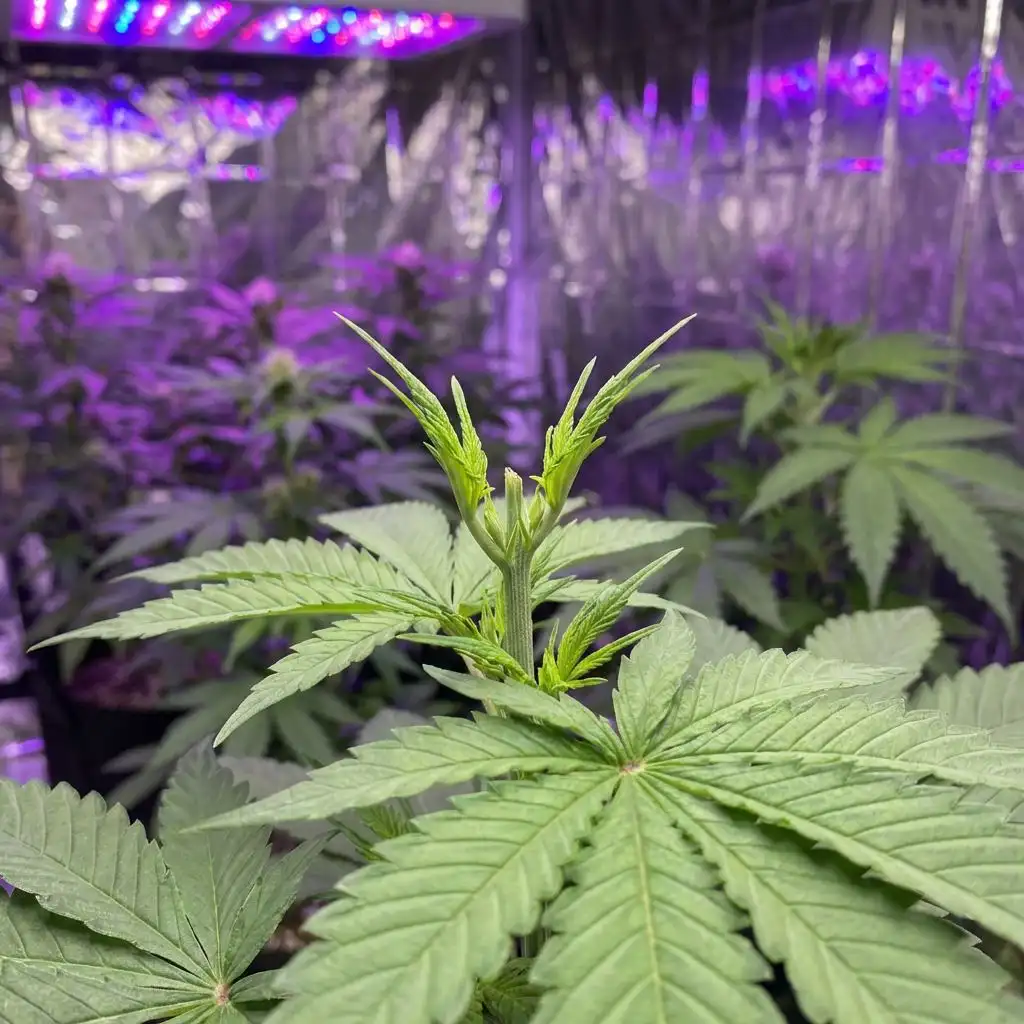
SCROG uses a horizontal screen or net (typically with 2–3 inch openings) placed 8–12 inches above the pot to create a perfectly flat canopy. As branches grow up through the net, you tuck them back under and weave them horizontally outward. This forces every bud site to the same height, ensuring uniform light distribution across the entire canopy.
SCROG works best with 1–4 plants per 4x4 area, topped 2–3 times to create multiple branches. You fill the screen during veg, typically waiting until 70–80% of the net squares are filled before flipping to flower. During the first 2–3 weeks of flower (the stretch), continue tucking new growth under the net. After stretch ends, let everything grow vertically through the screen.
The yield advantage is substantial: a well-executed SCROG can produce 30–50% more than the same genetics untrained because every bud site receives direct light. The tradeoff is time — SCROG requires a longer veg period (6–10 weeks) and daily attention to tucking. It also makes plant maintenance harder since you cannot easily move pots once branches are woven through the net.
5. SOG (Sea of Green)
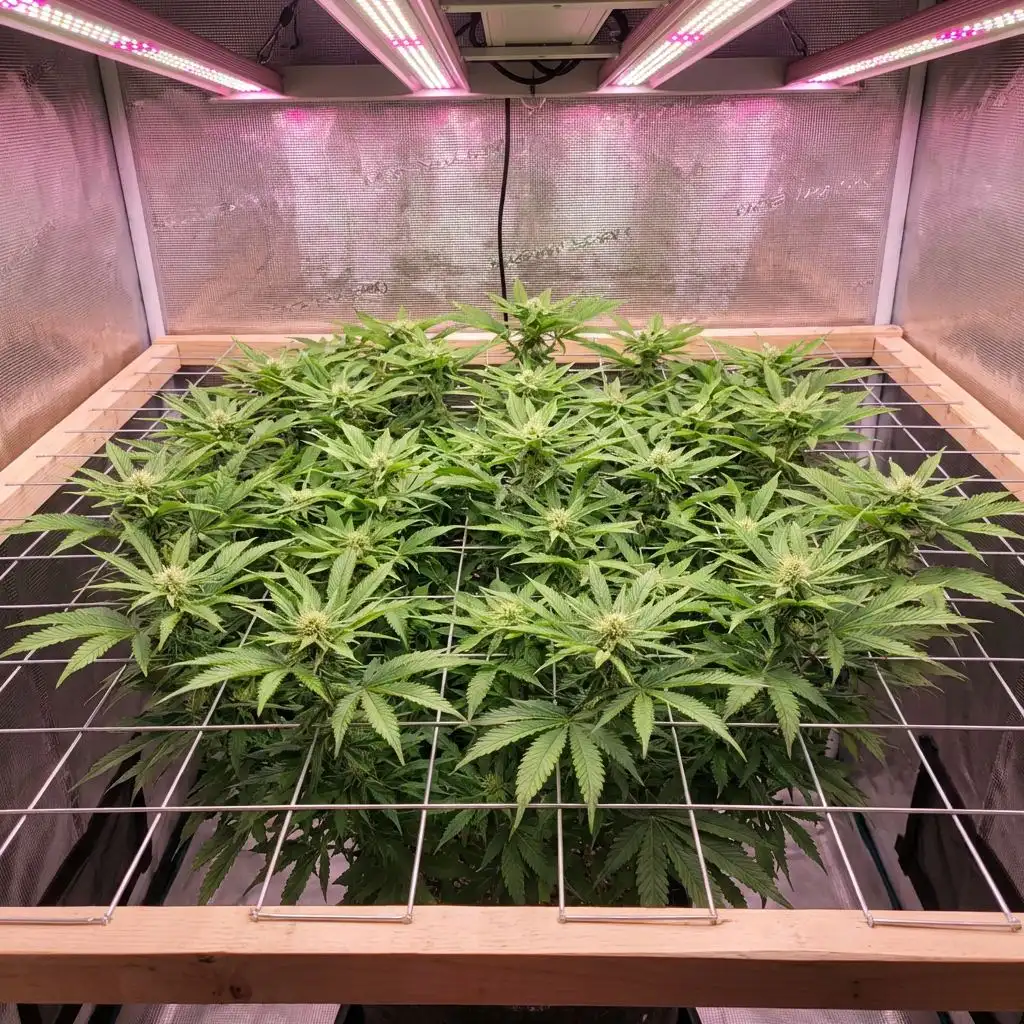
SOG takes the opposite approach from SCROG: instead of training a few plants to fill a space, you pack many small plants close together and flip to flower early, so each plant produces one main cola. A typical SOG runs 4–16 plants per square meter, each vegged for only 1–2 weeks (or rooted clones flipped immediately).
The advantage is speed. SOG harvests come 2–4 weeks earlier than SCROG because there is virtually no veg time. Each plant produces a single 14–28g cola, but the total canopy yield per square meter is competitive with longer methods — typically 400–600g/m² with good genetics and lighting. SOG is the preferred method for commercial operations where time-to-harvest directly impacts revenue.
SOG works best with clones from a single mother plant to ensure uniform height and flowering time. Using seeds introduces too much variation in phenotype, creating an uneven canopy. Note that SOG may have legal implications in jurisdictions with plant count limits, as you are growing many more individual plants than other methods.
6. Supercropping
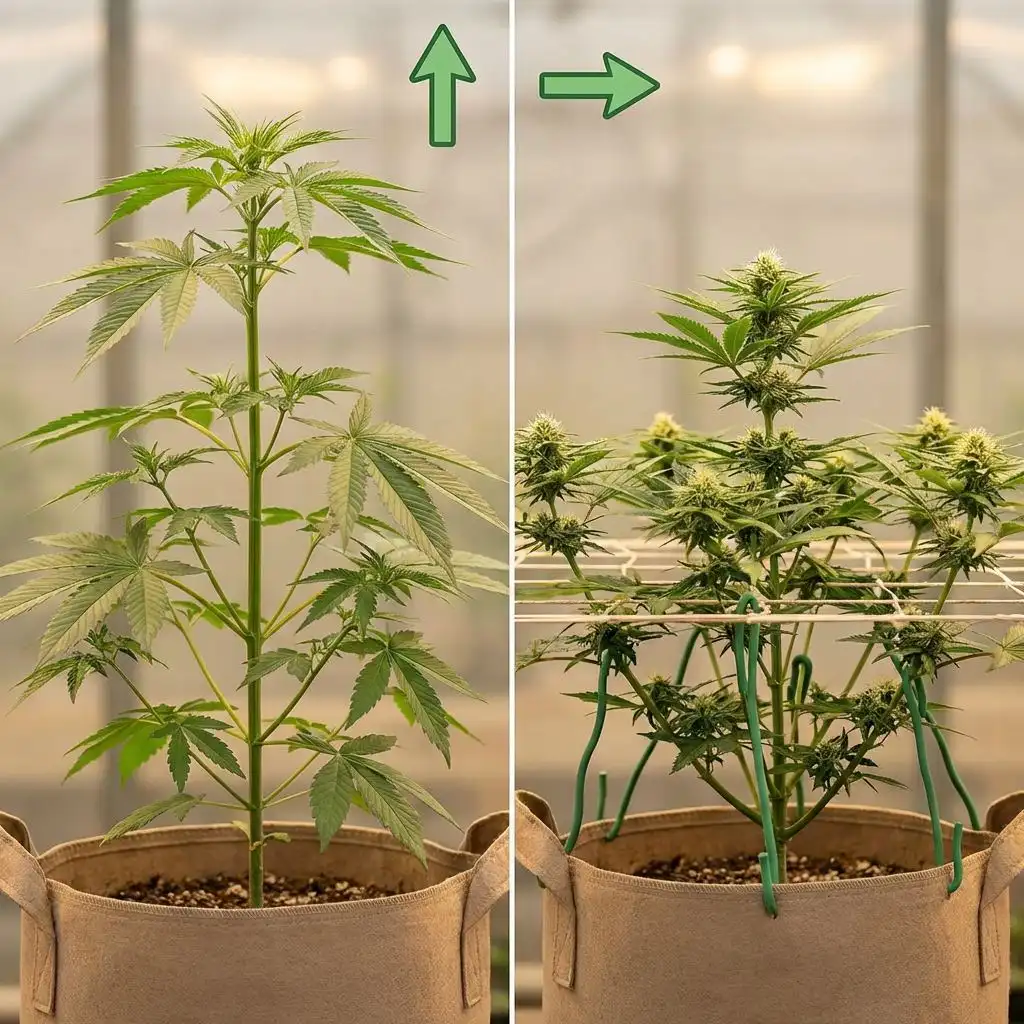
Supercropping is a high-stress technique where you deliberately bend a branch until the inner fibers break, creating a 90-degree knuckle without snapping the outer skin. Gently squeeze the stem between your fingers and roll it back and forth until you feel the internal tissues soften, then fold it over. The branch will hang limply at first but will form a reinforced knuckle within 3–7 days that becomes stronger than the original stem.
This technique serves multiple purposes. It reduces the height of overly tall branches to match the canopy — useful when one branch outgrows the others. The repair knuckle that forms creates a wider nutrient highway, often resulting in thicker buds on that branch compared to unsupercropped ones. It also triggers a stress response that increases resin production, as the plant interprets the damage as a threat and ramps up cannabinoid synthesis.
Supercrop during mid-to-late veg or the first week of flower (during stretch). Avoid supercropping after week 2 of flower, as the plant cannot recover quickly enough and you risk snapping brittle, woody stems. If you accidentally break through the outer skin, immediately tape the wound with plant tape or electrical tape — most breaks heal fully if supported within the first hour.
7. Defoliation
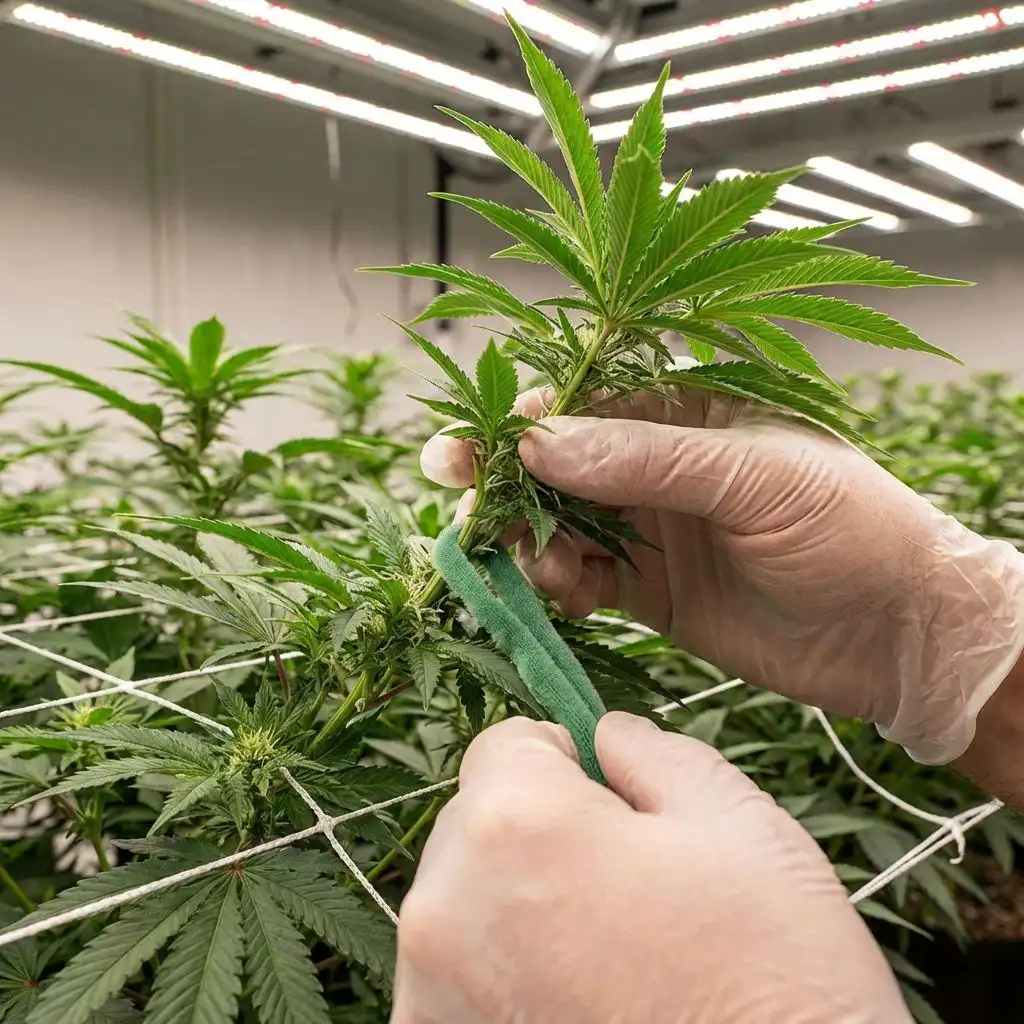
Defoliation — the selective removal of fan leaves — is one of the most debated topics in cannabis growing. Done correctly, it improves light penetration, airflow, and bud development. Done too aggressively, it can stunt growth and reduce yield by removing the plant's solar panels.
The most widely accepted defoliation strategy is a two-phase approach: once at the end of veg (or just before flip) and once around day 21 of flower. In each phase, remove large fan leaves that are blocking light to bud sites below, focusing on leaves in the interior canopy and those growing inward. Never remove more than 20–25% of total leaf mass in a single session, and always leave the small sugar leaves near bud sites intact.
Some strains respond better to defoliation than others. Heavy indica-dominant genetics with broad, overlapping fan leaves benefit most — they naturally create dense canopies that trap moisture and block light. Sativa-dominant strains with narrow, airy leaves often need little to no defoliation. Start conservatively with any new strain: remove fewer leaves than you think you should, observe the plant's response over 5–7 days, then decide if more is needed.
8. Which Technique for Which Situation
Choosing the right training method depends on your grow space, experience level, strain type, and goals. Here is a practical breakdown to help you decide:
- Complete beginner: Start with LST only. It is forgiving, requires no cutting, and works with any strain including autoflowers.
- Short tent (under 5 feet): Topping + LST is essential for height control. Add SCROG if you have the patience for a longer veg.
- Maximizing yield per plant: Top 2–3 times, combine with LST and SCROG. This is the highest-yield approach for 1–4 plants.
- Fastest harvest cycle: SOG with clones. Minimal veg, fast turnaround, consistent results.
- Autoflowers: LST only for most autos. Very vigorous autos can handle a single top if done before day 21 from seed, but this is risky.
- Outdoor grows: Topping and LST to keep plants wide and bushy for stealth. Supercropping to manage height in late summer.
| Technique | Difficulty | Yield Boost | Veg Time Added | Works with Autos? |
|---|---|---|---|---|
| LST | Beginner | 15–25% | None | Yes |
| Topping | Beginner–Inter. | 20–30% | 5–7 days | Risky |
| FIM | Intermediate | 20–30% | 3–5 days | Risky |
| SCROG | Intermediate | 30–50% | 2–4 weeks | No |
| SOG | Intermediate | 10–20% | None (less veg) | No |
| Supercropping | Advanced | 10–15% | 3–5 days | Risky |
| Defoliation | Intermediate | 5–15% | None | Light only |
🌱 Recommended Strains
Frequently Asked Questions
Why Train Cannabis Plants?
Cannabis naturally grows in a "Christmas tree" shape — one dominant central cola with smaller side branches that receive progressively less light. This is fine in nature, but in an indoor grow with a flat light source overhead, it means only the top 10–15% of the plant receives optimal light intensi...
What is LST (Low Stress Training)?
LST is the gentlest and most beginner-friendly training method. You simply bend the tallest branch down and away from center, securing it with soft plant ties, pipe cleaners, or garden wire to the pot rim. This breaks apical dominance — the plant's natural tendency to prioritize the highest growing ...
What is Topping & FIM?
Topping is the most popular high-stress training technique. You cut the main growing tip (apical meristem) cleanly with sterilized scissors just above a node, typically the 5th or 6th. This splits one cola into two equal branches, each of which becomes a main cola. Top those two branches again, and ...
What is SCROG (Screen of Green)?
SCROG uses a horizontal screen or net (typically with 2–3 inch openings) placed 8–12 inches above the pot to create a perfectly flat canopy. As branches grow up through the net, you tuck them back under and weave them horizontally outward. This forces every bud site to the same height, ensuring unif...
What is SOG (Sea of Green)?
SOG takes the opposite approach from SCROG: instead of training a few plants to fill a space, you pack many small plants close together and flip to flower early, so each plant produces one main cola. A typical SOG runs 4–16 plants per square meter, each vegged for only 1–2 weeks (or rooted clones fl...