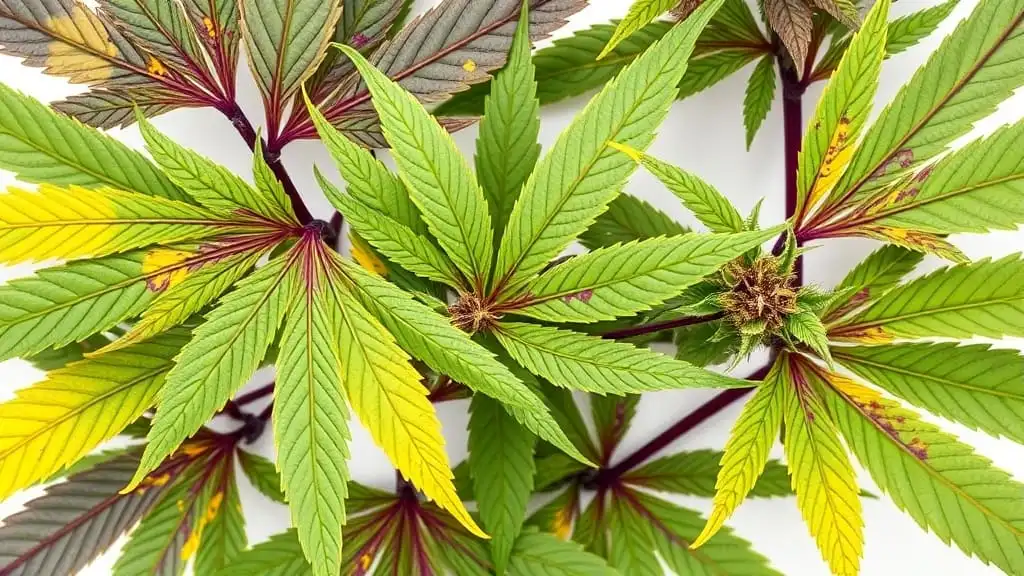
Cannabis nutrient deficiency identification guide

Cannabis Education

Cannabis Nutrient Deficiency Guide

Identify, diagnose, and fix every nutrient deficiency in cannabis plants. Visual symptom charts for 12 essential nutrients, pH lockout prevention, and feeding schedules.

NPK BasicsDeficiency PatternsDeficiency GuidepH & LockoutFeeding ScheduleNutrient BurnFAQ
💡

Key Takeaway

Most cannabis nutrient deficiencies are caused by incorrect pH, not missing nutrients. Keep your pH between 6.0\u20136.5 in soil (5.5\u20136.0 in hydro), and the majority of deficiency symptoms will resolve within 3\u20137 days. Always check pH before adding more fertilizer.

Understanding Cannabis Nutrients

Cannabis plants require a precise balance of macro and micronutrients to thrive. Understanding what each nutrient does is the first step to diagnosing problems and growing healthy, high-yielding plants.

Primary Macronutrients (NPK)

N

Nitrogen

Leaf growth, chlorophyll, proteins

The most important nutrient during vegetative growth. Nitrogen is a core component of chlorophyll, amino acids, and proteins. It drives leafy green growth, stem development, and overall plant vigour. Cannabis uses the most nitrogen during the vegetative phase and less during flowering.

P

Phosphorus

Root growth, bud formation, energy

Critical for root development, energy transfer (ATP), and flower/bud formation. Phosphorus demand increases dramatically during the flowering phase, where it drives bud size, density, and resin production. Insufficient phosphorus during bloom is one of the top yield-limiting factors.

K

Potassium

Water regulation, immunity, bud density

Regulates water transport, enzyme activation, and overall plant immunity. Potassium strengthens cell walls, improves drought resistance, and enhances bud quality and density. It works alongside phosphorus during flowering and is essential throughout the entire lifecycle.

Secondary & Micronutrients

Calcium (Ca)

Cell wall structure, root development, enzyme activity. Essential in coco coir grows.

Magnesium (Mg)

Central atom of chlorophyll. Without magnesium, photosynthesis stops. Also aids phosphorus uptake.

Sulfur (S)

Amino acid synthesis, terpene and oil production. Critical for flavour and aroma development.

Iron (Fe)

Chlorophyll synthesis and electron transport. Required in small amounts but causes severe chlorosis when deficient.

Understanding Deficiency Patterns

Before you start diagnosing individual nutrients, understanding why deficiencies appear where they do will make you a far better diagnostician. Two concepts unlock this: nutrient mobility and nutrient antagonism.

Mobile vs Immobile Nutrients

Every nutrient in cannabis is either mobile or immobile once it has been deposited in plant tissue. This single distinction tells you exactly where to look for symptoms and is the fastest way to narrow down which nutrient is missing.

Mobile Nutrients

Nitrogen (N), Phosphorus (P), Potassium (K), Magnesium (Mg)

These nutrients can be relocated within the plant. When supplies run low, the plant pulls them from older, lower leaves and ships them to new growth at the top. This is why mobile-nutrient deficiencies always show up on the bottom of the plant first — the old leaves are being sacrificed to keep new growth alive.

Immobile Nutrients

Calcium (Ca), Iron (Fe), Manganese (Mn), Boron (B), Zinc (Zn), Copper (Cu), Sulfur (S)

Once deposited in a cell, these nutrients are locked in place permanently. The plant cannot move them to where they are needed. When immobile nutrients are deficient, symptoms appear on new growth at the top of the plant — young leaves turn yellow, pale, twisted, or deformed while lower leaves look perfectly fine.

Quick Rule: Symptoms on lower/older leaves = mobile nutrient problem (N, P, K, Mg). Symptoms on upper/new growth = immobile nutrient problem (Ca, Fe, Mn, B, Zn). This one rule eliminates half the possible causes instantly.

Nutrient Antagonism

Nutrients do not exist in isolation — they interact. An excess of one nutrient can block the uptake of another, even when pH is perfect and the blocked nutrient is present in abundance. This is called nutrient antagonism, and it is one of the most common reasons growers see deficiency symptoms despite feeding heavily.

Excess Potassium (K) → blocks Calcium (Ca) and Magnesium (Mg)

Very common when pushing heavy PK boosters in flower. Causes Cal/Mag deficiency even with CalMag supplementation.

Excess Phosphorus (P) → blocks Zinc (Zn) and Iron (Fe)

Overdoing bloom boosters can trigger iron chlorosis on new growth and zinc rosetting.

Excess Calcium (Ca) → blocks Magnesium (Mg), Potassium (K), and Boron (B)

Excessive liming or CalMag can lock out other essential nutrients.

Excess Nitrogen (N) → blocks Potassium (K) and Calcium (Ca)

Heavy nitrogen feeding in veg can create K and Ca issues heading into flower.

Key Takeaway: When you see deficiency symptoms, do not automatically add more of the missing nutrient. Check whether you are overfeeding something else that is blocking uptake. More is not always better — balance is everything.

Root Zone Temperature

Cold root zones (below 60°F / 15°C) severely reduce the uptake of phosphorus, calcium, and iron — even when pH is perfect and nutrients are abundant. This is especially common in basements, garages, and grows with pots sitting directly on cold concrete floors. If you see phosphorus-like symptoms (dark purple leaves, slow growth) or calcium spots appearing in cooler months, check your root zone temperature before adjusting your feed. Raise pots off the floor with a rack or foam insulation, use a root zone heater, or increase ambient room temperature to at least 65°F (18°C).

Nutrient Deficiency Identification

Use these visual reference cards to identify and fix nutrient deficiencies in your cannabis plants. Each card includes symptoms, where to look, common causes, and the recommended fix.

Primary Macronutrients (N-P-K)

Nitrogen (N) molecule
N

Nitrogen (N)

Primary Macronutrient

Very Common Old leaves (bottom up)

Nitrogen is the nutrient cannabis consumes in the greatest quantity during vegetative growth. It is the backbone of chlorophyll, amino acids, and proteins — without adequate nitrogen, photosynthesis slows to a crawl and the plant cannot build new tissue. Nitrogen is highly mobile, so the plant cannibalizes older fan leaves to feed new growth when supplies run low.

Symptoms
  • Lower leaves turn uniformly pale yellow, then fully yellow
  • Yellowing progresses upward from the bottom of the plant
  • Affected leaves eventually wither and drop off
  • Stunted growth and reduced vigour overall
  • Stems may turn purple or reddish
Common Causes
  • Insufficient nutrient feeding during vegetative growth
  • Soil too depleted or not amended
  • Root zone too cold for nutrient uptake
  • pH lockout (below 6.0 in soil)
How to Fix: Increase nitrogen input immediately. Use a high-N vegetative nutrient or supplement with blood meal, fish emulsion, or ammonium sulfate. Correct pH to 6.2–6.8 in soil. In late flower, mild nitrogen deficiency is normal and acceptable.
Pro Tip: Overfeeding nitrogen is just as common as underfeeding. Excess nitrogen causes dark green, clawed leaves (the tips curl downward like an eagle's talon), delays flowering, and reduces bud quality. If your leaves look extremely dark green, you have too much N — not too little.
Phosphorus (P) molecule
P

Phosphorus (P)

Primary Macronutrient

Common Old leaves (bottom up)

Phosphorus drives root development, energy transfer (ATP), and flower formation. It is the nutrient most critical during the transition to bloom and throughout flowering — plants that lack phosphorus produce small, airy, underdeveloped buds. Phosphorus is mobile, so deficiency symptoms begin on older, lower leaves and work upward.

Symptoms
  • Dark green or blue-green leaves that develop purple or bronze patches
  • Stems and petioles turn purple or reddish
  • Leaves may curl downward and develop dark necrotic spots
  • Severely stunted growth and delayed flowering
  • Small, underdeveloped buds with poor density
Common Causes
  • pH lockout — phosphorus becomes unavailable below pH 6.0 or above 7.5
  • Cold root zone temperatures (below 15°C / 59°F)
  • Overwatering reducing oxygen at the root zone
  • Insufficient flowering nutrients during bloom
How to Fix: Correct pH to 6.2–6.8 (soil) or 5.5–6.2 (hydro/coco). Ensure root zone temperature is above 18°C. Supplement with a bloom booster or bone meal. Phosphorus uptake improves dramatically once pH and temperature are corrected.
Pro Tip: Phosphorus deficiency in early flower is one of the most yield-destroying problems because it stunts bud formation during the critical first 3 weeks of bloom. Make sure your bloom nutrients are dialed in before flipping to 12/12.
Potassium (K) molecule
K

Potassium (K)

Primary Macronutrient

Common Old leaves (bottom up)

Potassium regulates water transport, enzyme activation, and photosynthesis throughout the plant. It is essential for strong stems, disease resistance, and — critically — bud density and resin production during flower. Cannabis is a heavy potassium feeder, especially in mid-to-late flower when buds are packing on weight.

Symptoms
  • Leaf edges and tips turn brown and crispy (marginal necrosis)
  • Yellowing between veins on older leaves
  • Leaves curl upward at the edges
  • Weak stems that break easily
  • Reduced bud density and overall yield
Common Causes
  • Insufficient potassium in flowering nutrients
  • High sodium levels in water competing with K uptake
  • pH lockout above 7.0 in soil
  • Excess calcium or magnesium blocking potassium absorption
How to Fix: Increase potassium feeding with a potassium-rich bloom nutrient or potassium sulfate supplement. Correct pH and flush excess salts if using hard water. Avoid excessive CalMag supplementation that can block K uptake.
Pro Tip: Potassium deficiency and nutrient burn can look similar — both cause brown leaf edges. The key difference: nutrient burn affects leaf tips uniformly across the plant (top and bottom), while K deficiency targets older, lower leaves first and produces a more irregular brown pattern.

Secondary Nutrients

Calcium (Ca) molecule
Ca

Calcium (Ca)

Secondary Nutrient

Common New growth (top down)

Calcium is a structural nutrient — it forms the “cement” that holds cell walls together. Without adequate calcium, new tissue cannot form properly, roots weaken, and the plant becomes vulnerable to pathogens that exploit fragile cell walls. Calcium is immobile: once deposited in a cell wall, it stays there permanently. Deficiency symptoms appear exclusively on new growth at the top of the plant.

Symptoms
  • Irregular brown or tan spots on newer leaves
  • New growth appears distorted, twisted, or crinkled
  • Leaf tips may hook or curl downward
  • Stems and branches become weak and hollow
  • Root growth stalls, leading to secondary nutrient issues
Common Causes
  • Using reverse osmosis (RO) or distilled water without CalMag
  • Growing in coco coir (which naturally binds calcium)
  • pH below 6.0 in soil reduces calcium availability
  • High humidity reducing transpiration and calcium transport
How to Fix: Add a CalMag supplement at 1–2ml per litre. Ensure pH is 6.2–6.8 in soil or 5.8–6.2 in coco. If using RO water, CalMag is mandatory at every feeding. Calcium is immobile, so damaged leaves will not recover — watch new growth for improvement.
Pro Tip: If you grow in coco coir or use reverse osmosis (RO) water, treat Cal-Mag as a mandatory part of every feeding — not an optional supplement. Coco has a naturally high cation exchange capacity that steals calcium from your nutrient solution, and RO water has zero minerals. Without Cal-Mag, deficiency is guaranteed.
Magnesium (Mg) molecule
Mg

Magnesium (Mg)

Secondary Nutrient

Common Old leaves (bottom up)

Magnesium sits at the center of every chlorophyll molecule — without it, the plant literally cannot photosynthesize. It also activates over 300 enzyme systems involved in energy production, protein synthesis, and nutrient transport. Magnesium is mobile, so the plant pulls it from lower and middle leaves when supplies run low, creating one of the most recognizable deficiency patterns in all of horticulture.

Symptoms
  • Interveinal chlorosis — yellowing between leaf veins while veins stay green
  • Starts on lower/middle leaves and moves upward
  • Leaf edges may curl upward
  • In severe cases, leaves develop rust-coloured spots and drop
  • Overall pale, washed-out appearance
Common Causes
  • pH too low (below 6.0) locking out magnesium
  • Excess potassium competing with magnesium uptake
  • Using RO or soft water without supplementation
  • Heavy feeding schedules depleting available Mg
How to Fix: Apply CalMag supplement or Epsom salts (magnesium sulfate) at 1 tsp per gallon as a foliar spray or root drench. Correct pH to 6.0–6.5. Magnesium is mobile, so the plant will redirect it from old leaves to new growth — damaged leaves will not recover.
Pro Tip: Magnesium deficiency is extremely common in LED grows because LED lights drive photosynthesis harder than HPS at the same wattage, increasing the plant's magnesium demand. If you switched from HPS to LED and started seeing interveinal yellowing, increase your Cal-Mag dose by 50%.
Sulfur (S) molecule
S

Sulfur (S)

Secondary Nutrient

Uncommon New growth (top down)
Symptoms
  • New leaves turn uniformly pale yellow or lime green (similar to nitrogen but on new growth)
  • Growth slows noticeably
  • Stems become woody and thin
  • Buds develop less aroma and terpene production drops
  • Overall plant appears light green from the top down
Common Causes
  • Using pure or RO water without sulfur-containing nutrients
  • Overly alkaline soil (pH above 7.5)
  • Excessive use of calcium-only amendments
  • Very lean or inert growing media without organic matter
How to Fix: Add Epsom salts (magnesium sulfate) which provides both sulfur and magnesium. Most complete nutrient lines contain adequate sulfur. Correct pH to 6.0–7.0. Sulfur deficiency is rare when using quality cannabis nutrients.

Micronutrients

Iron (Fe) molecule
Fe

Iron (Fe)

Micronutrient

Moderate New growth (top down)

Iron is essential for chlorophyll synthesis, electron transport, and enzyme function in cannabis. Although classified as a micronutrient (plants need very small amounts), iron deficiency produces dramatic and unmistakable symptoms. Iron is immobile in the plant, so symptoms appear exclusively on new growth at the top of the canopy.

Symptoms
  • New leaves emerge bright yellow or nearly white
  • Interveinal chlorosis on young leaves — veins remain green
  • No brown spots or necrosis initially (unlike calcium deficiency)
  • Severe cases produce completely bleached new growth
  • Growth slows dramatically
Common Causes
  • pH too high (above 7.0 in soil, above 6.5 in hydro)
  • Overwatering causing root zone oxygen deprivation
  • Excess phosphorus, manganese, or zinc blocking iron uptake
  • Using non-chelated iron supplements in alkaline conditions
How to Fix: Lower pH to 6.0–6.5 (soil) or 5.5–6.0 (hydro). Iron lockout is almost always a pH issue — adding more iron without correcting pH will not help. Use chelated iron (Fe-EDDHA or Fe-DTPA) if supplementing directly. Improve drainage if overwatering.
Pro Tip: Iron deficiency in cannabis is almost never caused by a lack of iron in your nutrient solution — it is caused by high pH locking out what is already there. Before adding iron supplements, test and correct your pH. Nine times out of ten, lowering pH to 6.0–6.3 resolves iron chlorosis within a week.
Manganese (Mn) molecule
Mn

Manganese (Mn)

Micronutrient

Moderate New growth (top down)
Symptoms
  • Interveinal chlorosis on younger leaves (similar to iron but less severe)
  • Tan or brown necrotic spots develop within the yellowed areas
  • Leaf surfaces may take on a mottled, speckled appearance
  • Growth slows but is not as dramatically stunted as with iron deficiency
Common Causes
  • pH above 6.5 in soil or above 6.0 in hydro
  • Excess iron competing with manganese uptake
  • Overwatering and compacted growing media
  • High levels of calcium carbonate in soil
How to Fix: Lower pH to 6.0–6.5. Manganese deficiency is almost always pH-related. If pH is correct and deficiency persists, use a micronutrient supplement containing chelated manganese. Improve soil drainage and aeration.
Zinc (Zn) molecule
Zn

Zinc (Zn)

Micronutrient

Moderate New growth (top down)
Symptoms
  • New leaves emerge small and bunched together (rosetting)
  • Interveinal chlorosis on young growth
  • Leaf tips appear burnt or necrotic
  • Internodal spacing dramatically reduced — plant looks compact and stunted
  • Leaves may twist or curl sideways
Common Causes
  • pH too high (above 7.0)
  • Excess phosphorus — heavy bloom feeding can lock out zinc
  • Alkaline soils or hard water
  • Overuse of lime or dolomite in soil mix
How to Fix: Lower pH to 6.0–6.5. Reduce phosphorus levels if overfed during flower. Apply a zinc sulfate foliar spray (0.1% solution) for rapid correction. Ensure your base nutrient includes chelated zinc.
Boron (B) molecule
B

Boron (B)

Micronutrient

Uncommon New growth (top down)
Symptoms
  • New growth becomes thick, twisted, and brittle
  • Growing tips die back and lateral shoots attempt to take over
  • Hollow or rough stems
  • Roots become short, stubby, and swollen
  • Leaves may develop rough, bumpy texture
Common Causes
  • pH too high (above 6.8 in soil)
  • Overwatering leaching boron from soil
  • Low humidity combined with high temperatures
  • Excessive calcium reducing boron availability
How to Fix: Correct pH to 6.0–6.5. Apply a micronutrient supplement containing boron. Avoid over-liming soil. Boron toxicity occurs easily, so never apply borax or boric acid directly without extreme care — use a balanced micro mix instead.
Copper (Cu) molecule
Cu

Copper (Cu)

Micronutrient

Rare New growth (top down)
Symptoms
  • New leaves wilt and darken to a deep blue-green or purple shade
  • Leaf tips and edges turn pale and die back
  • Leaves feel limp despite adequate watering
  • Buds develop slowly with poor structure
Common Causes
  • pH above 7.0 locking out copper
  • Excessive zinc or iron competing with copper uptake
  • Extremely lean, peat-free growing media
  • Very high phosphorus levels
How to Fix: Correct pH to 6.0–6.5. Copper deficiency is very rare in cannabis grows using balanced nutrient lines. If confirmed, use a foliar spray with chelated copper at very low concentration. Never supplement copper without confirming deficiency first — copper toxicity is easy to trigger.
Molybdenum (Mo) molecule
Mo

Molybdenum (Mo)

Micronutrient

Rare Old + middle leaves
Symptoms
  • Interveinal chlorosis on middle-aged leaves
  • Leaf edges curl upward and inward (cupping)
  • Leaves develop an orange, red, or pink tint at margins
  • Resembles nitrogen deficiency but does not respond to nitrogen feeding
Common Causes
  • Very acidic pH (below 5.5) — the most common cause by far
  • Excess sulfur competing with molybdenum uptake
  • Growing in pure peat without pH buffering
  • Cold root zone temperatures
How to Fix: Raise pH to 6.0–6.5 — this alone usually resolves the issue. Molybdenum is required in tiny amounts and is present in virtually all nutrient lines. If pH is correct and symptoms persist, apply a foliar spray with sodium molybdate at very low concentration.

pH and Nutrient Lockout

pH is the single most important factor in nutrient availability. Even if you add the perfect amount of every nutrient, the wrong pH will prevent your plant from absorbing them. This is called nutrient lockout.

Soil

6.0 - 7.0pH range
Sweet spot: 6.2 - 6.8

Soil naturally buffers pH fluctuations, making it more forgiving than hydro. Most quality potting soils start around 6.5. Check runoff pH weekly and adjust input water as needed.

Hydro / Coco Coir

5.5 - 6.5pH range
Sweet spot: 5.8 - 6.2

Hydro and coco have no natural pH buffering. Check and adjust pH at every feeding. Coco coir naturally binds calcium and magnesium, making CalMag supplementation essential.

Nutrient Availability by pH (Soil)

Green bars show the pH range where each nutrient is available. Keep pH in the 6.0-7.0 zone for maximum overlap.

Nitrogen (N)
6\u20138
Phosphorus (P)
6\u20137.5
Potassium (K)
6\u20138
Calcium (Ca)
6\u20138
Magnesium (Mg)
6\u20138
Iron (Fe)
6\u20136.5
Manganese (Mn)
5.5\u20136.5
Zinc (Zn)
5.5\u20137
Sulfur (S)
6\u20138
Boron (B)
5.5\u20137.5
Copper (Cu)
5.5\u20137
Molybdenum (Mo)
6.5\u20138
4.05.06.07.08.09.0
Optimal soil range: 6.0 - 7.0

Basic Feeding Schedule

Cannabis nutrient demands change dramatically between growth stages. Here are the general NPK ratios and feeding guidelines for each phase.

Seedling
Weeks 1-2
NPK Ratio: None or very light
  • No nutrients needed for first 1-2 weeks in pre-fertilised soil
  • If using inert media, start at 25% strength
  • Seedlings burn easily — less is always more at this stage
  • pH water to 6.5 even without nutrients
Vegetative
Weeks 3-8+
NPK Ratio: High N, Medium P, Medium K (3-1-2)
  • Gradually ramp from 25% to 75% of recommended dose
  • Nitrogen is the primary driver of veg growth
  • CalMag supplementation recommended in coco and RO water
  • Feed every other watering — alternate with plain pH water
Early Flower
Weeks 1-3 of flower
NPK Ratio: Medium N, High P, High K (1-3-2)
  • Transition from veg to bloom nutrients gradually
  • Phosphorus demand increases sharply
  • Begin reducing nitrogen but do not eliminate entirely
  • Continue CalMag through early flower
Mid/Late Flower
Weeks 4-8+ of flower
NPK Ratio: Low N, High P, High K (0-3-3)
  • Minimal nitrogen — slight N deficiency in late flower is normal
  • Peak phosphorus and potassium for bud density and weight
  • Consider a PK booster during weeks 4-6
  • Begin flushing 1-2 weeks before harvest with plain pH water

General Feeding Tips

  • Always start at 50% or less of the manufacturer's recommended dosage and increase gradually
  • Check pH after mixing nutrients — adding nutrients changes the pH of your water
  • Water to 10-20% runoff to prevent salt buildup in the root zone
  • Keep a grow journal — record what you feed, when, and how the plant responds
  • Less is more — it is far easier to fix a deficiency than to recover from nutrient burn

Overfeeding & Nutrient Burn

Nutrient burn (nute burn) is one of the most common problems new growers face. It occurs when you feed your plants more nutrients than they can use, causing toxic salt buildup in the root zone.

Symptoms of Nutrient Burn

  • Brown, crispy tips on leaves — the earliest and most reliable sign
  • Tip burn progresses inward along the leaf edges if not corrected
  • Leaves may appear dark green, waxy, or unnaturally deep in colour
  • Leaf tips may curl downward (clawing)
  • In severe cases, entire leaves become crispy and die
  • Buds may develop poorly with reduced trichome production

How to Fix Nutrient Burn

01

Stop Feeding

Immediately stop adding nutrients. Switch to plain, pH-adjusted water.

02

Flush the Root Zone

Run 3x the pot volume of plain pH water through the growing medium to wash out excess salts.

03

Monitor Runoff EC/PPM

Test runoff water with an EC/TDS meter. Continue flushing until runoff PPM drops to acceptable levels (below 500 PPM for veg, below 800 for flower).

04

Resume at Lower Dose

After 3-5 days of plain water, resume feeding at 50% of your previous dose and increase gradually. The plant will tell you what it needs.

Prevention is Better Than Cure

Always start at half the manufacturer's recommended dose and increase gradually. Use an EC/TDS meter to measure nutrient concentration objectively. Feed-water-feed cycles (alternating nutrient water with plain pH water) prevent salt buildup and give the plant recovery time between feedings.

Frequently Asked Questions

Common questions about cannabis nutrient deficiencies, pH management, and plant nutrition.

What is the most common cannabis nutrient deficiency?

Nitrogen deficiency is the most frequently encountered nutrient deficiency in cannabis, especially during late vegetative growth and early flower when the plant's nitrogen demand spikes dramatically. However, the most common cause of deficiency symptoms overall is pH-induced nutrient lockout — not an actual lack of nutrients. Always check your pH before assuming you need to add more fertilizer.

How do I tell the difference between nutrient burn and deficiency?

Nutrient burn (excess) causes dark green leaf tips that turn brown and crispy in a uniform pattern across the entire plant — top and bottom, new and old growth alike. The browning is concentrated at the very tips. Deficiency, on the other hand, typically causes yellowing (not darkening) and follows a pattern: mobile nutrient deficiencies (N, P, K, Mg) start on lower leaves, while immobile deficiencies (Ca, Fe, Mn) appear on new growth. If your leaf tips are burnt and dark green, you are overfeeding. If your lower leaves are yellowing and falling off, you are underfeeding or have a pH problem.

Can I fix nutrient deficiency with foliar feeding?

Yes — foliar feeding is effective for fast, temporary relief of certain deficiencies, especially magnesium (Epsom salt spray), iron (chelated iron spray), and calcium. Plants absorb nutrients through their leaf stomata within hours, providing visible improvement in 2–5 days. However, foliar feeding is a band-aid, not a cure. The permanent fix must happen at the root zone: correct your pH, adjust your nutrient concentration, and ensure roots are healthy. Never foliar spray during flower once buds have formed — moisture on buds invites mold.

What pH should I maintain to prevent nutrient deficiencies?

For soil grows, maintain your root-zone pH between 6.0 and 6.5, with 6.2–6.3 being the ideal sweet spot where all 13 essential nutrients are simultaneously available. For hydroponic and coco coir grows, target pH 5.5–6.0 with 5.8 as the sweet spot. Measure both your input water pH and your runoff pH — if they differ by more than 0.5 units, your root zone is drifting and needs correction. Investing in a quality pH meter (Apera or Bluelab) and calibrating it monthly is one of the highest-ROI purchases any grower can make.

Should I flush my plants if I see deficiency symptoms?

Only flush if you suspect salt buildup or nutrient lockout — meaning you have been feeding heavily and your runoff EC/PPM is significantly higher than your input, or your runoff pH has drifted far outside the optimal range. In that case, flushing with 2–3 times the pot volume of pH-adjusted water resets the root zone. However, if your plant is genuinely underfed (low EC runoff, light feeding schedule), flushing will strip away what little nutrition remains and make the deficiency dramatically worse. Diagnose before you flush: check runoff pH and EC first, then decide whether the problem is too much salt or too little nutrition.

How long does it take for a cannabis plant to recover from a nutrient deficiency?

Once the underlying cause is corrected (usually pH), you should see improvement in new growth within 3–7 days. Already-damaged leaves will generally not recover — mobile nutrient deficiency leaves stay yellow, and immobile nutrient damage stays spotted or deformed. Watch the newest growth at the top of the plant for signs of recovery rather than waiting for old damage to heal. Full plant recovery typically takes 1–2 weeks.

Grow With Confidence

Healthy Plants Start With Great Genetics

Now that you can identify and fix any nutrient issue, pair your knowledge with premium genetics. Explore our beginner-friendly strains, germination resources, and expert growing tips.

Germination GuideGrow TipsEasy-to-Grow SeedsPlant Diagnosis Tool