Your grow light's box says '1000W' on the front and '450W actual draw' on the back, and somewhere in the fine print there's a number called PPFD cannabis growers obsess over. That single metric — measured in micromoles per square meter per second — predicts your harvest weight better than wattage, brand, or price ever will. In our 15+ years of dialing in canopies for both small tents and commercial rooms, we've watched more grows fail from light placement mistakes than from any nutrient or pest issue.
This guide gives you the measured PPFD and DLI targets for every stage, decodes the three different 'PPF' numbers manufacturers put on spec sheets, and shows you how to actually verify what's hitting your canopy — without spending $400 on a research-grade quantum sensor.
What Is PPFD? (Definition, Units, and Why It Matters)
PPFD (Photosynthetic Photon Flux Density) measures the number of photosynthetically active photons in the PAR range (400–700 nm) reaching one square meter per second, expressed in μmol/m²/s . In plain terms: it counts the photons your plant can actually use for photosynthesis, in the spot you're measuring.
Wattage tells you what the wall socket gives up. Lumens tell you what a human eye sees. Neither describes what a leaf is doing. As Spider Farmer's grow team puts it, "PPFD is crucial for understanding how much usable light is available for plants during photosynthesis" . That's why every serious cultivation discussion — and every cannabis research paper — uses PPFD instead.
One number, one spot, one moment in time. PPFD is a snapshot — move the sensor 12 inches and the reading changes dramatically. That's why hanging height matters more than wattage.
PPFD vs PPF vs DLI — Decoding the Light Measurement Alphabet

Three acronyms get used interchangeably online, and they shouldn't. Each one answers a different question.
| Metric | Units | What It Tells You |
|---|---|---|
| PPF | µmol/s | Total PAR photons the fixture emits per second (a property of the light) |
| PPFD | µmol/m²/s | Photons landing on one square meter per second at a specific point on your canopy |
| DLI | mol/m²/day | Total PAR photons delivered to that spot across a 24-hour day |
As GrowWeedEasy explains, "DLI stands for daily light integral. It describes how much light in the PAR (Photosynthetically Active Radiation) range is delivered within a 24-hour period to an area" . The math is simple: DLI = PPFD × photoperiod hours × 0.0036. A canopy reading 600 µmol/m²/s on an 18/6 schedule receives 600 × 18 × 0.0036 = 38.9 mol/m²/day.
PPF is the fixture's spec. PPFD is what your canopy actually receives. DLI is what your canopy receives over a full day. A weak light run 24 hours can deliver the same DLI as a strong light run 12 hours — but cannabis is photoperiodic, so you can't cheat the schedule during flower .
How to Read a Grow Light Spec Sheet (Calculated PPF vs Total PPF vs Usable PPF)
This is where most growers get burned. Manufacturers publish a 'PPF' number, but it can be one of three very different things — and the marketing-friendly version is wildly inflated.
Calculated PPF (the marketing number)
Calculated PPF assumes 100% diode efficiency and is typically significantly higher than what the fixture actually produces . This is the number you'll see in big bold type on Amazon listings. Treat it like a car's 'highway MPG under ideal conditions' — directionally useful, practically misleading.
Total PPF (the lab number)
Total PPF is measured inside an integrating sphere — a calibrated chamber that captures every photon the fixture emits . This is honest, but it's still not what your plants get.
Usable PPF (the canopy number)
Coco For Cannabis defines Usable PPF as Total PPF minus the 10–15% of photons typically lost to radiance or reflection in real grow setups . This is the number that actually matters for sizing a fixture to a tent.
If a spec sheet doesn't say which PPF it's quoting, assume it's the Calculated (marketing) value. Discount by 25–35% to estimate Usable PPF before you trust it for tent sizing.
PPFD Targets by Growth Stage (2026 Reference Chart)
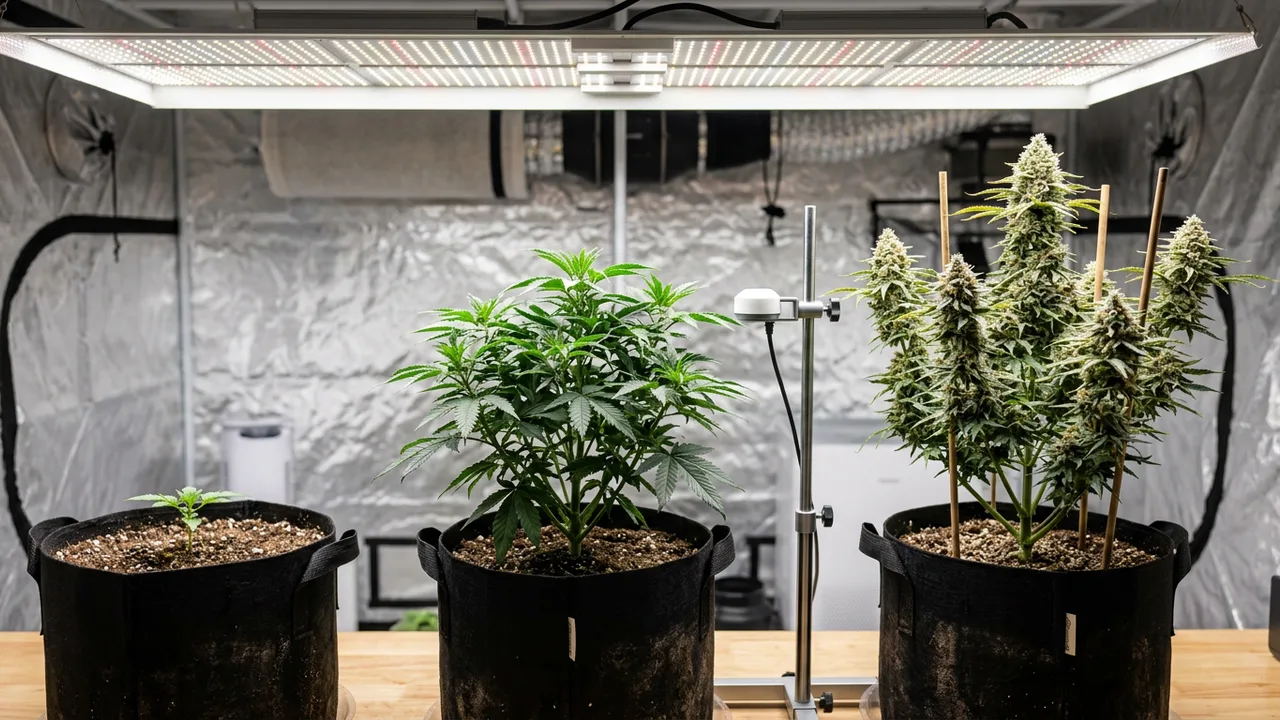
Here are the working targets we use across our trial rooms, cross-referenced against the published recommendations from cultivation sources and peer-reviewed cannabis photosynthesis data.
| Stage | PPFD (µmol/m²/s) | Photoperiod | DLI (mol/m²/day) |
|---|---|---|---|
| Seedling / clone (first 2 weeks) | 200–400 | 18/6 | ~13–26 |
| Vegetative | 400–600 | 18/6 | ~26–39 |
| Early to mid flower | 600–900 | 12/12 | ~26–39 |
| Late flower (peak) | 800–1,000 | 12/12 | ~35–43 |
| CO2-enhanced flower | 800+ | 12/12 | ~35+ |
Note: published, citable sources in this guide cover veg and flower in detail. Seedling-stage targets vary widely between growers and aren't well-standardized in peer-reviewed literature, so the 200–400 range above is a working consensus rather than a hard rule. Start low, watch for stretch or bleaching, and adjust.
Why the flower number isn't a single value
Spider Farmer recommends pushing toward the upper end (near 1,000 µmol/m²/s) only in the final week of flower . Cannabiz Credit's chart frames the general flowering range as 600–900 µmol/m²/s and reserves the 800+ tier for grows running CO2 supplementation . Coco For Cannabis's 'PPF rule for optimal lighting is 65 µmol Usable PPF per square foot or 700 µmol Usable PPF per square meter,' which lands in the middle of that band .
These aren't contradictions — they describe different scenarios. The ~700 µmol/m²/s benchmark reflects where leaf-level photosynthesis saturates without CO2 enrichment. The 800–1,000 range describes whole-canopy targets that keep working because deeper leaves are still photon-starved when the top of the canopy hits saturation.
Use our light calculator to convert your fixture's PPF spec and tent size into a target hanging height for each stage.
The PPFD × CO2 × Temperature Relationship
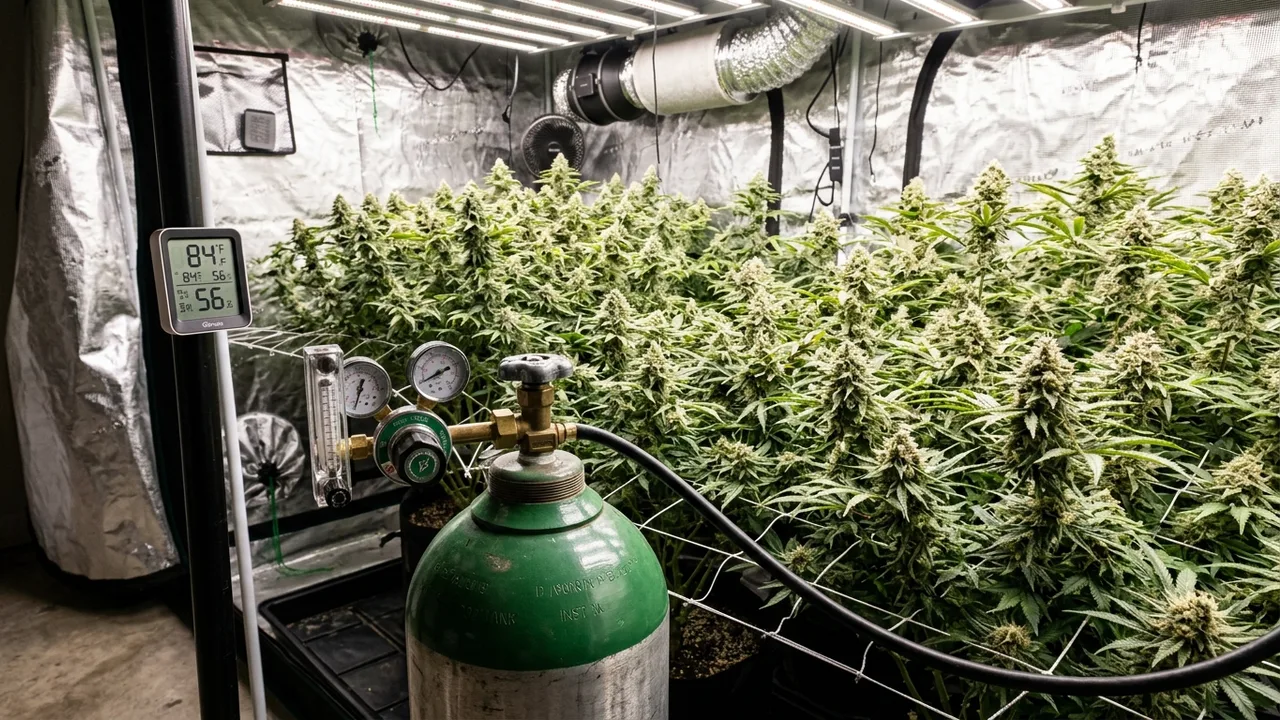
PPFD is not a standalone variable. Cannabis photosynthetic response varies with PPFD, temperature, and CO2 concentrations together . Crank the lights without addressing the other two and you'll see leaf curl, bleaching, and stalled growth long before you see bigger buds.
The CO2 multiplier
Eric Lam of the Cannabiz Credit Association notes that "when combined with high-intensity lighting (800+ PPFD), CO2 supplementation can push photosynthesis beyond normal limits, potentially increasing yields by 20-30%" . At ambient CO2 (~420 ppm), the photosynthetic ceiling is much lower than most LED-era growers assume.
Temperature scales with light
Higher PPFD demands higher leaf temperature to keep enzyme rates aligned. Plants running 900+ µmol/m²/s typically want canopy temps in the 82–85°F range — well above the 75–78°F sweet spot for a 500 µmol veg room. Pair this with our temperature control guide and a VPD calculator to keep transpiration on pace.
The mental model: PPFD × CO2 × Temperature × VPD is a system, not a stack of independent dials. Move one without the others and the plant pays the difference.
What the Research Shows on Light, Yield, and Cannabinoid Potency
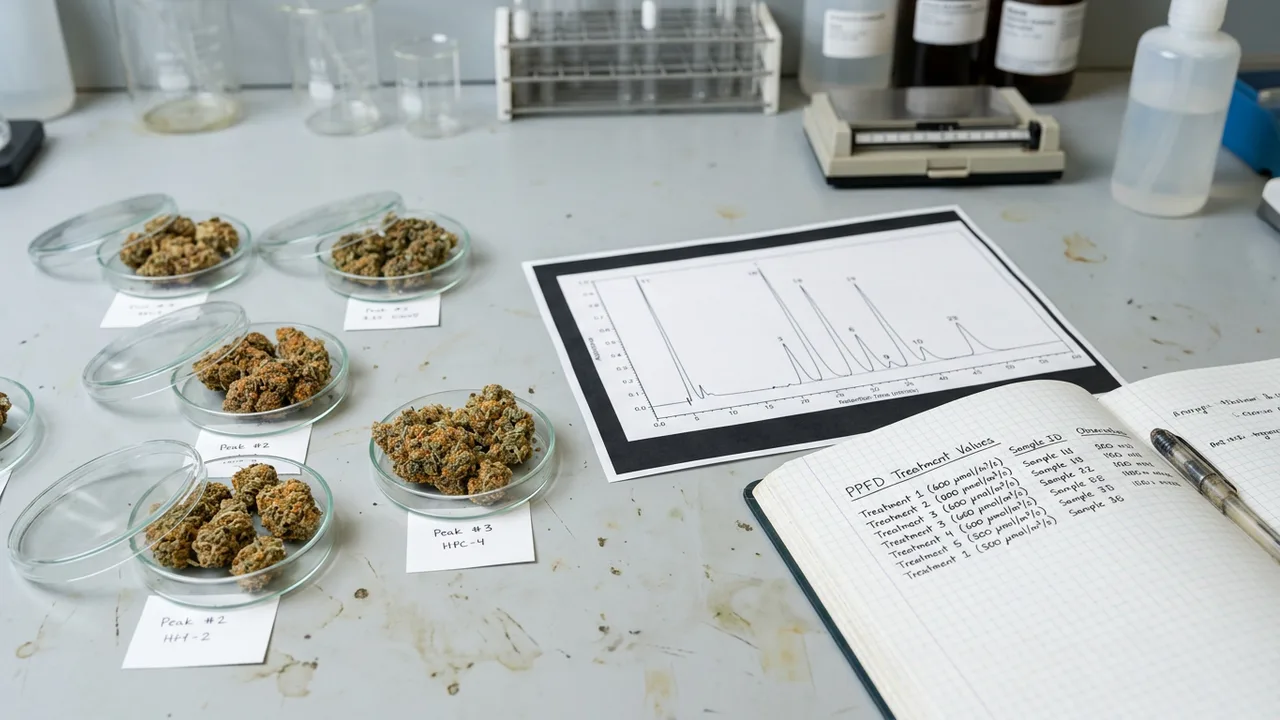
Multiple peer-reviewed studies confirm that light intensity significantly affects both flower yield and cannabinoid content in Cannabis sativa grown in controlled environments . Higher light intensity during flowering increases both inflorescence mass and concentrations of specialized metabolites including cannabinoids .
Yield and potency don't follow the same curve
Here's the nuance most guides skip. Research shows yield, cannabinoid potency, and leaf-level photosynthesis respond differently to increasing light — yield scales with applied PPFD even after leaf-level photosynthesis saturates earlier . In other words, the per-leaf machinery hits a ceiling before the whole canopy does, because lower-tier leaves are still gaining photons as upper leaves max out.
Measured cannabinoid data
One PMC-published trial on Cannabis sativa 'Stillwater' reported, after 81 days of flowering under varied light treatments, CBD concentration of 5.53 ± 0.01 mg·g⁻¹ inflorescence dry weight, CBDA at 214 ± 0.4 mg·g⁻¹, and total equivalent CBD of 193 ± 0.4 mg·g⁻¹ . The trial documents that increasing PPFD shifted both yield and cannabinoid concentrations upward within the tested range.
The 65 µmol/sq ft Rule and Sizing Your Grow Light
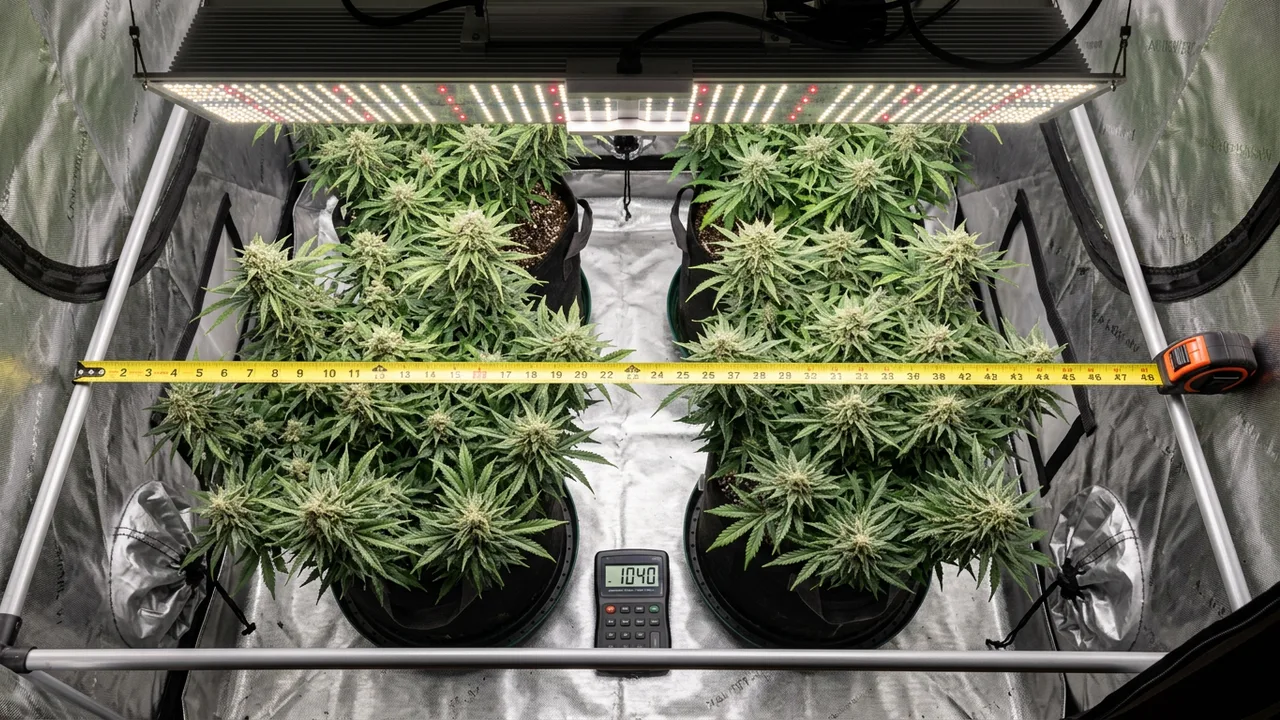
Coco For Cannabis's working rule for indoor cannabis: "The PPF rule for optimal lighting is 65 µmol Usable PPF per square foot or 700 µmol Usable PPF per square meter" . Multiply your canopy area by 65 to get the Usable PPF target your fixture needs to deliver.
Measure canopy area
Width × depth in feet. A 4×4 tent = 16 sq ft of canopy.
Multiply by 65
16 sq ft × 65 = 1,040 µmol Usable PPF needed .
Decode the spec sheet
If the fixture lists Calculated PPF, discount by 25–35% to estimate Usable PPF .
Verify at the canopy
Take PPFD readings at multiple points after install — never trust the spec alone.
Expected Yield by Tent Size and Usable PPF
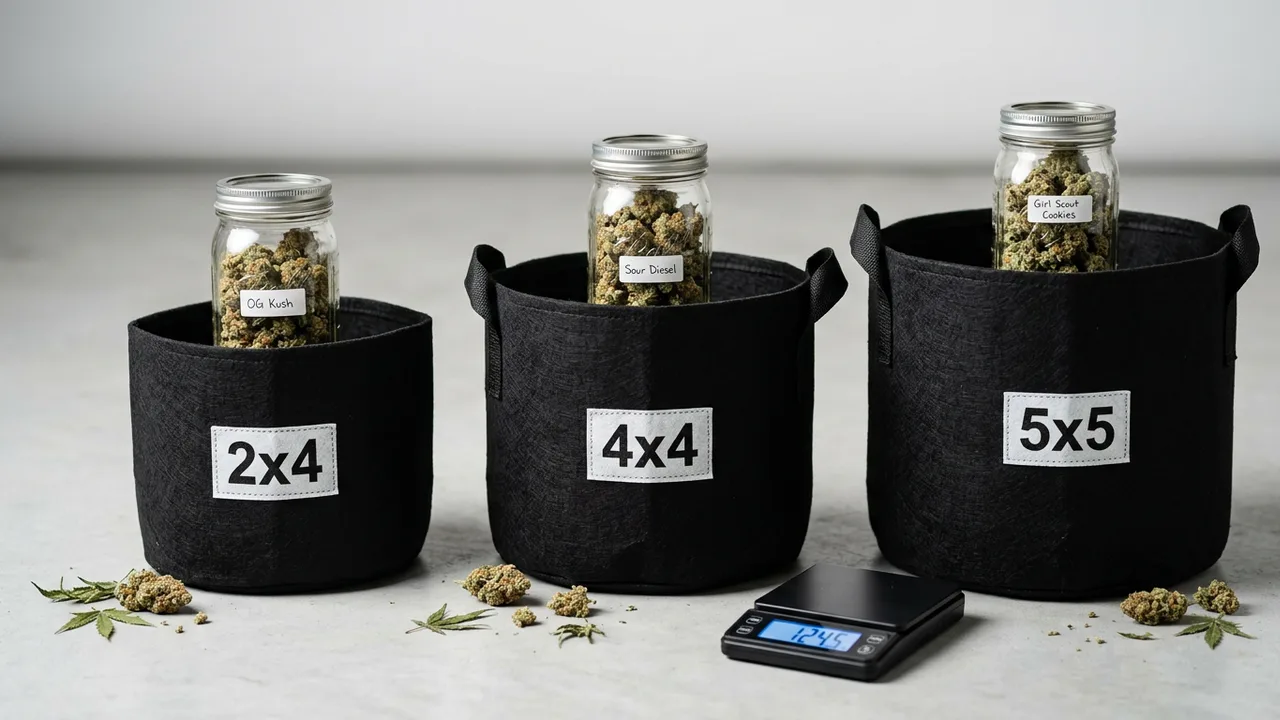
Coco For Cannabis publishes a Grow Space Calculator mapping Usable PPF to expected harvest weight, using benchmarks of 0.55 g/µmol (low harvest) to 0.75 g/µmol (benchmark) efficiency . Real-world yield depends heavily on genetics, training, and runtime — these are upper-bound projections at full operator competence.
| Tent Size | Canopy Area | Usable PPF Target | Low Harvest (0.55 g/µmol) | Benchmark (0.75 g/µmol) |
|---|---|---|---|---|
| 2' × 4' | 8 sq ft | 520 µmol | 286 g | 390 g |
| 4' × 4' | 16 sq ft | 1,040 µmol | 572 g | 780 g |
| 5' × 5' | 25 sq ft | 1,625 µmol | 894 g | 1,219 g |
For a tent-by-tent build comparison, see our 2x2 vs 4x4 tent guide. To estimate harvest in grams, our yield estimator uses these same efficiency benchmarks.
Measuring PPFD in Your Own Grow Space
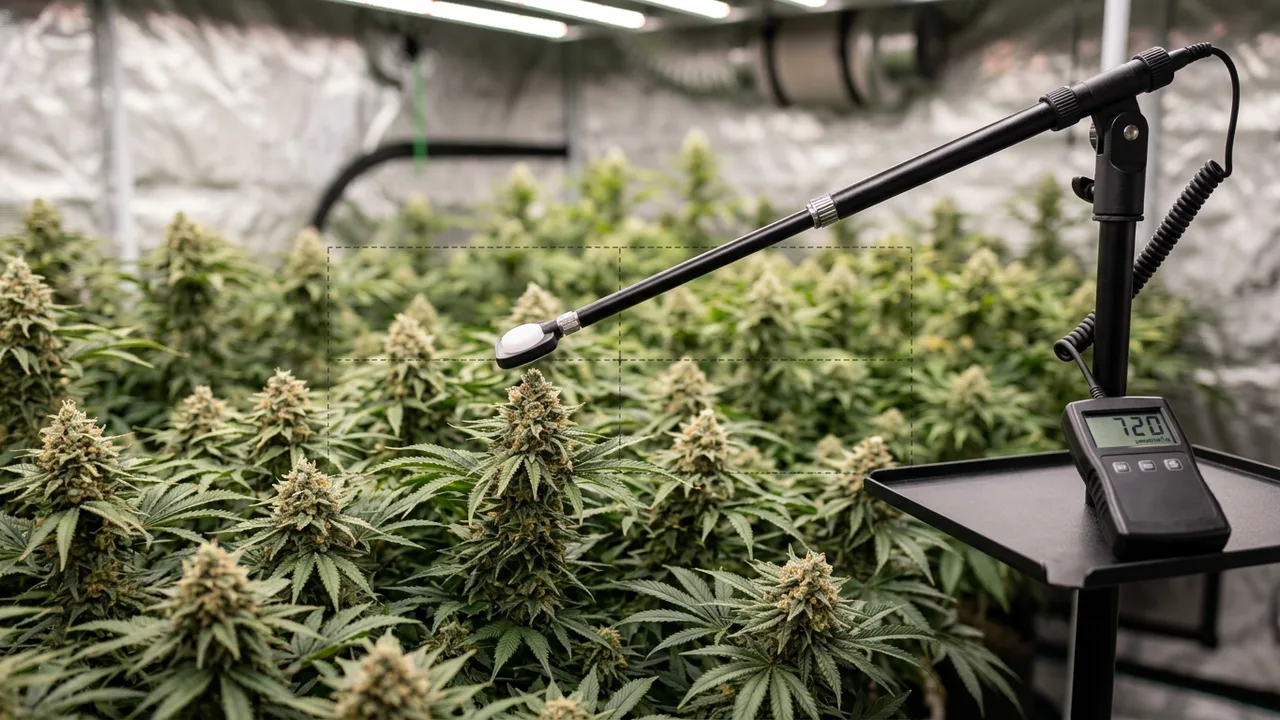
Spec sheets predict; meters confirm. Before you trust any PPFD number, verify it where the buds will form.
Quantum PAR meters (the right tool)
A dedicated quantum sensor measures photons in the 400–700 nm PAR range and reports µmol/m²/s directly. Apogee MQ-500 ($545) and the Photone Pro accessory are the consumer-grade gold standard. For a one-time hobbyist purchase, a $100–150 LightScout Quantum Light Meter is acceptable for relative readings.
Phone lux apps (the imperfect shortcut)
Phone-based lux apps measure visible light, then apply a conversion factor to estimate PPFD. The error rate runs ±15–25% under broad-spectrum LEDs and worse under heavily red-shifted spectrums, because phone sensors weight for human-eye response (peak green) rather than plant-relevant red and blue. Use them for relative readings — comparing Spot A to Spot B in the same tent — never for absolute calibration against published targets.
The 5-point measurement grid
- Reading 1: dead center of canopy
- Reading 2: front-left corner of canopy
- Reading 3: front-right corner
- Reading 4: back-left corner
- Reading 5: back-right corner
Average the four corners and compare to center. Center should be within 30% of the corner average — if it's wildly higher, the fixture is too low or too small for your footprint.
Why hanging height matters more than wattage
PPFD follows the inverse-square law: double the distance from the fixture, and intensity drops to roughly one-quarter. A 240W LED at 12" can deliver more canopy PPFD than a 480W LED at 30". Adjust height first, dimmer second, fixture upgrade last.
Take readings at canopy height with the lights at full operating intensity, not at floor level or with the fixture cold. Run the light at least 15 minutes before measuring — LEDs drop slightly as drivers warm up.
Putting It Together: Strain Choice and Light Strategy
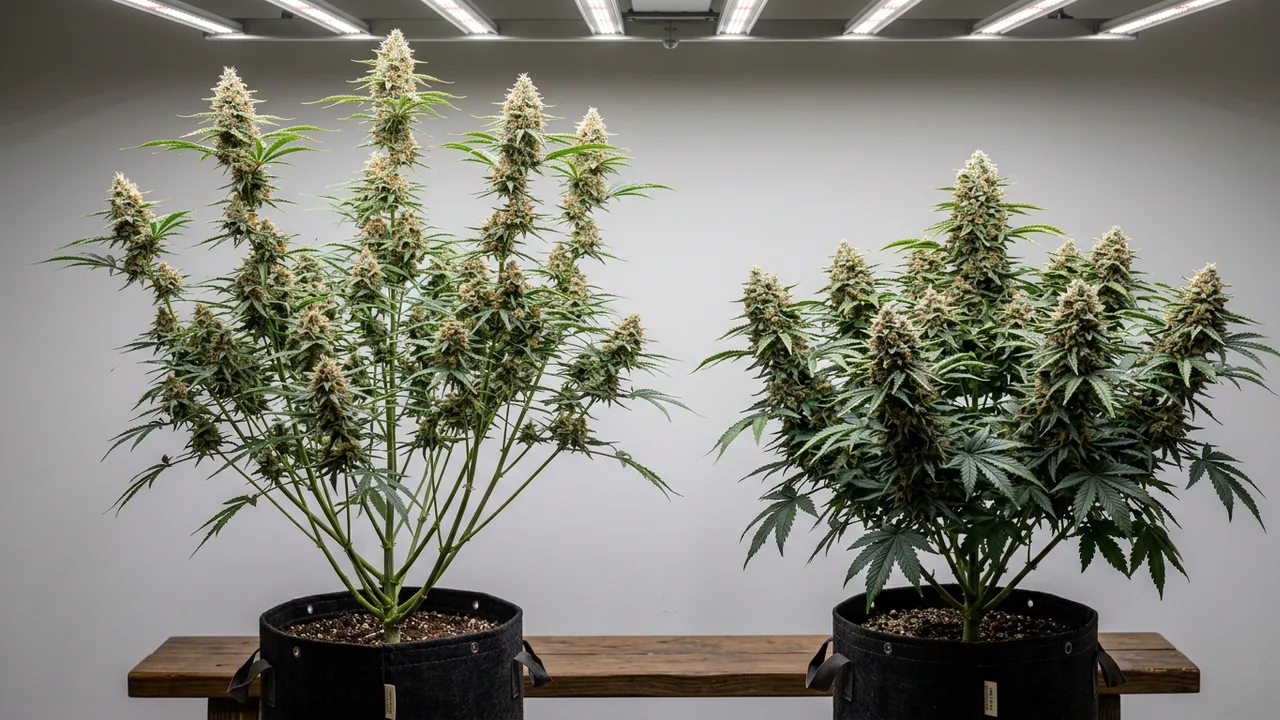
Different genetics tolerate different ceilings. Sativa-leaning strains with thin leaves and open structure (e.g., Super Lemon Haze, Sour Diesel) often handle higher PPFD without bleaching. Dense indica-leaning strains with broad fan leaves (e.g., Northern Lights × Big Bud, OG Kush) usually want a slightly lower ceiling and benefit more from defoliation to get light deeper into the canopy.
For first-time growers running their first PPFD-managed flower cycle, forgiving genetics matter. Our beginner strain guide covers picks that recover well from light-stress mistakes — and every pack ships under our germination guarantee.
Spectrum also matters alongside intensity. Blue-heavy spectrum during vegetative growth encourages shorter internodes and compact bushy growth, while red-heavy spectrum during flowering promotes bud development . For a deeper dive, see our cannabis light spectrum guide. LED grow lights also offer 40–60% energy savings compared to HPS fixtures , which compounds over a full flower cycle.
The pre-harvest finish
Some growers reduce light intensity or use 48 hours of darkness in the final 1–2 weeks before harvest to stress plants and increase resin production . The evidence here is mixed — for a full breakdown of what's actually supported, see our pre-harvest dark period evidence review.
Frequently Asked Questions
What's the ideal PPFD for cannabis flowering?
600–1,000 µmol/m²/s, with the upper end (800–1,000) reserved for the final 1–2 weeks of flower or for grows running CO2 supplementation . Without CO2, ~700 µmol/m²/s is the practical leaf-photosynthesis ceiling .
What DLI does cannabis need in veg vs flower?
Veg DLI on an 18/6 schedule at 400–600 PPFD lands at roughly 26–39 mol/m²/day . Flower DLI on 12/12 at 600–900 PPFD lands at roughly 26–39 mol/m²/day as well — the shorter photoperiod offsets the higher intensity .
Can I use a phone lux app instead of a PAR meter?
For relative comparisons within the same tent and same fixture, yes. For absolute calibration against published PPFD targets, no — error rates run ±15–25% and worse under red-heavy spectrums because phone sensors weight for human vision, not plant photosynthesis.
How does CO2 change my PPFD ceiling?
CO2 supplementation paired with 800+ PPFD can potentially increase yields by 20–30% by pushing photosynthesis beyond ambient-CO2 limits . The interaction is multiplicative — PPFD, temperature, and CO2 must scale together . See our CO2 supplementation guide.
Why does my fixture's spec sheet show three different PPF numbers?
Calculated PPF assumes 100% diode efficiency (marketing value). Total PPF is the integrating-sphere lab measurement. Usable PPF subtracts the 10–15% lost to radiance and reflection in real grow setups . Always size your tent against Usable PPF.
Does higher PPFD mean more THC?
Higher light intensity during flowering increases both inflorescence mass and cannabinoid concentrations within tested ranges . However, yield, potency, and leaf-level photosynthesis respond differently — yield continues scaling even after leaf photosynthesis saturates . Specific THC ceilings tied to PPFD aren't well-defined in current peer-reviewed literature.
What PPFD is too much?
Without CO2, sustained PPFD above ~1,000 µmol/m²/s commonly causes leaf bleaching, stalled growth, and reduced photosynthetic efficiency. With CO2 enrichment and proper temperature management, the workable ceiling rises — but specific saturation thresholds aren't well-documented in citable peer-reviewed sources.
Sources & References
This article was researched and fact-checked using 8 verified sources including 4 peer-reviewed studies, 2 industry sources, 2 community resources.
- Cannabis Yield, Potency, and Leaf Photosynthesis Respond Differently to Increasing Light Levels in an Indoor Environment - PMC — pmc.ncbi.nlm.nih.gov/articles/PMC8144505 [Research]
- High light intensity improves yield of specialized metabolites in medicinal cannabis (Cannabis sativa L.), resulting from both higher inflorescence mass and concentrations of metabolites - ScienceDirect — sciencedirect.com/science/article/pii/S2214786124000561 [Research]
- Effect of Light Intensity and Two Different Nutrient Solutions on the Yield of Flowers and Cannabinoids in Cannabis sativa L. Grown in Controlled Environment — mdpi.com/2073-4395/14/12/2960 [Research]
- Photosynthetic response of Cannabis sativa L. to variations in photosynthetic photon flux densities, temperature and CO2 conditions - PMC — pmc.ncbi.nlm.nih.gov/articles/PMC3550641 [Research]
- How Much Light (PPF) Do You Need for Indoor Cannabis? - Coco For Cannabis — cocoforcannabis.com/how-much-light-ppf-do-you-need-for-indoor-cannabis [Industry]
- How to Increase "DLI" for Bigger Yields (Daily Light Integral Tips) | Grow Weed Easy — growweedeasy.com/how-to-increase-dli-for-bigger-yields-daily-light-integral-tips [Industry]
- PPFD for Different Plant Growth Stages — spider-farmer.com/blog/ppfd-for-different-plant-growth-stages [Community]
- Cannabis Light Requirements Chart — Cannabiz Credit Association — cannabizcredit.com/blog/cannabis-light-requirements-chart [Community]