Every serious grower eventually hits the same wall: the plant looks healthy, the lights are dialed, the nutrients are clean — but the yield still feels like it's leaving money on the table. That's because an untrained cannabis plant naturally grows like a Christmas tree, with one dominant cola hogging the light and a dozen weaker side branches struggling below. Plant training flips that script. According to GrowWeedEasy's cultivation guide, proper training can increase yields by up to 40% without adding a single watt of light or upgrading equipment . This cannabis training methods comparison breaks down the four techniques that matter most — LST, topping, FIMming, and mainlining — so you can pick the right one for your strain, your space, and your experience level.
Why Train Cannabis Plants at All?
Cannabis training is the practice of physically manipulating a plant's shape, structure, or timeline to produce more bud sites, a flatter canopy, and a more efficient light footprint. GrowWeedEasy reports yield improvements of up to 40% over untrained plants using these techniques alone, without any upgrade to lighting or equipment . That's the kind of ROI that makes training non-negotiable for anyone growing in a tent or limited space.
Training exists because of a hormone called auxin. Auxin concentrates in the tallest tip of the plant and tells every lower branch, "don't bother, I've got this." Every training method on this list — whether it bends, cuts, or manipulates timing — is really just a different way to break auxin dominance and wake up dormant bud sites.
Training isn't optional for maximum yield — it's the single highest-ROI skill a grower can learn. The question isn't whether to train, but which method fits your strain and skill level.
The Three Categories of Cannabis Training
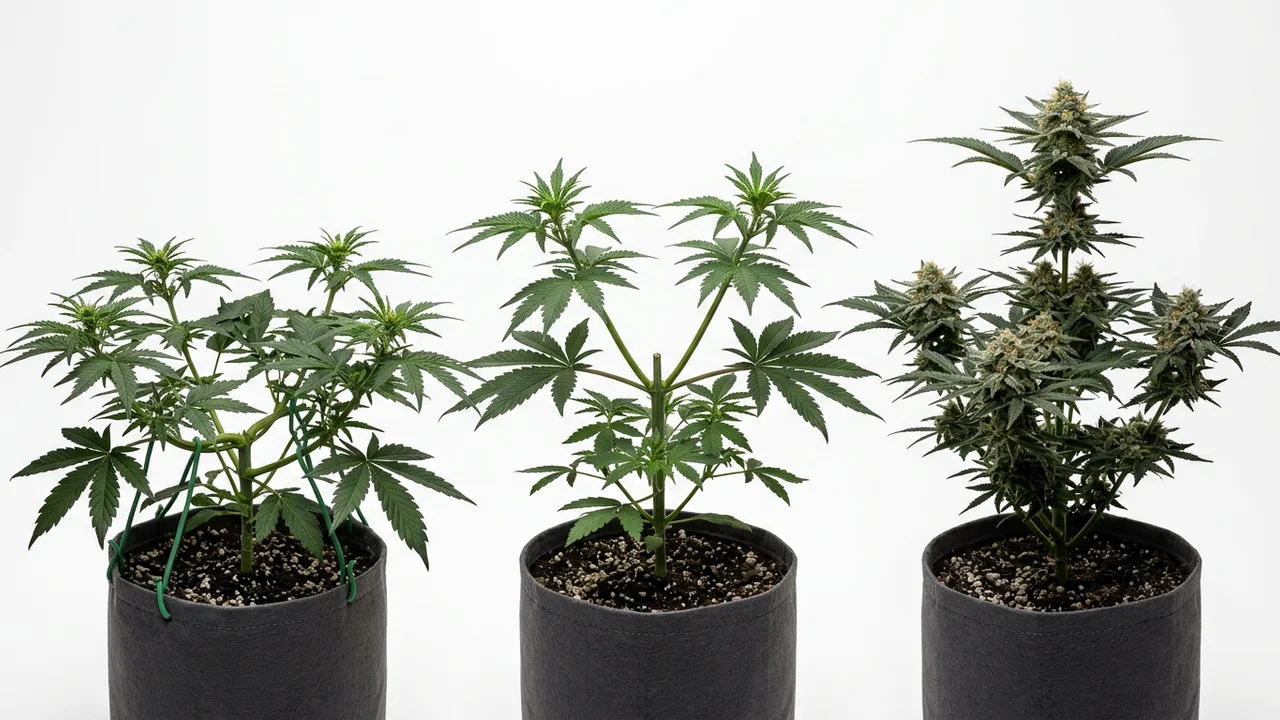
Before comparing individual techniques, it helps to understand the framework. GrowWeedEasy organizes cannabis training into three distinct categories: bending and securing parts of the plant, strategically damaging or removing parts of the plant, and manipulating the grow timeline itself to produce faster yields . Every method we discuss fits into one of these buckets.
- Bending & securing — LST, ScrOG, supercropping
- Damage-based — topping, FIMming, manifolding, defoliation
- Timeline manipulation — 12-12 from seed
The first group is gentle and low-risk. The second group creates intentional wounds to redirect growth hormones. The third group changes when you flip to flower. Most experienced growers combine at least two categories on the same plant for compounding gains.
Low Stress Training (LST): The Gentle Workhorse
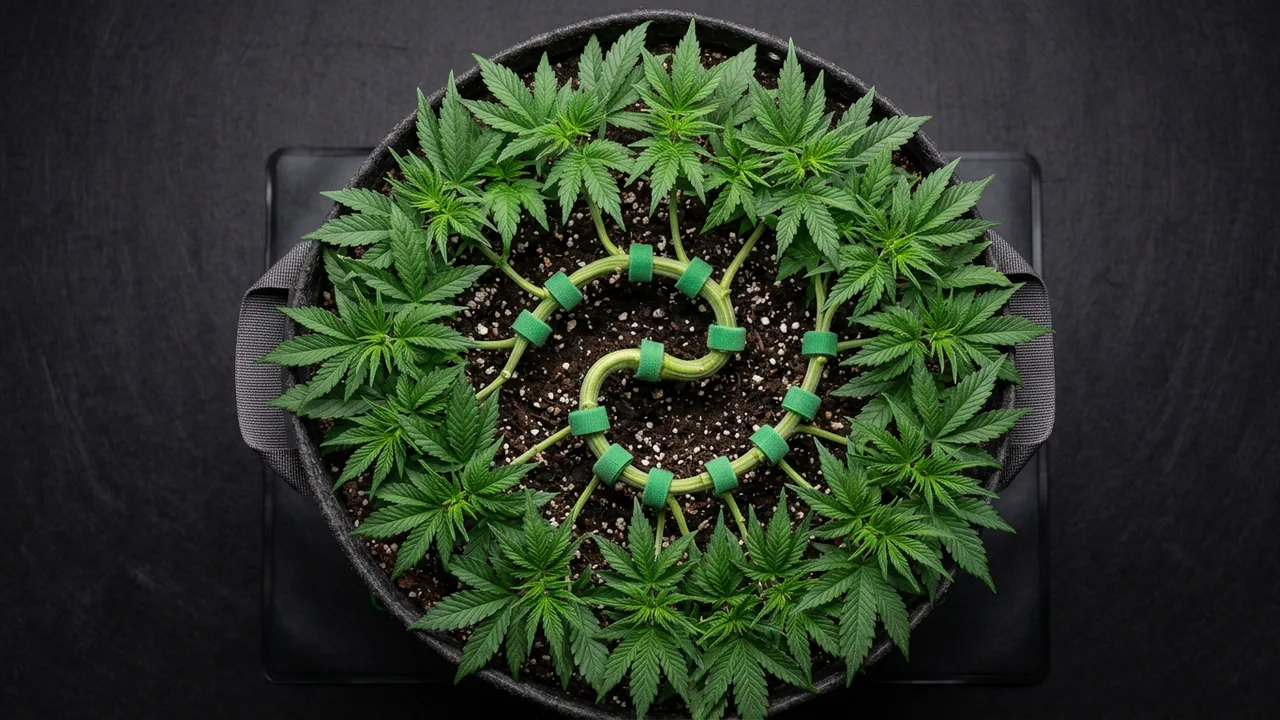
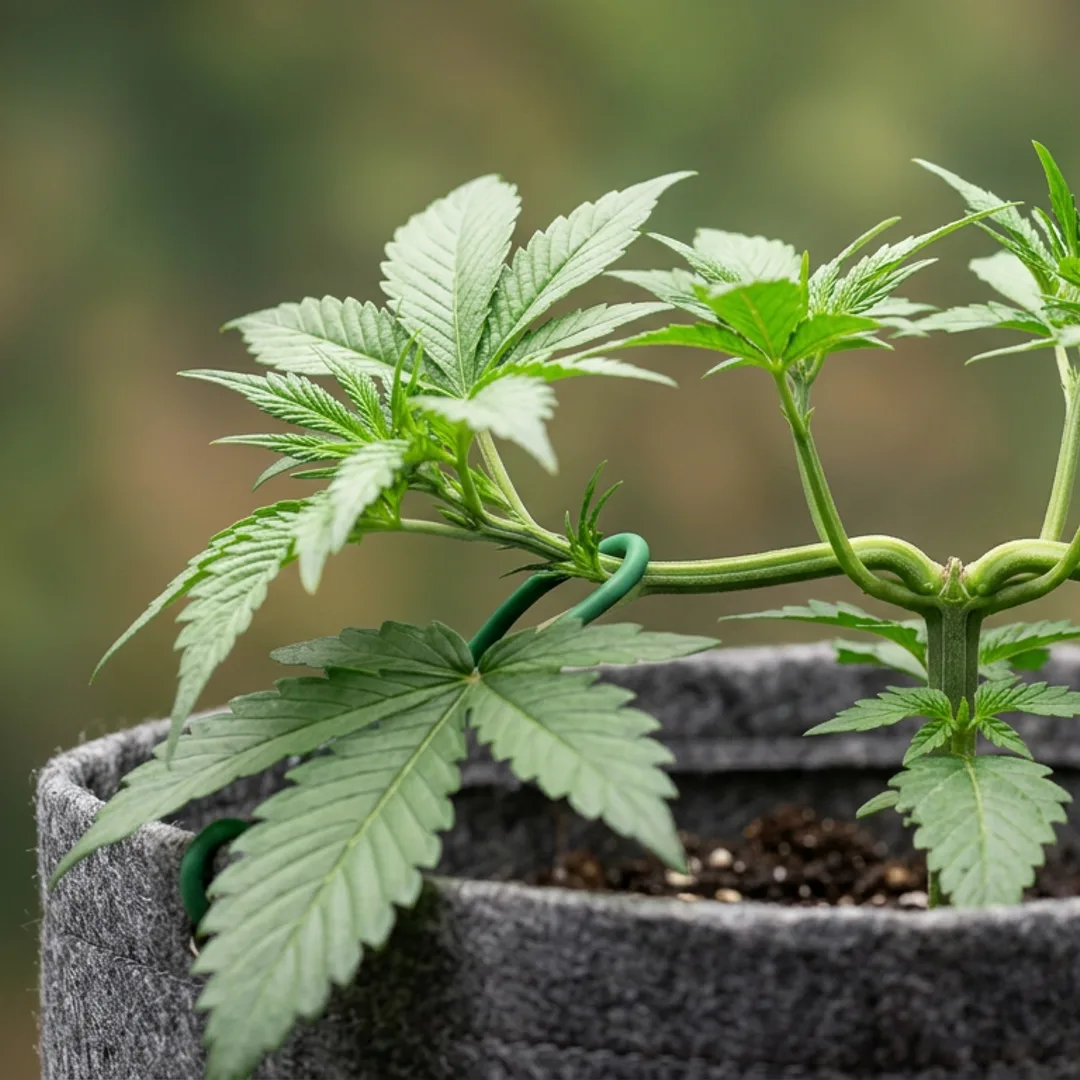
LST is the technique every new grower should learn first. It involves bending the main stem and branches horizontally and tying them in place with soft plant ties. The reason ties are critical: without them, cannabis stems are phototropic and will simply grow back up to their original position within a day or two . The tie is what forces the plant to accept a new shape.
How LST Works
When you bend the main stem sideways, every side branch along that stem suddenly becomes the "tallest" point from the plant's perspective. Auxin redistributes, dormant nodes wake up, and you end up with 6–12 roughly equal colas instead of one dominant spike. The canopy goes flat, light penetration improves, and lower popcorn buds become real flowers.
When to Start LST
Begin as soon as the plant has 4–5 nodes and the stem is still flexible — typically 2–3 weeks after germination. Bend the main stem at a 90° angle away from its growth direction and secure with garden wire or plant ties threaded through drainage holes.
Use coated garden wire or Velcro plant ties — never bare string or zip ties. String digs into soft stems as they thicken and can girdle a branch within a week.
Topping: The Classic Yield Multiplier
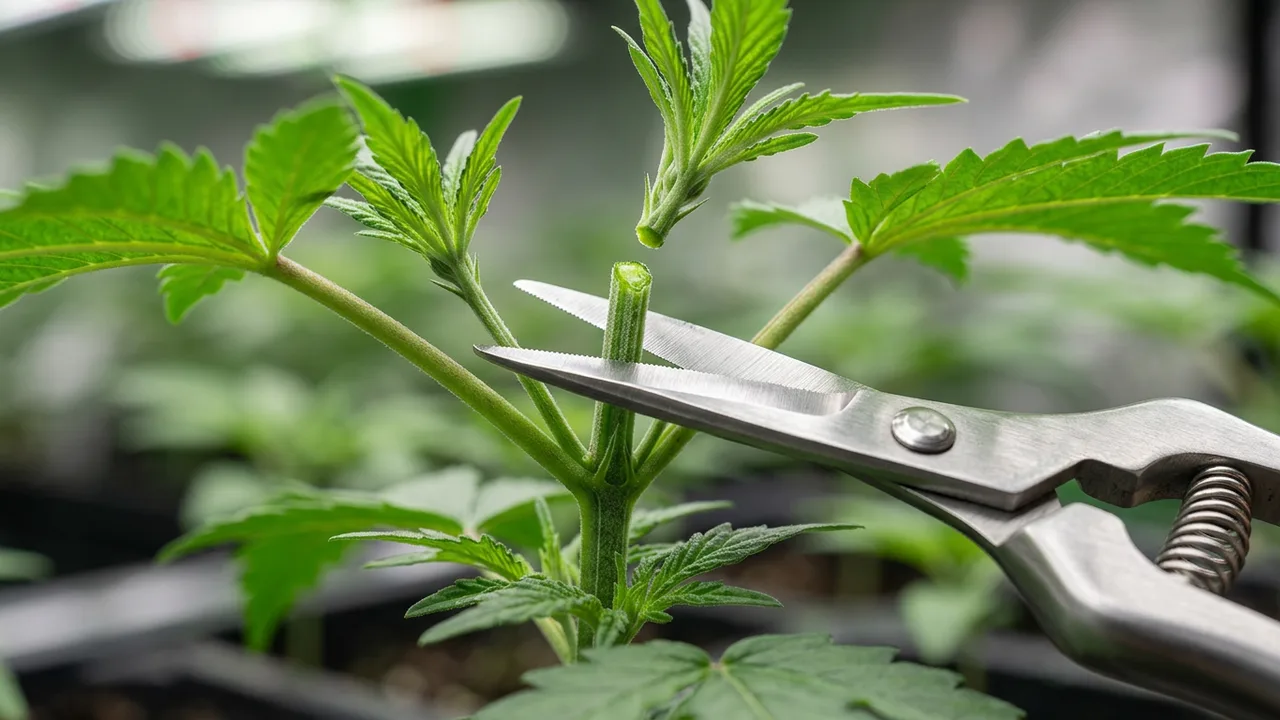
Topping falls into the damage-based category — a technique where you strategically remove the growing tip of the main stem to force the plant to produce multiple colas . You're literally cutting off the apical meristem, which eliminates auxin dominance at that site and promotes two new colas from the node just below the cut.
How to Top
Wait for 5–6 nodes
The plant should have at least 5 nodes of healthy growth, typically 3–4 weeks into veg.
Identify the cut point
Locate the newest growth tip at the top of the main stem. Cut between the 4th and 5th node.
Make a clean cut
Use sterilized, sharp scissors. Cut cleanly through the stem — no tearing.
Let the plant recover
Expect 5–7 days of slowed growth while the plant redirects resources to the two new main colas.
For a deeper dive into technique, timing, and recovery, our dedicated topping cannabis guide walks through every variable.
Never top a plant that's already stressed, root-bound, or showing nutrient deficiencies. Topping a weak plant can set it back weeks — or kill it outright.
FIMming: Topping's Less Predictable Cousin
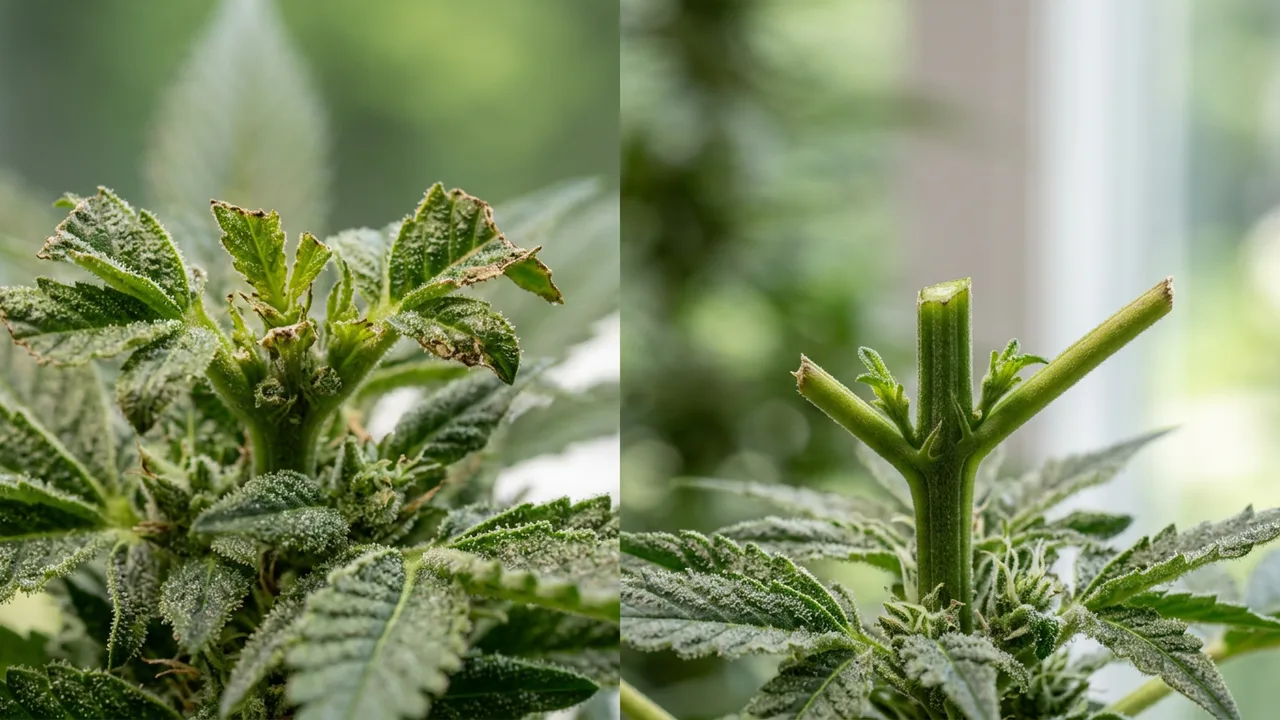
FIM stands for "F*** I Missed" — a technique that allegedly started as a botched topping attempt. Instead of cutting cleanly between nodes, you pinch or cut off roughly 75–80% of the newest growth tip, leaving a small portion intact. The result: instead of 2 new colas, you often get 4 (sometimes 3, sometimes even more).
FIMming vs Topping: The Key Difference
Topping is surgical — you remove the entire tip and get a predictable 2-cola response. FIMming is messy by design — you leave damaged tissue behind, which confuses the plant's growth hormones and can produce 3–5 new growth points. The trade-off: FIMming has a higher failure rate and the new colas are often uneven in size and vigor.
Our full FIMming technique guide covers exact pinch angles and recovery timelines.
| Factor | Topping | FIMming |
|---|---|---|
| New colas | 2 (predictable) | 3–5 (variable) |
| Recovery time | 5–7 days | 3–5 days |
| Failure rate | Low | Moderate |
| Symmetry | High | Low |
| Best for | Mainlining, SCROG setups | Maximum cola count |
Manifolding (Mainlining): The Structured Approach
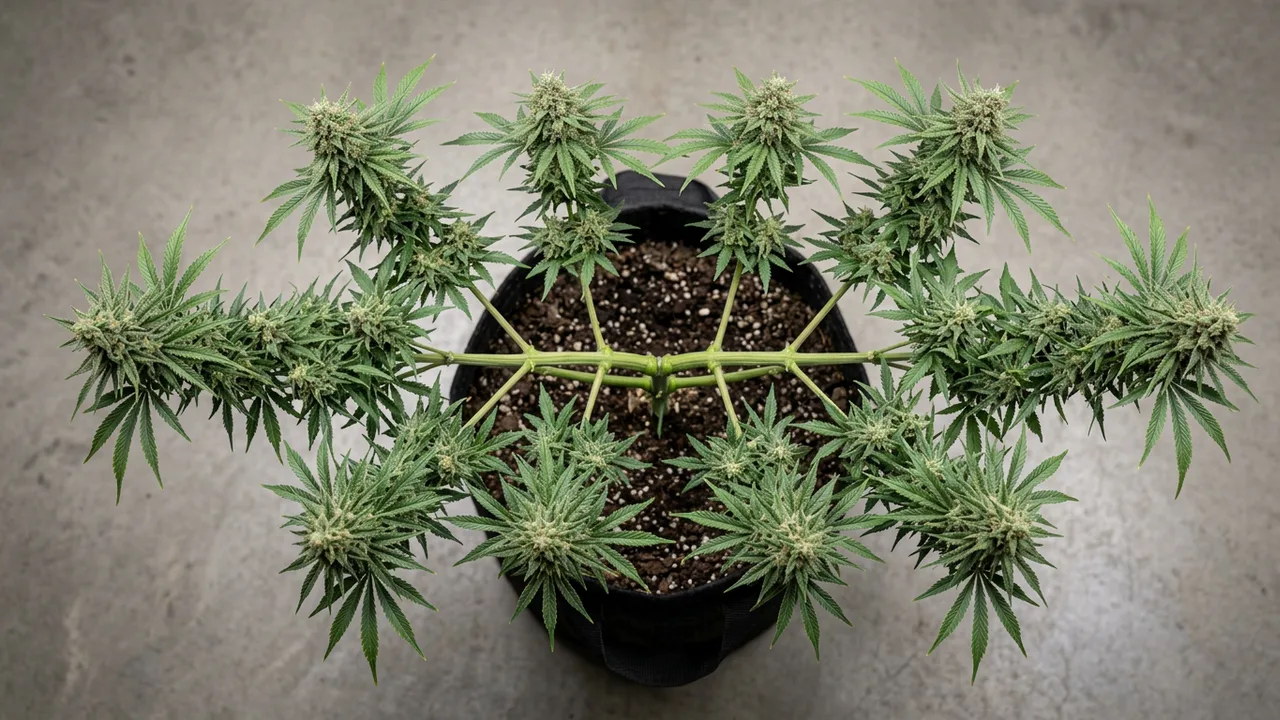
Manifolding — often called mainlining — is a damage-based technique that produces a symmetrical, hub-and-spoke structure of colas . It's essentially topping on steroids: you top the plant down to the 3rd node, remove everything below, and then top each of the two remaining branches repeatedly to build a perfect 8, 16, or 32-cola manifold.
Why Mainline?
The payoff is uniformity. Every cola finishes at the exact same height, every bud site gets equal light, and the plant looks like a menorah. For growers chasing maximum canopy efficiency under a single light, it's hard to beat.
The Cost
Mainlining requires 2–3 weeks of additional veg time per doubling. An 8-cola manifold typically adds 4–6 weeks to your grow cycle compared to a simple topped plant. That makes it a photoperiod-only technique — autoflowers don't have the veg window to spare.
Head-to-Head: The Full Comparison Table
Here's the side-by-side breakdown of all four methods on the factors that matter most: yield potential, risk, recovery time, ease of use, and autoflower viability.
| Method | Category | Stress Level | Recovery | Yield Gain | Beginner-Friendly | Autoflower-Safe |
|---|---|---|---|---|---|---|
| LST | Bending | None | 0 days | 20–35% | ✅ Yes | ✅ Yes |
| Topping | Damage | High | 5–7 days | 25–40% | ⚠️ Moderate | ⚠️ Risky |
| FIMming | Damage | Moderate | 3–5 days | 25–40% | ❌ No | ⚠️ Risky |
| Mainlining | Damage | Very High | 2–3 weeks total | 30–40%+ | ❌ No | ❌ No |
Yield gain ranges reflect the up-to-40% ceiling reported in GrowWeedEasy's training guide and scale based on technique aggressiveness and grower execution.
Autoflower vs Photoperiod: Which Methods Work?
This is where most new growers get burned. Autoflowers operate on a fixed internal clock — roughly 10–12 weeks from seed to harvest — and they don't care if you've finished training them or not. Any technique that causes meaningful recovery time eats directly into your final yield.
Autoflower Training Rules
- LST — the gold standard for autos, zero recovery penalty
- Light defoliation — acceptable if done early, sparingly
- Topping — high-risk; only attempt on fast, vigorous genetics
- FIMming — not recommended
- Mainlining — never
If you're running autos like Swiss Cheese Auto, Skywalker OG Auto, or Holy Grail Kush Auto, stick to LST. Our genetics team has run enough trials to say with confidence that autos topped past week 3 frequently finish smaller than untrained controls.
Photoperiod Training Freedom
Photoperiods are the playground. Because you control when they flip to flower, you can veg them for 6, 8, or 12 weeks while executing complex training. Strains like White Widow, OG Kush, Gorilla Glue #4, Wedding Cake, and Gelato all respond beautifully to topping + LST combos.
Sativa-dominant photoperiods like Super Lemon Haze or Durban Poison benefit enormously from topping because they naturally stretch tall and uneven. Topping breaks that vertical dominance and gives you a manageable canopy for indoor tents.
Combining Training Methods: Where the Real Gains Live
Single techniques are good. Combined techniques are where growers unlock serious yield. According to GrowWeedEasy, a topped plant combined with LST can grow multiple colas rather than one dominant central cola, dramatically increasing the number of bud sites . This is the foundational stacking pattern every serious grower eventually adopts.
The Big Three Combos
Top + LST (the standard)
Top once at node 5, let the two new colas develop, then LST both outward. Result: 4–8 even colas, flat canopy, beginner-friendly.
Mainline + ScrOG
Build an 8-cola manifold, then weave the colas through a screen as they stretch into flower. Result: a perfectly flat sea of equal-sized colas. Our ScrOG guide covers screen setup in detail.
LST + Selective Defoliation
Use LST to open the canopy, then selectively remove fan leaves blocking bud sites during weeks 2–3 of flower. Ideal for autos where aggressive damage is off the table.
Never stack multiple high-stress techniques in the same week. Top + supercrop + heavy defoliation at once is how plants turn into hermies. Space stressful interventions 5–7 days apart.
Matching the Method to Your Strain
Strain structure matters as much as technique. Indica-dominant plants already grow short and bushy — they need less aggressive training. Sativa-dominant plants stretch tall and rangy — they practically demand topping to stay manageable indoors.
Best Training Method by Strain Type
| Strain Type | Example Strains | Recommended Method |
|---|---|---|
| Indica-dominant, compact | Northern Lights x Big Bud, Purple Kush, Bubba Kush | LST only — already short |
| Balanced hybrid | White Widow, OG Kush, Gelato | Top + LST combo |
| Sativa-dominant, stretchy | Super Lemon Haze, Sour Diesel, Durban Poison | Mainline or double-top + ScrOG |
| Autoflower | Skywalker OG Auto, Amnesia Haze Auto | LST only |
| Heavy-yielder photos | Northern Lights x Amnesia Haze, Quantum Kush | Top + LST + light defoliation |
For more on setting up your tent around these training strategies, see our pillar indoor growing guide and plan your grow with the free grow planner.
Timeline Manipulation: 12-12 From Seed
GrowWeedEasy classifies 12-12 from seed as a third category of training: timeline manipulation used to produce faster yields . Instead of giving plants a vegetative period, you place them under a 12-hour light schedule from germination onward. The plant flowers almost immediately.
Trade-offs are significant. Yields per plant drop dramatically because the plant never builds the frame that supports heavy bud production. But total time from seed to harvest can shrink to 8–10 weeks. It's a niche method for growers prioritizing speed or legal plant-count limits over per-plant yield.
Which Training Method Wins? Our Verdict
No single method wins every category — that's why the right answer depends on what you're optimizing for.
Best Overall: LST
Lowest risk, zero recovery time, compatible with every strain and every grow style, including autos. If you learn one technique well, make it this one.
Best for Maximum Yield: Top + LST Combo
For photoperiod growers willing to invest an extra week of veg, nothing beats the simplicity and yield of topping once and then LST-ing both resulting colas outward.
Best for Canopy Perfection: Mainlining + ScrOG
If you're a perfectionist with time to spare and a single-light setup, the mainline-ScrOG combo produces the most uniform canopy possible.
Skip Unless Experienced: FIMming
FIMming's inconsistency makes it hard to recommend over plain topping for most growers. The extra colas rarely justify the unpredictability.
Start with LST. Add topping on your second or third grow once you trust your environment. Try mainlining only when you've harvested at least 3 successful cycles. Skill compounds — don't skip steps.
Tools & Resources
- Yield estimator — project harvest weight by training method
- Grow planner — schedule topping and LST around flower flip
- VPD calculator — keep recovery conditions dialed
- Plant diagnosis — troubleshoot post-training stress signs
- Germination guarantee — every seed backed for sprouting
Limitations of the Current Evidence
Worth being honest: peer-reviewed academic research on cannabis plant training is virtually nonexistent. The 40% yield claim comes from an industry cultivation guide , not a controlled university study. Real-world results depend heavily on strain, environment, grower skill, and cycle length. Treat all yield figures — ours included — as rough benchmarks rather than guaranteed outcomes.
Frequently Asked Questions
What is the best cannabis training method for beginners?
Low Stress Training (LST) is the clear beginner's choice. It requires no cutting, has no recovery period, works on every strain including autoflowers, and still delivers 20–35% yield gains. Master LST first before attempting topping or FIMming.
Can you top an autoflower cannabis plant?
Technically yes, but it's high-risk. Autoflowers run on a fixed clock, and the 5–7 day recovery from topping can permanently reduce final yield. Stick to LST for autos unless you're running vigorous genetics and have experience.
What's the difference between LST and topping for yield?
LST redistributes existing growth hormone to wake up dormant branches without cutting anything — safer but slightly lower ceiling. Topping removes the main growth tip to force two new colas, with higher yield potential but 5–7 days of recovery stress. Combined, they outperform either method alone.
Is FIMming better than topping?
Not for most growers. FIMming can produce 3–5 new colas instead of 2, but the results are inconsistent and colas often grow unevenly. Topping is more predictable, cleaner, and easier to plan a canopy around. FIMming is best reserved for experienced growers chasing maximum cola count.
When should I start training my cannabis plants?
Start LST at 4–5 nodes (about 2–3 weeks from germination). Wait for 5–6 nodes before topping (3–4 weeks). Mainlining starts at the same point as topping but extends 2–3 weeks longer. Never train a stressed or deficient plant — stabilize health first.
Sources & References
This article was researched and fact-checked using 4 verified sources including 3 peer-reviewed studies, 1 industry source.
- Differences in Cannabis Use Characteristics, Routines, and Reasons for Use Among Individuals With and Without a Medical Cannabis Card - PMC — pmc.ncbi.nlm.nih.gov/articles/PMC9276841 [Research]
- Effects of different methods of cannabis use on cognition and blood THC: A systematic review - ScienceDirect — sciencedirect.com/science/article/abs/pii/S0278584625001538 [Research]
- Cannabis and Athletic Performance - PMC — pmc.ncbi.nlm.nih.gov/articles/PMC8566388 [Research]
- Complete Guide to Cannabis Plant Training | Grow Weed Easy — growweedeasy.com/cannabis-plant-training [Industry]