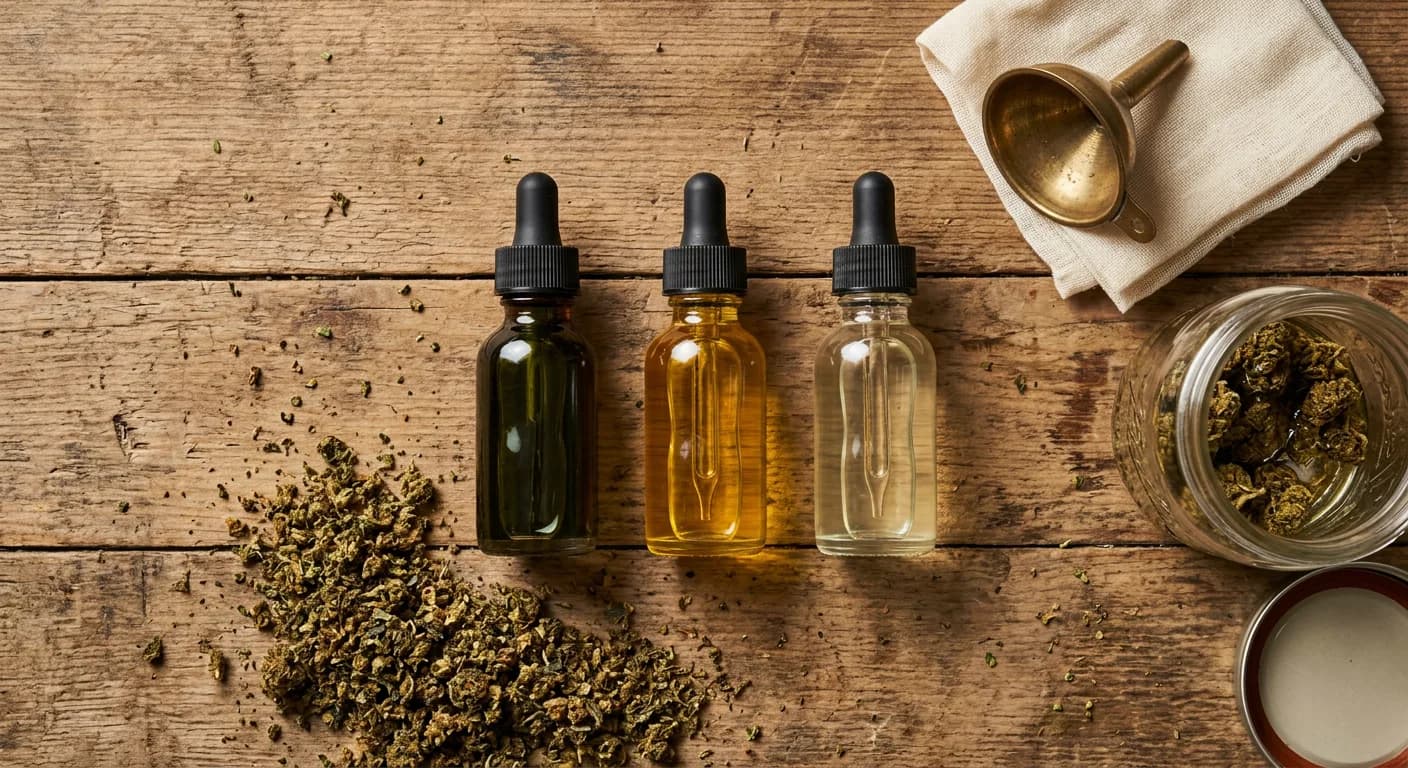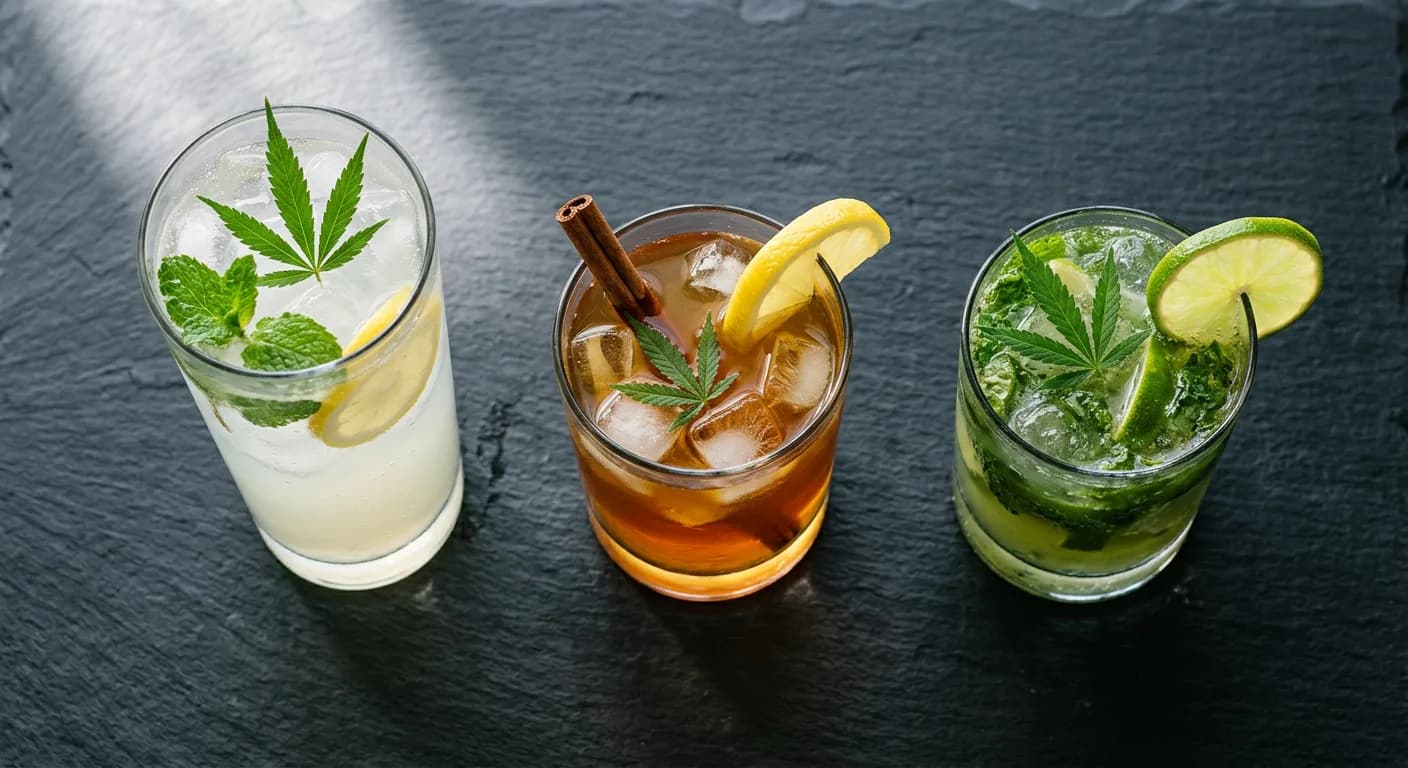
Walk into any dispensary in a legal state and you'll find a refrigerated shelf dedicated entirely to cannabis infused drinks — sparkling waters, lemonades, tonics, and shot-format elixirs priced between $6 and $18 each. The category is one of the fastest-growing segments in the legal cannabis market, projected to exceed $1 billion in annual sales before 2027. And yet almost every commercially produced version you'll try is made from the same base: a cheap, flavorless nanoemulsion concentrate that a manufacturer dilutes into carbonated water.
Here's what those brands won't tell you. If you grow your own cannabis at home, you can make fresher, more flavorful, and far more cost-effective cannabis beverages in your own kitchen — and they can actually taste like something you'd want to drink. The single reason most home attempts fail is not the cannabis, not the recipe, not the equipment. It's one word: emulsification.
This guide solves that problem completely. You'll learn the science behind why THC resists water, three practical home-friendly solutions, a master THC simple syrup recipe, five real drink recipes, and exactly how to dose safely — whether you're a first-time cannabis beverage maker or a home grower looking to put your harvest to work in new ways.
Why THC and Water Don't Mix (The Emulsification Problem)
Making cannabis infused drinks that actually work starts with understanding a basic chemistry problem — and it's simpler than you think once you see it clearly.
THC is a hydrophobic molecule. That means it repels water and bonds instead with fats and oils. When you drop raw cannabis oil or a fat-based infusion into a glass of water, the THC-carrying oil floats straight to the surface. You end up with a greasy ring around your glass and unpredictable dosing — some sips are near-zero, one sip is everything. This is why so many homemade weed drinks either do nothing or hit like a freight train with no middle ground.
The science in plain English: Oil molecules are nonpolar — their electrons are distributed evenly, creating no charge. Water molecules are polar — they have a slight negative charge on one end. Polar molecules are attracted to each other and actively push out nonpolar ones. This is why no amount of shaking will keep oil suspended in water long-term without a third ingredient.
What Commercial Brands Actually Do: Nanoemulsification
Commercial cannabis beverage brands solve this with a process called nanoemulsification. Here's what it means: the cannabis oil is broken into particles between 10 and 200 nanometers in size (for reference, a human hair is roughly 70,000 nanometers wide) using high-energy equipment like ultrasonic processors or high-pressure homogenizers. These particles are then coated with emulsifying agents — usually food-grade surfactants — that make each tiny oil droplet compatible with water.
The result is a stable, clear or slightly opaque liquid that doesn't separate, has rapid absorption because the tiny particles cross the gut lining faster, and can be blended invisibly into any beverage. The downside? Industrial nanoemulsification equipment costs $10,000 to $100,000+, and the concentrate itself is flavorless. You're paying for convenience and packaging, not quality.
What You Can Do at Home
You can't replicate industrial nanoemulsification in a home kitchen. But you can get surprisingly close using widely available food-grade emulsifiers — particularly sunflower lecithin. The result won't have 10-nanometer particles, but it will stay mixed long enough to drink, absorb consistently, and taste far better than anything from a can.
The key insight: you don't need perfect nanoemulsification for a great home cannabis drink. You need particles small enough to stay suspended for the duration of drinking, and an emulsifier stable enough to hold them there. Sunflower lecithin does exactly that at $8–12 per pound from any health food store.
Three Home-Accessible Emulsification Solutions
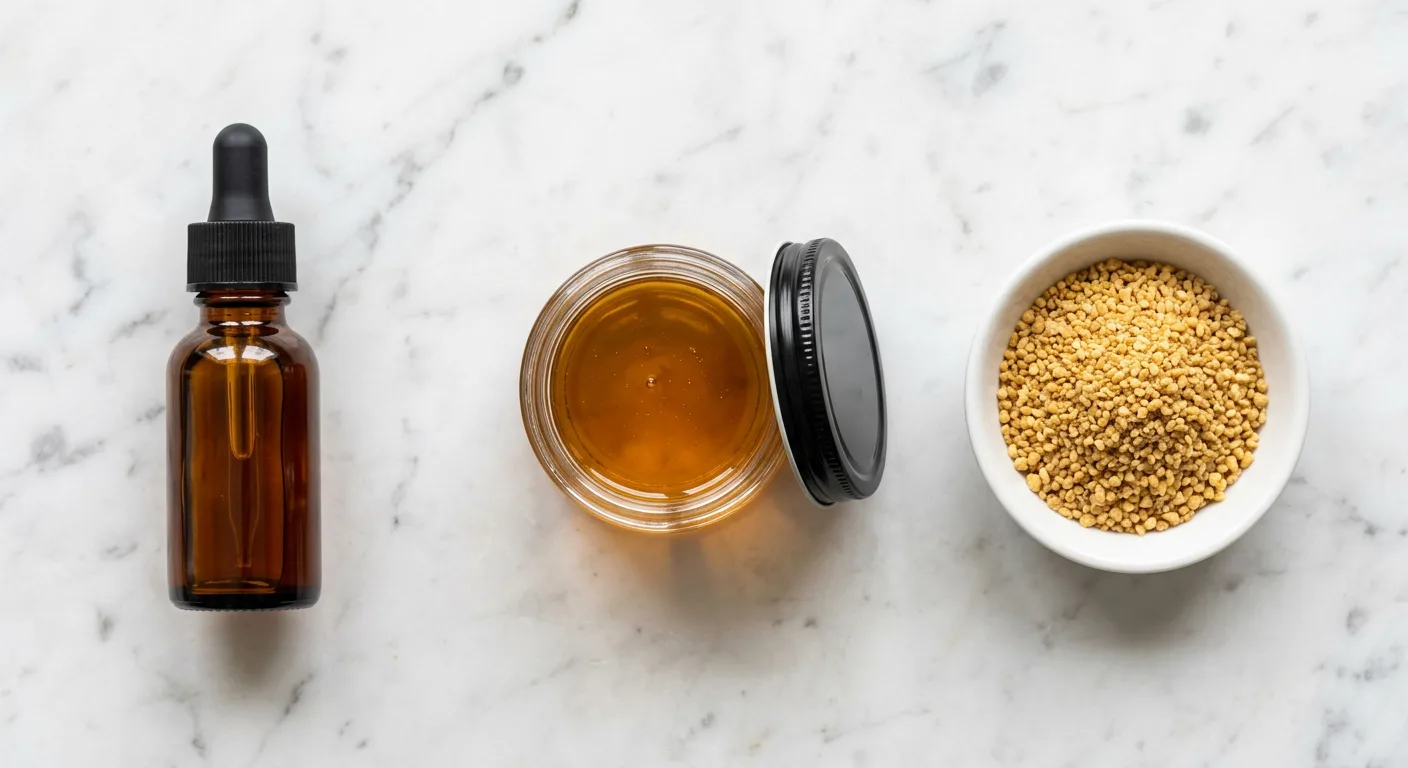
There are three practical approaches to making cannabis infused drinks that don't separate at home. Each has a different speed of preparation, onset time, and ideal use case. Understanding which to use when will save you hours of frustration.
Solution 1: Alcohol-Based Cannabis Tincture (Fastest, Most Versatile)
A cannabis tincture made with high-proof alcohol (190-proof grain alcohol or at minimum 151-proof) partially solves the emulsification problem because ethanol is a co-solvent — it bridges the gap between oil-soluble THC and water. Tinctures mix into drinks better than raw oils, though they'll still show some separation in purely water-based drinks if the alcohol concentration is low.
- Best for: Fast drinks, cocktails with alcohol already present, sublingual use
- Onset: 15–45 minutes when swallowed, 5–15 minutes sublingually
- Shelf life: 6–12 months in a dark glass bottle
- Separation risk: Low in alcohol-containing cocktails, moderate in water-only drinks
To make a basic tincture: decarb your cannabis (240°F / 115°C for 40 minutes), pack loosely into a glass jar, cover completely with high-proof alcohol, seal, and store in a cool dark place for 2–6 weeks shaking daily. Strain through cheesecloth. Start with 3.5g of flower per 250ml of alcohol for a moderately potent tincture.
Tincture shortcut: The "Green Dragon" method uses a warm water bath at 165°F / 74°C for 20 minutes instead of weeks of cold soaking. The tincture is ready the same day and tests show comparable potency. Keep alcohol below its boiling point (173°F) to prevent evaporation.
Solution 2: Lecithin-Enhanced Oil Infusion
This is the middle-ground approach: infuse decarbed cannabis into a carrier oil (coconut or MCT oil are best), then add sunflower lecithin during the infusion process. Lecithin is a phospholipid — its molecule has one end that bonds with oil and one end that bonds with water, which is exactly what you need to create a stable emulsion.
- Best for: THC simple syrup base, hot drinks, fatty drink applications
- Onset: 30–60 minutes
- Shelf life: 1–4 months refrigerated
- Separation risk: Low when properly emulsified with lecithin, shake before use
Use sunflower lecithin, not soy lecithin. Sunflower lecithin has a cleaner flavor profile, is better tolerated by people with soy sensitivities, and its phospholipid composition emulsifies more effectively at room temperature. Use 1 tablespoon per cup of carrier oil.
Solution 3: Vegetable Glycerin Tincture (Naturally Water-Miscible)
Vegetable glycerin (VG) is a thick, sweet, odorless liquid derived from plant oils. Unlike alcohol, it's non-intoxicating and adds a slight sweetness to drinks. Unlike oil, it is naturally water-soluble — it mixes into any liquid without separation. This makes VG-based cannabis tinctures the cleanest option for purely water-based cannabis beverages.
- Best for: Sparkling waters, teas, non-alcoholic drinks, CBD mocktails
- Onset: 30–60 minutes (slower than alcohol tincture)
- Shelf life: 6–12 months refrigerated
- Separation risk: Essentially none — mixes completely with water
The tradeoff: glycerin extracts cannabinoids less efficiently than alcohol, so a glycerin tincture will typically be lower potency per ml than an equivalent alcohol tincture. Compensate by using more cannabis material or a longer infusion time (4–6 weeks warm infusion at 100–120°F). A slow cooker on the lowest setting works perfectly.
| Method | Water Compatibility | Onset Speed | Potency per ml | Best Use Case |
|---|---|---|---|---|
| Alcohol Tincture | Moderate | 15–45 min | High | Cocktails, sublingual |
| Lecithin Oil Infusion | Low (needs emulsification) | 30–60 min | High | Simple syrups, hot drinks |
| Glycerin Tincture | Excellent | 30–60 min | Moderate | Water drinks, mocktails, teas |
THC Simple Syrup Recipe: Your Beverage Base
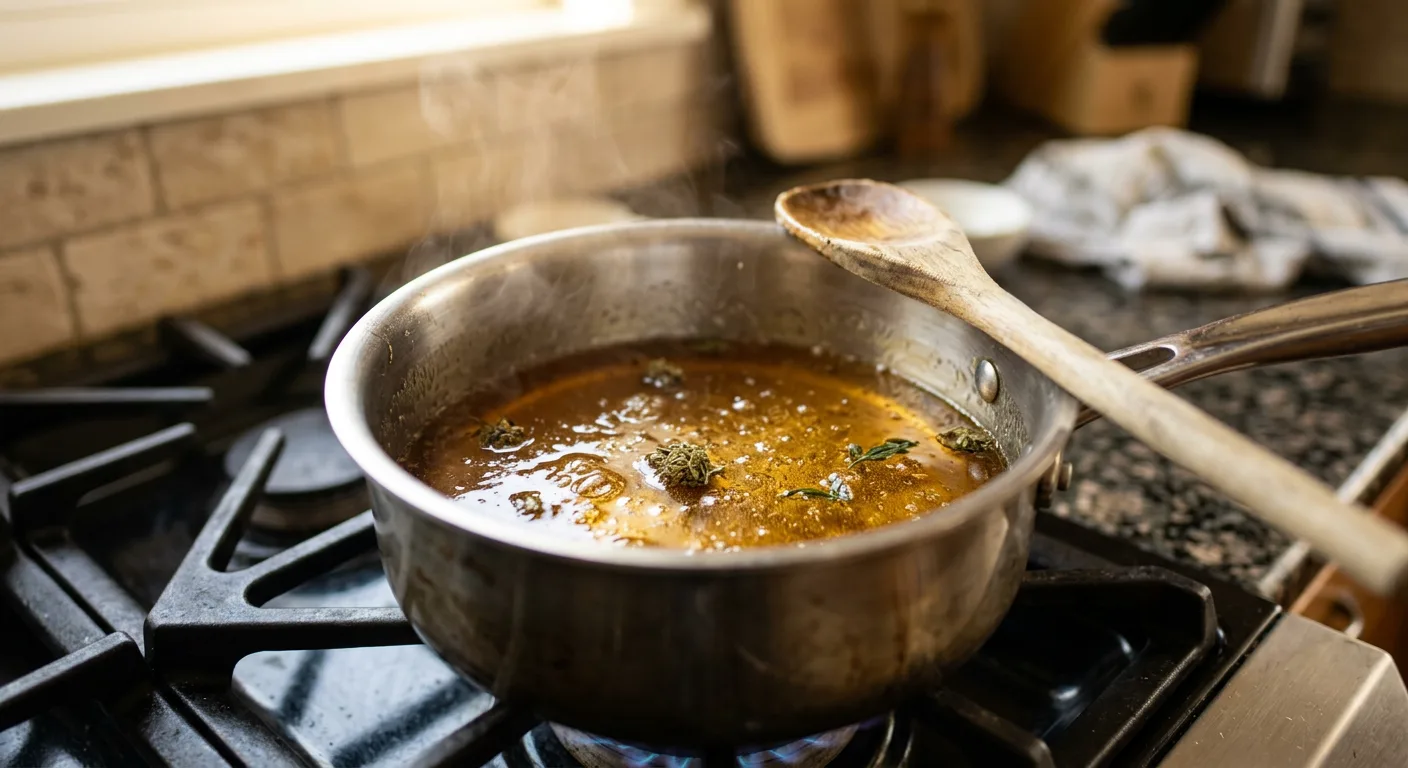
THC simple syrup is the most versatile base you can make for cannabis beverages at home. It stores well, doses consistently, mixes into hot or cold drinks, and can be added to any recipe that already calls for simple syrup — which is most cocktails and mocktails. Master this recipe and you have the foundation for everything else in this guide.
What You Need
- 3.5g (1/8 oz) decarbed cannabis flower — use a potency you know
- 1 cup (240ml) water
- 1 cup (200g) white cane sugar
- 1 tablespoon (14g) sunflower lecithin granules or liquid
- Cheesecloth or fine mesh strainer
- Small saucepan with lid
- Glass jar with airtight seal for storage
- Thermometer (optional but recommended)
Decarboxylation is non-negotiable. Raw cannabis contains THCA, not THC. THCA has minimal psychoactive effect. You must convert it to THC by applying heat before infusing. Skip this step and your syrup will be nearly inactive. Spread ground flower on a baking tray lined with parchment, cover loosely with foil, and bake at 240°F / 115°C for exactly 40 minutes.
Step-by-Step Process
Decarboxylate the Cannabis
Preheat your oven to 240°F / 115°C. Grind your cannabis to a medium-coarse consistency — not powder, which burns and tastes bitter. Spread evenly on a parchment-lined baking sheet, cover loosely with foil, and bake for 40 minutes. The flower should turn from bright green to a slightly brownish-olive color. Let it cool completely before using.
Dissolve Sugar Into Water
Combine 1 cup of water and 1 cup of sugar in a small saucepan over medium heat. Stir continuously until all sugar crystals dissolve completely — about 3–5 minutes. Do not let it boil vigorously; you want a gentle simmer around 170–180°F / 77–82°C.
Add Lecithin and Cannabis
Reduce heat to the lowest setting. Add 1 tablespoon of sunflower lecithin to the syrup and whisk until fully dissolved — about 2 minutes. Add your decarbed cannabis. Stir to combine, place the lid on the saucepan, and maintain a gentle simmer for 20 minutes. Keep temperature below 200°F / 93°C to prevent THC degradation.
Strain and Store
Pour the syrup through a fine mesh strainer or double-layered cheesecloth into your glass storage jar. Press or squeeze the plant material gently to extract maximum liquid. Discard the spent flower. Let the syrup cool to room temperature with the lid off, then seal and refrigerate. It will keep for 3–4 weeks.
Label and Calculate Dose
Use a permanent marker to label your jar with the date, the amount of cannabis used, and its approximate THC percentage. This is your dosing reference. See the dosing section below for the full calculation method.
Flavor upgrade: Add citrus zest (lemon, lime, or orange), fresh ginger slices, or whole spices (cardamom, cinnamon) to the saucepan during the 20-minute simmer. Strain them out with the plant matter. The resulting syrup carries both THC and those aromatic flavors, making your drinks significantly more complex without any extra effort.
5 Cannabis Cocktail and Drink Recipes
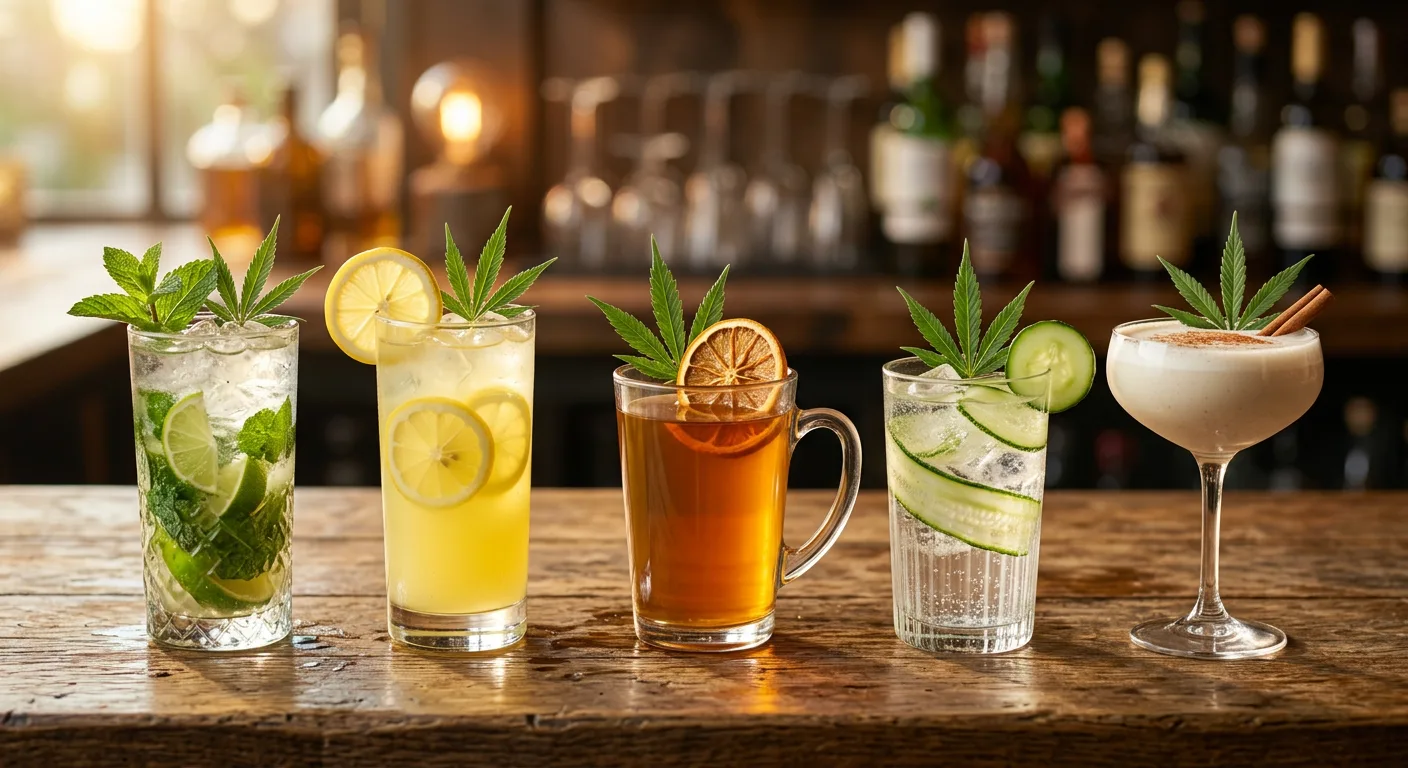
Each recipe below uses either THC simple syrup or tincture as the base. Adjust dosing based on your personal tolerance — all recipes are written for a standard 5mg THC serving per drink, which is appropriate for most consumers. Scale up only after you know how your batch affects you.
Recipe 1: Cannabis Mojito
A classic cannabis tincture cocktail that uses the mint and lime to completely mask any herbal cannabis flavor. The alcohol in the rum also helps the tincture disperse evenly.
- 2 tsp THC simple syrup (approx. 5mg THC per serving)
- 6–8 fresh mint leaves
- 1 oz fresh lime juice
- 2 oz white rum (omit for mocktail version)
- Sparkling water to top
- Ice, mint sprig and lime wheel to garnish
Muddle mint leaves gently in the bottom of a glass — don't shred them, just bruise them to release the oils. Add ice, THC syrup, lime juice, and rum. Stir 10 times. Top with sparkling water. Garnish and serve immediately. Stir again before drinking if you've let it sit more than 5 minutes.
Recipe 2: Infused Lemonade
The most accessible cannabis beverage at home — bright, refreshing, and naturally disguises any cannabis flavor. Works perfectly with a glycerin tincture for a completely clear, non-separating result.
- 1 tsp THC simple syrup or 1ml glycerin tincture (5mg THC)
- 3 oz fresh squeezed lemon juice
- 8 oz cold water or sparkling water
- 1 tsp regular simple syrup (to taste for sweetness)
- Ice and lemon wheels to garnish
Combine all ingredients in a glass over ice. Stir vigorously for 20 seconds. The acid in the lemon juice helps the syrup incorporate more effectively. Taste and adjust sweetness. If using glycerin tincture, it will dissolve completely on its own with minimal stirring.
Recipe 3: THC Honey Tea
A warming, calming drink that works brilliantly with indica-dominant strains. The hot water helps the lecithin emulsification fully activate, and honey's viscosity keeps everything suspended.
- 1 tsp THC simple syrup (5mg THC)
- 1 tablespoon raw honey
- 8 oz hot water (175–185°F / 80–85°C — not boiling)
- 1 tea bag of choice (chamomile and lemon ginger work exceptionally well)
- Squeeze of lemon, optional
Brew your tea bag for 4 minutes then remove. Add honey and stir until dissolved. Add THC simple syrup and stir again for 15 seconds. Add lemon if using. Do not add the syrup to boiling water — temperatures above 200°F can begin to degrade THC. Let water cool 2–3 minutes off the boil before adding your infusion.
For the honey tea, an indica-leaning strain makes the most sense. Strains with myrcene and linalool terpene profiles — like Northern Lights x Big Bud (20% THC) or Purple Kush (27% THC) — complement chamomile's natural sedative qualities beautifully. Check our best strains for relaxation for more options.
Recipe 4: Sparkling Cannabis Water
The cleanest, most refreshing option — and the one that most closely resembles commercial cannabis drinks. This recipe requires a glycerin tincture for best results because the lack of other flavors means any separation or oiliness will be immediately noticeable.
- 1ml cannabis glycerin tincture (5mg THC)
- 10 oz chilled sparkling water
- 2 slices cucumber or 3 mint leaves, optional
- Small pinch of sea salt (enhances mouthfeel)
Add glycerin tincture to the bottom of a cold glass. Pour sparkling water gently down the side of the glass to preserve carbonation. Drop in cucumber or mint. Stir once with a spoon — the glycerin disperses completely. The sea salt is optional but rounds out the flavor and reduces the slight sweetness of the glycerin base.
Recipe 5: CBD Mocktail (Non-Intoxicating Version)
Ideal for social situations, for people building tolerance, or when you simply want the relaxation benefits without full intoxication. This version uses a CBD-dominant flower or hemp-derived CBD tincture instead of high-THC cannabis.
- 1ml CBD glycerin tincture or CBD simple syrup
- 2 oz fresh grapefruit juice
- 1 oz elderflower cordial
- Sparkling water to top (about 4 oz)
- Rosemary sprig for garnish
Build over ice in a tall glass. Add CBD tincture, grapefruit juice, and elderflower cordial. Stir well. Top with sparkling water. Slap the rosemary sprig between your palms to release its oils before placing as garnish. The bitterness of grapefruit balances the sweetness of elderflower while the CBD contributes a gentle edge-taking relaxation without intoxication.
Never serve cannabis drinks to guests without explicit, informed consent. Always label containers clearly in shared fridges. Cannabis beverages can look identical to non-infused drinks. Dosing someone without their knowledge is not only unethical but illegal in every jurisdiction.
Dosing Cannabis Drinks: Why Liquids Hit Differently
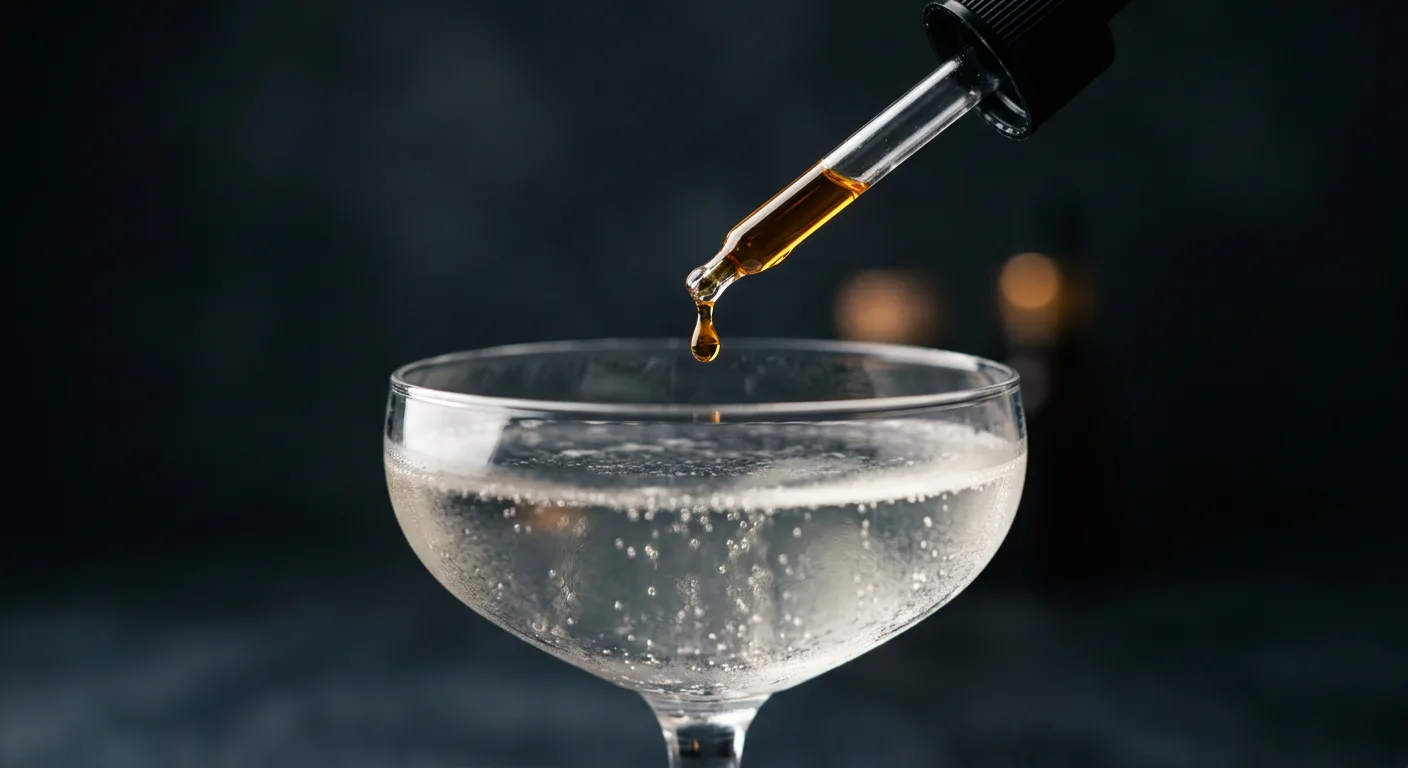
Dosing cannabis infused drinks is one of the most important skills to develop — and the one most new users underestimate. Liquid cannabis behaves differently from solid edibles in ways that have real physiological explanations.
Why Drinks Absorb Faster Than Solid Edibles
When you eat a cannabis brownie or capsule, the THC must first be digested along with food. The stomach empties slowly, the liver processes the THC into 11-hydroxy-THC (the more potent metabolite), and onset can take 45–90 minutes — sometimes longer on a full stomach. With a properly emulsified cannabis drink, absorption begins partially in the mouth (buccal absorption) and continues rapidly in the small intestine without the digestive delay of fats and solids.
The result: onset in 20–45 minutes for most people, with peak effects at around 60–90 minutes. Effects also tend to be somewhat shorter in duration — 2–4 hours versus 4–6 hours for solid edibles — because the rapid absorption curve means a faster decline.
Why emulsification matters for dosing: If your drink has separated, the first few sips may contain almost no THC while the last sip contains all of it. Proper emulsification doesn't just make a better drink — it makes dosing predictable. Always stir or gently shake before drinking, even a well-made infusion.
How to Calculate Your Dose From Homemade Syrup
Here's the math made simple. Use this formula:
Total THC in batch = weight of flower (grams) × THC% × 1000 × 0.88 (decarb efficiency)
Example: 3.5g of cannabis at 20% THC
- 3.5 × 0.20 = 0.7g of THCA
- 0.7g × 1000 = 700mg
- 700mg × 0.88 (decarb conversion) = approximately 616mg total THC in your batch
- If your syrup batch made 200ml, each ml contains roughly 3mg THC
- A 5mg serving = approximately 1.7ml of syrup, or just under 1/3 of a teaspoon
This is a theoretical maximum — real-world extraction efficiency ranges from 60–80% depending on infusion time, temperature control, and lecithin quality. Use 70% of your calculated figure as a realistic working estimate when you're new to a batch. Our edible dosage calculator will run these numbers for you automatically if you input your flower weight and THC percentage.
- Start at 2.5–5mg THC per drink if you're new to edibles
- Wait at least 90 minutes before considering a second serving
- Label every batch with date, cannabis amount, and THC%
- Keep a simple log of dose vs. effect for 3–4 sessions to calibrate
- Tolerance varies dramatically — what's mild for one person is strong for another
- Reduce dose significantly if combining with alcohol (see next section)
Alcohol and THC: What Actually Happens When You Mix Them
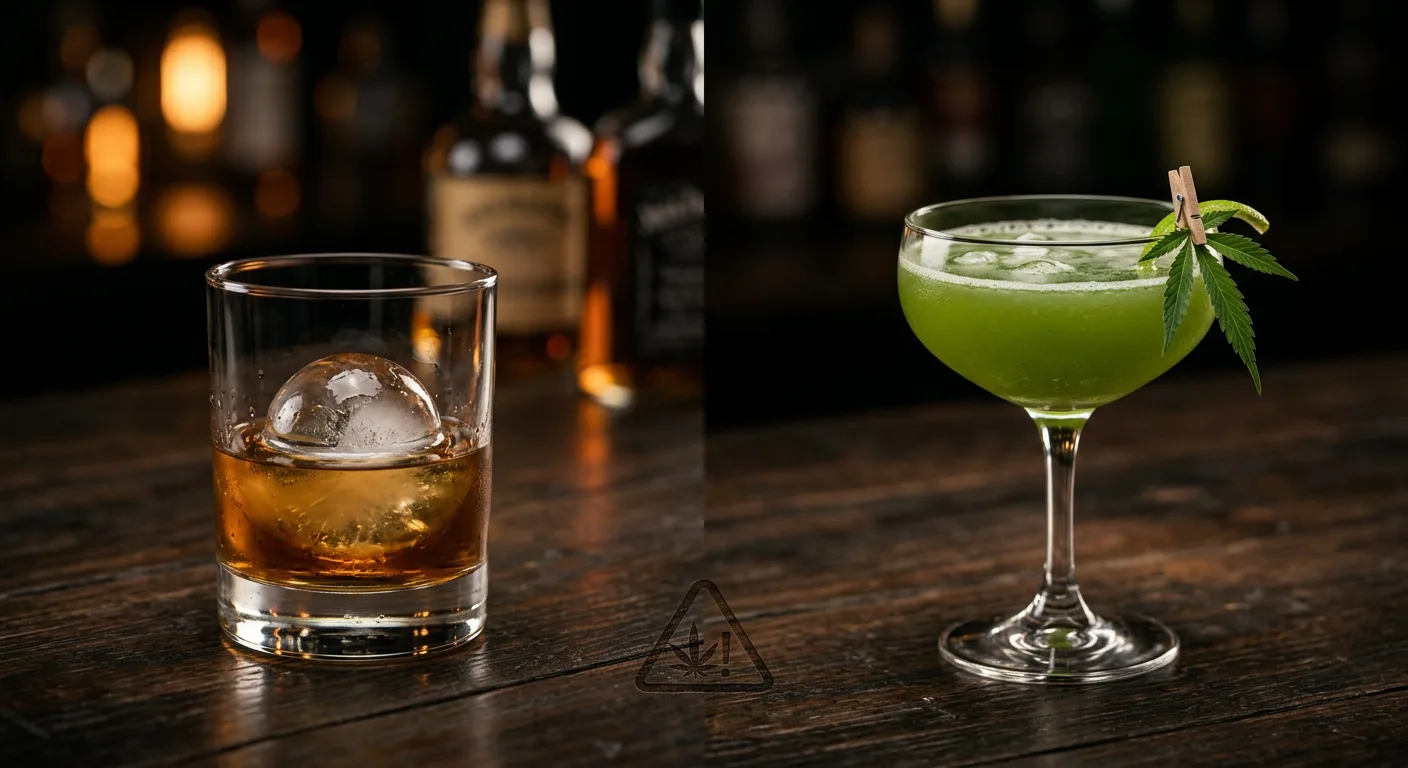
Combining alcohol and THC in a cannabis cocktail is legal, widely done, and genuinely enjoyable for many people — but it deserves an honest, non-preachy explanation of what actually happens in your body so you can make informed decisions.
The Pharmacology of Crossfading
Both alcohol and THC affect the central nervous system, but through different mechanisms. Alcohol is a CNS depressant that works primarily through GABA and glutamate receptors. THC works primarily through the endocannabinoid system, particularly CB1 receptors in the brain. When combined, the effects are not simply additive — they can be synergistically amplified in ways that are disproportionate to the dose of either substance alone.
A 2019 study published in Clinical Chemistry found that consuming alcohol before cannabis significantly increased peak blood THC concentrations compared to cannabis alone. The proposed mechanism: alcohol increases intestinal permeability, allowing faster and more complete THC absorption. In practical terms, the same dose of THC hits harder and faster when alcohol is already present in your system.
Practical Harm-Reduction Guidelines
- Order matters: Alcohol first, then cannabis tends to intensify effects more than cannabis first, then alcohol. If you're sensitive, consider reversing the order.
- Reduce both doses: If your standard drink is 10mg THC, drop to 5mg when combining with alcohol. If your standard drink is two standard alcoholic drinks, consider one.
- Stay hydrated: Both substances are dehydrating. Alternate cannabis drinks with water.
- Avoid driving entirely: Both alcohol and THC impair driving. Combined, the impairment is significant. This is non-negotiable.
- Know your setting: Crossfading in familiar environments with trusted people is meaningfully safer than in unfamiliar settings.
There's a reason experienced cannabis consumers often call replacing alcohol with cannabis drinks "California Sober" — many people find low-dose THC beverages at social events provide the relaxed, sociable feeling they previously sought from alcohol, without the hangover, the caloric load, or the next-morning regret. That's a legitimate, personal choice. Just make it an informed one.
The designated driver option: THC-only cannabis beverages (no alcohol) with proper emulsification are increasingly popular at social events precisely because they provide an alternative to alcohol. A well-made 5mg cannabis sparkling water is genuinely fun at a party. Check your local laws — in many states it's fully legal to serve these to consenting adults at private events.
Choosing the Right Cannabis Strain for Your Drinks
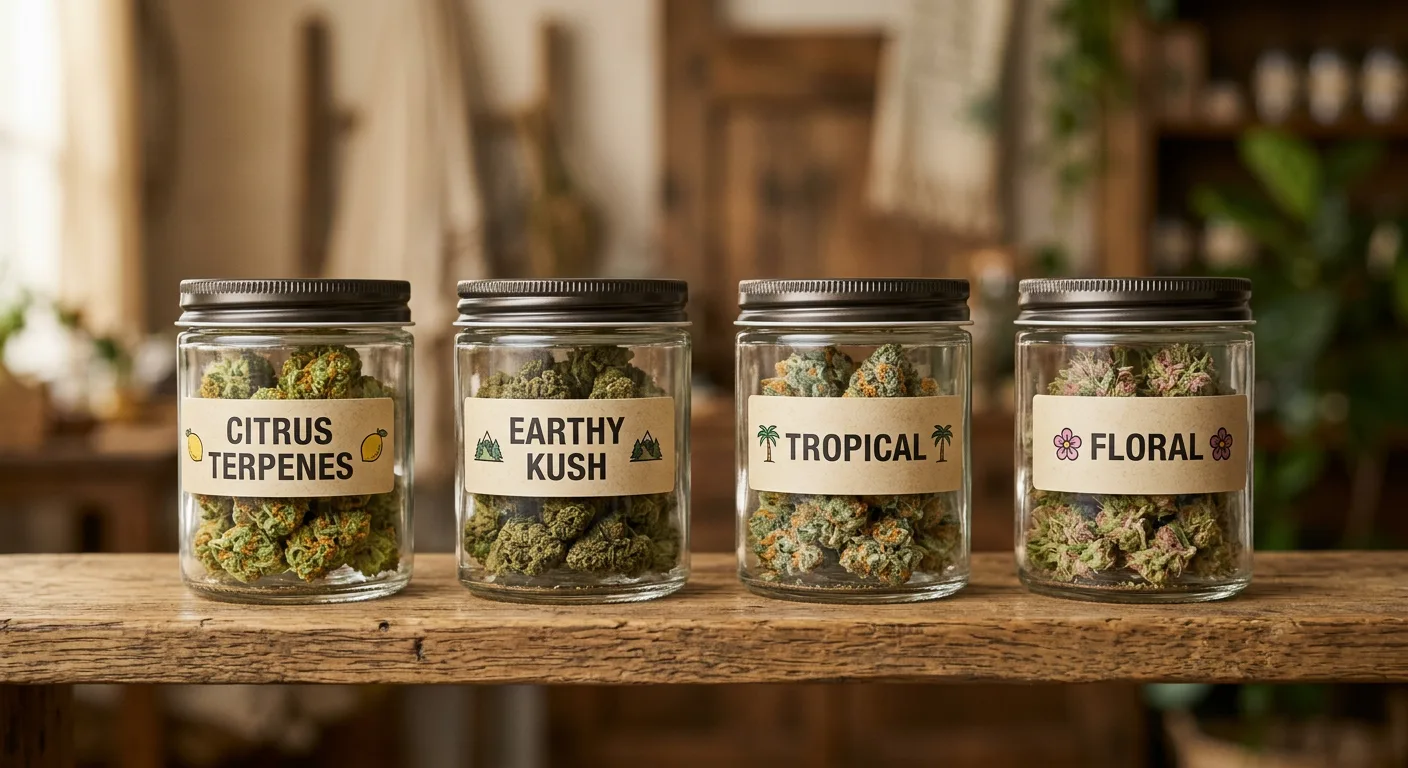
The strain you grow or use for your beverage base matters more than most recipes acknowledge. Terpene profiles survive into tinctures and syrups — especially at low infusion temperatures — and they contribute meaningfully to the flavor and effect profile of your finished drink.
Citrus and Tropical Strains for Cocktails
Strains with high limonene and terpinolene content are naturals for cocktails and lemonades. Their bright, citrus, and sometimes tropical aromas survive the syrup-making process and integrate seamlessly with fruit-based drinks. Consider:
- Super Lemon Haze (23% THC) — strong citrus-haze profile, energizing effect, pairs beautifully with the mojito or lemonade recipe
- Sour Diesel (24% THC) — fuel-citrus complexity, cerebral and uplifting, excellent in the sparkling cannabis water recipe
- Tangerine Haze (18% THC) — sweet tangerine aroma, smooth sativa energy, ideal for the mocktail CBD cocktail if blended with CBD hemp
- Gorilla Glue — earthy-citrus hybrid with balanced effects, widely available and popular for beverage applications
- Zkittlez — sweet tropical profile, relaxed indica effect, excellent in tropical fruit-based drinks
Earthy and Kush Strains for Teas and Hot Drinks
For the THC honey tea or any warm drink recipe, indica-dominant kush varieties with myrcene, linalool, and caryophyllene terpenes are ideal. Their earthy, floral, and spiced notes complement the warmth of tea naturally, and the relaxing body effect suits the context of a warm evening drink.
- OG Kush (26% THC) — complex spice and earth notes, deeply relaxing, the archetypal choice for an evening THC tea
- Northern Lights x Amnesia Haze (24% THC) — combines the body relaxation of NL with Amnesia's cerebral uplift, interesting complexity in warm drinks
- Purple Power (10% THC) — lower potency makes dosing more forgiving for beginners, sweet berry notes work in teas and honey drinks
- Wedding Cake — vanilla and pepper terpene profile, intensely relaxing, excellent in chamomile-based THC tea recipes
- Gelato — sweet, dessert-like, potent hybrid that works well in richer drink bases
If you're growing specifically for beverage applications, choose strains with terpene profiles that complement your favorite drink styles. Lower-temperature infusion (under 180°F) preserves more volatile terpenes in your syrup. The flavor difference between a terpene-rich homemade syrup and a flavorless commercial nanoemulsion concentrate is significant and immediately noticeable.
Potency Considerations for Home Beverage Production
Higher-THC strains require more precise dosing but use less material per batch. Lower-potency strains give you more margin for error and work well for microdosing applications. Here's a quick comparison for a 200ml syrup batch using 3.5g of flower:
| Strain | THC% | Estimated Total THC (at 70% extraction) | Approx. THC per ml of syrup |
|---|---|---|---|
| Purple Power | 10% | ~245mg | ~1.2mg/ml |
| Tangerine Haze | 18% | ~441mg | ~2.2mg/ml |
| Super Lemon Haze | 23% | ~564mg | ~2.8mg/ml |
| OG Kush | 26% | ~637mg | ~3.2mg/ml |
| Purple Kush | 27% | ~661mg | ~3.3mg/ml |
For consistent home growing that feeds your beverage program year-round, our grow planner tool can help you schedule continuous harvests so you're never waiting on supply. Our yield estimator will help you predict exactly how much finished flower each grow cycle produces.
If you're interested in growing for beverages specifically, the guide to harvesting for maximum potency and the small harvest curing guide are essential reading. Proper cure affects terpene retention significantly, which directly impacts your finished drink's flavor.
Troubleshooting Common Cannabis Drink Problems
Even with the best technique, things can go wrong. Here are the most common issues home beverage makers encounter and exactly how to fix them.
Problem: Drink Tastes Too Strongly of Cannabis
This almost always means you infused at too high a temperature (above 185°F) or infused for too long, extracting chlorophyll and plant waxes along with cannabinoids. Both contribute bitter, grassy flavors. Solutions:
- Keep infusion temperature strictly below 180°F and use a thermometer to verify
- Reduce infusion time to 20–25 minutes maximum for syrup applications
- Use a finer-grained sugar (caster sugar) which dissolves faster, reducing total cooking time
- Mask remaining flavor with strongly flavored mixers: citrus juice, ginger beer, mint, elderflower
Problem: Drink Separated After Mixing
This means your emulsification wasn't strong enough. Possible causes and fixes:
- Insufficient lecithin — increase to 1.5 tablespoons per cup of carrier oil in your next batch
- Lecithin wasn't fully dissolved — whisk it into the warm liquid for a full 3 minutes before adding cannabis
- Drink was made too far in advance — emulsions can break down over hours, especially at low temperatures. Make drinks fresh.
- Switch to glycerin tincture for water-only applications — it won't separate at all
Problem: No Effect After Drinking
This is the most frustrating outcome and usually has one of three causes:
- Cannabis wasn't decarbed: Raw THCA has minimal psychoactivity. Verify your decarb process with a thermometer.
- Separation occurred: All the THC was in the portion of the drink you didn't consume. Stir aggressively before drinking.
- Dose was too low: Some people require 10–15mg to feel clear effects, especially if they already consume cannabis regularly. Recalculate and incrementally increase.
The three-step quality check before any beverage session: (1) Confirm your cannabis was properly decarbed — it should be golden-brown, not green. (2) Confirm your syrup or tincture is well emulsified — shake the jar and watch if it separates within 30 seconds. (3) Confirm your dose math — use the edible dosage calculator with your specific flower weight and THC% before starting a new batch.
Frequently Asked Questions
How do you make THC drinks at home?
Decarboxylate your cannabis at 240°F for 40 minutes to activate THC, then infuse it into a simple syrup made with water, sugar, and sunflower lecithin. The lecithin acts as an emulsifier that keeps THC suspended in the water-based syrup rather than separating. This syrup can then be stirred into any drink recipe from cocktails to sparkling water. Start with 3.5g of flower per cup of syrup and use approximately 1–2 teaspoons per drink for a 5–10mg THC serving.
Can you put tincture in a drink?
Yes — cannabis tinctures are one of the simplest ways to make a cannabis infused drink at home. Alcohol-based tinctures work well in cocktails because the ethanol acts as a co-solvent and helps the THC disperse. Glycerin-based tinctures are even better for non-alcoholic drinks because vegetable glycerin is fully water-miscible and won't leave an oily ring or layer in your glass. Add 0.5–1ml of tincture per drink and stir or shake to incorporate.
Do cannabis drinks work as well as edibles?
Cannabis drinks typically work faster than solid edibles — onset is 20–45 minutes versus 45–90 minutes for food-based edibles — because emulsified liquids absorb more rapidly through the gut and partially through the mouth's mucous membranes. The effects are often slightly less intense but more predictable when the drink is properly emulsified. The key difference from solid edibles is that drinks are harder to dose if the infusion has separated, so always stir before drinking.
What is the best emulsifier for homemade cannabis drinks?
Sunflower lecithin is the best all-round emulsifier for home cannabis beverage production. It's food-grade, widely available at health stores and online, has a neutral flavor, and its phospholipid structure effectively bridges the oil-water barrier to keep THC-infused oil suspended in water-based drinks. Use 1 tablespoon per cup of carrier oil for tinctures, or add it directly to your simple syrup during cooking. Soy lecithin also works but has a slightly stronger flavor and is not ideal for people with soy sensitivities.
How long do homemade cannabis drinks and syrups last?
THC simple syrup stored in a sealed glass jar lasts 3–4 weeks in the refrigerator. Alcohol-based cannabis tinctures store for 6–12 months in a cool, dark glass bottle. Glycerin tinctures keep 6–12 months refrigerated. Pre-mixed cannabis cocktails should be consumed within 24–48 hours because the emulsion can break down and carbonation is lost. Always label batches with the date, cannabis strain, weight used, and estimated THC content for consistent dosing over time.