Picture this: you spend three months growing a strain the seed bank advertised at 28% THC. You dry it, cure it carefully, and pay $80 to get it lab tested. The result? 17.4%. The Reddit thread in r/microgrowery practically writes itself — "Why did my 30% THC strain test at 18%?" — and thousands of growers have lived that exact disappointment.
The problem isn't that you did something wrong. The problem is that cannabis seed bank THC percentage accuracy is one of the most poorly understood issues in the entire cultivation space. The number on the packet tells you almost nothing about what you will actually harvest.
This guide breaks down exactly how seed banks arrive at those numbers, why they almost always overstate what home growers achieve, and how to read a seed bank's claims like an informed buyer rather than a marketing target.
How Seed Banks Actually Determine THC Percentages
Most seed banks do not run systematic, statistically rigorous testing across hundreds of plants. Instead, they rely on a much narrower process — and one that heavily favors the best possible outcome.
The Single-Phenotype Selection Method
When a breeder develops a new strain, they typically germinate dozens to hundreds of seeds from the genetic cross and grow them side by side. They observe growth patterns, terpene profiles, bud density, and resin production, then hand-select the one or two phenotypes that express the most desirable traits. That champion phenotype — sometimes called the "cut" — is what gets submitted for lab testing.
The tested plant does not represent the average plant in the pack. It represents the genetic ceiling — the best possible outcome from that gene pool under the best possible grow.
The selection bias problem: If a breeder grows 50 plants and submits the top 2 for testing, the resulting THC number describes only 4% of the actual seed batch. The remaining 96% — the plants you will actually grow — may express anywhere from 60% to 100% of that figure, depending on phenotype, environment, and skill.
Optimized Lab Grow Conditions
Professional phenotype selection grows are not run under a 300W blurple LED in a 4×4 tent. They typically use:
- High-output LED or HPS lighting optimized for PPFD targets above 800–1,000 µmol/m²/s
- Precisely controlled temperature and humidity maintained within tight VPD ranges (see our VPD calculator to understand what this means for your setup)
- Professionally formulated nutrient programs with real-time EC and pH monitoring
- Perfectly timed harvest based on trichome microscopy
- Professional drying and curing facilities maintaining 60°F / 60% RH for extended periods
Each of these factors alone can shift final cannabinoid content by several percentage points. Together, they create growing conditions that most home cultivators simply cannot replicate — which is why seed bank THC claims so consistently exceed what hobbyist growers achieve.
Third-Party Lab Testing — Who Pays, Who Profits
Most seed bank THC testing is conducted by commercial cannabis testing labs. These labs are legitimate, ISO-accredited, and accurate — but they test only what they are given. If a seed bank submits one elite phenotype grown in optimal conditions, the lab produces an accurate result for that specific sample. That number then gets applied to every seed in every packet sold under that strain name, regardless of how each plant actually expresses.
Important: Even reputable labs can produce variable results. A 2022 study in the Journal of Analytical Toxicology found inter-lab variability of ±4–6 percentage points for the same cannabis sample tested across different facilities. That variance alone is enough to make a "25% THC" strain look like a 19% strain — or a 31% strain — depending on the lab.
Genetic Potential vs. Expressed THC: A Critical Distinction
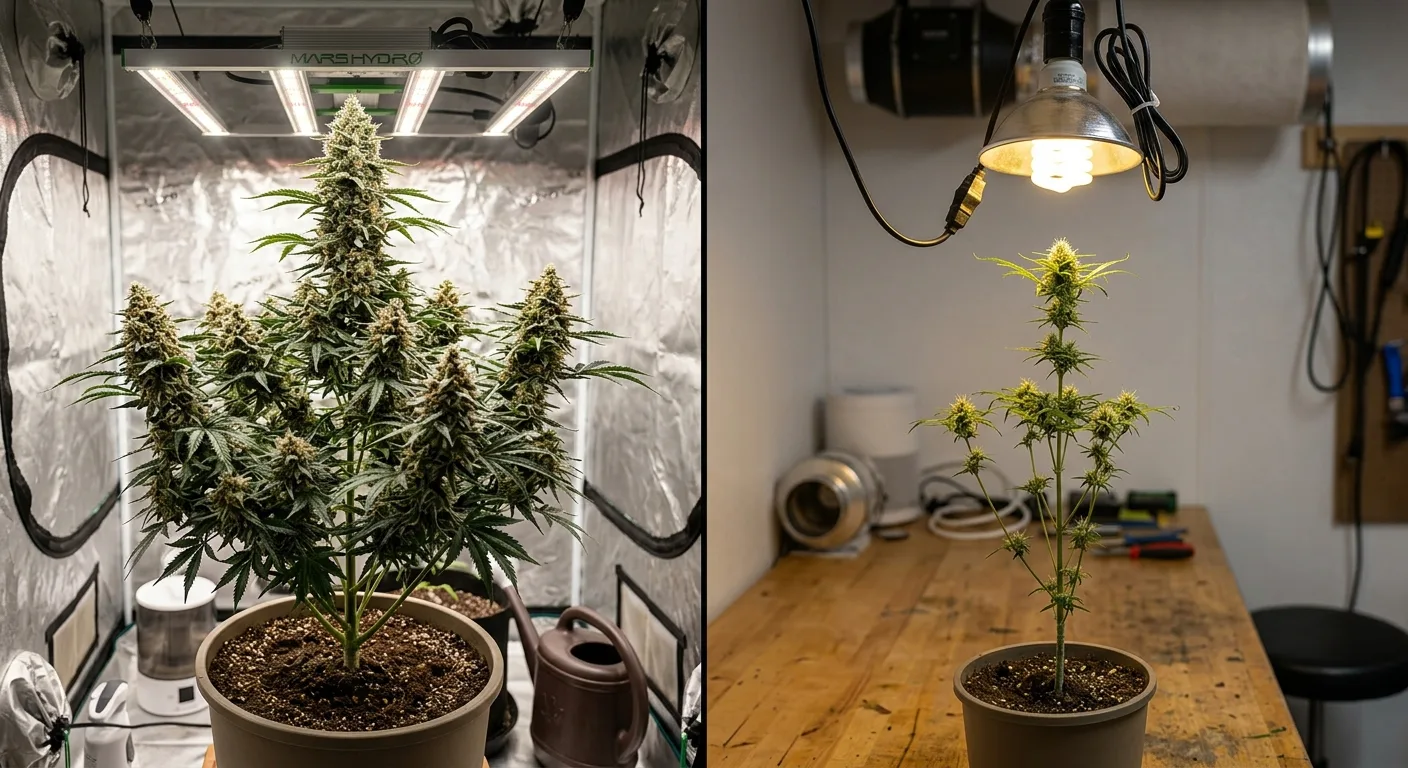
Genetics set the ceiling for THC production, but your grow environment determines where on that spectrum your plant actually lands. A seed carries the blueprint — not the building.
Think of it like horsepower in an engine: a sports car rated at 500hp produces that output at peak performance, with premium fuel, on a dynamometer at sea level. Drive it on a hot day with cheap gas up a steep hill and you'll see something very different. Cannabis plants work the same way.
Phenotype Variation Within a Single Seed Pack
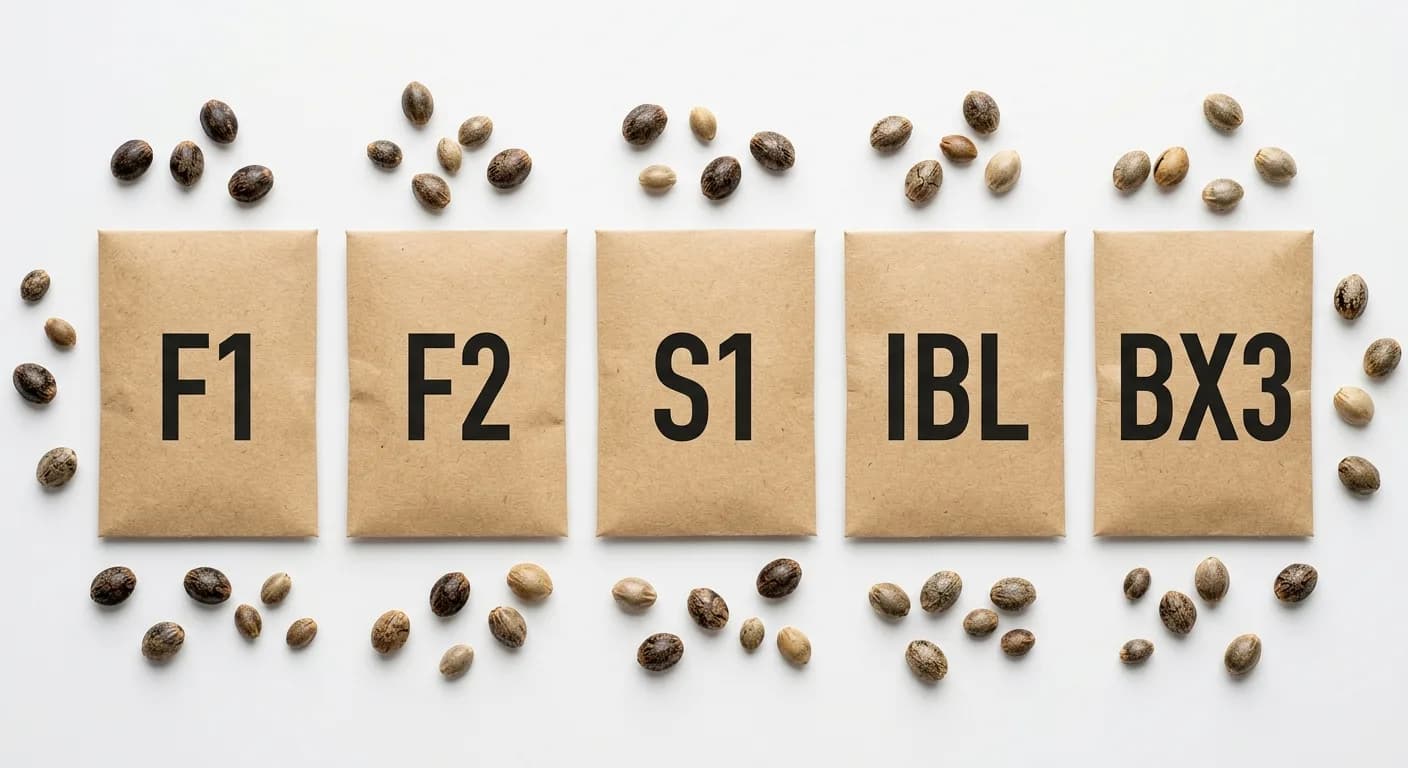
Unless you are buying fully stabilized IBL (inbred line) seeds or clones from a verified mother plant, every seed in your pack is genetically unique. Even seeds from the same two parent plants can express dramatically different trait combinations.
Within a single pack of 10 feminized seeds, you might reasonably expect:
- 2–3 plants that express close to the genetic ceiling for THC
- 4–5 plants that land in the middle range (70–85% of peak)
- 2–3 plants that lean toward the lower end of the genetic spectrum (50–70% of peak)
- Occasional outliers in either direction
The seed bank tested the best plant from their pheno hunt. You are buying a lottery ticket for a range of expressions. Understanding this isn't pessimism — it's the foundation of informed seed selection. For a deeper look at seed breeding categories, read our guide to F1 Hybrid vs S1 vs IBL cannabis seeds.
Autoflower vs. Feminized: Does Seed Type Affect Accuracy?
Autoflowering strains often show wider phenotype variation than photoperiod feminized seeds because autoflowering genetics are generally less stabilized — many autoflower lines are still relatively young in breeding terms. This means the gap between marketed and actual THC content can be slightly larger for autos, though environmental impact remains the dominant factor for both types. Explore the full breakdown of seed type trade-offs on our autoflower vs. feminized seeds guide.
The THCA vs. THC Labeling Problem That Inflates Every Number
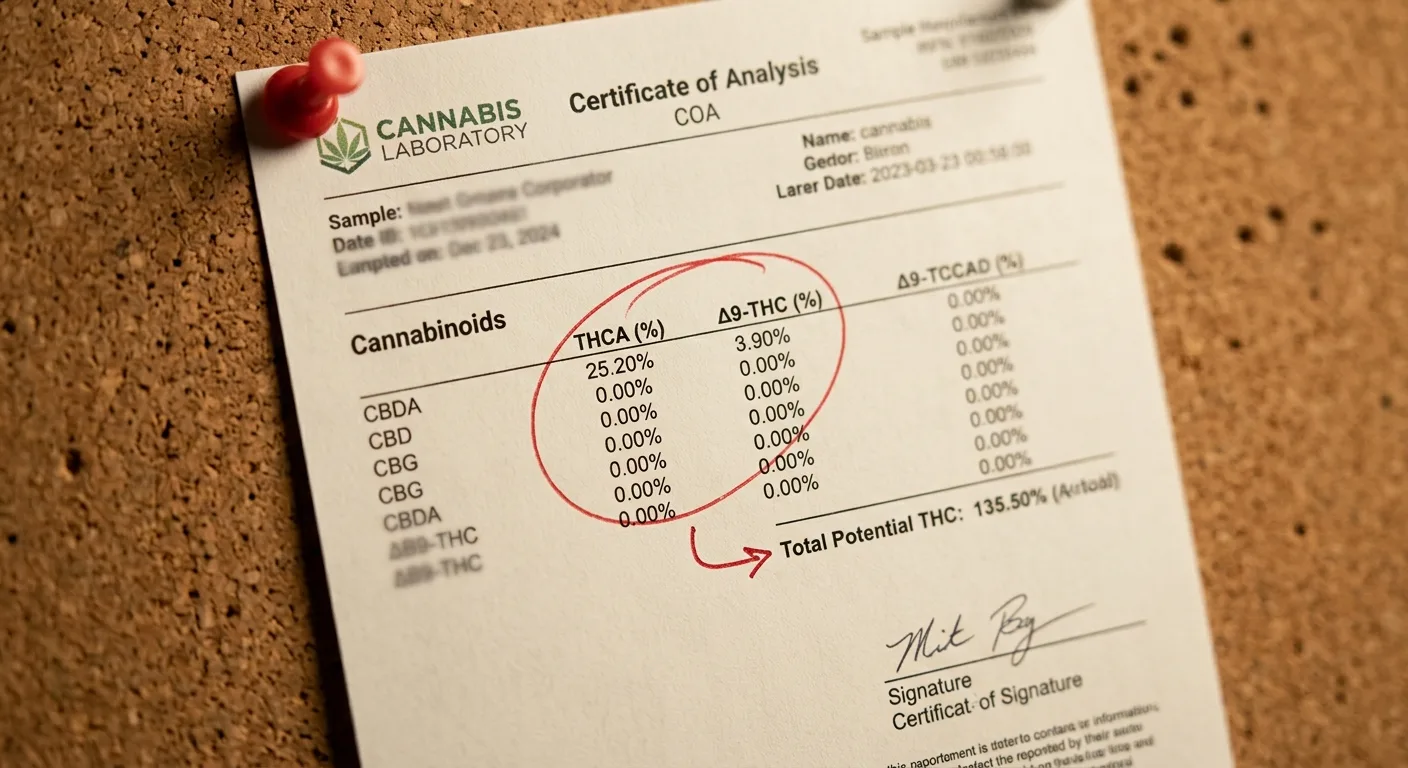
This is one of the most important and least-discussed issues in cannabis seed marketing — and it inflates virtually every THC percentage you see on a seed packet.
What the Difference Actually Is
Raw cannabis plants do not produce significant amounts of THC. They produce THCA — tetrahydrocannabinolic acid — which is the non-intoxicating acidic precursor. THCA converts to THC through decarboxylation: the application of heat when you smoke, vaporize, or cook cannabis. (For the full science, see our decarboxylation guide.)
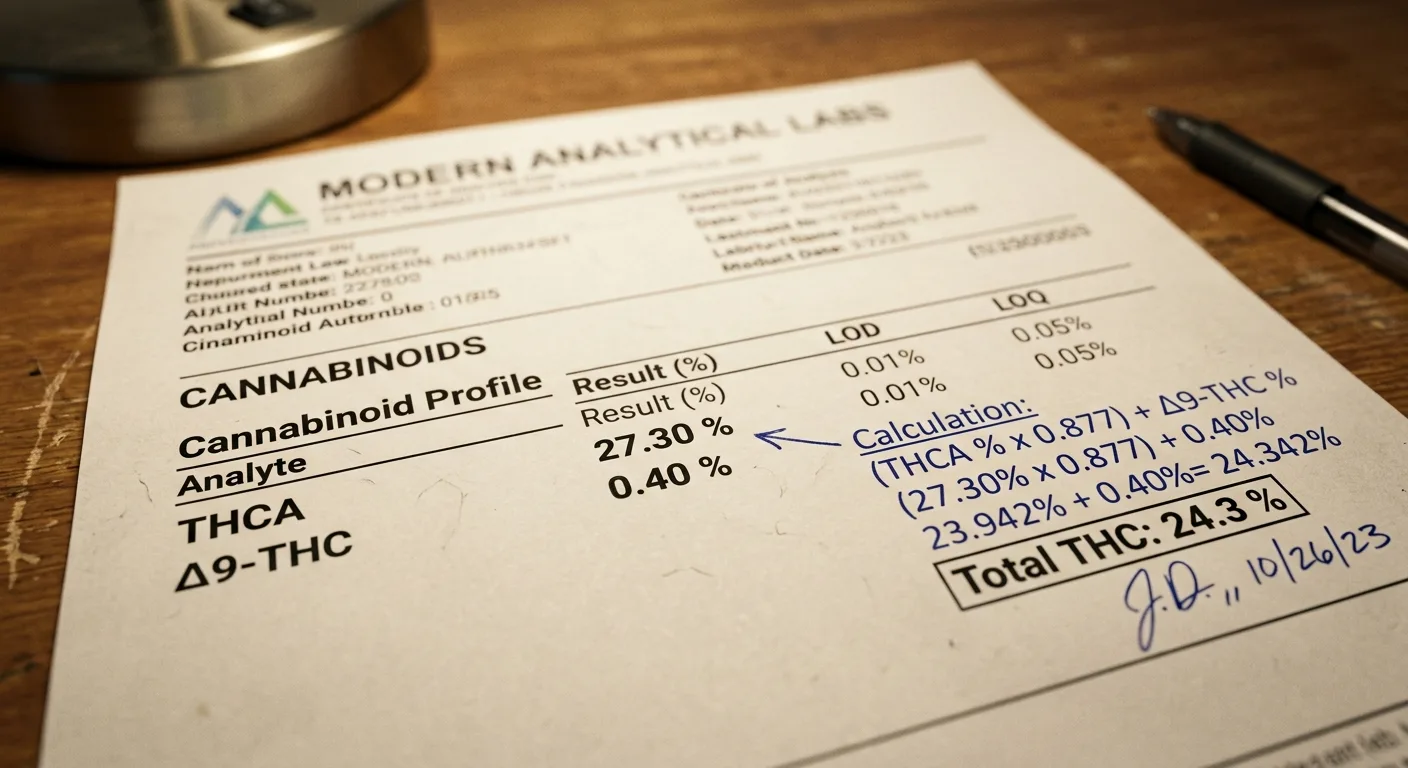
On a proper Certificate of Analysis (COA), you will see both figures listed separately. The conversion is calculated using this formula:
Total THC = (THCA × 0.877) + THC
The 0.877 factor accounts for the molecular weight lost when THCA sheds a carboxyl group during decarboxylation. This means a plant testing at 28% THCA actually converts to approximately 24.6% THC — about a 12–15% reduction from the raw THCA number.
How Seed Banks Exploit This Gap
Many seed banks — not all, but many — list the THCA percentage as if it were the THC percentage. A strain with 28% THCA gets marketed as "28% THC." When your finished flower tests at 24% total THC after conversion, you may actually be getting a reasonably accurate result for the genetics — but the framing made it look like a 4-point shortfall.
Stack this onto phenotype variation and suboptimal home grow conditions, and you can see how a "30% THC" strain realistically lands at 16–20% for most home growers. The marketing isn't always dishonest — it's often just using numbers that reflect peak THCA in a champion phenotype under ideal conditions, with no clarification of what those numbers mean in practice.
Our trichome biology guide explains exactly how the cannabis plant manufactures cannabinoids at the cellular level — understanding this process helps you optimize conditions for maximum THC expression rather than just chasing a number on a label.
Four Growing Variables That Slash Your Actual THC Output
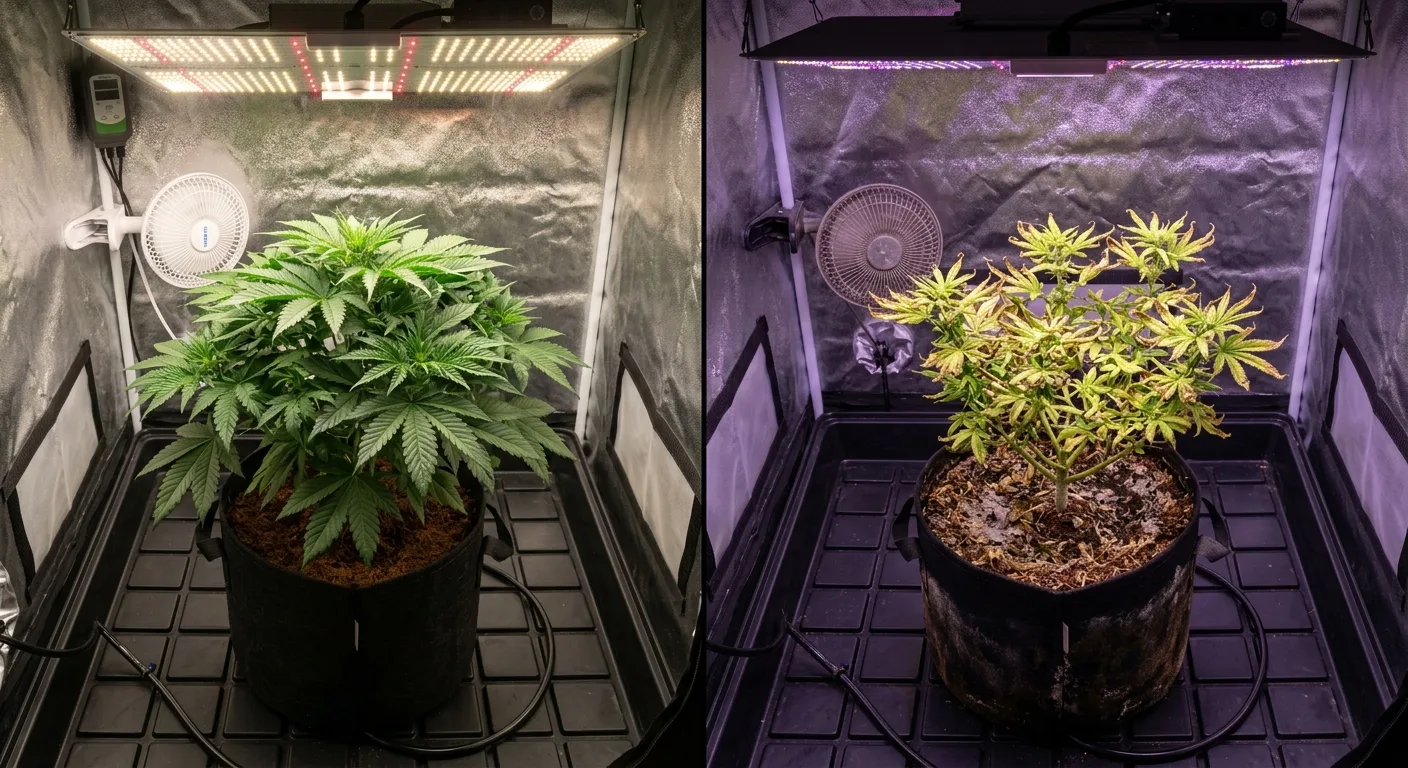
Even if genetics and lab methodology were perfectly transparent, the grow environment remains the single largest factor separating marketed claims from actual results. Four variables account for the majority of THC shortfalls in home grows.
1. Light Intensity and Spectrum
Cannabinoid biosynthesis is directly tied to photosynthesis efficiency and UV light exposure. Plants grown under inadequate light — below 600 µmol/m²/s PPFD during flowering — produce measurably less THCA than the same genetics under 900–1,000 µmol/m²/s. The difference can easily represent 4–8 percentage points of final THC content. Use our light calculator to check whether your setup delivers enough intensity for the canopy area you're working with.
2. Harvest Timing
THC content peaks at a specific window during late flowering and degrades rapidly after that point. Harvesting 1–2 weeks early can reduce THC by 20–30% as THCA synthesis is still incomplete. Harvesting too late allows THC to oxidize into CBN, also reducing potency. Most home growers without a quality jeweler's loupe or microscope simply guess — and guessing costs potency.
Trichome color is your most reliable harvest timing indicator. Clear trichomes mean THC is still developing. Milky white indicates peak THC. Amber signals degradation to CBN has begun. Aim for 70–90% milky, 10–20% amber for maximum THC preservation.
3. Drying and Curing Conditions
Post-harvest handling is dramatically underestimated as a potency factor. Cannabis dried too fast (under 7 days) or at temperatures above 70°F degrades terpenes and cannabinoids before curing even begins. Improper curing — too little time, wrong humidity, or no burping — continues that degradation. A study published in Drug and Alcohol Dependence found that improperly stored and cured cannabis lost up to 16% of its THC within 6 months. Proper drying and curing at 58–62% RH is not optional for preserving genetic THC potential.
4. Nutrient Management and Stress
Chronic nutrient stress, root zone problems, pH imbalance, heat stress, and overwatering all divert the plant's metabolic resources away from cannabinoid production. A plant fighting root rot, nitrogen toxicity, or a persistent pH lockout simply cannot dedicate energy to THCA synthesis. Optimal THC expression requires near-perfect plant health throughout the entire flowering period — a high bar that most home grows don't consistently reach.
The seed bank tested one perfect plant. Your result is the product of genetics, environment, timing, and handling — all interacting simultaneously. Improving any single variable moves you closer to genetic potential; improving all of them is what actually gets you there.
What 'Up to X%' Actually Means — Legally and Scientifically
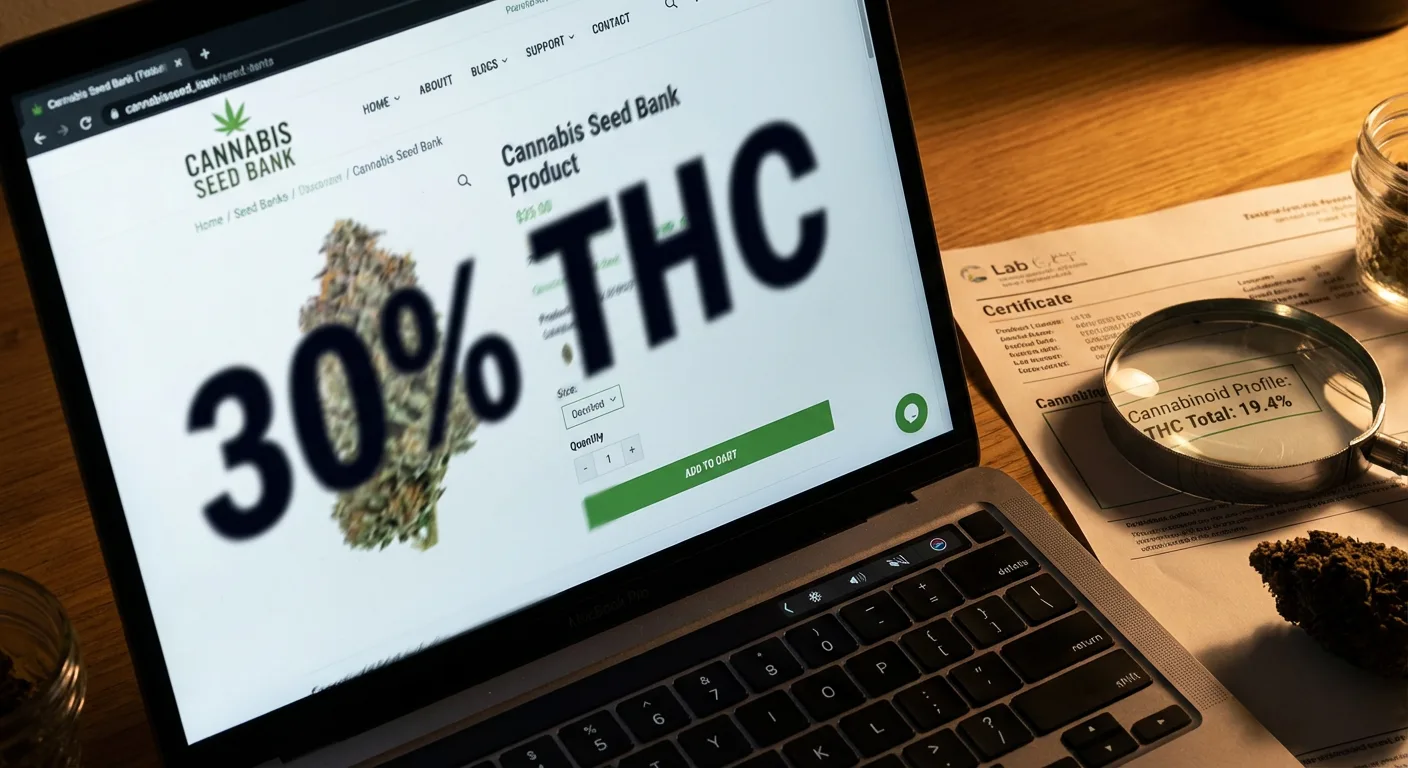
"Up to 28% THC" is four words that carry enormous legal protection for seed banks and almost zero practical information for buyers. Understanding what this phrase actually means prevents costly disappointment.
The Legal Function of 'Up To'
In marketing law, "up to" functions as a ceiling claim — it states a maximum achievable under some unspecified set of conditions. It carries no obligation to disclose the average, the minimum, or the conditions required to achieve the maximum. A strain marketed as "up to 28% THC" could legitimately have an average expression of 14% under typical conditions and still be legally compliant with that claim, as long as one documented sample ever reached 28%.
This is not a cannabis-industry-specific problem. The same language appears in solar panel efficiency ratings, car fuel economy claims, and broadband speed advertising. But in cannabis, where buyers make significant investments based on potency expectations, the gap between "up to" and "typical" matters enormously.
The Statistical Reality Behind a Single Data Point
A single lab result from a single phenotype in a single grow is not a statistically valid representation of a strain's THC distribution. For a claim to be genuinely meaningful, a seed bank would need to:
- Test a minimum of 20–30 individual plants from the strain batch
- Grow those plants under standardized, documented conditions
- Report the mean, median, and range — not just the peak
- Disclose the grow conditions used during testing
- Update results as the genetic line is refined over generations
Virtually no commercial seed banks do all of these things. A few forward-thinking operations do some of them — and those are the ones worth paying attention to.
Watch out for round numbers. A strain advertised at exactly "25% THC" or "30% THC" should prompt immediate skepticism. Real lab results almost never land on round numbers — authentic COA data reads like 23.7%, 18.4%, or 26.1%. Perfect round numbers in marketing copy strongly suggest the figure was estimated or selected for appeal rather than measured.
Red Flags vs. Credible Claims: A Seed Buyer's Comparison
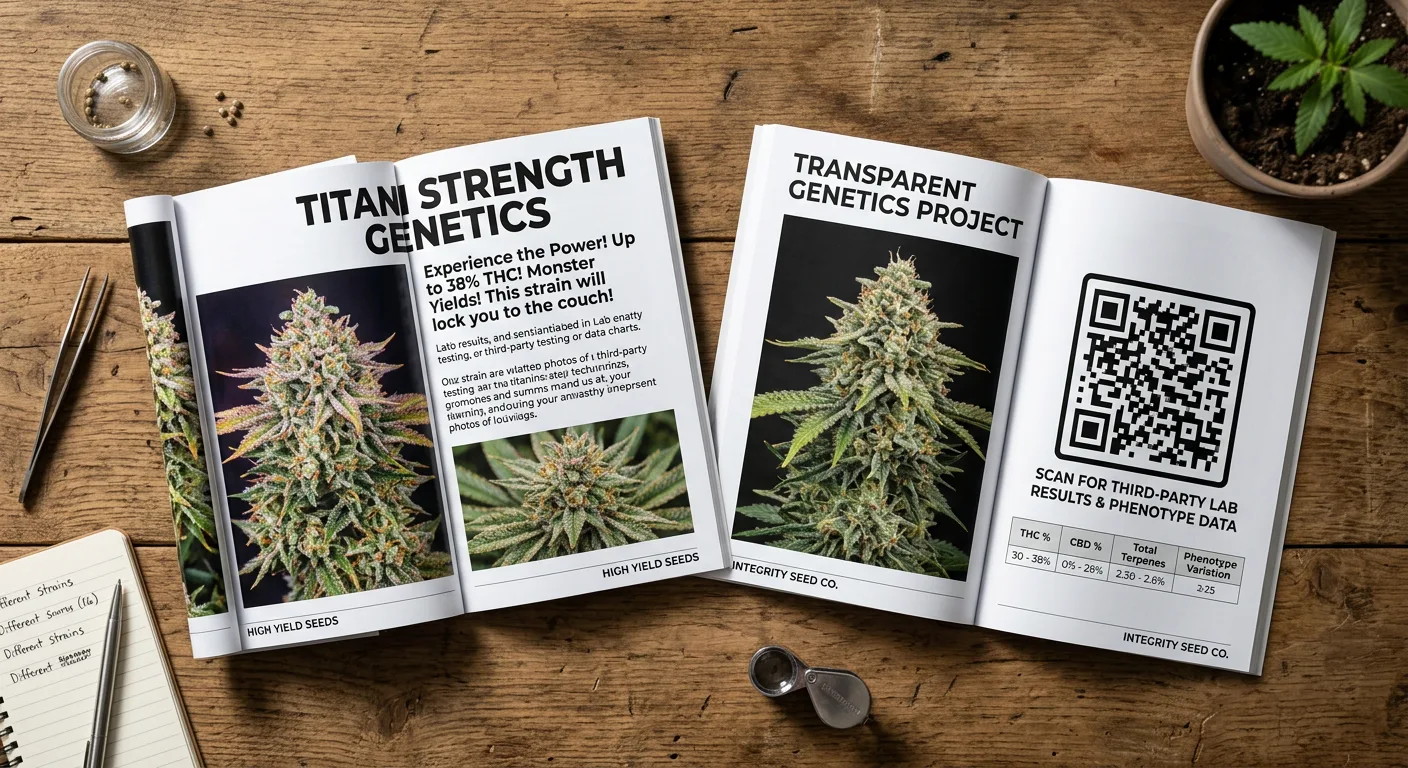
Not all seed bank THC claims are equally misleading. Once you know what to look for, the difference between honest genetic data and pure marketing copy becomes easy to spot.
| Signal | Red Flag ⚠️ | Credible Claim ✓ |
|---|---|---|
| THC figure format | Single round number (e.g., "30% THC") | Range with context (e.g., "22–27% THCA") |
| Lab data availability | No COA linked or available | Third-party COA downloadable on strain page |
| Testing disclosure | No mention of how or where tested | Lab name, date, and phenotype specified |
| Phenotype disclosure | One THC figure for all seeds in pack | Acknowledges phenotype variation exists |
| THCA vs. THC | No distinction made between the two | Reports both THCA and Total THC separately |
| Grow condition disclosure | No mention of test grow conditions | States lighting, medium, and environment used |
| User data | Only breeder-reported numbers | Links to user grow reports with actual test results |
| Marketing language | "Guaranteed," "always," "consistently hits" | "Up to," "potential," "under optimal conditions" |
| Number specificity | Round numbers only | Specific decimal results (e.g., 24.3%) |
What Good Transparency Actually Looks Like in Practice
The most credible seed bank presentations share the phenotype number ("Pheno #3, the highest-resin expression"), the lab name, the grow medium (coco, soil, hydro), and the light source used during testing. They acknowledge that home results will vary and suggest a realistic range rather than a single peak figure. They distinguish between THCA percentage and calculated total THC.
Compare this to simply writing "28% THC" in bold on a product page with no supporting data. The latter is not inherently fraudulent — but it gives you nothing to evaluate.
How to Evaluate Seed Bank THC Claims Before You Buy

Knowing how seed bank THC percentage accuracy works is only half the equation. Here is a practical framework for applying that knowledge before you spend money on seeds.
Search for Third-Party COAs
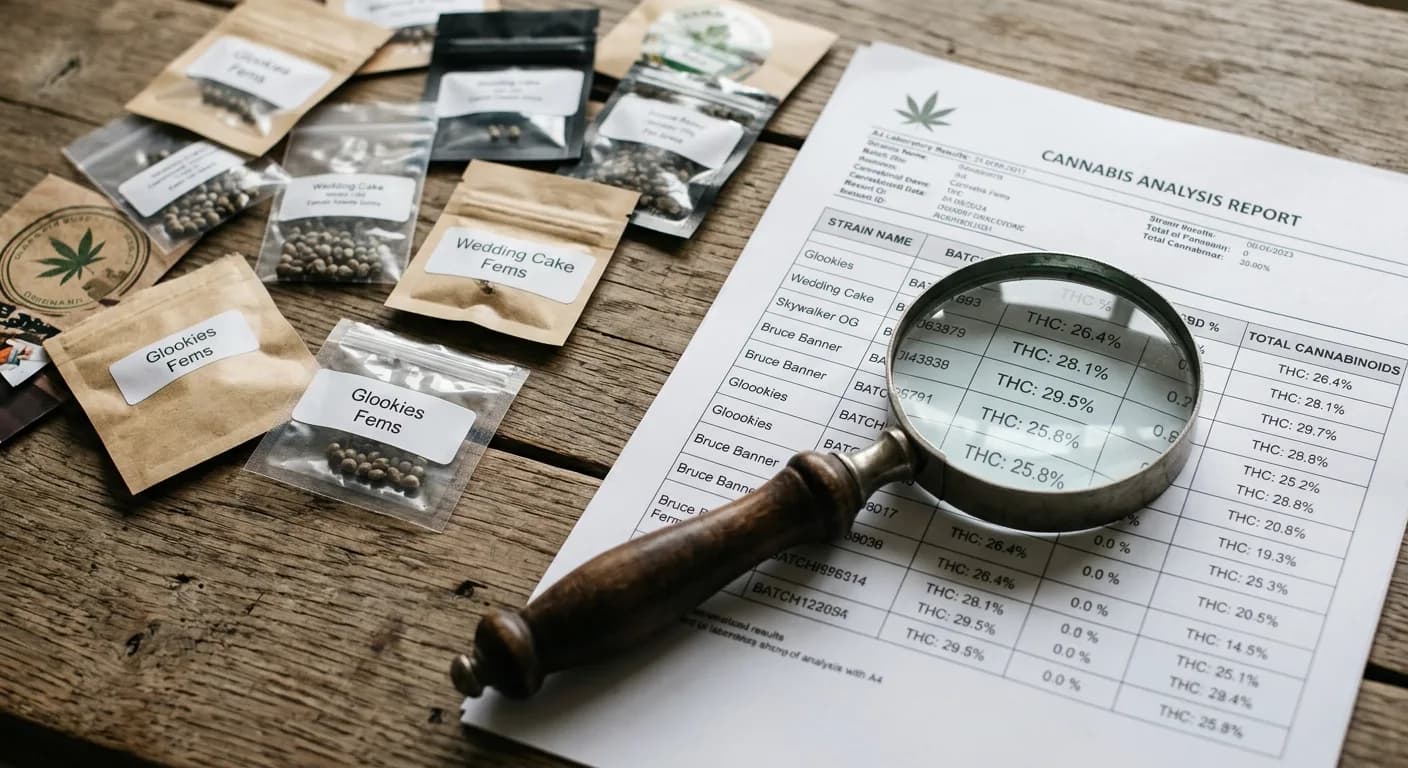
Look for a downloadable Certificate of Analysis linked directly on the strain page — not just a statement that "the strain has been tested." The COA should show the lab name, sample date, THCA percentage, THC percentage, and total THC calculation. If it doesn't exist on the product page, search the lab name plus strain name to verify independently.
Check Grow Reports with Actual Lab Results
Forums like r/microgrowery, Grow Diaries, and GrowDiaries.com contain thousands of user-documented grows with actual harvest data, sometimes including lab results. Searching the strain name plus "lab test" or "harvest results" often turns up realistic data points that reflect home grow conditions — far more useful than breeder claims.
Apply the 0.877 Conversion Yourself
When you find a COA, identify the THCA percentage and multiply it by 0.877, then add any residual THC. That total is the realistic cannabinoid content of the flower when consumed. If the seed bank is advertising "28% THC" but the COA shows 28% THCA with 0.3% THC, the actual consumable THC is approximately 24.8% — before environmental and phenotype variables reduce it further.
Apply a Realistic Home Grow Discount
Even with good genetics and solid technique, most home growers express 70–85% of a strain's documented genetic ceiling. If a strain's COA shows 26% total THC from an optimized test grow, a realistic expectation for a competent home grower using good equipment is 18–22%. Use this mental model consistently and you will rarely be disappointed.
Prioritize Proven Genetics Over Peak Marketing Numbers
A strain with documented, consistent results in the 20–22% range from multiple independent grows is more valuable than a strain claiming 30% with no supporting data. Consistency and repeatability matter more than theoretical peaks. Stable, well-documented genetics like OG Kush Feminized (26% THC potential) or White Widow Feminized (25% THC potential) carry decades of cultivation data from growers worldwide — that community knowledge base is worth more than any single lab test.
Before selecting seeds purely for THC percentage, run your planned setup through our yield estimator and grow cost calculator. Maximum THC and maximum yield don't always come from the same strain — and the most efficient grow for your situation may not be the one with the highest THC claim on the packet.
What Honest THC Marketing Actually Looks Like
Setting a realistic standard for what responsible seed bank THC communication looks like helps buyers recognize when a brand is genuinely trying to inform them versus simply winning a number competition.
Ranges Instead of Peaks
An honest THC claim reads: "This strain typically expresses 18–24% total THC under optimal conditions, with phenotype variation expected." A range acknowledges genetic diversity within the seed batch and prevents the all-or-nothing disappointment of a single-number claim. It is also more scientifically accurate by definition.
Strains we carry illustrate why ranges matter more than peaks. New York Power Diesel Feminized (24% THC potential) and Northern Lights x Amnesia Haze Feminized (24% THC potential) may share the same peak figure, but their phenotype variation profiles, terpene expression, and grow difficulty differ significantly. The number alone tells you almost nothing about the grow experience or realistic outcome.
Condition Disclosure
Transparent seed banks specify what conditions produced the tested result: "Tested under 600W HPS, coco/perlite, 18-week photoperiod flowering, 12-week cure." This lets buyers calibrate expectations based on their own setup. If you're running a 200W LED in a 2×2 tent with a 6-week cure, you now have a realistic basis for discounting the lab result.
Acknowledging the THCA Distinction
The cleanest presentation shows both the THCA percentage from the COA and the calculated total THC figure. This single practice would eliminate most of the confusion around inflated seed bank THC claims — and it costs nothing except the honesty to present it clearly.
Celebrating the Achievable Range, Not Just the Ceiling
Some of the most satisfying harvests come from strains that consistently land in the 18–22% range for home growers — not strains that theoretically peak at 30% but reliably express at 16% in practice. Strains like Sour Diesel Feminized (24% THC potential), Black Widow Feminized (26% THC potential), and Super Lemon Haze Feminized (23% THC potential) have well-documented cultivation histories that give buyers real-world expectations to work from. Wedding Cake, Gorilla Glue #4, and Gelato are other examples of strains with extensive independent grow data that paint a realistic picture of typical home grow results.
The best seed bank you can buy from is one that gives you enough information to make an accurate prediction about your grow — not one that gives you the highest number on the label. Verify what a seed bank stands behind by checking their germination guarantee as a proxy for overall confidence in their genetics quality.
Improving Your Own THC Expression: Practical Next Steps
The most productive response to understanding seed bank THC percentage accuracy isn't frustration — it's optimization. Every variable that separates your result from the tested result is a variable you can improve.
Optimize Your Environment First
Before spending money on premium high-THC genetics, ensure your grow environment can support their expression. Temperature, humidity, CO2, and VPD management during flowering are the biggest controllable factors in THC expression. Our VPD guide for cannabis walks through the exact ranges that support maximum cannabinoid production at each growth stage.
Master Harvest and Post-Harvest Handling
Trichome assessment, precise harvest timing, slow drying at controlled humidity, and proper curing collectively preserve more THC from the plant you grew than almost any genetic upgrade you could make. Invest in a 60–100x digital microscope for trichome assessment — it costs $30 and will improve your results more than most grow upgrades.
If you want to understand exactly what's happening inside those trichomes that determines your final THC content, our cannabis trichome biology guide covers the biochemistry of THCA synthesis from start to finish — useful background for any grower chasing real potency improvements.
Run a Pheno Hunt When Quality Matters Most
If you're growing a strain specifically for potency, buying a 5- or 10-pack and running a pheno hunt gives you the same advantage seed banks have: the ability to identify and keep the highest-expressing plant. Grow all seeds simultaneously, harvest and test separately, then clone the best performer before it finishes. This is how professional cultivators consistently achieve results closer to genetic potential — and how you can too.
Track Everything, Then Compare
Use our free grow planner to document every variable across your grow cycle. When you get lab results back, you'll have a precise record of what conditions produced those numbers — giving you a real baseline to improve from rather than guessing what to change next cycle.
Understanding that seed bank claims describe genetic potential — not guaranteed results — transforms how you grow. Instead of feeling misled when your harvest tests lower than the label, you have a precise framework for understanding why and a clear path to closing that gap.
The Bottom Line on Seed Bank THC Percentage Accuracy
Cannabis seed bank THC percentage accuracy is a systemic industry problem rooted in several compounding factors: single-phenotype selection bias, optimized test grow conditions that don't reflect home growing realities, the THCA-to-THC conversion that inflates every number, and marketing language like "up to" that provides legal cover with no informational value.
The gap between a seed bank's advertised THC percentage and your actual harvest result is not a failure of your grow — it is the predictable outcome of a marketing system that systematically overstates achievable results. The r/microgrowery thread asking "why did my 30% THC strain test at 18%?" doesn't need one answer. It needs this entire explanation.
Armed with this understanding, you can evaluate any seed bank's claims against a clear framework: look for third-party COAs, check the THCA vs. THC distinction, apply the 0.877 conversion factor, discount for phenotype variation and home grow conditions, and prioritize strains with broad community-verified data over strains with impressive but unsupported marketing numbers. That framework will serve you far better than any single THC percentage ever could.
Frequently Asked Questions
Are seed bank THC percentage claims accurate?
Rarely under typical home grow conditions. Most seed bank THC claims reflect best-case results from a single elite phenotype grown under professional conditions — optimized lighting, nutrients, VPD, and timed harvests. The average home grower can realistically expect 60–85% of the marketed figure, meaning a "28% THC" strain may consistently produce 17–22% in a well-run home grow.
Why did my 30% THC strain test at 18%?
Several factors compound to produce this result: you likely grew a mid-range phenotype (not the champion the breeder tested), under suboptimal light intensity, with less-than-perfect nutrient management, harvested slightly early or late, and cured for less time than ideal. Additionally, the seed bank may have reported THCA as THC, meaning their "30%" was actually 30% THCA — which converts to approximately 26.3% total THC even before any growing variables apply.
What is the difference between THCA and THC percentage on a lab report?
THCA is the raw acidic form found in living and freshly harvested cannabis — it is not intoxicating and must convert to THC through heat (decarboxylation) to produce effects. The conversion factor is 0.877, meaning 28% THCA converts to approximately 24.6% THC. Many seed banks list THCA as "THC" on marketing materials, inflating the number by roughly 12–15% before any growing variables are applied.
How do I find reliable THC data for a strain before buying seeds?
Start by checking the seed bank's product page for a linked third-party Certificate of Analysis — if there isn't one, that's a red flag. Then search r/microgrowery, GrowDiaries, and cannabis forums for user grow reports that include lab results. Look for multiple independent data points, not just the breeder's claim. Strains with years of community cultivation data will give you the most realistic expectations for your home grow.
Does growing in better conditions guarantee higher THC results?
Better conditions reliably move your result closer to the genetic ceiling, but they cannot exceed it. Optimizing light intensity, VPD, nutrient timing, harvest timing, and curing can realistically improve your expressed THC by 20–40% compared to a poorly managed grow of the same genetics. However, genetic potential remains the hard ceiling — which is why choosing genetics with honest, well-documented data matters as much as environmental optimization.