You did your research. You picked a strain, budgeted for your grow, and handed over your money — only to receive a padded envelope with seeds that never germinate, look nothing like the strain described, or never arrive at all. If that sounds familiar, you've experienced what tens of thousands of growers encounter every year from cannabis seed bank red flags they didn't know to look for.
This guide exists because most seed banks won't publish it. It invites comparison, and they'd rather you not look too closely. We'd rather you look very closely — because a buyer who knows exactly what separates a scam from a legitimate vendor will always make better decisions.
Here's everything you need to know before you spend a single dollar on seeds online.
Why the Cannabis Seed Industry Has a Serious Trust Problem
The cannabis seed market operates in a uniquely accountability-free environment. Unlike most e-commerce sectors, it faces no FDA oversight, limited consumer protection enforcement, and significant legal gray areas that make buyers reluctant to escalate complaints publicly.
Several structural factors compound this problem:
- Anonymous international transactions: Many seed banks operate from overseas jurisdictions with no extradition or consumer protection treaties with the US.
- Pseudonymous reviews: Most review platforms allow unverified usernames, making fake five-star review campaigns easy and cheap to execute.
- Shipping ambiguity: Seeds crossing international borders can be seized by customs — giving scam vendors a built-in excuse for non-delivery that's hard to disprove.
- Buyer embarrassment: Depending on the buyer's state, they may avoid reporting a scam because it means admitting to purchasing cannabis-related products.
The cannabis seed industry's trust gap isn't an accident — it's a structural feature that bad actors exploit deliberately. The only defense a buyer has is knowing exactly what red flags to look for before money changes hands.
According to grower forums on Reddit and Seedfinder, complaints about non-delivery, wrong strains, and dead seeds are among the most frequently posted topics — appearing in hundreds of threads annually. The good news: legitimate vendors leave a very different fingerprint. You just need to know what you're looking at.
Before we get into the warning signs, it's worth checking our guide on whether cannabis seeds are legal in your state — understanding the legal landscape helps you know what protections you can realistically claim if something goes wrong.
The 12 Biggest Cannabis Seed Bank Red Flags
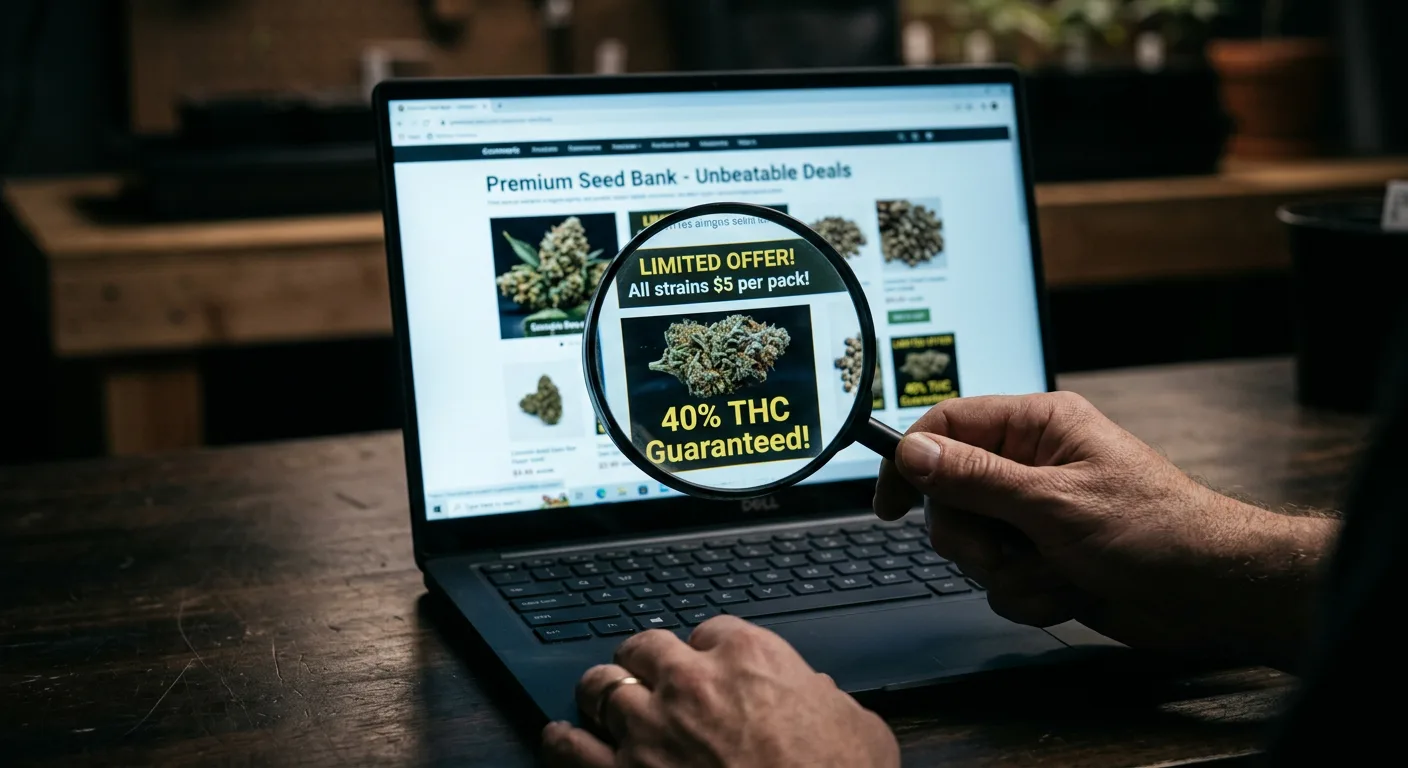
These warning signs are ranked loosely by how reliably they predict a scam or low-quality vendor. One flag alone might mean little. Three or more flags together? Walk away.
Red Flag 1: No Verifiable Physical Address or Business Registration
Every legitimate business has a real address. Not a P.O. box, not a vague city reference in a footer, and not a generic 'international shipping facility' with no searchable name. A verifiable address means one you can actually find in a business registry, on Google Maps, or through a WHOIS lookup tied to a real entity.
How to check:
- Search the company name in the business registry of the country or state they claim to operate in.
- Run a Google Maps search on any address they list — street view it.
- Search their domain at whois.domaintools.com and look for a registrant name (many use privacy protection, but the domain age is still visible).
A seed bank with no traceable business identity has no accountability. If your seeds don't arrive or don't germinate, you have zero legal recourse against an entity that effectively doesn't exist on paper.
Red Flag 2: Cryptocurrency Is the Only Payment Option
Crypto-only payment policies are a significant warning sign. Legitimate seed banks typically offer multiple payment options — credit cards, debit cards, bank transfers, or well-known processors — precisely because they want to serve the widest possible customer base and because they're confident enough in their product to accept reversible payments.
Scam operations prefer cryptocurrency for one simple reason: transactions are irreversible. Once you send Bitcoin or Ethereum to a wallet, there is no chargeback, no dispute process, and no recovery path if the vendor disappears.
Some legitimate vendors do offer crypto as a discount option alongside other payment methods — that's different from crypto being your only choice. If you see no card or bank option, treat it as a serious red flag.
Red Flag 3: Impossible THC Claims and Hyperbolic Strain Marketing
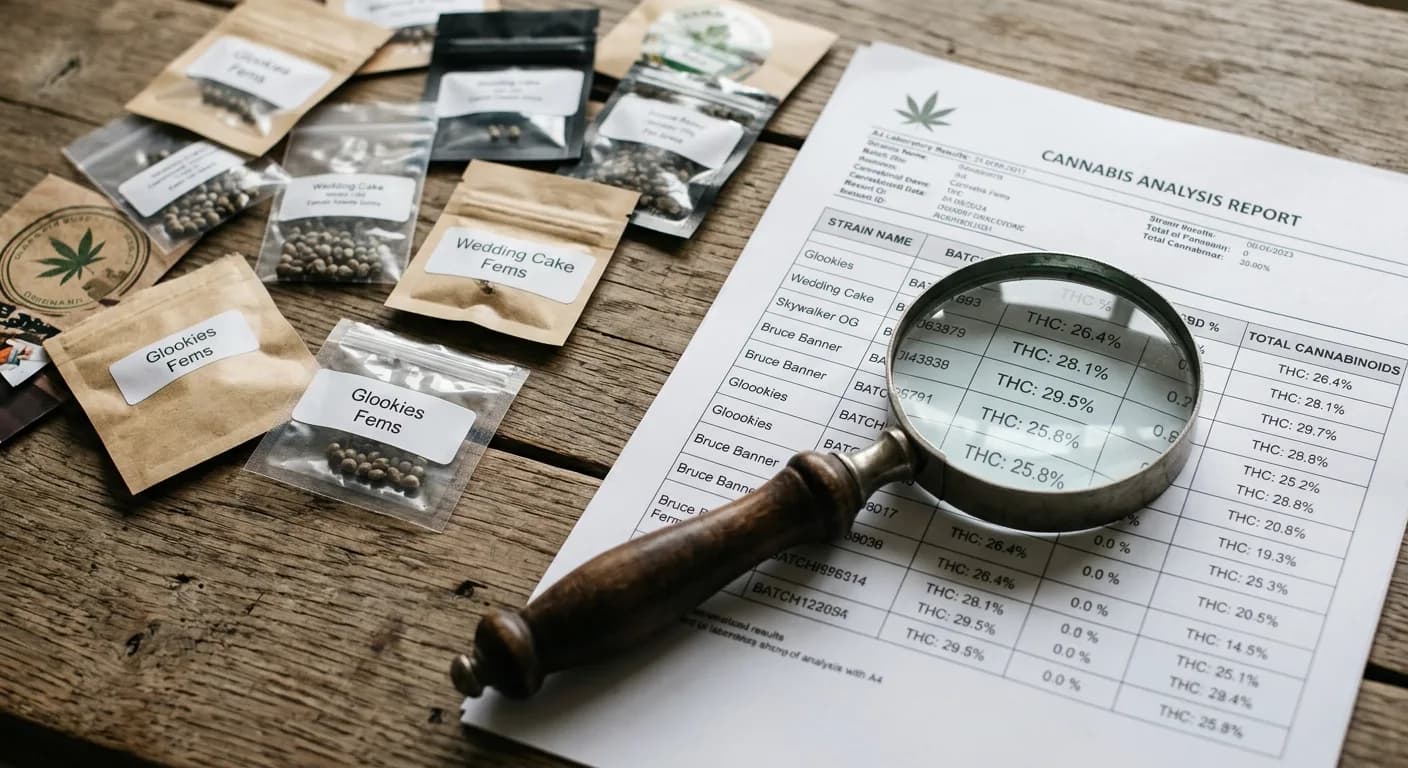
This one is easy to spot once you know the science. The current verified THC ceiling for cultivated cannabis — achieved under optimal lab conditions with elite genetics and rigorous testing — sits around 30–33%. Independent third-party lab testing on competition-winning flowers consistently reflects this range.
Claims of 35%, 38%, or '40% THC' are biologically implausible under realistic growing conditions. When a seed bank lists every strain as 'award-winning,' describes every variety as 'the strongest in the world,' or posts THC numbers that exceed what's verifiably possible, they're either lying about test data, misrepresenting numbers, or have no scientific basis for their claims at all.
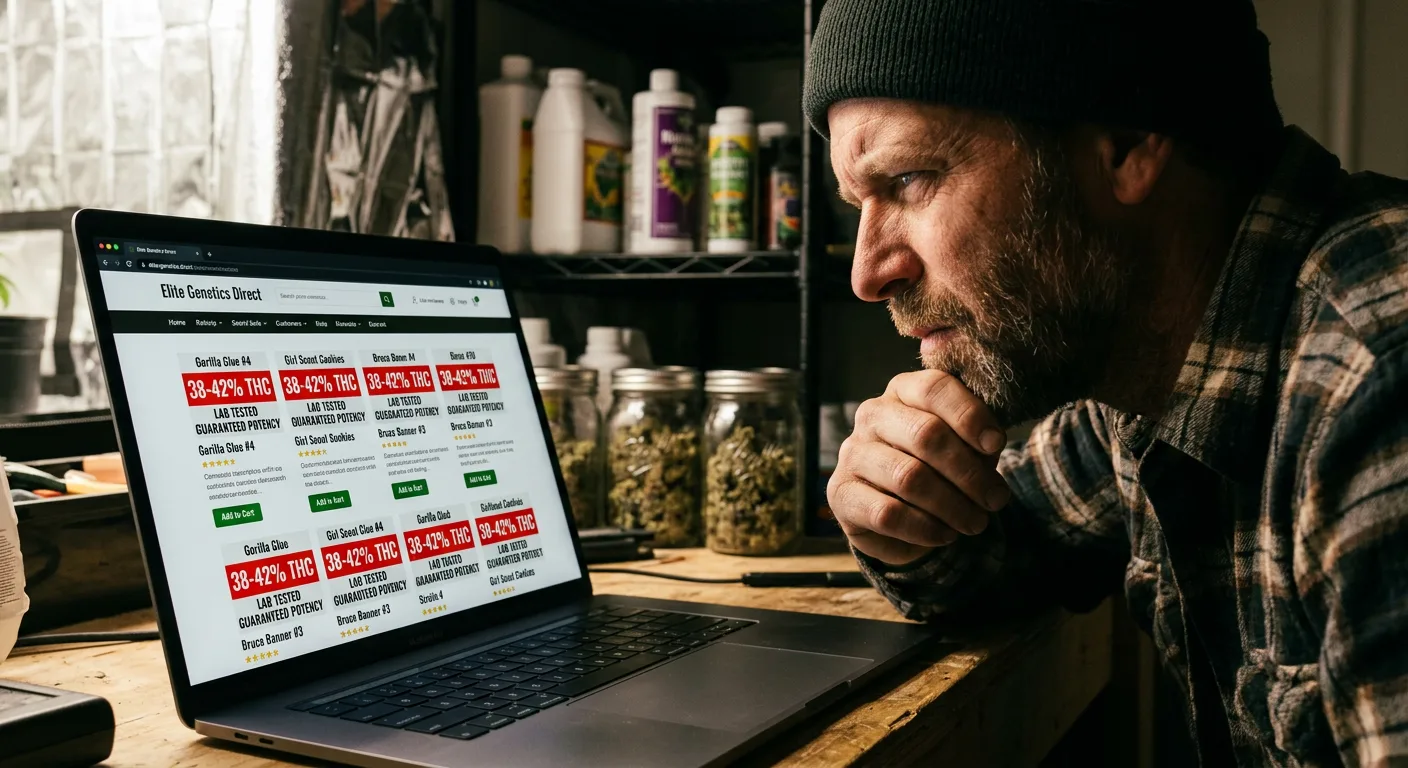
Honest vendors publish realistic, strain-specific numbers. For example, a well-bred OG Kush sits at around 26% THC under good conditions — exceptional, but credible. A Quantum Kush pushing 30% THC is noteworthy precisely because it's at the top of the realistic range. Numbers beyond that deserve immediate skepticism.
Cannabis THC percentage is measured by weight of dried flower. The theoretical maximum is limited by the density of trichomes per unit area and the biosynthetic capacity of the plant. Peer-reviewed cannabis science places the practical ceiling below 35% for dried flower — any claim above this should be treated as marketing fiction.
Red Flag 4: No Community Presence on Seedfinder, Forums, or Reddit
Legitimate seed banks accumulate a digital trail over time. Growers share grow reports, post germination results, argue about phenotype variation, and tag vendors in both praise and complaints across platforms like:
- Seedfinder.eu — the most comprehensive strain and breeder database, with community grow reports
- r/seedbank — the largest Reddit community for seed bank reviews and warnings
- r/microgrowery — growers frequently mention seed sources in grow journals
- Cannabis forums like GrassCity, RollItUp, and ICMag — decades of verifiable breeder reputation data
Search the seed bank name across all of these. If you find nothing — no reviews, no complaints, no grow reports, no mention at all — that absence is itself a red flag. A seed bank claiming to have sold genetics for years should have a community footprint to match.
Red Flag 5: Reviews Only on Their Own Website
Every seed bank publishes glowing reviews on their own site. That's expected — and it means almost nothing in isolation. What matters is whether those reviews exist independently, on platforms the vendor doesn't control.
Trustworthy third-party review signals include:
- Trustpilot profile with verified purchase tags and a mix of positive and critical reviews
- Google Business reviews under the company name
- Named user reviews on Reddit with post history showing real growers
- Grow reports on Seedfinder tied to specific strains the vendor sells
Real reviews have nuance. A legitimate vendor's review profile will include occasional complaints about shipping delays, packaging issues, or a single bad germination result — alongside praise. A page of nothing but perfect five-star reviews with identical language and no negatives is almost certainly manufactured.
Red Flag 6: Strain Descriptions Copied from Other Seed Banks
This one takes two minutes to verify and is remarkably revealing. Copy a sentence or two from a strain description on the suspicious site and paste it into Google in quotation marks. If it returns results from multiple other seed bank websites, the vendor is simply scraping content rather than writing from genuine knowledge of their genetics.
Original strain descriptions — especially from vendors who actually bred or source from named breeders — contain specific phenotype notes, grow time ranges, and terpene profiles that reflect real cultivation experience. Generic, copied descriptions suggest the vendor is a middleman at best, or selling unlabeled bulk seeds at worst.
Red Flag 7: No Clear Germination Guarantee Terms
A germination guarantee is only meaningful if it has clear, written terms. Look for:
- A specific germination rate threshold (e.g., 80% or 90%)
- Defined conditions under which the guarantee applies (proper germination method, temperature range)
- A clear process for claiming a replacement or refund
- A time limit for reporting germination failure
Vague language like 'we stand behind our seeds' or 'contact us if you have issues' with no specific terms is not a guarantee — it's marketing copy. Before buying, check whether the vendor's guarantee page answers the question: exactly what do I get, and how do I claim it? Our own germination guarantee page shows you what transparent terms actually look like.
Also see our guide on how to store cannabis seeds properly — even good seeds from a legitimate vendor need correct storage to maintain viability.
Red Flag 8: Vague Stealth Shipping with No Specifics
Stealth shipping is a real and necessary practice for international seed orders — but there's a difference between genuine discretion and deliberate vagueness used to avoid accountability.
Trustworthy vendors describe their stealth methods in enough detail to build confidence without compromising security. They might reference:
- Seeds embedded in or disguised within other items
- Plain, unbranded outer packaging with no cannabis references
- Tracking numbers provided within a specific timeframe
- A reshipping policy if customs seize the package
A scam operation will use 'discreet shipping guaranteed' as a phrase that sounds reassuring but commits to nothing. If the order doesn't arrive, they'll point to customs as an excuse — and offer no remedy. Stealth shipping claims without a documented reshipping or refund policy for seized packages are a warning sign.
Red Flag 9: Customer Service Unresponsive Before Purchase
This is one of the most reliable and easiest tests you can run. Before placing an order, send a specific question to the vendor's customer service — ask about a particular strain's grow time, their germination guarantee claim process, or their payment options. Then measure the response.
- Green flag: Specific, knowledgeable reply within 24–48 hours
- Yellow flag: Generic auto-reply or vague answer after 3+ days
- Red flag: No reply, bounced email, or a form submission that disappears into silence
Ask a detailed question that requires real knowledge to answer — something like 'What's the typical stretch ratio on your [specific strain] during early flowering?' A vendor with genuine cultivation experience will give you a real answer. A drop-shipper or scam operation won't be able to.
Red Flag 10: Prices That Are Too Good to Be True
Quality cannabis genetics have real production costs. Stable breeding programs require multiple generations of selection — often 5–8 backcross generations to stabilize a trait. Proper storage in climate-controlled conditions, germination testing before sale, and regulatory compliance all add overhead.
When a seed bank offers premium feminized seeds at 60–70% below market price, one of three things is happening:
- The seeds are old, improperly stored stock with low viability
- The genetics are mislabeled or unverified bulk seeds
- The listing is a scam and the seeds won't arrive at all
Market benchmarks vary by strain type, but feminized photoperiod seeds from verified genetics typically run $8–$15 per seed from reputable sources. Autoflower seeds from premium breeders usually fall in the $10–$20 range. Seeds priced at $2–$3 each with no explanation deserve skepticism, not excitement.
Red Flag 11: Generic Stock Photos Instead of Real Grow Photos
Real breeders and seed banks have actual grow rooms, actual plants, and actual harvests. They accumulate real photographs over years of operation — close-up trichome shots, harvest weights, phenotype comparisons, customer grow journals. These images have a specific, unpolished authenticity that stock photos don't replicate.
To verify whether photos are stock images:
- Right-click any product photo and select 'Search image on Google' (or use Google Lens)
- Stock photos appear on multiple unrelated sites; real grow photos typically don't
- Look for watermarks from stock photo agencies like Shutterstock or Adobe Stock embedded in image metadata
A seed bank whose entire catalog is illustrated with the same three generic bud photos used across the internet has never grown what they're selling.
Red Flag 12: Domain Registered Recently with No History
A seed bank claiming to be an established, trusted vendor should have an operational history to match. Use a WHOIS lookup tool to find the domain's creation date. Any seed bank with a domain registered less than 12–18 months ago deserves extra scrutiny — especially if they lack the community footprint described in Red Flag 4.
Also check the Wayback Machine (web.archive.org) to see if the site has changed dramatically in a short period — scammers frequently rebrand under new domains after burning their reputation on a previous URL.
| Red Flag | Risk Level | How to Verify |
|---|---|---|
| No verifiable address | 🔴 High | Business registry, Google Maps |
| Crypto-only payments | 🔴 High | Check payment page |
| THC claims above 35% | 🔴 High | Cross-reference published strain data |
| No forum/community presence | 🟠 Medium-High | Search Seedfinder, Reddit |
| Reviews only on own site | 🟠 Medium-High | Trustpilot, Google, Reddit search |
| Copied strain descriptions | 🟠 Medium-High | Google quote search |
| No germination guarantee terms | 🟠 Medium | Read guarantee page in full |
| Vague stealth shipping | 🟠 Medium | Check for reshipping policy |
| No pre-sale CS response | 🔴 High | Send a test inquiry |
| Prices far below market | 🟠 Medium-High | Compare with 3+ other vendors |
| Stock photo catalog | 🟡 Medium | Google reverse image search |
| Domain registered recently | 🟠 Medium-High | WHOIS + Wayback Machine |
Green Flags: What a Trustworthy Seed Bank Actually Looks Like
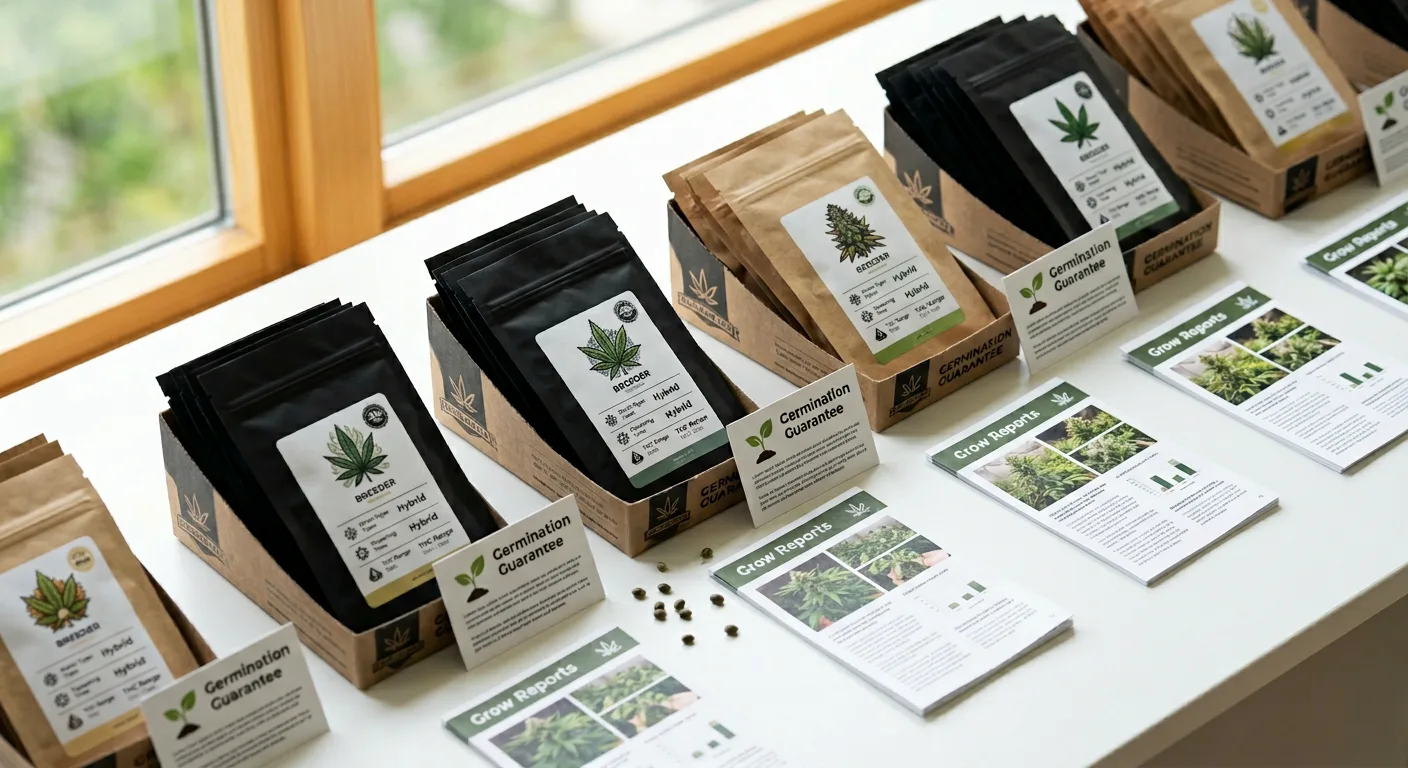
Trustworthy seed banks share a consistent set of positive signals that accumulate over years of operation. These green flags are the inverse of the red flags above — but worth naming explicitly so you know what you're looking for.
Transparent Breeder Sourcing
A reputable vendor tells you where their genetics come from. They name the breeding lineages, describe the cross clearly (not just 'exotic hybrid'), and can tell you something specific about the parent strains. If a vendor's strain page reads like a vague marketing pamphlet with no lineage information, they likely don't know — or don't want you to know — where the seeds actually originated.
Real Grow Reports and Community Engagement
The best vendors actively participate in growing communities. They share grow data, respond to forum posts, publish real harvest photos, and engage with growers who post results — good or bad. This kind of engagement is impossible to fake at scale and builds genuine credibility over time.
Specific, Written Germination Guarantee
As noted above, the specifics matter. A trustworthy vendor's guarantee reads like a contract, not a slogan. It names the germination rate, conditions, claim process, and remedy — and it's easy to find on the site before you purchase. Check our germination guarantee for a reference point on what clear terms look like.
Honest THC and Flowering Time Data
Legitimate vendors publish realistic numbers. THC percentages that vary by strain (not every strain maxing at the same suspiciously high number), flowering times that reflect actual grow experience, and yield estimates qualified by the phrase 'under optimal conditions' are all signs of a vendor who respects their buyers.
Strains like Northern Lights x Big Bud (20% THC) or Silver Pearl (21% THC) are honest reflections of what those genetics deliver — impressive, but not mythologized.
Multiple Payment Options
Credit card, debit card, bank transfer, and optionally cryptocurrency. Multiple options signal that the vendor is confident their product will satisfy customers — because a credit card chargeback is a real risk they're willing to accept.
When in doubt, pay by credit card for your first order with any new vendor. It's the single most powerful consumer protection tool available — chargebacks give you real recourse that crypto and wire transfers simply don't provide.
The 5-Step Verification Checklist Before You Buy

Run this checklist before placing any order from a seed bank you haven't used before. It takes about 20–30 minutes and can save you significant money and frustration.
Search the vendor name on Reddit and Seedfinder
Go to r/seedbank and search the vendor's name. Look for threads — both positive and negative. Search Seedfinder.eu for the breeder name. If nothing appears for a vendor claiming years of operation, that's a serious problem.
Run a WHOIS check on the domain
Visit whois.domaintools.com and enter the seed bank URL. Note the domain creation date. Also check web.archive.org to see the site's history. A domain less than 12 months old with no Wayback Machine history is a red flag.
Test customer service before purchasing
Send a specific, cultivation-knowledge question via email or their contact form. Note the response time and the quality of the answer. A vendor who can't answer 'what's the typical yield range for [strain] in a 5-gallon container under 600W HPS?' doesn't know their product.
Reverse-image-search their product photos
Right-click any strain photo and use Google's image search or Google Lens. If the same image appears on stock photo sites or dozens of unrelated seed bank pages, the vendor is using generic imagery and likely doesn't cultivate what they sell.
Read the germination guarantee in full
Find the guarantee page — not just the badge on the homepage — and read the actual terms. Confirm it specifies a germination rate, the conditions it requires, how to file a claim, and what the remedy is (replacement, refund, or credit). Vague guarantees are no guarantees at all.
Five steps, 30 minutes, and a test email are a small investment compared to the cost of a full grow season built on seeds that were never going to germinate. Due diligence before purchase is the only reliable protection in an industry with minimal external oversight.
If you're still in the early research phase of planning a grow, our grow planner tool helps you map out your full cycle — and our yield estimator lets you set realistic harvest expectations based on strain, lighting, and grow space before you commit to a seed purchase.
Understanding whether to grow autoflower vs. feminized seeds is another key decision that reputable vendors should be able to help you navigate — it's a core part of matching genetics to your specific grow setup.
What to Do If You Already Got Scammed
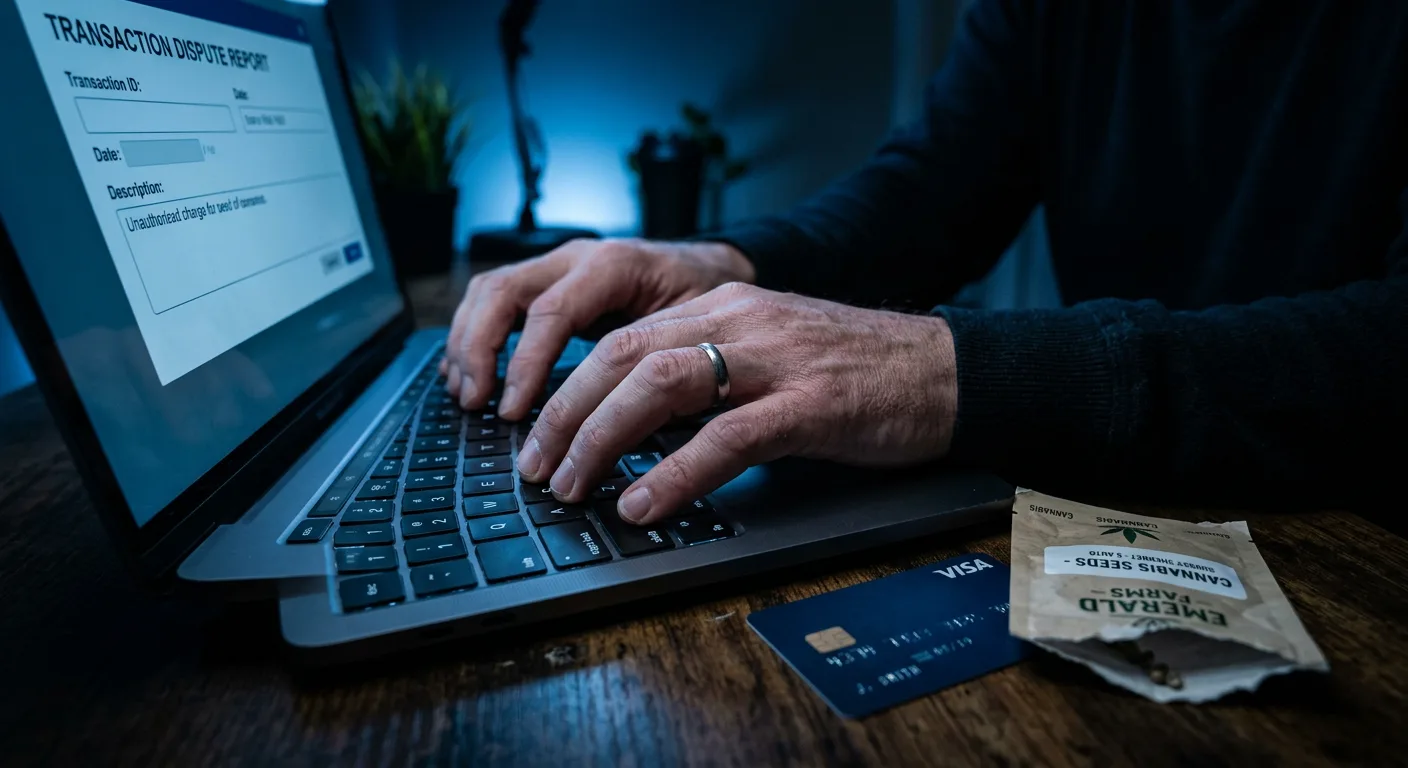
If you've already placed an order and something has gone wrong — seeds didn't arrive, germination rate was near zero, or the strain is clearly mislabeled — here are your concrete options.
If You Paid by Credit or Debit Card
File a chargeback immediately. Contact your card issuer, explain that you received goods not as described (or nothing at all), and initiate a dispute. Most card issuers allow disputes within 60–120 days of the transaction date. Keep all order confirmation emails, tracking information, and correspondence with the vendor as evidence.
If You Paid by Cryptocurrency
Recovery is extremely unlikely. Crypto transactions are irreversible by design. Your realistic options are:
- Contact the vendor directly with documented evidence and request a resolution
- Report the wallet address to the exchange you used (Coinbase, Kraken, etc.) — some exchanges track flagged wallets
- File a complaint with the FBI's Internet Crime Complaint Center (IC3.gov) for scams above a certain threshold
Report the Vendor Publicly
Community reporting is one of the most effective tools available. Post a detailed, factual account of your experience on:
- r/seedbank — the most read seed bank review community
- Trustpilot — publicly visible and indexed by search engines
- Seedfinder.eu — if the vendor or breeder is listed there
- Cannabis cultivation forums where the vendor may have been discussed
Stick to documented facts in public posts. Describe what you ordered, what you received, when you received it, and your germination results. Avoid speculation or accusations you can't back up — factual reports carry more weight and are protected speech.
Document Everything for Future Reference
Save screenshots of the vendor's product pages, pricing, guarantee claims, and all correspondence. This documentation protects you in dispute processes and makes your community report credible and useful to other buyers researching the same vendor.
How This Checklist Applies to a Legitimate Vendor

Reading a list of red flags is most useful when you can immediately apply it to a real example. Here's what happens when you run the 5-step verification process and the 12-flag checklist against a vendor operating transparently.
Verifiable Presence and History
A legitimate vendor's domain history is visible and consistent. Their site hasn't been rebranded or rebuilt overnight. They appear in forum discussions with a track record that includes both satisfied customers and the occasional honest complaint — the kind of nuanced review profile that only comes from real transactions at scale.
Honest, Strain-Specific Data
Look at the strain catalog. Honest THC numbers vary by strain — some are moderate, some are high, none are physically impossible. A catalog that includes strains like Purple Power at 10% THC alongside Purple Kush at 27% THC tells you the vendor isn't simply inflating every number to impress buyers. That variance reflects real genetic data.
Similarly, strains like Swazi (18% THC) and Swiss Miss (15% THC) appear alongside heavier hitters like Black Widow (26% THC) and White Widow (25% THC). The spread is the credibility signal.
Responsive, Knowledgeable Support
Test it. Ask a cultivation question before purchasing. A team with genuine growing experience — like the DSS Genetics team — gives specific answers. Ask about flowering time, stretch ratios, or the terpene profile of a specific strain and see what you get back.
Looking for strains that match a specific effect profile? Our grow planner and plant diagnosis tool are free resources that demonstrate the kind of cultivation depth a trustworthy vendor brings to the relationship — before and after you purchase.
Clear Guarantee Terms
A confident vendor backs their seeds with specific, written terms. If you've read through this guide, you now know exactly what to look for — a germination percentage, defined conditions, a claim process, and a real remedy. Our germination guarantee spells all of this out because we expect growers to read it before buying.
If you're new to germination protocols and want to ensure you're giving seeds the best possible start, our guide on storing cannabis seeds for long-term viability covers the conditions that affect germination rates from the moment seeds are packaged to the moment they hit your grow medium.
The vendors who publish content like this guide — who explain how to spot bad actors in their own industry — are making a specific bet: that buyers who do their research will recognize the difference. That transparency is itself a green flag. It only makes sense for a vendor who's confident they'll pass the test.
How can I tell if a cannabis seed bank is a scam?
Key red flags include no verifiable physical address, cryptocurrency-only payments, THC claims above 35%, zero presence on third-party forums like Seedfinder or r/seedbank, reviews only on their own site, vague stealth shipping policies, and a domain registered within the last year. Run the 5-step due diligence checklist in this guide before purchasing from any unfamiliar vendor.
What makes a cannabis seed bank trustworthy?
A reputable seed bank has verifiable business information, a genuine community presence on Seedfinder and cannabis forums, transparent breeder sourcing, a written germination guarantee with specific terms, multiple payment options including credit cards, responsive pre-sale customer service, and real third-party reviews on platforms like Trustpilot or Reddit that include a realistic mix of positive and critical feedback.
Are cheap cannabis seeds always low quality?
Not always, but extremely low prices — 50% or more below market average — are a serious warning sign. Quality genetics require real production costs including stable breeding programs, controlled storage, and germination testing. Seeds priced at $2–$3 each with no explanation often indicate poor genetics, old non-viable stock, or an outright scam where seeds may not arrive at all.
What should I do if a cannabis seed bank scammed me?
If you paid by credit or debit card, file a chargeback with your bank immediately — most allow disputes within 60–120 days. Report the vendor on r/seedbank, Seedfinder, and Trustpilot with documented, factual details. If you paid in cryptocurrency, recovery is extremely unlikely — which is exactly why crypto-only payment policies are themselves a major red flag to avoid in the first place.
Can I verify a cannabis seed bank's domain registration age?
Yes — use a free WHOIS lookup at whois.domaintools.com and enter the seed bank's URL. You'll see the domain creation date immediately. Also check web.archive.org (the Wayback Machine) to see the site's full history and whether it has changed dramatically. Any seed bank with a domain less than 12–18 months old and no community history warrants serious caution, especially if other red flags are present.