You spent months growing, drying, and carefully curing your harvest. Now the question that every seasonal grower, perpetual grower, and large-batch producer eventually faces: how do you store cannabis long term without watching all that potency, flavor, and aroma slowly disappear?
Long term cannabis storage is not complicated — but it is precise. Get the four key variables wrong and your prized harvest degrades into flat, harsh, low-potency flower within a few months. Get them right, and you can be opening jars 18 months later to flower that still smells alive and hits clean.
This guide covers the science of degradation, the container hierarchy growers swear by, the vacuum sealing debate, why your fridge is probably the wrong choice, and a practical archiving system for growers who want to compare a phenotype over time.
The Four Enemies of Stored Cannabis
The four main enemies of stored cannabis are light (UV radiation), heat, oxygen, and humidity. Each degrades your flower through a different mechanism, and controlling all four simultaneously is the entire goal of a proper long-term storage setup.
Understanding what each enemy does — specifically — helps you make smarter decisions at every step. Here is exactly how each one damages your stored flower.
1. Light (UV Radiation)
UV light is the single fastest way to destroy THC. A 1987 study published in the Journal of Pharmacy and Pharmacology by Fairbairn et al. — still one of the most cited in cannabis stability research — identified light exposure as the primary cause of cannabinoid degradation, faster than either heat or oxygen alone.
UV photons break the molecular bonds in THC, converting it into CBN (cannabinol). CBN is mildly psychoactive and sedating, but it is not what most growers spent months cultivating. Even indirect ambient light through a window causes measurable degradation over weeks.
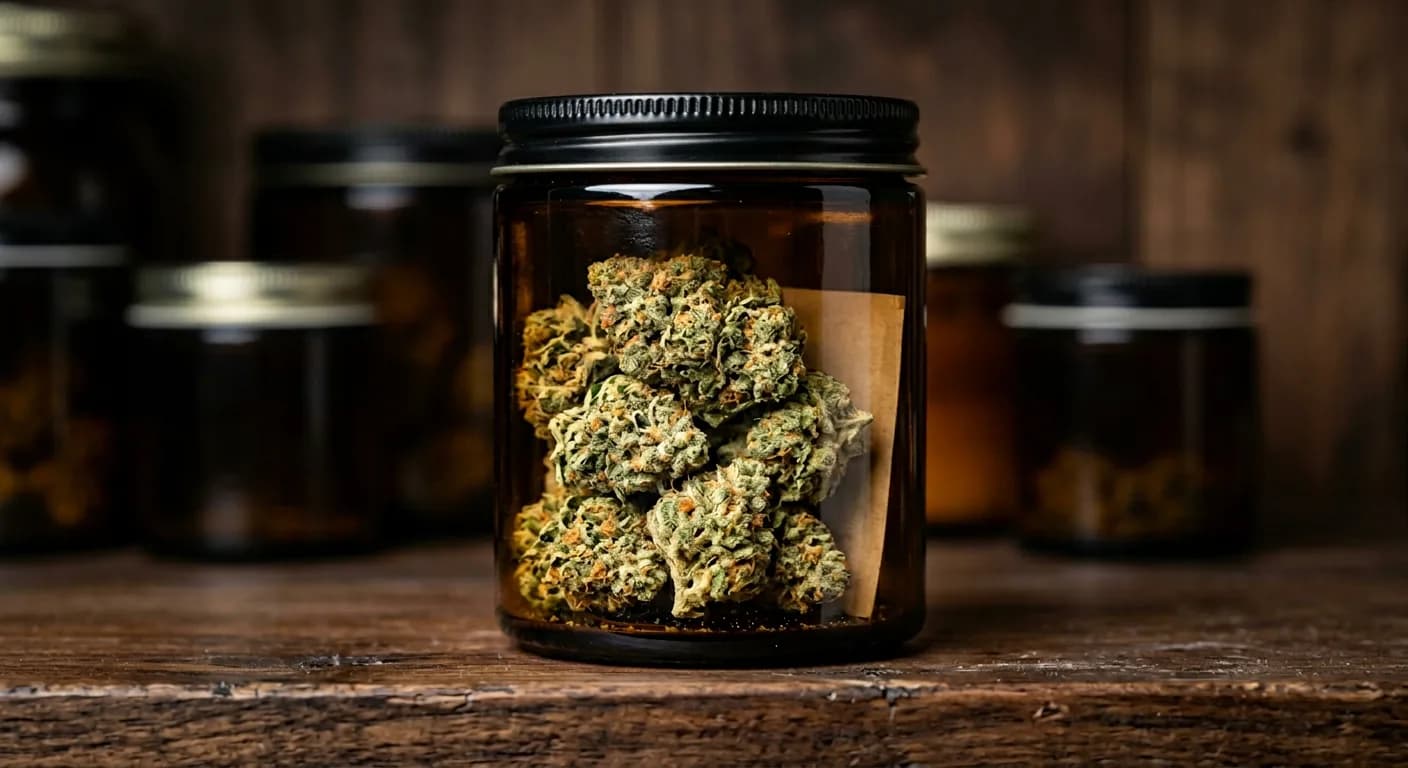
Never store cannabis in clear glass on a countertop or windowsill. A jar of flower left in indirect sunlight for 4 weeks can lose more THC than a properly stored jar loses in 6 months. Always use amber or dark glass, or store any container inside a completely dark space.
2. Heat
Heat accelerates every chemical reaction inside your stored cannabis — including terpene evaporation and THC breakdown. Terpenes, the aromatic compounds responsible for flavor and much of the entourage effect, are highly volatile. Most start evaporating noticeably above 70°F (21°C).
At temperatures above 77°F (25°C), terpene loss becomes rapid enough to notice within weeks. Myrcene, linalool, and the lighter citrus terpenes like limonene are the first to go. Heat also promotes mold growth if any residual moisture is present. Keep storage temperatures between 60–65°F (15–18°C) for best results.
3. Oxygen (Oxidation)
Every time you open a jar, oxygen enters and begins oxidizing your cannabinoids. THC oxidizes into CBN through prolonged oxygen exposure. Terpenes oxidize too, producing stale, harsh flavors that experienced consumers immediately recognize as "old" cannabis.
This is why airtight containers are non-negotiable for long-term storage — and why the "archive jar" strategy discussed later in this guide is so effective. The less you open a jar, the less oxygen enters, and the longer your flower stays intact.
4. Humidity: The Two-Sided Problem
Humidity is unique among the four enemies because too much and too little are both damaging. Here is the range you need to understand:
- Above 65% RH: Mold and mildew growth. Botrytis cinerea (bud rot) can colonize stored flower within days at high humidity, especially in poorly ventilated jars.
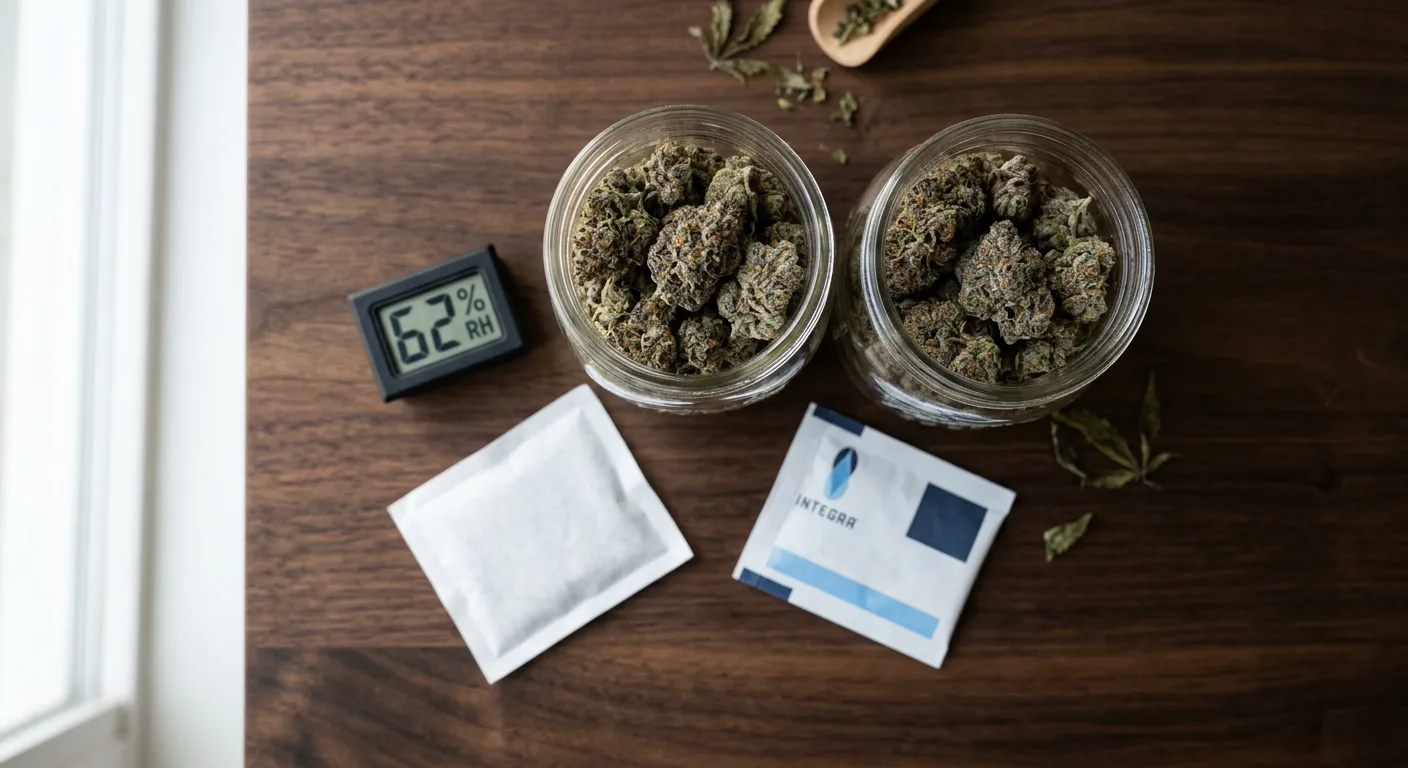
- 62% RH: Ideal. Buds remain slightly pliable, trichomes stay intact, and no mold growth occurs.
- 55–62% RH: Acceptable. Slightly drier, but potency and flavor are well-preserved.
- Below 50% RH: Over-drying begins. Trichomes become brittle and break during handling. Terpenes evaporate faster. Buds taste harsh.
- Below 40% RH: Rapid degradation. Cannabis becomes powder-dry, losing structure and aroma quickly.
Use a Boveda 62% two-way humidity pack in every long-term storage jar. These packs add or remove moisture as needed to maintain the target RH passively, with no maintenance required. Replace them every 2–3 months or when the pack becomes fully hard.
The Degradation Timeline: What Science Actually Says
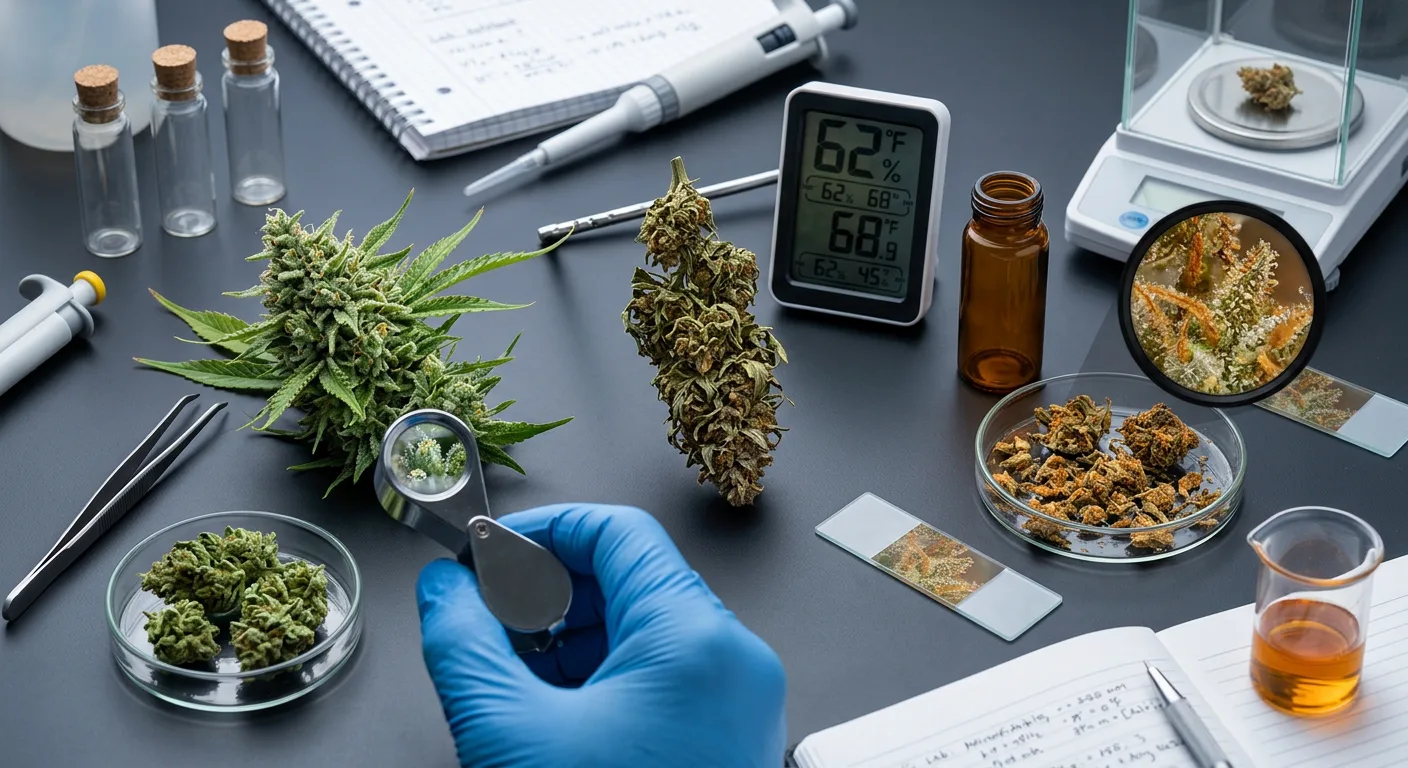
THC degrades primarily into CBN over time, with the rate determined by storage conditions. Under poor conditions, cannabis can lose 16% or more of its THC content in the first year. Under optimal conditions, that loss can be kept below 5–8% over the same period.
Two frequently referenced sources in the cannabis storage community provide useful benchmarks. Analytical 360, a cannabis testing laboratory, has observed consistent THC degradation patterns in samples tested at intervals, noting that improperly stored flower shows measurable potency decline within 3 months. The Hippie Butter degradation research, while informal, aligned closely with Fairbairn et al.'s foundational findings: light and temperature are the dominant variables, and controlling them dramatically extends shelf life.
The CBN Conversion Mechanism: THC (delta-9-tetrahydrocannabinol) loses a hydrogen molecule through oxidation, converting first to delta-8-THC and then to CBN. This process is irreversible. No storage method recovers lost THC — the goal is always to slow the conversion rate, not reverse it.
THC Degradation Rate Table: Estimated Monthly Loss by Condition
| Storage Condition | Est. THC Loss / Month | Est. Loss at 6 Months | Est. Loss at 12 Months |
|---|---|---|---|
| Optimal (dark, 62°F, 62% RH, airtight glass) | 0.4–0.6% | 2–4% | 5–8% |
| Good (dark, 68°F, 58% RH, airtight glass) | 0.7–1.0% | 4–6% | 8–12% |
| Average (dim room, 72°F, 55% RH, glass jar) | 1.2–1.8% | 7–10% | 14–18% |
| Poor (ambient light, 78°F, variable RH, plastic bag) | 2.5–3.5% | 14–20% | 26–34% |
| Very Poor (direct sun, 85°F+, no humidity control) | 4–6%+ | 22–35% | 40–50%+ |
*These are estimates based on published degradation studies and laboratory testing observations. Actual rates vary by starting moisture content, strain, and environmental consistency.
The difference between optimal and poor storage conditions is not subtle — it is the difference between 6% THC loss and 34% THC loss over 12 months. For a strain that starts at 25% THC, poor storage can drop you to roughly 16–17% THC within a year. Optimal storage keeps you at 23–24%.
Container Hierarchy: Best to Worst for Long-Term Storage
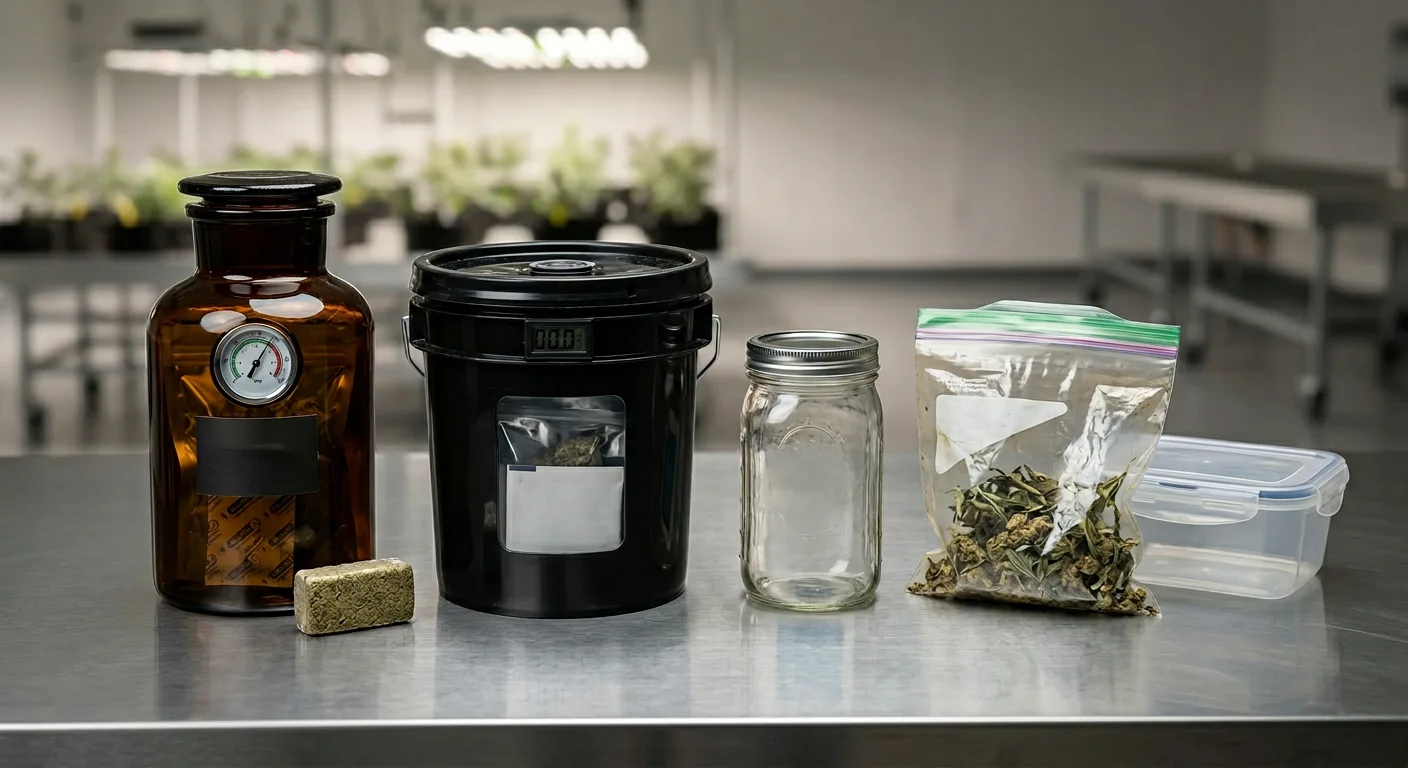
Not all containers protect cannabis equally. The best containers for long-term cannabis storage are airtight, non-reactive, opaque or UV-filtering, and sized correctly so minimal air space remains above the flower. Here is the full hierarchy from best to worst.
Tier 1 — Amber Glass Mason Jar + Humidity Pack (Gold Standard)
A wide-mouth amber glass mason jar with a metal airtight lid and a 62% Boveda humidity pack inside is the best all-around solution for most growers. Glass is chemically inert — it does not leach compounds, absorb odors, or generate static electricity like plastic does. Amber glass blocks the UV spectrum that degrades THC fastest.
Size your jars to minimize air space. A half-ounce of flower fits perfectly in a half-pint (8oz) jar. A full ounce fits a pint (16oz). Leaving a quarter of the jar empty means more oxygen contact with each opening.
Tier 2 — UV-Protected Dark Glass Jar
Specialty UV-protective glass jars (often marketed specifically for cannabis storage) block a broader UV spectrum than standard amber glass. Brands like Infinity Jars use violet-spectrum glass that blocks most visible light and UV while transmitting only far-red and infrared frequencies. These are excellent but more expensive. For most home growers, amber mason jars with careful placement in a dark space perform nearly identically at a fraction of the cost.
Tier 3 — Titanium / Stainless Steel Airtight Container
Medical-grade titanium herb containers with airtight seals are a solid Tier 3 option. They are durable, completely opaque, and non-reactive. The downside is cost and the fact that you cannot visually check the contents without opening the jar (introducing oxygen). They work very well for stash jars used regularly, less ideal for archive storage where minimal opening matters most.
Tier 4 — Mylar Bag (Vacuum Sealed)
Mylar bags, when properly vacuum-sealed, block light and eliminate almost all oxygen. For bulk storage of large quantities — think a full harvest in 4oz portions — vacuum-sealed mylar is practical and effective for 6–12 month storage. The tradeoff is trichome damage from compression (covered in detail in the next section) and the need for dedicated equipment.
Tier 5 — Plastic Zip-Lock / Sandwich Bags (Avoid)
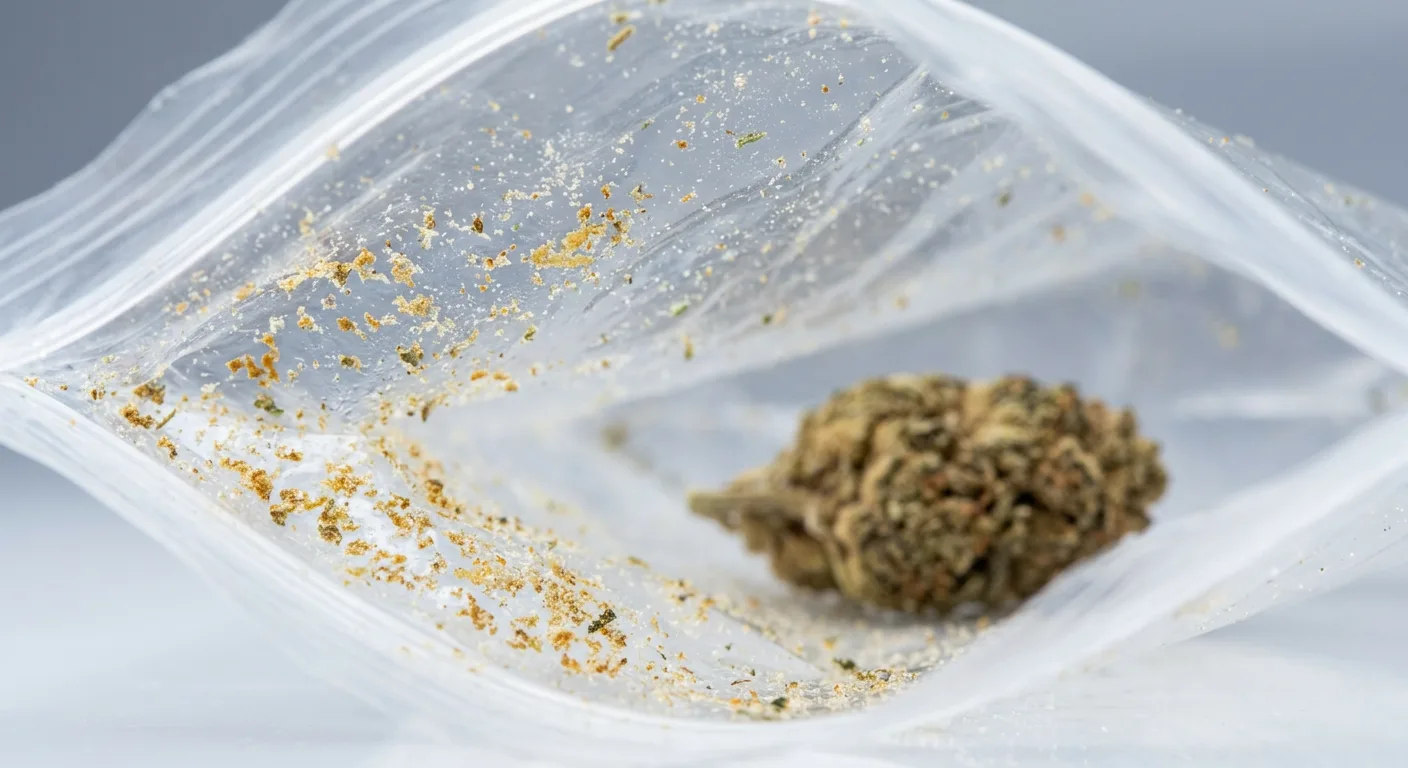
Plastic bags are the worst option for long-term storage and should be avoided entirely. They allow slow oxygen transfer through the bag walls. They generate static electricity that actively pulls trichomes off buds and sticks them to the inside of the bag. They do not regulate humidity. They provide no UV protection. A bag full of beautiful flower looks like trichome-dusted shake within two weeks.
- Amber or UV-protective glass: ✓ Use for all long-term storage
- Metal airtight lid with rubber seal: ✓ Required
- Boveda or Integra Boost 62% pack: ✓ Include in every jar
- Size jar to flower quantity (minimal air space): ✓ Important
- Label with strain, harvest date, and THC%: ✓ Always
- Clear plastic bags: ✗ Never for long-term storage
- Tupperware or food storage containers: ✗ Not airtight enough
Vacuum Sealing Cannabis: When It Helps and When It Hurts
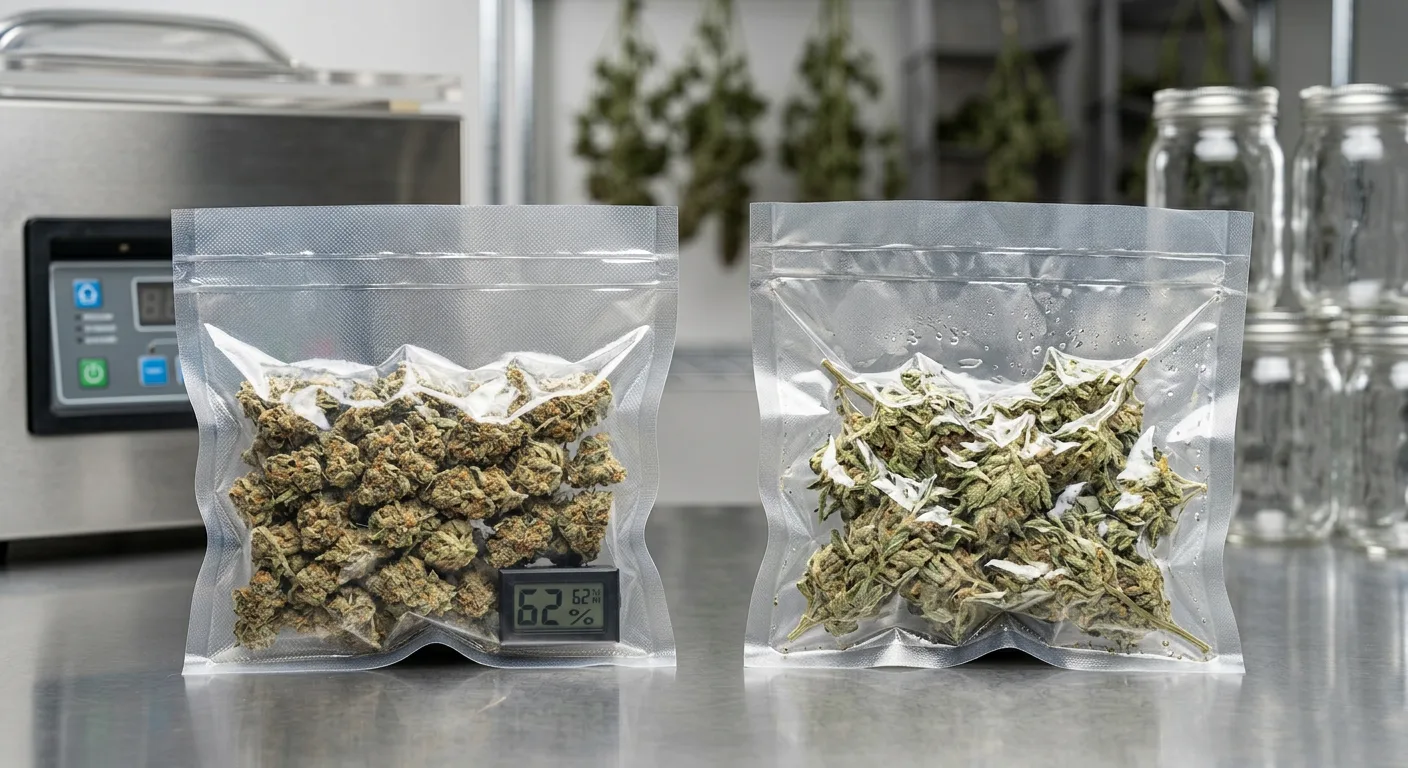
Vacuum sealing removes oxygen effectively, which slows THC oxidation. However, the physical pressure of vacuum sealing crushes trichomes — the resin glands where THC, CBD, and terpenes are stored. For long-term flower storage, vacuum sealing is a trade-off that requires careful consideration.
When Vacuum Sealing Makes Sense
- Bulk storage of large quantities (1oz+ portions you will not open for 6–12 months)
- Trim and sugar leaf destined for extraction — trichome structure does not matter if you are making hash or rosin
- Pre-pressed kief or bubble hash — already processed, structural damage is irrelevant
- Transport or moving large quantities where space efficiency matters
- Secondary packaging inside a dark container — vacuum seal into a mylar bag, then store inside a dark box to combine benefits
When Vacuum Sealing Hurts Your Flower
- Premium whole-bud storage — compression destroys the bud structure and breaks trichome stalks
- Regular-access stash jars — resealing after each use is impractical and each reseal event stresses the buds
- Terpene-forward strains — the pressure accelerates terpene release; compressed mylar bags off-gas aroma faster than glass jars
If you vacuum seal cannabis for long-term storage, use a chamber vacuum sealer set to the lowest pressure setting rather than a standard suction-based bag sealer. Chamber sealers create uniform pressure rather than sucking air through the bag, which causes significantly less physical damage to bud structure.
The Freezing Debate: Should You Freeze Your Cannabis Flower?
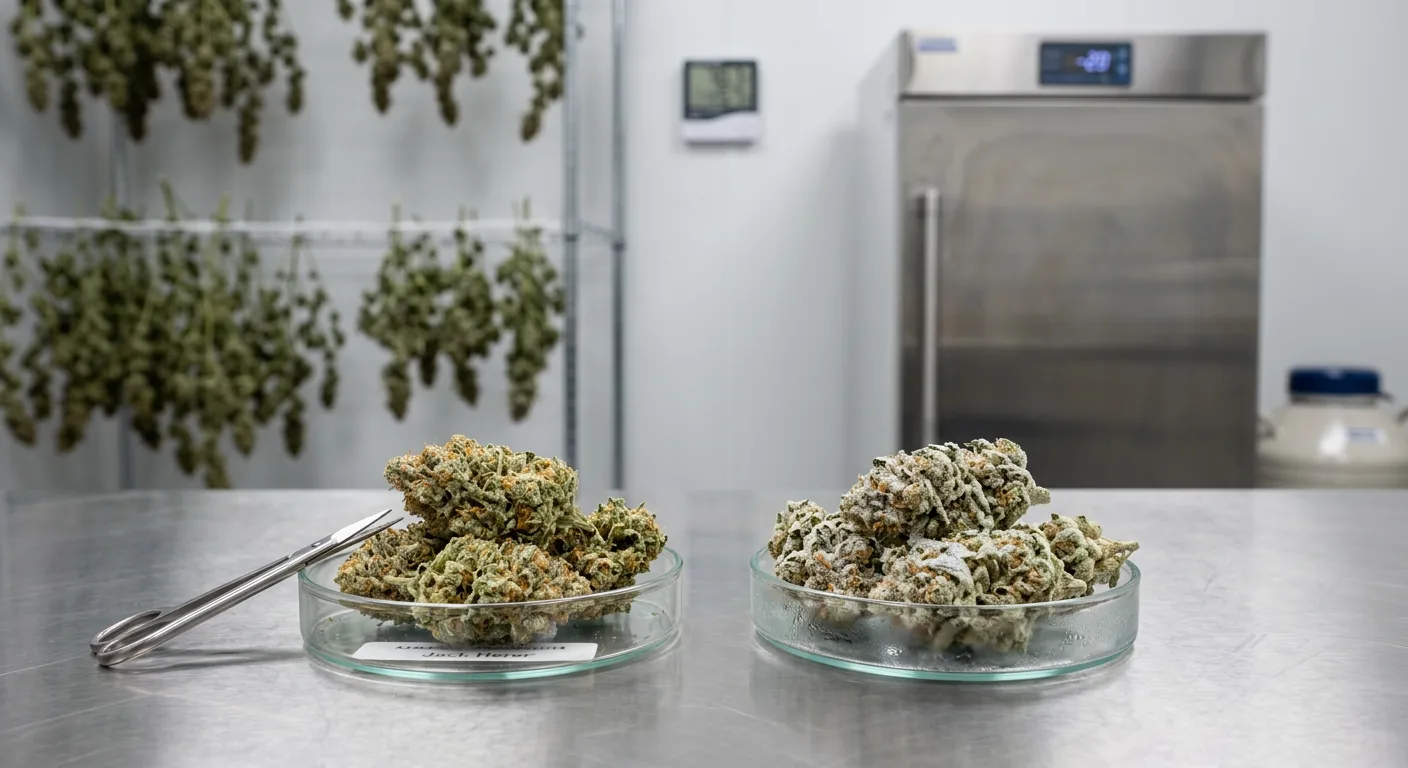
Freezing cannabis flower is technically effective at halting chemical degradation — cold temperatures nearly stop terpene evaporation and THC-to-CBN conversion. However, frozen trichomes become extremely brittle and shatter on contact, making freezing a risky strategy for preserving smokable flower.
The Trichome Problem
Trichome stalks are fragile at room temperature. At freezing temperatures (32°F / 0°C and below), the resin inside trichome heads solidifies, and the stalks become as brittle as glass. Any movement, handling, or vibration causes trichomes to snap off and fall away from the bud. This is actually the exact principle used in dry-sift hash making and ice water extraction — freezing cannabis to detach trichomes is intentional in those processes.
For smokable flower storage, however, you want trichomes firmly attached. Opening a bag of frozen buds in a warm room and handling them even gently can strip 10–20% of surface trichomes before you ever get them to a grinder.
If you do freeze cannabis flower — for any reason — always allow jars to return to full room temperature before opening them. Condensation from cold air meeting warm humid air will deposit moisture directly onto your buds. Allow 2–4 hours for a fully sealed jar to equilibrate before opening.
When Freezing Is the Right Choice
- Trim and sugar leaf for hash-making — freeze, then use the ice water extraction method
- Bubble hash production — freeze the material first for cleaner extraction
- Live resin or rosin production — flash-freezing fresh-frozen material preserves terpenes for concentrate production
- Dried and cured flower in a completely sealed, oxygen-purged container — theoretically effective if you can guarantee no handling of frozen material, but high risk for most home setups
The bottom line on freezing: it is the right tool for concentrate production, not for preserving smokable flower. For most growers storing 1–24 months of cured buds, a dark cool room at 60–65°F with airtight glass jars outperforms a freezer in practice — because it eliminates the trichome damage risk entirely.
Advanced note: Freeze-drying (lyophilization) is a completely different process that removes moisture under vacuum at very low temperatures without the trichome-damage problem associated with standard freezing. This is covered in depth in our upcoming freeze-drying article — a genuinely exciting preservation method for high-value harvests.
Optimal Storage Environment: Temperature, Light & Humidity
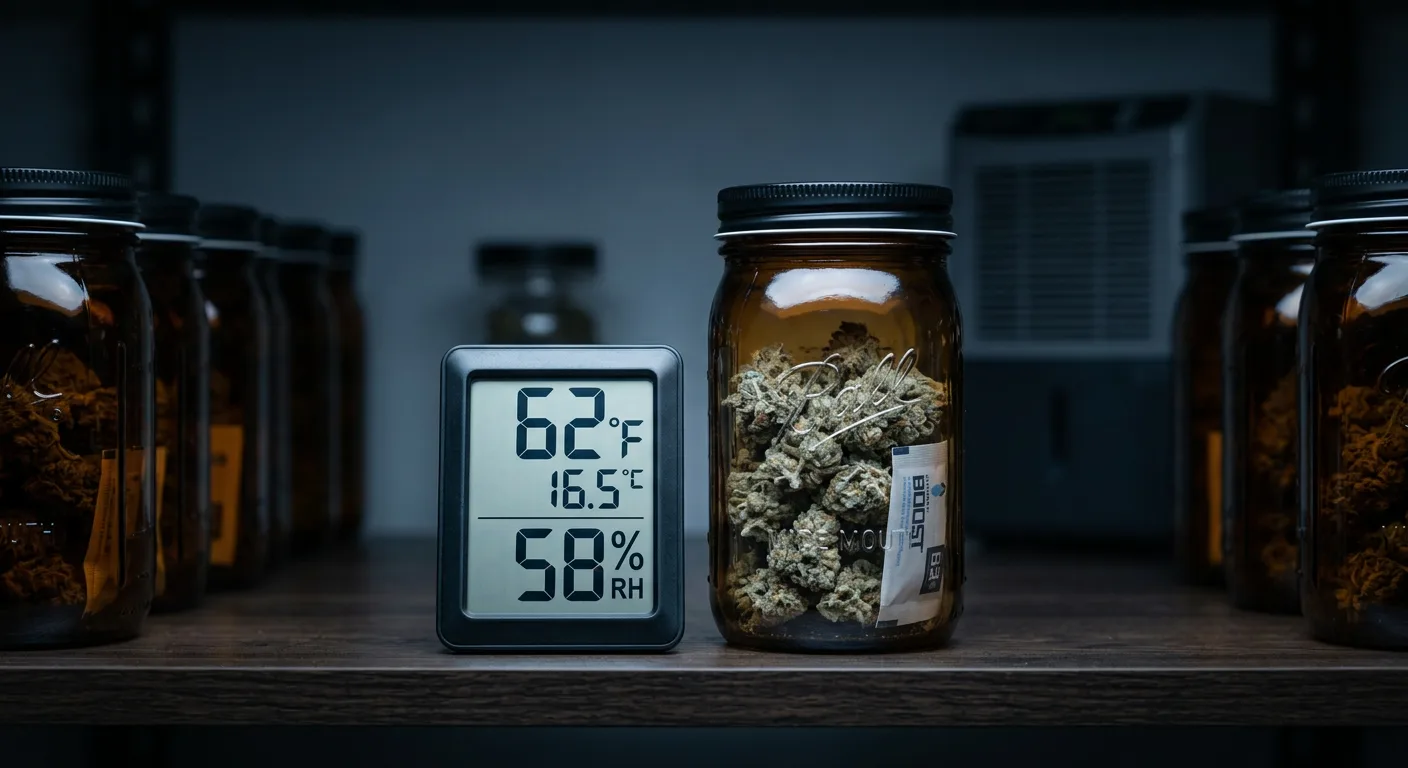
The ideal cannabis storage environment is dark, cool, stable in temperature, and humidity-controlled between 55–62% RH. The most common mistake growers make is choosing an environment that meets two or three of these requirements but fails on the fourth — usually either humidity or temperature stability.
Why the Fridge Usually Fails
Refrigerators seem like an obvious choice — they are dark (when closed) and cool. The problem is humidity fluctuation. Every time you open the fridge door, warm humid air enters the cold interior. This causes condensation cycles inside any jar that is not perfectly sealed, and it creates brief but repeated humidity spikes. Over weeks of daily fridge use, these cycles promote mold growth and trichome degradation.
A second problem is that most refrigerators run at 35–40°F (2–4°C) — cold enough to make trichomes brittle, though not as extreme as freezing. If your only option is fridge storage, use vacuum-sealed mylar bags inside a sealed secondary container to buffer humidity swings, and dedicate a separate mini-fridge exclusively to cannabis storage so you minimize door openings.
The Best Practical Storage Locations
- A dedicated dark cabinet or cupboard — away from heat sources, pipes, and exterior walls (which fluctuate with outside temperature)
- A basement or cellar — naturally stable temperature and humidity in most climates; ideal if your basement runs 55–65°F year-round
- A wine cooler set to 60–65°F — the closest thing to a perfect cannabis storage appliance; stable temperature, minimal door openings, and easily kept dark
- An interior closet away from exterior walls — temperature-stable in most conditioned living spaces
- Temperature: 60–65°F (15–18°C) target
- Relative humidity inside jars: 55–62% RH
- Light exposure: zero — completely dark storage
- Oxygen exposure: minimal — airtight containers, open as infrequently as possible
- Temperature stability: avoid locations near stoves, water heaters, HVAC vents, or exterior walls
- Vibration: low — avoid locations on top of appliances or near heavy machinery
Place a small digital hygrometer inside or beside your storage cabinet to monitor ambient humidity — not just inside the jars. If your storage area regularly exceeds 65% ambient RH, add a small desiccant canister to the cabinet itself and check your jar seals.
The Stash Jar vs. Archive Jar System
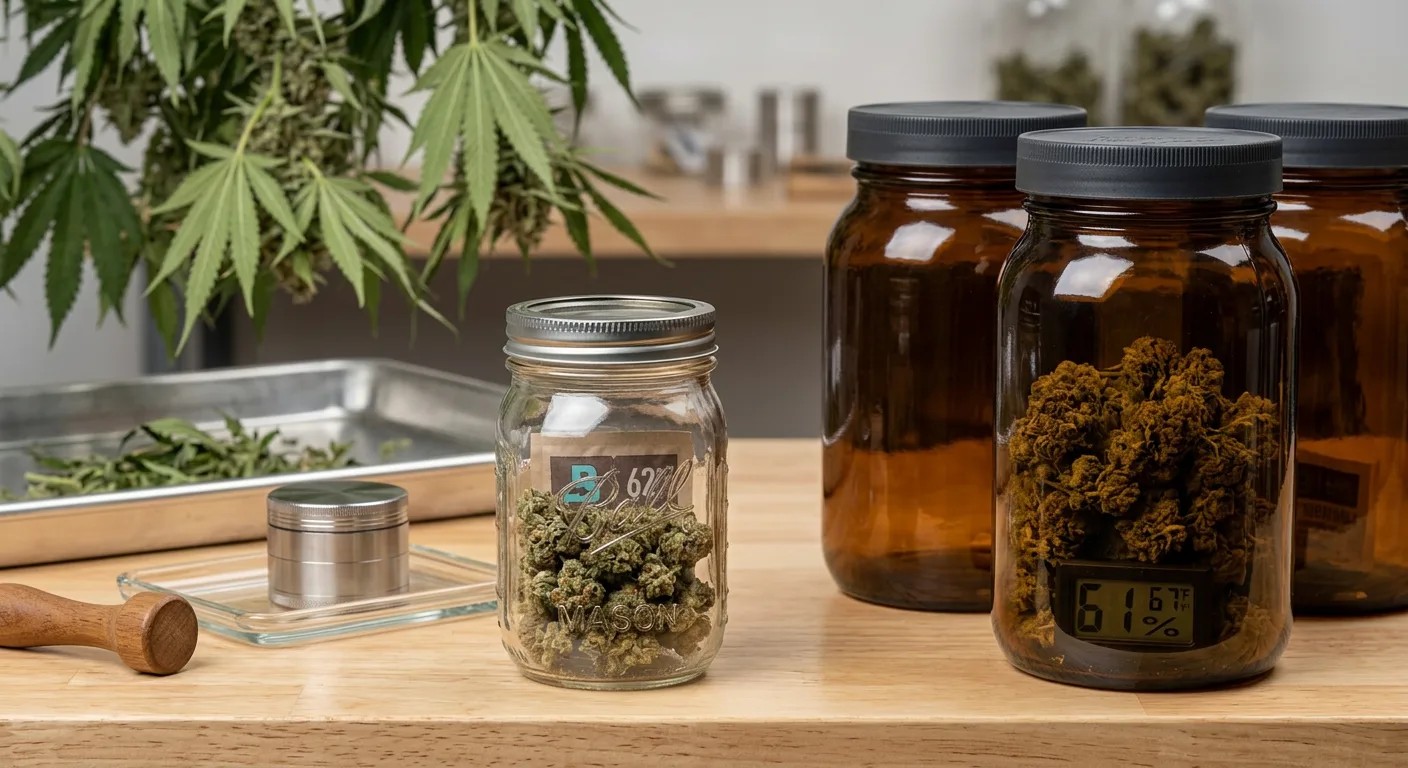
The stash jar vs. archive jar system separates your harvest into two categories: jars for regular use and jars sealed for long-term preservation. This approach protects your best material from the oxygen exposure that comes with frequent opening while keeping everyday supply accessible.
This system is particularly valuable for phenotype hunters, breeders, and growers who want to evaluate how a strain ages — or who want to preserve a particularly exceptional pheno for future comparison. Here is how it works in practice.
The Stash Jar
Your stash jar is your daily driver. It holds 1–2 weeks of supply, gets opened regularly, and is cycled through before oxidation becomes significant. Use a standard amber glass mason jar with a humidity pack. Refill it from an archive jar when it runs low — minimizing how often the archive jars are opened.
The Archive Jar
Archive jars are sealed at harvest time, labeled with strain name, harvest date, starting THC% (if tested), and a "do not open before" date. They are stored in the most optimal conditions available — coolest, darkest, most stable location. An archive jar should be opened as few times as possible.
For maximum preservation, consider oxygen-purging archive jars before sealing. A quick flush of food-grade nitrogen or CO2 gas from a small dispensing canister before closing the lid displaces the oxygen inside and dramatically slows oxidation. This is the same technique used in premium wine storage and long-term food preservation.
Archive Jar Labeling System
- Strain name — e.g., "OG Kush Pheno #3"
- Harvest date — month and year at minimum
- Starting THC% — from a lab test or estimated from strain data
- Cure completion date — when the cure reached target RH after the burping phase
- Quantity — in grams, so you can track without opening
- Target open date — when you plan to access the jar
Some craft growers use the archive jar system to deliberately age cannabis, similar to wine aging. Certain high-resin strains — particularly indica-dominant genetics with dense trichome coverage — develop a smoother, less anxious character over 12–18 months as myrcene settles and some THCA continues converting. This is a niche preference, but it is real, and controlled aging requires exactly the same setup as preservation storage.
If you are new to post-harvest processing, understanding the full curing process is essential before storage begins. See our complete guide to curing cannabis in mason jars with a proper burping schedule — curing and storage are sequential steps, and skipping proper curing guarantees degradation regardless of how well you store.
Which Strains Store Best? Genetics Matter More Than You Think
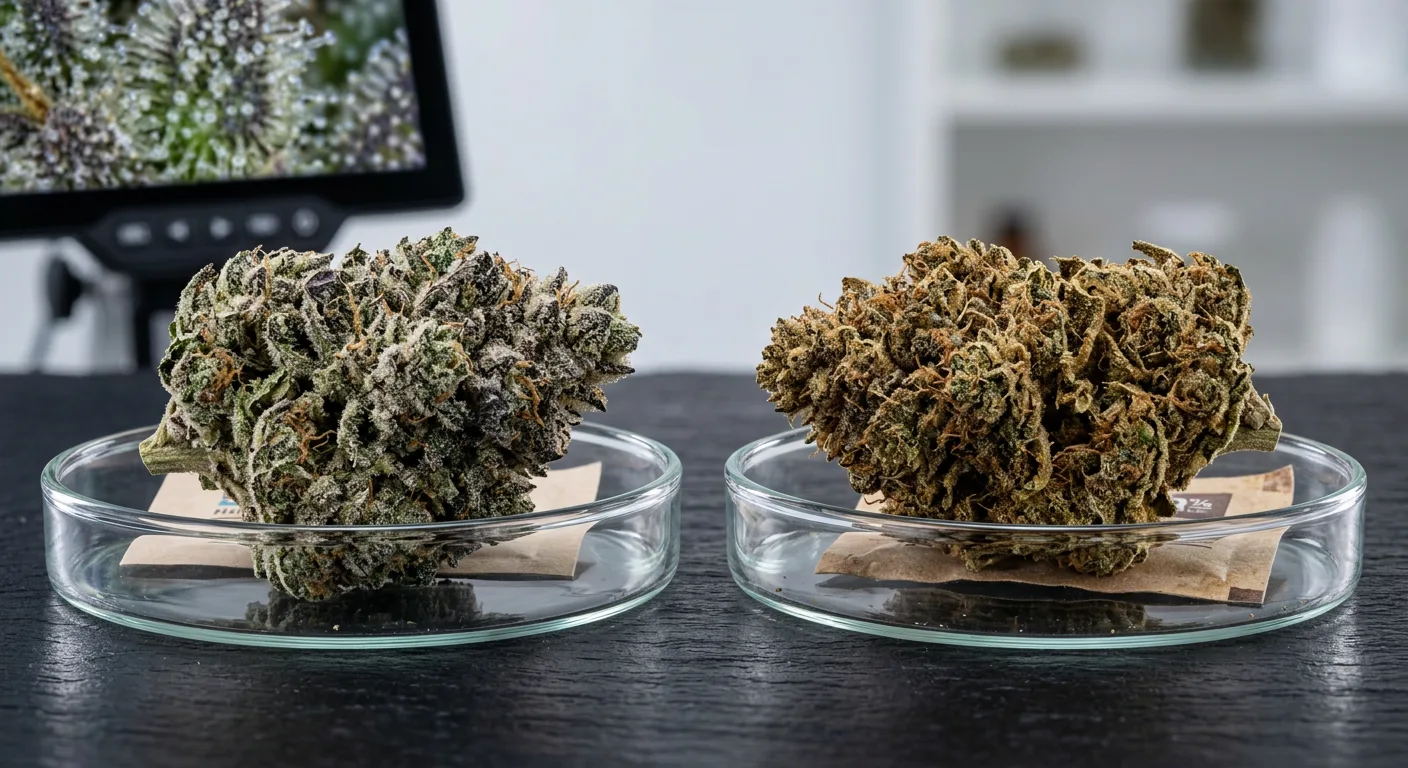
High-resin, lower-moisture strains with dense trichome coverage store significantly better than airy, lower-resin varieties. Genetics that naturally produce thick, stable trichome structures resist physical degradation during storage, and higher cannabinoid concentration means the flower retains meaningful potency even after some percentage of THC converts to CBN.
What Makes a Strain Storage-Friendly
- High resin production — more trichomes means more THC to start with, so proportional losses hurt less
- Dense bud structure — compact buds with low surface area relative to mass retain moisture more evenly and lose terpenes more slowly
- Lower natural moisture content at cure — strains that cure to 55–60% RH naturally without over-drying tend to store more consistently
- Stable terpene profiles — some terpenes are more volatile than others; strains dominated by myrcene and caryophyllene tend to age better than those dominated by the highly volatile limonene or terpinolene
Strong-Storing Strains to Consider
OG Kush is frequently cited by experienced growers as one of the best-aging varieties available. Its exceptionally dense trichome coverage, high starting THC (our OG Kush Feminized tests at 26% THC), and caryophyllene-rich terpene profile make it a natural candidate for archive storage. Properly stored OG Kush at 12 months is still a very different — and often still excellent — experience.
Purple Kush is another heavily resinous variety built for long-term preservation. Starting at 27% THC (see our Purple Kush Feminized), its indica-dominant density and thick trichome matrix hold up exceptionally well over extended storage. Myrcene-dominant strains like this tend to mellow gracefully rather than degrading harshly.
For high-THC starting points that give you the most buffer against percentage loss over time, look at:
- Quantum Kush Feminized — 30% THC starting point; even 20% THC loss leaves you at 24%
- Black Widow Feminized — 26% THC, classic resinous structure, extremely dense trichome coverage
- White Widow Feminized — 25% THC, legendary resin production, one of the most storage-consistent strains in cultivation history
- Papaya Feminized — 25% THC, very dense bud structure, fruity terpene profile holds well in cold dark storage
Well-known varieties from other breeders that age particularly well based on widely reported grower experience include Gorilla Glue #4 (extremely high resin, stores exceptionally), Wedding Cake (dense structure, stable terpene profile), and MAC (Miracle Alien Cookies) — all recognized within the community for their storage performance.
In contrast, very airy, sativa-dominant strains with high terpinolene content — such as some Dutch and Southeast Asian genetics — lose their characteristic aroma much faster in storage. This does not make them bad strains, but they are best consumed within 3–6 months of cure completion rather than archived.
For guidance on selecting the right genetics for your grow environment before harvest even begins, the cannabis seed selection by climate guide covers how different genetics perform under varying environmental conditions — relevant because climate affects resin production at harvest, which in turn affects storage performance.
Step-by-Step: Setting Up Your Long-Term Cannabis Storage System
Setting up a proper long-term cannabis storage system takes about 30–45 minutes after your cure is complete. The numbered steps below walk through the full process from selecting containers to labeling your archive jars for 12+ month storage.
Confirm Your Cure Is Complete
Before long-term storage, your cannabis must be fully cured — not just dried. A completed cure means buds have stabilized at 55–62% internal RH and the grassy smell has fully converted to your strain's characteristic aroma. Opening a jar should not smell like fresh-cut hay. If you are still in the active burping phase, storage is premature. See our mason jar curing guide for the full burping timeline.
Select and Clean Your Containers
Choose amber glass mason jars in sizes appropriate to your quantities. Wash jars with hot water and unscented soap, rinse thoroughly, and dry completely before use. Any residual moisture or cleaning agent will transfer to your cannabis. For archive jars, consider a final rinse with isopropyl alcohol (99%) and allow to fully evaporate before filling.
Divide Into Stash and Archive Portions
Decide how much you will use within the next 2–4 weeks (your stash jar supply) and how much you want to preserve long-term (your archive jars). Fill stash jars no more than 80% full for regular access. Fill archive jars as fully as practical — minimum air space means minimum oxygen exposure per opening.
Add Humidity Packs
Place one appropriately sized Boveda or Integra Boost 62% humidity pack in each jar. For a pint jar (16oz / ~28g capacity), use a 4-gram pack. For a quart jar (32oz / ~56–60g capacity), use an 8-gram pack. Do not use humidity packs designed for cigars — cannabis requires different RH targets (58–62%), not the 65–72% used for tobacco.
Optional: Oxygen Purge Archive Jars
For archive jars you will not open for 6+ months, consider a quick food-grade nitrogen or CO2 flush before sealing. Hold the dispenser nozzle at the opening of the filled jar and release a 2–3 second burst before immediately closing the lid. This displaces oxygen and meaningfully slows THC oxidation during extended storage.
Label Everything Comprehensively
Use waterproof labels or a permanent marker directly on masking tape. Record: strain name, phenotype number if applicable, harvest date, cure completion date, starting weight, and target open date. You will not remember these details in 12 months — and proper labeling makes the stash jar vs. archive jar system work correctly.
Choose and Prepare Your Storage Location
Place jars in your chosen dark, cool, stable-temperature location. If using a cabinet, line the interior with dark fabric or cardboard to block any light that enters around door edges. Place archive jars at the back; stash jars at the front for easy access without disturbing archive stock. Add a small digital hygrometer to monitor ambient conditions.
Establish a Maintenance Schedule
Check stash jars every 1–2 weeks. Check archive jars every 4–6 weeks — visually, without opening. Replace humidity packs in any jar when they become fully rigid (fully saturated or depleted). Log your checks with dates. At 6 months, open one archive jar to evaluate aroma and structure; if it passes your quality check, the system is working. If terpene fade is significant, review your temperature and light control.
- Amber glass mason jars in appropriate sizes
- Metal airtight lids with rubber seals (replace if any lid shows rust or deformation)
- Boveda or Integra Boost 62% humidity packs (4g for half-pint, 8g for pint, 67g for quart)
- Digital hygrometer for ambient monitoring
- Waterproof labels or permanent marker + masking tape
- Food-grade nitrogen or CO2 can (optional, for archive jar oxygen purging)
- Dark storage cabinet or box away from heat sources
- Maintenance log (a simple notebook or notes app works fine)
Use our free yield estimator tool before harvest to project your total output — knowing how many grams you expect helps you buy the right number and sizes of jars before harvest day, so you are not scrambling with inadequate containers when everything comes down at once.
Connecting Storage to Your Broader Grow Strategy
Long-term cannabis storage does not exist in isolation — it is the final step in a cultivation chain that starts with seed selection and runs through harvest timing, drying, and curing. Growers who plan for storage from the beginning make better decisions at every earlier stage.
One example: harvest timing directly affects storage performance. Cannabis harvested with mostly cloudy trichomes (peak THC) before significant amber conversion stores with more THC headroom than flower harvested late with 30–40% amber trichomes (already partially converted to CBN). The storage timeline you are managing starts at the moment of harvest.
Another connection is terpene knowledge. Understanding which terpenes dominate your strain helps you predict its storage behavior. Strains heavy in myrcene and caryophyllene tend to age more gracefully than those dominated by highly volatile terpenes like terpinolene. If you grow a terpinolene-dominant strain, prioritize consuming it within 6 months of cure rather than archiving it long-term.
For growers interested in maximizing the terpene and cannabinoid profile available for storage, understanding what you are growing in depth — genetics, terpene expression, resin production traits — is half the battle. The top high-THC strains guide covers which genetics give you the most starting potency to work with, and the cannabis breeding basics guide explores why some phenotypes express more storage-friendly traits than others.
Finally, if you are using our grow planner tool to schedule perpetual harvests or plan seasonal grows, factor in storage capacity as a constraint. A well-planned perpetual grow spaces harvests so your oldest stored flower is being consumed before your newest harvest goes into jars — maintaining a natural rotation that keeps everything within its ideal consumption window.
Long-term cannabis storage is the final competitive advantage for serious home growers. You can grow world-class flower, but if you lose 25–30% of your THC to poor storage conditions in the first year, you have wasted months of effort. The investment in proper containers, humidity control, and a dark cool environment costs less than $50 and returns that in preserved potency on your very first harvest.
Frequently Asked Questions
How long can cured cannabis last before going bad?
Properly cured and stored cannabis can last 12 to 24 months without significant quality loss. Under ideal conditions — 60–65°F, 55–62% RH, complete darkness, and an airtight glass container — some growers report acceptable potency and flavor at 2 years or beyond, though terpene loss accelerates noticeably after 18 months. "Going bad" in the sense of mold requires humidity above 65% RH; potency degradation is gradual, not sudden.
Does cannabis lose potency over time, and how fast?
Yes. THC degrades into CBN through oxidation, UV exposure, and heat. Under poor conditions (ambient light, warm temperatures, plastic bags), cannabis can lose 16–34% of its THC in the first year. Under optimal storage conditions (dark, 62°F, airtight glass, 62% RH), estimated loss is closer to 5–8% over 12 months. The degradation process is irreversible — no storage method recovers converted THC.
Does vacuum sealing cannabis preserve THC and terpenes?
Vacuum sealing removes oxygen effectively and slows THC oxidation, which helps preserve THC content. However, the physical pressure of vacuum sealing crushes trichomes and accelerates terpene loss through compression. It is best suited for bulk storage of trim or processed material, not for preserving the structure, aroma, and full terpene profile of whole-bud flower. A chamber vacuum sealer at low pressure causes significantly less damage than a suction bag sealer.
What is the best humidity level for storing cannabis long-term?
The ideal relative humidity for long-term cannabis storage is 58–62% RH inside the storage container. Above 65% RH, mold and mildew become a serious risk. Below 50% RH, trichomes become brittle, terpenes evaporate faster, and buds become harshly dry. A 62% Boveda or Integra Boost humidity pack inside an airtight glass jar is the most reliable way to maintain this range passively without any monitoring equipment.
How do I store cannabis for more than 6 months without losing potency?
For 6–24 month storage: use amber glass mason jars filled close to capacity, with a 62% humidity pack, sealed with an airtight metal lid. Store in a completely dark location at 60–65°F with stable temperature. For archive jars you will not open for 6+ months, consider flushing with food-grade nitrogen before sealing to displace oxygen. Open stash jars regularly and archive jars as rarely as possible. Choose high-resin strains with dense bud structure — they lose a smaller proportion of effective potency over time.