You booked the trip. You checked that weed is legal there. You're assuming the rest will figure itself out. That's where most visitors get tripped up — because cannabis tourism laws by state are not as simple as 'it's legal, so I can do what I want.' The gap between what's legal to purchase and what's legal to consume, where you can do it, and what you can do with it afterward is wide enough to ruin a vacation or land you in serious federal trouble.
This guide covers everything a visitor needs to know in 2026: which states let you walk in off the street and buy, where you can actually consume without hiding in a back alley, what happens at the airport, and the surprisingly nuanced question of cannabis seeds as souvenirs. Read everything before you go.
Can Tourists Actually Buy Cannabis in Legal States?
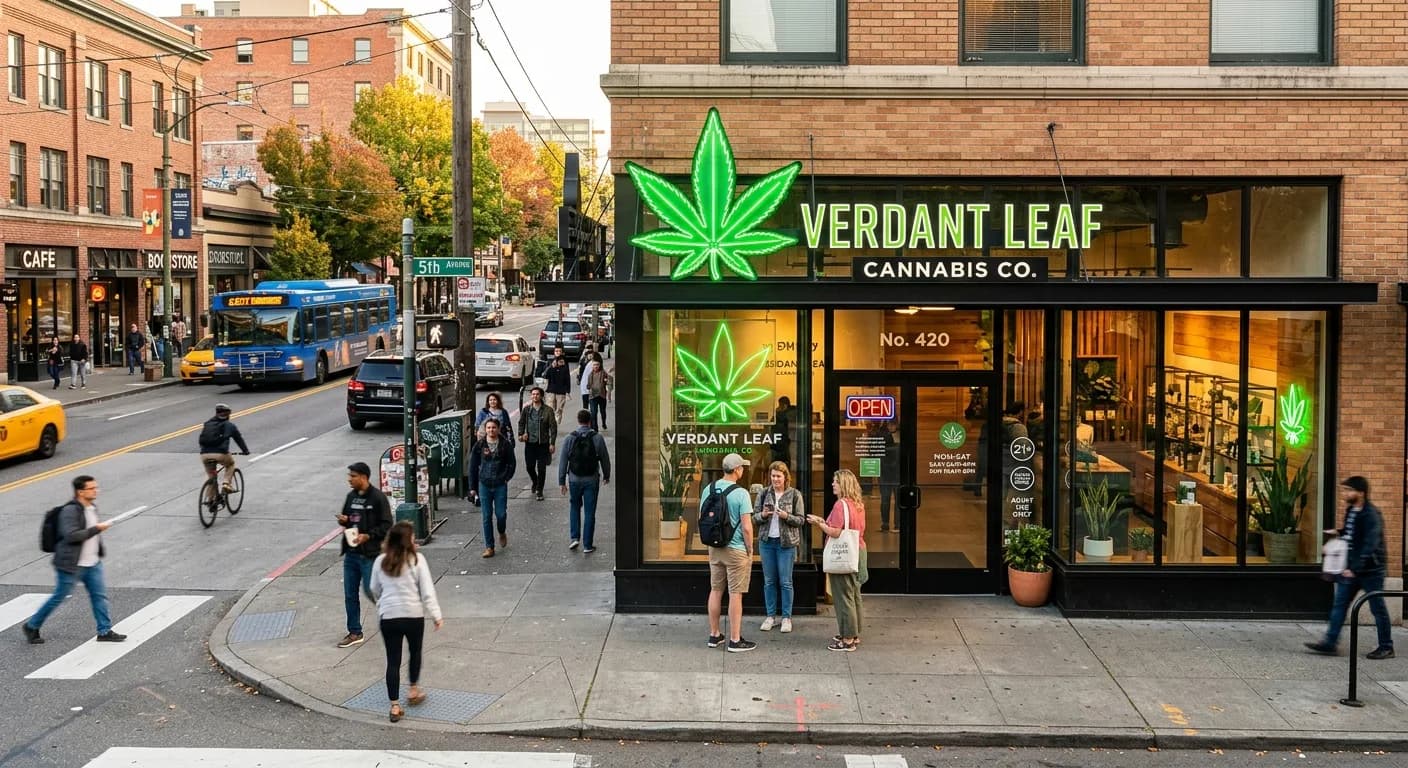
Yes — and this surprises many first-time visitors. Every U.S. state with a licensed adult-use (recreational) cannabis market allows out-of-state visitors to purchase cannabis at retail dispensaries. No state residency requirement exists in any legal market as of 2026. You need one thing: a valid government-issued photo ID proving you are 21 or older.
Acceptable IDs at virtually every dispensary include:
- U.S. driver's license or state ID (from any state, including non-legal states)
- U.S. passport or passport card
- Military ID
- Foreign passport (accepted at most dispensaries)
International visitors — including Canadians, Europeans, and others — can legally purchase cannabis at U.S. dispensaries using a foreign passport. The dispensary simply needs to verify you are 21+. Some dispensaries in tourist-heavy markets like Las Vegas and Denver have seen foreign nationals make up a significant share of daily foot traffic.
Key Takeaway: No state in the U.S. has a residency requirement for cannabis purchases. If you're 21+ with valid ID, you can walk into any licensed dispensary in a recreational state and buy. The restrictions kick in when you try to consume, transport, or take it home.
Purchase Limits for Visitors vs. Residents
Purchase limits are the same for visitors and residents. States set daily purchase limits per transaction — your home address or ID origin does not change what you can buy in a single visit.
| State | Daily Purchase Limit (Adults 21+) | Flower Equivalent |
|---|---|---|
| Colorado | 1 oz flower / 8g concentrate / 800mg edibles | 28g |
| Nevada | 1 oz flower / 3.5g concentrate | 28g |
| California | 1 oz flower / 8g concentrate | 28g |
| Oregon | 1 oz flower / 5g concentrate / 500mg edibles | 28g |
| Washington | 1 oz flower / 7g concentrate / 16 oz infused liquid | 28g |
| Michigan | 2.5 oz flower | 70g |
| Illinois | Out-of-state visitors: 15g flower / 2.5g concentrate / 250mg edibles | 15g* |
| New York | 3 oz flower / 24g concentrate | 85g |
| New Jersey | 1 oz flower per transaction | 28g |
| Arizona | 1 oz flower | 28g |
*Illinois notably applies a lower purchase limit specifically to out-of-state visitors compared to state residents (who can buy 30g). This is the only active market in 2026 with a visitor-specific quantity restriction.
Illinois Exception: Illinois is currently the only recreational state that distinguishes between resident and non-resident purchase amounts. Out-of-state visitors are limited to 15g of flower per transaction versus 30g for Illinois residents. Know this before you visit.
What Dispensaries Are Required to Ask
Every licensed dispensary will scan or manually verify your ID at the door and again at the point of sale. This is not optional — it is mandated by state licensing laws and failure to comply can cost a dispensary its license. You will typically fill out a simple intake form on your first visit confirming you are a voluntary adult purchaser.
Some high-volume tourist markets (Las Vegas strip dispensaries, Denver airport-area shops) have expedited check-in systems specifically designed for first-time visitors. Staff at these locations are used to answering tourist questions — don't be embarrassed to ask about products, potency, or local rules.
Consumption Lounges & Social Spaces: Where Visitors Can Actually Smoke
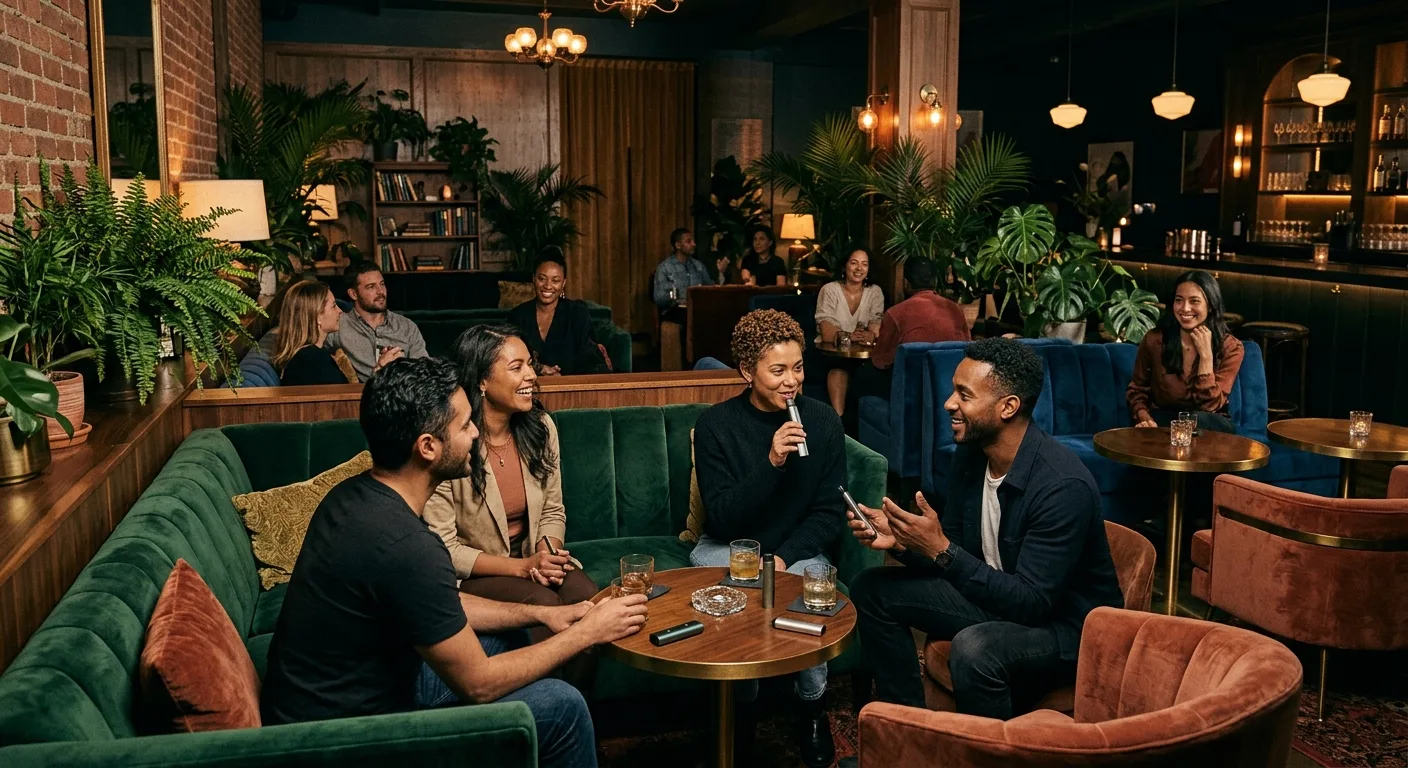
Buying cannabis is the easy part. Consuming it legally as a visitor is the real puzzle. Most states prohibit cannabis use in any public place — on the street, in parks, in hotel rooms (which are typically governed by private property rules), and in vehicles. Consumption lounges exist specifically to solve this problem, and their legal status varies significantly by state in 2026.
Nevada: The Most Visitor-Friendly Consumption Market
Nevada has the most developed consumption lounge infrastructure of any state, driven largely by Las Vegas tourism economics. The state's Cannabis Compliance Board began issuing consumption lounge licenses alongside dispensary licenses, and by 2026 several standalone lounges and dispensary-attached lounges operate on and near the Las Vegas Strip.
Key facts for visitors in Nevada:
- Adults 21+ can consume at licensed lounges regardless of residency
- Some lounges allow BYOC (bring your own cannabis purchased from a licensed dispensary)
- On-site sales and consumption in the same location are permitted under certain licenses
- Consuming in your hotel room is prohibited by Nevada law and almost universally by hotel policy — but enforcement is complaint-driven
- Consuming anywhere visible from a public space or in a vehicle carries a civil penalty of up to $600
Pro Tip for Vegas Visitors: Several dispensaries near Fremont Street and the Strip have lounge areas attached. Ask at the point of sale — budtenders will direct you to the nearest legal consumption space. This is what they're there for.
Colorado: Amsterdam-Style Lounges Are Now Operating
Colorado passed legislation allowing cannabis hospitality businesses in 2019, but the licensing rollout moved slowly. By 2026, Denver and several other municipalities have licensed cannabis consumption lounges and what are called 'cannabis hospitality businesses' — including some bar-style venues where you can consume on-site.
Colorado visitor consumption rules:
- Licensed consumption lounges are open to any adult 21+ with ID
- Public consumption remains illegal statewide (up to $100 fine)
- Some lounges are BYOC, others have retail attached
- Denver's specific municipal licensing is more permissive than some rural Colorado counties — check local rules if visiting outside Denver
- Consuming in your rental car or Uber is a criminal offense
California: Lounges Are Operational but Patchy
California legalized consumption lounges at the state level, but local municipalities must individually permit them — which many have not. Los Angeles has licensed some consumption venues; San Francisco has a handful; Palm Springs has become something of a cannabis tourism destination with multiple licensed businesses. In 2026, California's consumption lounge market remains fragmented — heavily dependent on which city you're visiting.
New Jersey: Lounges Launched in 2024–2025
New Jersey's Cannabis Regulatory Commission authorized consumption lounge licensing, and the first venues opened in 2024–2025. Given New Jersey's proximity to New York City (which has no consumption lounges as of 2026), NJ lounges have attracted significant cross-state visitors. Adults 21+ with any valid ID can access these venues.
Illinois: Consumption Lounge Framework Exists, Rollout Is Slow
Illinois included consumption space provisions in its legalization law but the operational rollout has lagged. A small number of licensed consumption areas exist in Chicago as of 2026, primarily attached to dispensaries rather than standalone venues. Public consumption carries fines, and the hotel situation is the same as everywhere else: technically prohibited, practically dependent on the establishment's policy.
Other States: The General Rule
States like Oregon, Washington, Michigan, Arizona, and New York technically permit some form of social consumption licensing, but operational venues are sparse or nonexistent in many markets. Michigan and New York in particular have been slow to open licensed venues despite having the legal framework. Always research the specific city you're visiting — not just the state — before assuming you'll have a legal consumption option.
The Visitor Reality Check: In most legal states, as a tourist you'll face the same problem: you can buy legally but have nowhere legal to consume. A good dispensary budtender will always know the closest consumption-friendly option — ask directly before you leave the shop.
The Hard No: Crossing State Lines With Cannabis
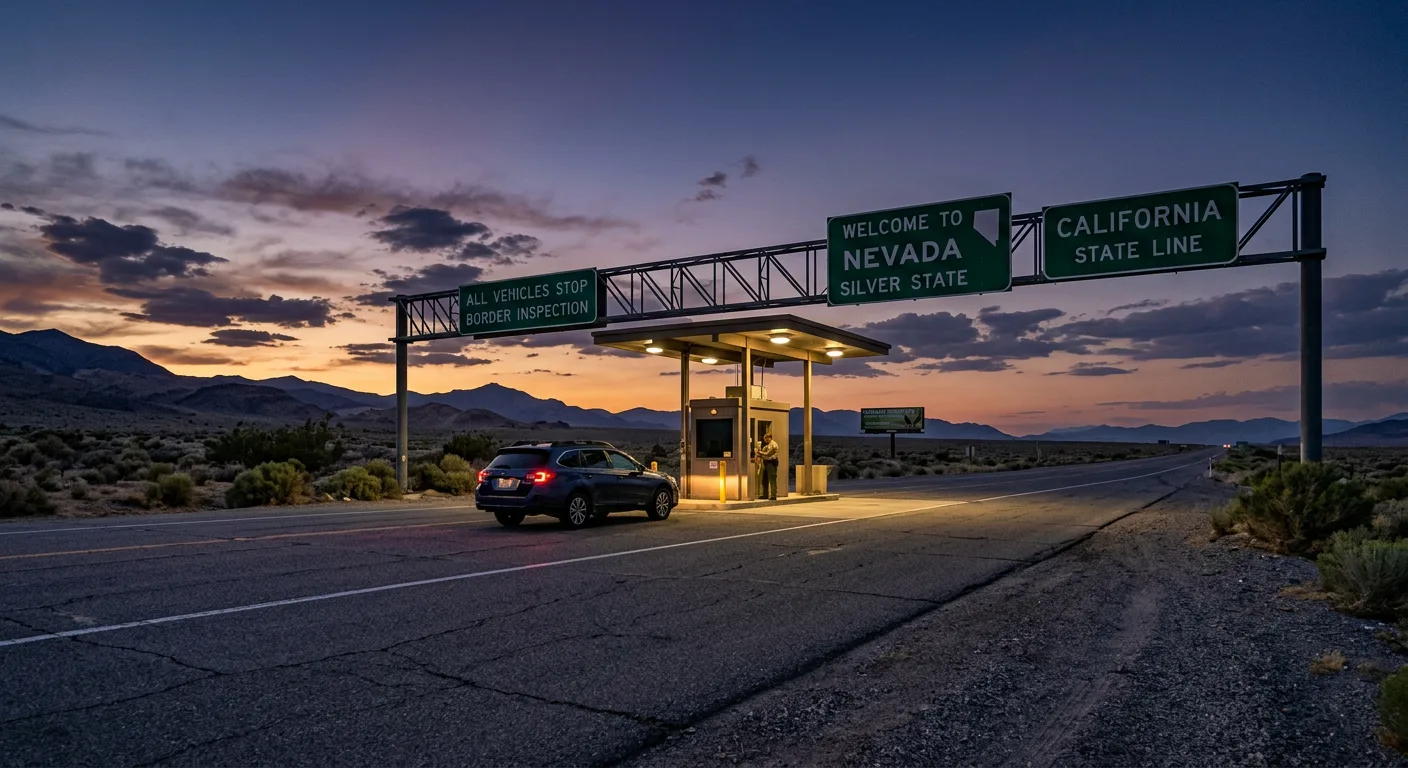
This is the most important section in this guide. It doesn't matter how much cannabis you bought legally, how little is left, or that you're driving between two fully legal states. Transporting cannabis across any state line in the U.S. is a federal crime under the Controlled Substances Act — specifically, interstate drug trafficking. The legal status of cannabis in either state is completely irrelevant to federal law.
Real-world scenarios that constitute federal trafficking:
- Driving from Denver, CO to Salt Lake City, UT with cannabis you bought legally in Colorado
- Driving from Las Vegas, NV to Los Angeles, CA with cannabis — even though both states are legal
- Taking a train or bus from one legal state to another with cannabis in your bag
- Mailing cannabis you purchased to your home address (federal mail system)
- Using a private vehicle or rental car across any state line with cannabis
Critical Warning: Federal cannabis trafficking charges are not a fine — they are criminal offenses that can result in federal prosecution, prison time, and a permanent federal record. The fact that weed was purchased legally in a legal state provides zero federal defense. Consume it there or leave it behind. Period.
State Border Patrol: What Actually Happens
Cannabis tourism forums are full of stories about people driving between legal states without incident. This reflects the reality of selective enforcement — not the legal reality. Border patrol agents at state lines operate under federal authority and can search your vehicle if they have reasonable suspicion. Interstate highways near legal states (I-70 in Colorado, I-15 between Nevada and California, I-90 in Washington) see regular federal-agency presence.
The smell of cannabis in a vehicle can establish probable cause for a search. The presence of a dispensary bag in plain view can constitute reasonable suspicion. 'I bought it legally' is not a legal defense to a federal trafficking charge. The risk is not worth it.
Flying With Cannabis: TSA, Airport Rules & What Actually Happens
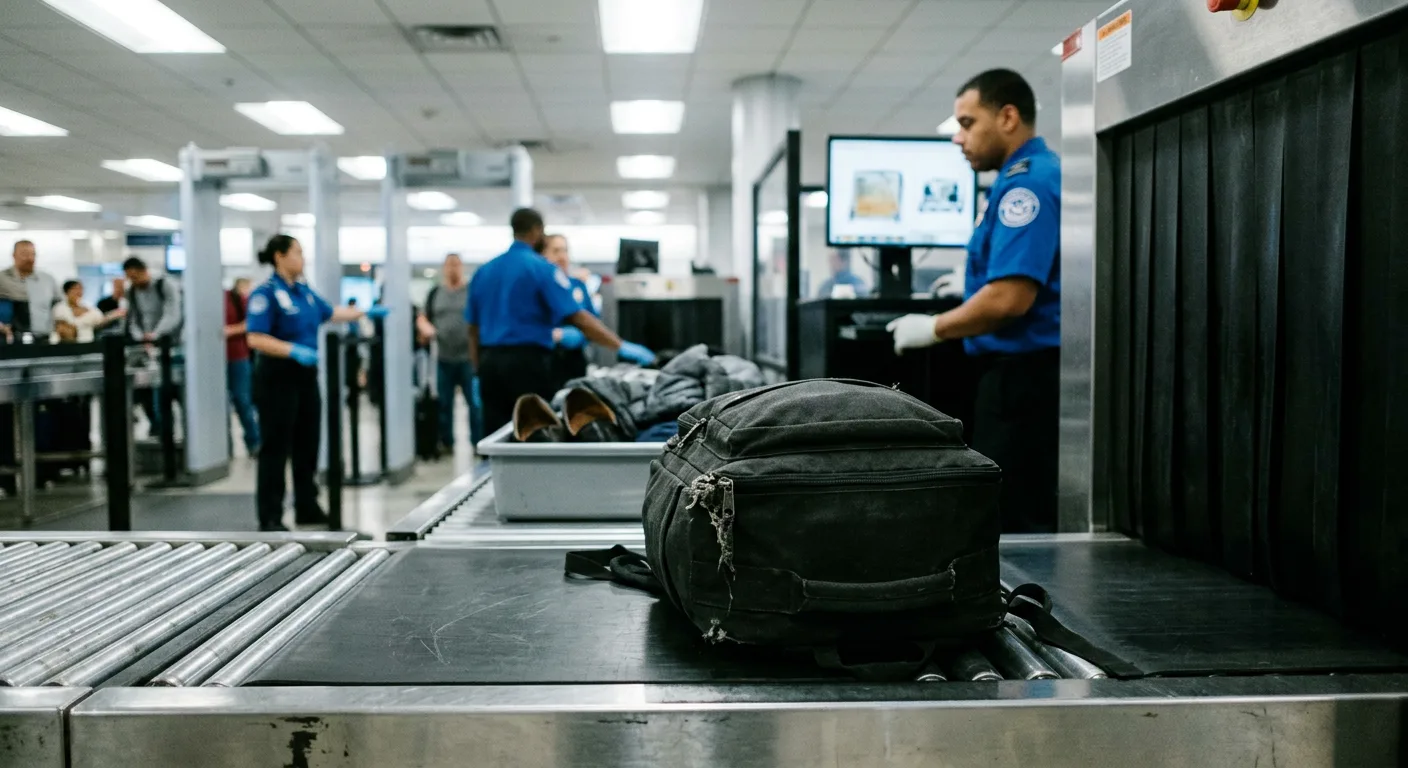
Flying with cannabis — even a small amount, even within a legal state — sits in a complicated gray zone that visitors routinely misunderstand. Here's the full picture for 2026, including what TSA actually looks for, what airports in legal states do about it, and why 'what actually happens' differs from 'what the law says.'
TSA's Official Policy (And Its Limits)
The Transportation Security Administration is a federal agency. Cannabis is a federal Schedule I controlled substance. TSA's official policy states that TSA officers 'do not search for marijuana or other illegal drugs' but that if cannabis is discovered during security screening, TSA will refer the matter to law enforcement.
What this means practically:
- TSA scanners and agents are looking for weapons, explosives, and security threats — not cannabis
- Cannabis is unlikely to be the focus of a search unless it's obvious (strong smell, visible packaging, suspicious density on X-ray)
- If TSA finds it, they do not arrest you — they call the airport's law enforcement officers
- What those officers do depends entirely on the airport's location and local law
Airport-by-Airport: How Legal-State Airports Handle Discovery
Several major airports in legal states have adopted pragmatic policies for small amounts of cannabis:
- Los Angeles International (LAX): LAX-PD policy (updated 2019) directs officers to allow passengers with less than the California legal possession limit to keep their cannabis or dispose of it, rather than arresting them. This applies only to domestic departures.
- Denver International (DEN): Denver Airport prohibits cannabis on its property. However, Denver PD officers typically offer the option to dispose of small amounts before proceeding through security.
- Harry Reid International (LAS) — Las Vegas: Similar disposal option for small amounts — but the airport has amnesty boxes before security checkpoints specifically for this purpose.
- Portland International (PDX): Oregon law allows possession; PDX officers have discretion but typically allow disposal rather than charging.
The key phrase in every case above is 'small amounts' and 'domestic.' Flying internationally with any cannabis — even from a legal-state airport — is a completely different and far more serious matter involving federal customs law and the laws of your destination country.
The Real Risk: The scenario most travelers worry about — getting arrested for a joint in their carry-on at Denver airport — is unlikely in practice. The scenario they don't worry about — flying into a non-legal state with cannabis from a legal state — is a genuine criminal risk. Know where you're landing, not just where you're departing.
Cannabis on Flights: Destination Matters More Than Origin
Even if you somehow pass through a legal-state airport with cannabis and board a domestic flight, the destination state's laws apply when you land. Arriving in Texas, Florida, Idaho, or any other non-legal state with cannabis constitutes possession under that state's law. Some of those states have serious mandatory minimums for possession charges. Your origin story ('I bought it legally in Colorado!') does not transfer.
The Seed Tourism Angle: Can You Buy Cannabis Seeds and Bring Them Home?
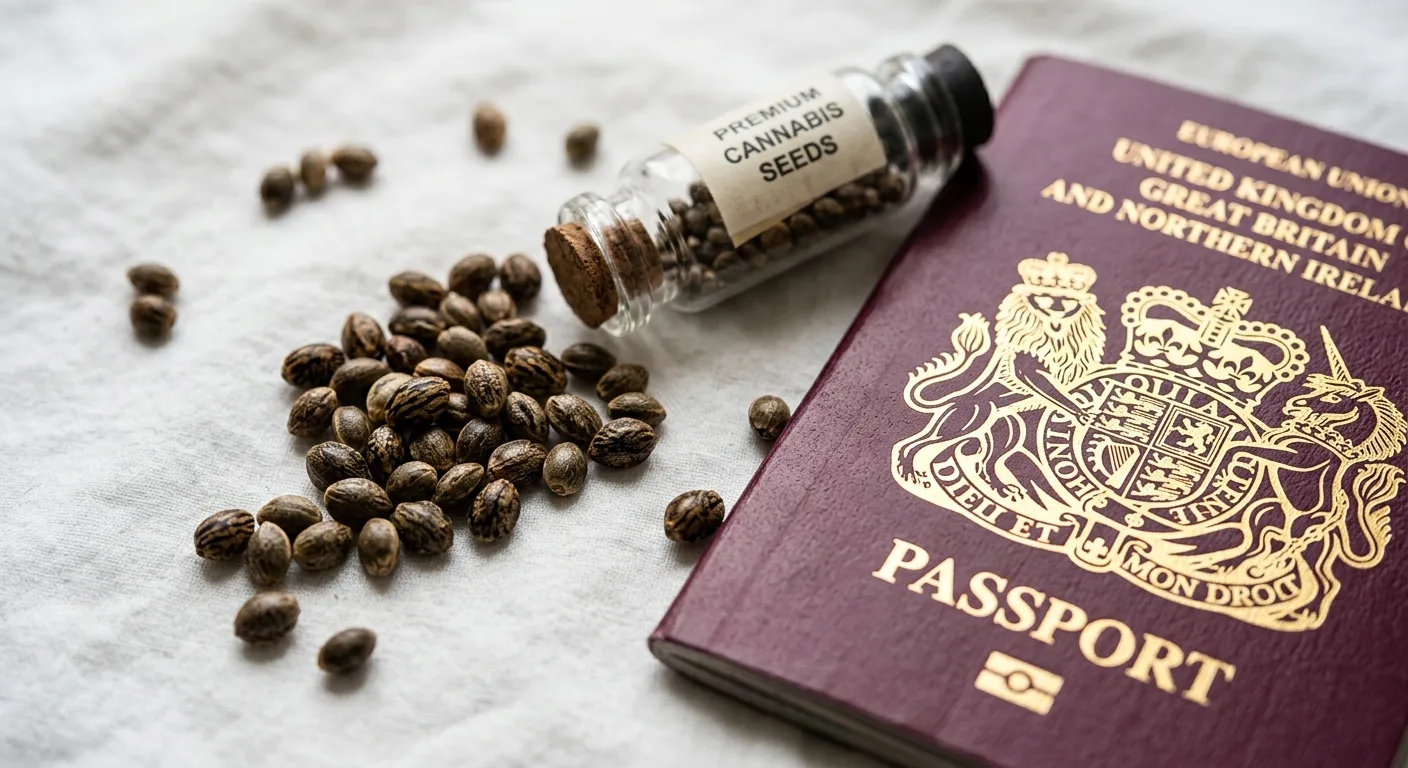
This is the question almost no cannabis tourism guide addresses directly — and it has become a real phenomenon as seed genetics have gone mainstream. Visitors to legal states often browse seed selections at dispensaries or dedicated seed retailers, fall in love with a particular strain, and wonder: can I bring these home?
The short answer: legally, no. The practical reality: more complicated.
The Legal Status of Transporting Seeds Across State Lines
Cannabis seeds are controlled under the same federal law as flower, concentrate, and any other cannabis product. They are Schedule I controlled substances regardless of whether they are 'viable' (capable of germination) or not. Transporting them across state lines — in a car, by mail, in a checked bag, or in a carry-on — is subject to the same federal interstate trafficking statutes that apply to flower.
The argument that 'they're just seeds, not plants' does not hold up legally. DEA scheduling covers the entire cannabis plant and all its parts, including seeds.
What Actually Happens With Seed Tourism
In practice, small quantities of cannabis seeds are rarely the focus of law enforcement attention. However, 'rarely prosecuted' and 'legal' are not the same thing. A few important realities:
- Customs and Border Patrol specifically trains for seed detection at international border crossings
- Seeds sent through the U.S. Postal Service are subject to federal mail law — interception does happen
- State-line crossings by vehicle with seeds carry the same federal risk as flower
- Flying from a legal state with seeds is subject to the same TSA/local-law dynamics as flower
The Smarter Alternative: Seed tourism is an unnecessary risk with a much simpler solution. Ordering premium cannabis seeds online from a reputable seed retailer ships to your door without requiring a flight, a border crossing, or a legal gray-area purchase. The genetics available online are at least as good — usually better — than what you'll find on dispensary shelves.
Why Online Seeds Beat Seed Tourism Every Time
Beyond the legal risk, seed tourism has practical limitations that online purchasing doesn't:
- Dispensary seed selections are curated for local market preferences — not necessarily the genetics you want
- Strain information at the point of sale is often superficial compared to detailed online descriptions
- Online seed retailers carry extensive catalogues with verified THC percentages, grow difficulty ratings, flowering times, and genetic lineage
- You can browse at home, research thoroughly, and order the exact genetics you want — no trip required
If you're curious about what's worth growing, the genetics available online cover every category: high-THC workhorses like OG Kush Feminized (26% THC) and Quantum Kush Feminized (30% THC), classic diesels like Sour Diesel Feminized (24% THC), and beginner-friendly autoflowers like Skywalker OG Autoflower (23% THC) — all available without leaving your home state. Compare that to gambling on what's in stock at a dispensary seed case after a cross-country flight.
For beginner growers who want maximum yield from their first order, the Northern Lights x Big Bud Feminized (20% THC) is one of the most forgiving and productive strains available online — the kind of genetics you'd be lucky to find at a dispensary seed wall. For those who like a citrus-forward cerebral high, Super Lemon Haze Feminized (23% THC) delivers consistent results. Learn more about storing whatever you buy in our complete seed storage guide to maximize viability.
Seed Shopping Tip: Before buying seeds — online or in person — check your home state's laws on possession and cultivation. Our complete 2026 seed legality guide covers what's permitted state by state, so you know exactly where you stand before anything arrives at your door.
Cannabis-Friendly Hotels & Accommodation: What to Look For
Finding somewhere legal to actually consume is the defining frustration of cannabis tourism in 2026. Hotels present a specific problem: they are private property governed by their own policies, and the vast majority of major hotel chains prohibit cannabis use entirely — regardless of state law. Violation of this policy typically results in a cleaning fee ($250–$500 is common), potential room cancellation, or both.
Categories of Cannabis-Friendly Accommodation
Genuinely cannabis-friendly accommodation falls into a few categories:
- Cannabis B&Bs and boutique properties: Several operators in Colorado, California, and Nevada specifically market to cannabis tourists. These properties are typically owner-operated and explicitly permit consumption in designated outdoor spaces or specific rooms.
- VRBO/Airbnb private rentals: Individual hosts can set their own cannabis policies. A significant number of listings in Colorado and California explicitly allow cannabis use in outdoor spaces. Always check the listing and confirm in writing before booking.
- Campgrounds and outdoor recreation: Many national and state parks prohibit cannabis (federal land = federal law). Private campgrounds in legal states vary. RV camping on private lots in legal states is one of the more genuinely flexible consumption environments.
- Cannabis-branded hospitality: A small but growing category of purpose-built cannabis hotel experiences exists in Colorado and California. These are marketed explicitly as '420-friendly' and typically have designated outdoor consumption spaces compliant with local ordinances.
Hotel Smoke Detectors: Smoking or vaping cannabis in a hotel room that prohibits it isn't just a policy violation — it can trigger fire suppression systems, result in facility charges, or constitute property damage. Even in legal states, consuming in a prohibited space is a real-world and financial risk. Don't assume you won't be caught.
How to Find Genuine 420-Friendly Stays
Several booking platforms now include cannabis-friendliness filters or dedicated categories. When searching independently, look for these signals in a listing:
- Explicit mention of '420 friendly,' 'cannabis welcome,' or 'designated smoking area' in the description
- Properties listed with outdoor patios, gardens, or private decks (often the designated consumption space)
- Host reviews specifically mentioning cannabis tolerance
- Location proximity to consumption lounges in the same neighborhood
Purchase Laws vs. Consumption Laws: They Are Not the Same Thing
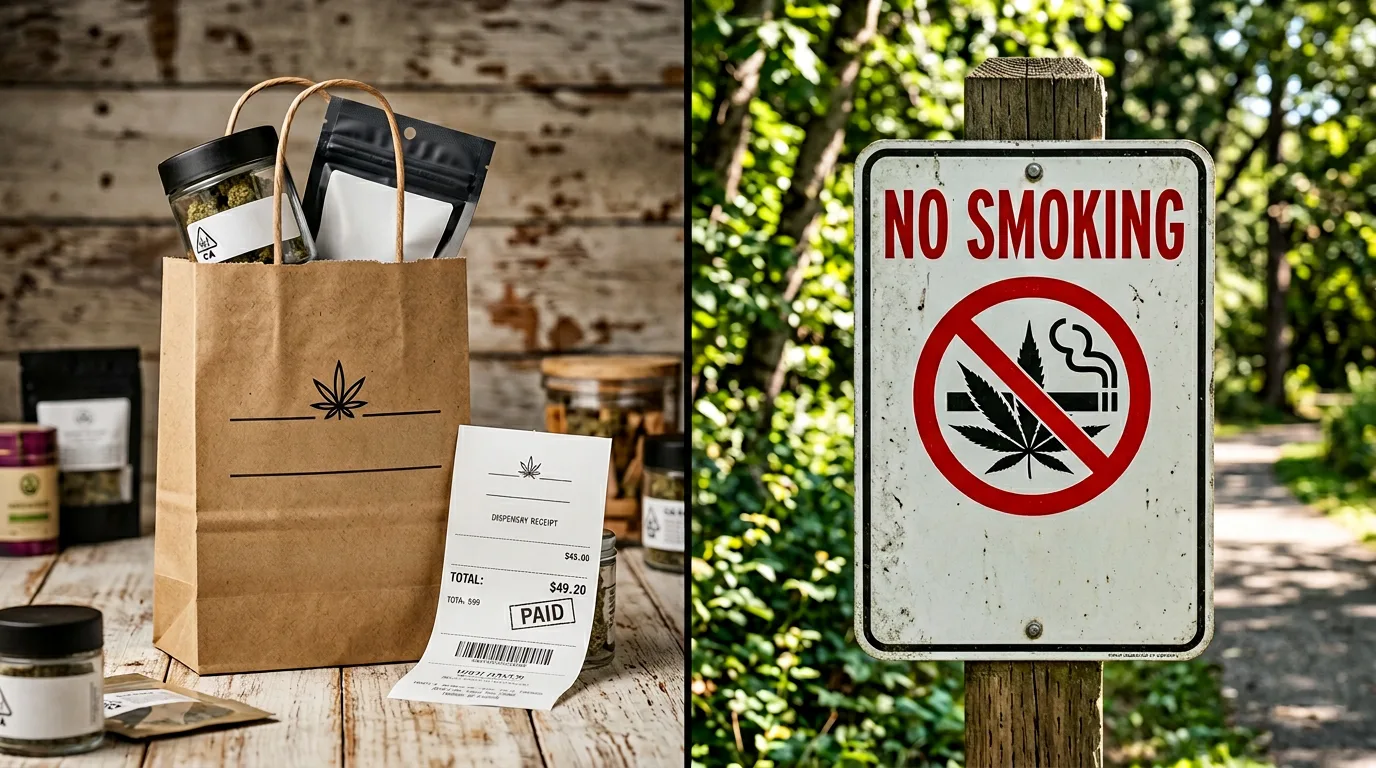
One of the most common tourist mistakes is conflating the right to buy cannabis with the right to consume it anywhere. These are two entirely separate areas of law, and in every legal state, they operate independently. Understanding the difference before you visit will save you from fines, embarrassing situations, or worse.
What 'Recreational Legal' Actually Means
When a state legalizes recreational cannabis, it typically means:
- Adults 21+ may purchase from licensed retailers
- Adults 21+ may possess up to the state limit
- Adults may consume in private, on private property where they have permission to do so
It does NOT mean:
- You can smoke on public sidewalks, in parks, at beaches, or on any public land
- You can consume in bars, restaurants, or retail spaces unless specifically licensed
- You can consume in your rental car, Uber, or any vehicle
- You can consume anywhere tobacco smoking is prohibited (in most states, cannabis consumption laws mirror tobacco public smoking bans)
Public Consumption Penalties by State
| State | Public Consumption Penalty | Type |
|---|---|---|
| Colorado | Up to $100 fine | Civil infraction |
| Nevada | Up to $600 fine | Civil infraction |
| California | $100 fine | Civil infraction |
| Oregon | Up to $1,000 fine | Class B violation |
| Washington | Up to $100 fine | Civil infraction |
| Illinois | Up to $200 fine | Civil infraction |
| New York | Up to $25 fine | Civil infraction |
| Michigan | Up to $100 fine | Civil infraction |
| Arizona | Up to $300 fine | Civil infraction |
| New Jersey | Up to $200 fine | Civil infraction |
Enforcement Reality: Public consumption enforcement is highly variable. New York City, for example, rarely enforces its $25 fine in many neighborhoods, while other jurisdictions actively ticket. Fines are not the only risk — being publicly intoxicated in some states can escalate to a misdemeanor arrest even if the underlying substance is legal.
State-by-State Quick Reference: Visitor Cannabis Rules 2026
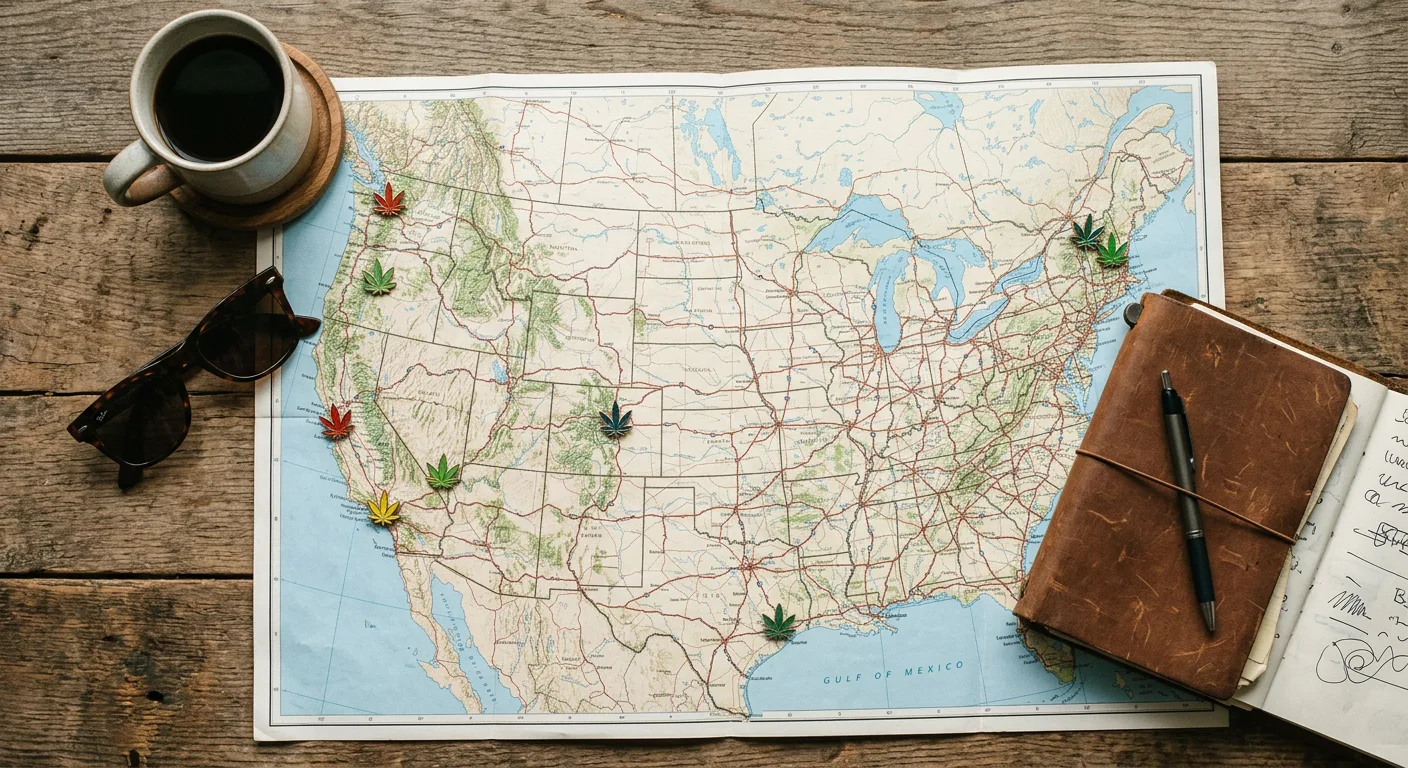
Use this section as a fast-reference when planning a specific trip. Each entry covers what visitors can do, where they can consume, and notable restrictions unique to that state's cannabis tourism laws.
Colorado — Most Experienced Cannabis Tourism Market
- Out-of-state purchase: Yes, 1 oz limit, any valid 21+ ID
- Consumption lounges: Yes — Denver has multiple licensed venues; other cities vary
- Public consumption: Illegal, civil fine up to $100
- Notable: One of the most cannabis-tourism-developed states; Breckenridge, Aspen, and Denver have robust dispensary infrastructure for visitors
Nevada — Best for First-Time Cannabis Tourists
- Out-of-state purchase: Yes, 1 oz limit
- Consumption lounges: Yes — most developed in Las Vegas; some Strip-adjacent options
- Public consumption: Illegal; fine up to $600
- Notable: Airport amnesty boxes at Harry Reid International; most tourist-friendly infrastructure overall
California — Best Variety, Most Variable by City
- Out-of-state purchase: Yes, 1 oz limit
- Consumption lounges: Available in select cities (LA, SF, Palm Springs); many cities have not opted in
- Public consumption: Illegal; $100 fine
- Notable: Palm Springs has become a cannabis-friendly destination with multiple lounge options and 420-friendly hotels
Oregon — Budget-Friendly, Few Lounge Options
- Out-of-state purchase: Yes, 1 oz limit
- Consumption lounges: Limited; framework exists but few operational venues
- Public consumption: Illegal; up to $1,000 fine (highest on this list)
- Notable: Oregon has some of the lowest cannabis prices in the U.S. — excellent for purchasing, limited for consuming legally
Washington State — Seattle Market Is Large, Lounge Scene Is Small
- Out-of-state purchase: Yes, 1 oz limit
- Consumption lounges: Very limited; law has evolved slowly
- Public consumption: Illegal; $100 fine
- Notable: Large dispensary market in Seattle; consumption options for visitors remain a significant gap
Michigan — Highest Purchase Limit, Growing Lounge Scene
- Out-of-state purchase: Yes, 2.5 oz limit (highest of any state)
- Consumption lounges: Licensing framework exists; growing number of venues in Detroit and Grand Rapids
- Public consumption: Illegal; up to $100 fine
- Notable: Michigan's 2.5 oz purchase limit is the most generous for visitors; prices are competitive with Oregon
New York — Largest Legal Market, Slowest Lounge Rollout
- Out-of-state purchase: Yes, 3 oz flower limit
- Consumption lounges: Framework exists; operational venues remain very limited as of 2026
- Public consumption: $25 fine (lowest in the U.S.) — widely unenforced in many NYC neighborhoods
- Notable: Despite the $25 fine and relaxed enforcement in some areas, public consumption in NYC still carries real risk; the legal lounge infrastructure has not kept pace with the retail market
Illinois — Visitor-Specific Purchase Limits Apply
- Out-of-state purchase: Yes, but limited to 15g flower (residents get 30g)
- Consumption lounges: Limited; some Chicago-area dispensary-attached options
- Public consumption: Illegal; up to $200 fine
- Notable: Only state with visitor-specific purchase limits — know this before you go
Pro Tip for Trip Planning: Before visiting any legal state, check the specific municipality — not just the state — for consumption lounge availability. Many state-level rules delegate lounge licensing to cities and counties, and urban centers are almost always more permissive than surrounding areas.
Practical Tips Every Cannabis Tourist Should Know
Laws are one thing — practical, on-the-ground knowledge is what actually makes a cannabis trip work. These are the things that veteran cannabis travelers know that first-timers often don't.
Talk to Your Budtender
A great budtender is the best cannabis tourism resource available to you. They know the local lounge options, the nearest cannabis-friendly outdoor spaces that are tolerated (even if not strictly legal), the best products for first-time or casual visitors, and the dosing pitfalls that send tourists to urgent care after underestimating edibles. Always tell them you're visiting and ask for their honest recommendations — it's exactly what they're trained for.
Start Lower Than You Think You Need To
Cannabis-related emergency room visits spike in legal states around major tourist seasons. The overwhelming driver is not flower but edibles. Visitors buy a 100mg edible bar, eat a quarter of it, feel nothing after 45 minutes, eat another quarter — and then get hit hard two hours later. Legal state dispensaries are required to sell edibles in individually labeled 10mg-per-serving packages for exactly this reason. Follow the serving size. Wait the full two hours.
Consume Before You Drive — Not Even a Little
Driving under the influence of cannabis is a DUI in every U.S. state — legal or not. Colorado, Washington, and Nevada all have per se DUID laws with THC blood limits. Other states use impairment-based standards. Rental car companies have specific policies around DUI violations. A cannabis-related DUI as a visitor can mean immediate license issues in your home state through the interstate compact system. Don't drive stoned.
Use Delivery Where Available
Several states with recreational markets permit licensed cannabis delivery to hotels and private residences. California, Nevada, and Massachusetts all have active delivery markets. If your accommodation is the issue (can't consume there, no lounge nearby), delivery gets the product to a more manageable situation. Check local delivery availability through dispensary apps or websites before your trip.
Plan Your Genetics Research Before You Go
If discovering new strains is part of your travel motivation, do your research at home first. Dispensary menus vary wildly by region — what's abundant in Colorado may be unavailable in New Jersey. Apps like Leafly and Weedmaps show real-time dispensary menus so you can identify target purchases before you arrive. And remember: if you find a strain you love, the genetics are almost certainly available to grow at home. Our Indica vs. Sativa growing guide is a good starting point for understanding what you're working with.
Strains like White Widow Feminized (25% THC) and Purple Kush Feminized (27% THC) appear on dispensary shelves across legal states — and both are available online as seeds for home cultivation in states where growing is permitted. If the idea of growing your own appeals to you after your trip, use our grow planner tool to map out your first indoor grow, and the yield estimator to set realistic expectations before you invest in equipment.
For those drawn to classic sativas found in West Coast dispensaries, New York Power Diesel Feminized (24% THC) and Tangerine Haze Feminized (18% THC) are widely loved genetics that grow beautifully indoors. Autoflowering options like Amnesia Haze Autoflower (17% THC) make the transition from tourist to home grower especially accessible — no complicated light schedule management required. For complete context on autoflower growing, see our autoflower beginner's guide.
The Bottom Line on Seed Tourism: The entire seed tourism exercise — traveling to a legal state, finding a dispensary with good genetics, navigating legal risk to bring seeds home — is a complicated, risky, and ultimately unnecessary trip when the same genetics (often better-documented and more reliably sourced) are available online with discreet shipping to your door. Save the trip for the experience. Get the seeds a smarter way.
Frequently Asked Questions
Can tourists buy cannabis in legal states without a residency card?
Yes. Every recreational cannabis state that allows adult-use sales permits out-of-state visitors to purchase cannabis with a valid government-issued photo ID proving they are 21 or older. No state residency is required. Illinois is the only state that applies a lower purchase limit to out-of-state visitors (15g vs. 30g for residents), but even there, purchase access is fully open to visitors.
Can I take cannabis I bought in Colorado back to my home state on a plane?
No. Transporting cannabis across state lines — including by air — is federal interstate drug trafficking under the Controlled Substances Act, regardless of the laws in either state. This applies even when flying between two legal states. The practical risk at departure from legal-state airports is low for small amounts, but landing in a non-legal state with cannabis is a genuine criminal risk under that state's law.
Which states have cannabis consumption lounges open to visitors in 2026?
Nevada (Las Vegas area), Colorado (Denver and select municipalities), California (select cities including Palm Springs, parts of LA and SF), New Jersey, and Illinois (limited Chicago-area options) all have licensed consumption lounges open to adults 21+ regardless of residency. The quality and quantity of venues varies significantly — Nevada has the most visitor-friendly infrastructure, while Illinois and New York have the least developed operational lounge scenes despite having legal frameworks.
Can I buy cannabis seeds in a legal state and bring them home?
Legally, no. Cannabis seeds are federally scheduled controlled substances, and transporting them across state lines — by car, plane, or mail — is subject to the same federal law as any other cannabis product. In practice, enforcement of small seed quantities is rare but not zero, particularly at international border crossings. The far simpler alternative is purchasing seeds online from a reputable retailer, which ships directly to your home without requiring interstate transport of a controlled substance.
What actually happens if TSA finds cannabis in my carry-on?
TSA agents are not actively searching for cannabis — their primary mission is identifying security threats. If cannabis is discovered incidentally, TSA policy requires them to refer the matter to local law enforcement. At airports in legal states (LAX, DEN, LAS), local officers typically offer the option to dispose of small amounts rather than pursue charges. The risk increases significantly if you're departing for a non-legal state, and flying internationally with cannabis is a serious federal and customs offense in any scenario.