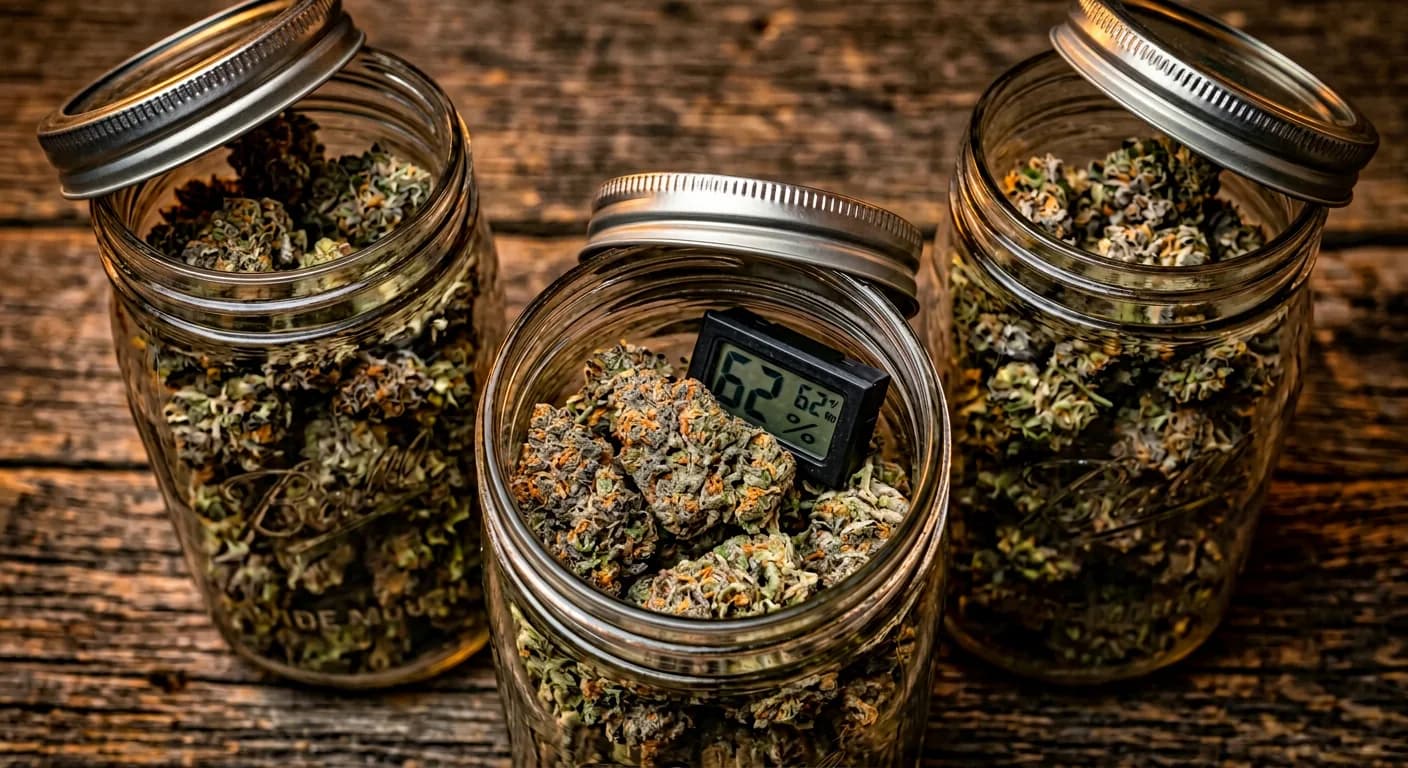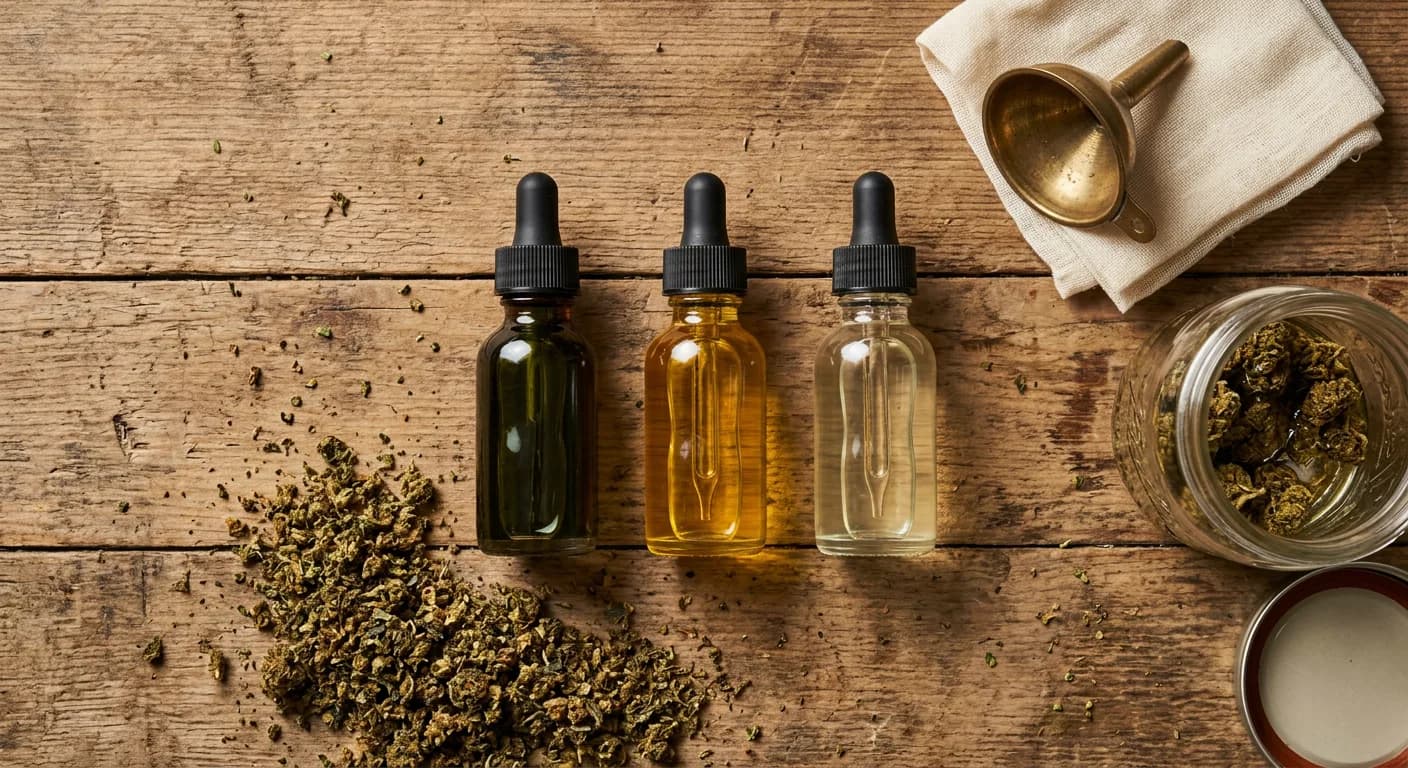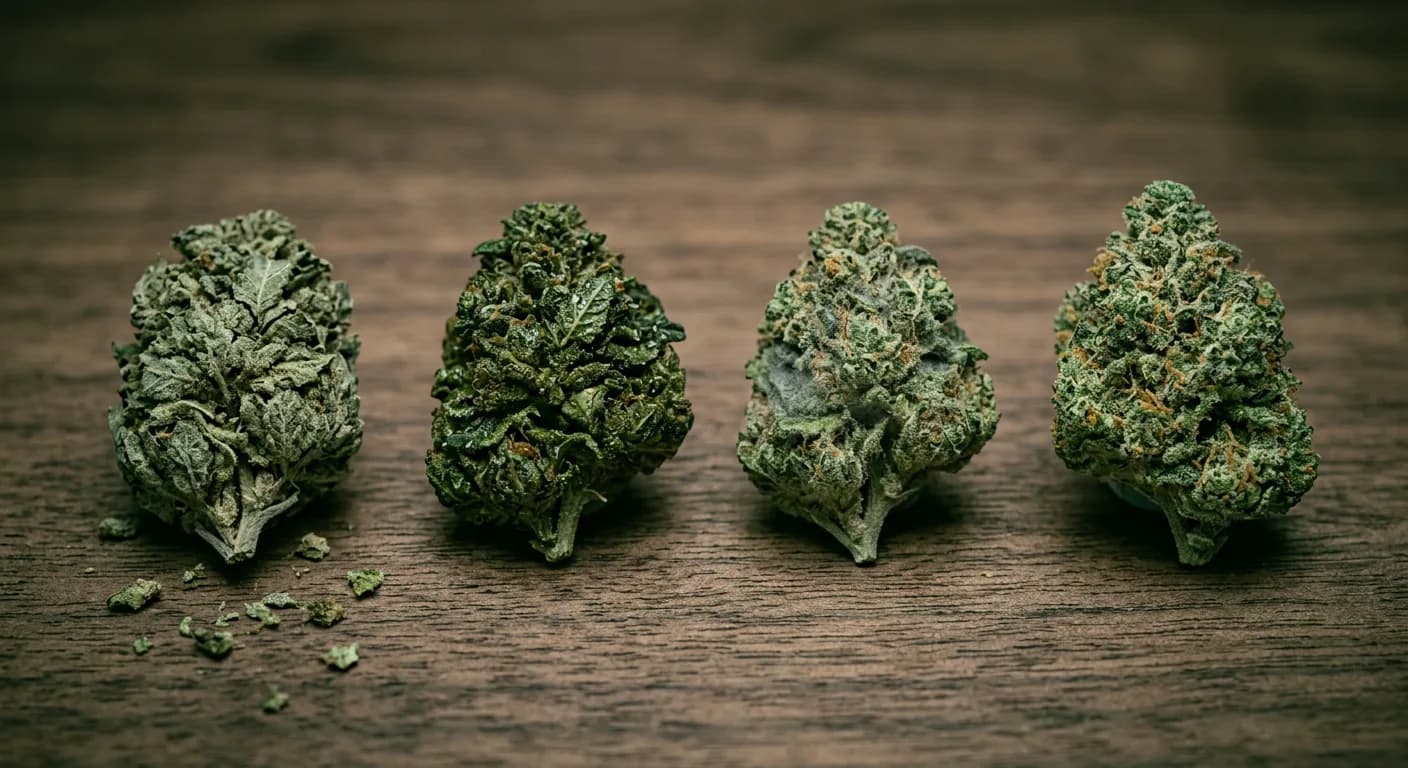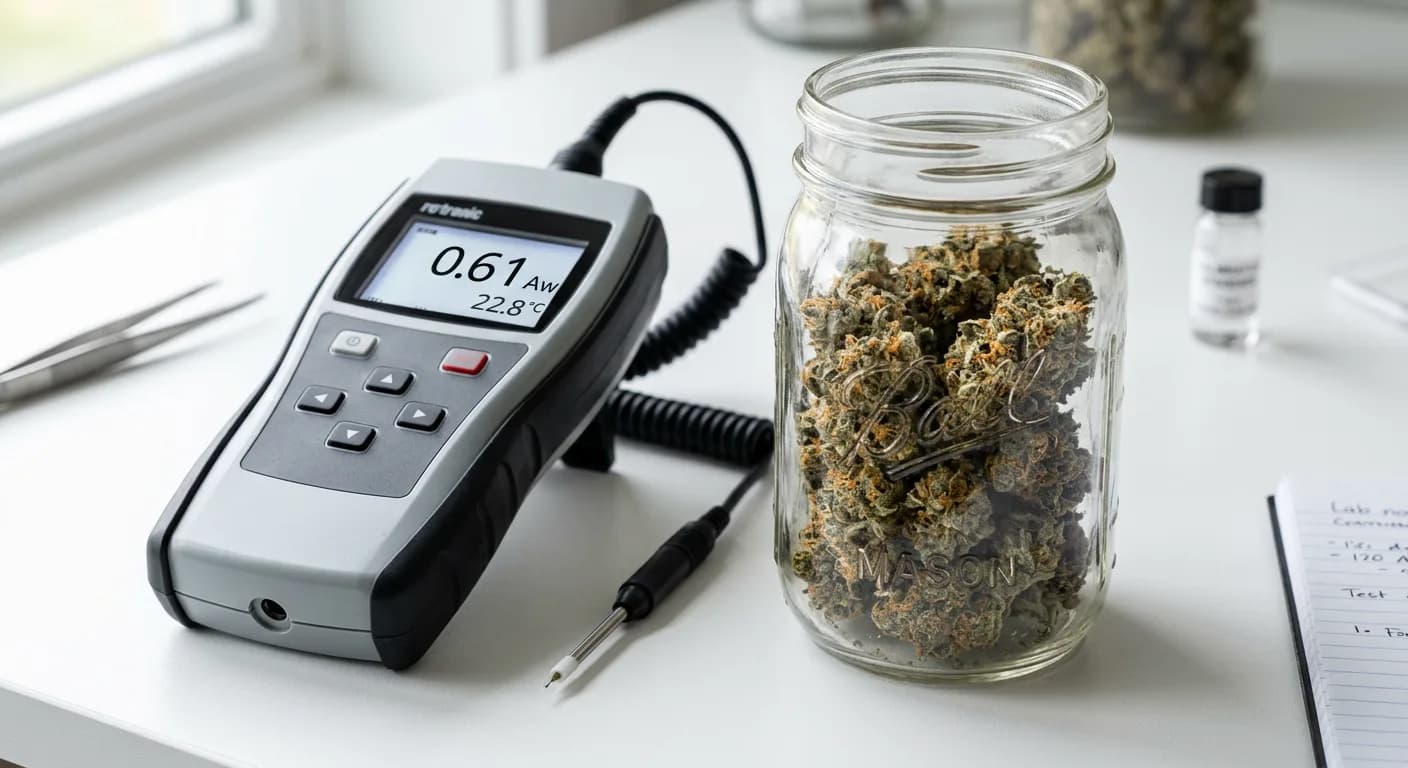
Every week on r/microgrowery, another grower posts the same bewildering problem: they followed a perfect curing protocol, their hygrometer read a solid 62% RH inside the jar, and two weeks later they're staring at a fuzzy grey bloom of mold destroying their harvest. The answer nobody gives them is water activity cannabis curing: the metric that commercial producers actually use to determine whether cannabis is safe to store, ship, and sell.
Room humidity tells you about the air. Water activity tells you about the bud itself. These are fundamentally different measurements, and confusing them is exactly why mold keeps winning. This guide breaks down the science, the standard, the tools, and the corrective actions, so your next cure is bulletproof.
Free vs. Bound Moisture: What Water Activity Actually Measures
Water activity (Aw) is the measure of free, unbound water in a substance, expressed on a scale from 0.00 (bone dry) to 1.00 (pure liquid water). It is not a measure of how much water is present by weight. It measures how much of that water is mobile, available to chemical reactions, and, critically: available to support microbial life like mold and bacteria.
In any cannabis bud, water exists in two forms. Bound water is chemically attached to sugars, proteins, cell walls, and other molecules. Mold cannot access it; it is effectively locked away. Free water moves through the plant matrix, evaporates into surrounding air, and creates the environment where Botrytis, Aspergillus, and other pathogens thrive.
Aw is defined as the ratio of the vapor pressure of water in a food or plant material (p) to the vapor pressure of pure water at the same temperature (p₀): Aw = p/p₀. At equilibrium, Aw numerically equals the equilibrium relative humidity (ERH) divided by 100, which is why a cannabis sample at Aw 0.62 will equilibrate to approximately 62% RH in a perfectly sealed container.
This is also why two buds can have identical moisture content percentages by weight yet wildly different mold risk profiles. Dense, resinous genetics bind water differently than airy, thin-walled buds. A sample at 12% moisture content could sit at Aw 0.58 (safe) or Aw 0.67 (actively dangerous) depending entirely on the bud's cellular structure and how curing has progressed.
Moisture content tells you how much water is in the bud. Water activity tells you what that water is doing. For mold prevention, only water activity gives you a reliable answer.
ASTM D8196 and the 0.55–0.65 Aw Standard Explained
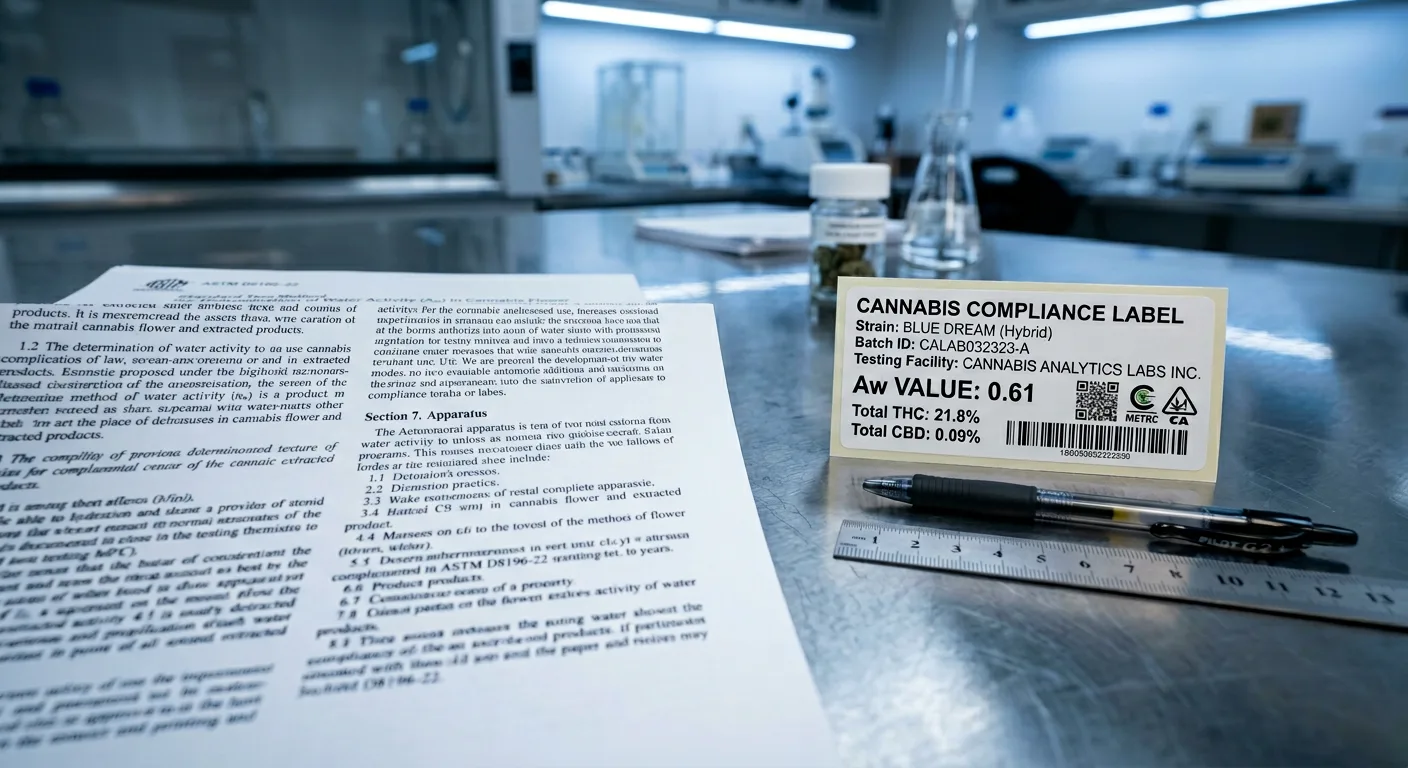
The 0.55–0.65 Aw safe zone for cannabis is not a rule of thumb invented by growers: it is codified in ASTM D8196, the official ASTM International standard specifically developed for cannabis water activity measurement. Regulatory agencies in legal cannabis markets, state compliance labs, and commercial producers all reference this standard when assessing whether a product is shelf-stable and safe for sale.
ASTM D8196 defines the standard test method for water activity in cannabis flower and related materials. It specifies instrument calibration requirements, sample preparation procedures, temperature control conditions (measurements must occur at a controlled temperature, typically 25°C), and the 0.55–0.65 Aw target range as the benchmark for compliant, shelf-stable cannabis.
Many state cannabis markets now require water activity testing on commercial flower before it can be sold at dispensaries, in the same way potency and pesticide testing are mandatory. Even if your state does not yet require it, testing to the same standard protects your crop and your reputation.
The 0.55–0.65 range was chosen because it sits at the intersection of two competing concerns: high enough to keep terpenes intact and smoke smooth, low enough that no known cannabis mold pathogen can sustain growth. Botrytis cinerea (bud rot) requires a minimum Aw of approximately 0.93 for germination but can sustain growth at lower levels. Aspergillus species, the genus most dangerous to immunocompromised consumers, requires a minimum Aw of around 0.70–0.78 depending on species. Staying below 0.65 gives a significant safety buffer against all common cannabis pathogens.
The ASTM D8196 standard exists because the cannabis industry needed a single, scientifically defensible number. That number is 0.55–0.65 Aw. Everything outside that range represents a measurable, quantifiable risk.
What Happens Above 0.65 Aw: Mold, Mycotoxins, and Ruined Harvests
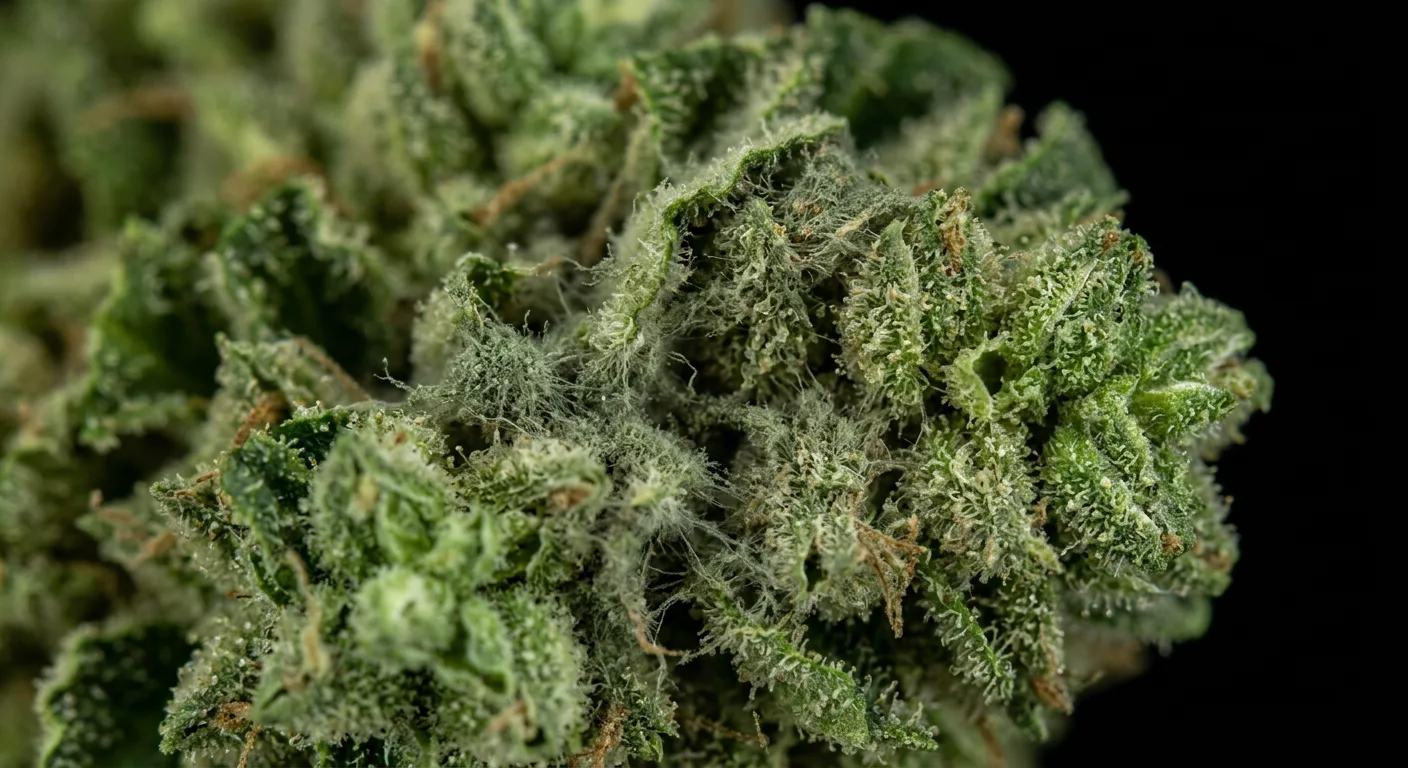
Above 0.65 Aw, cannabis enters what microbiologists call the intermediate moisture zone, the sweet spot for fungal growth. At 0.70 Aw and above, Aspergillus flavus and Aspergillus niger can begin active colonization. By 0.75 Aw, Botrytis can fully establish itself even in darkness inside a sealed jar. At 0.80+ Aw, you are essentially creating a controlled environment for cultivating mold rather than preserving cannabis.
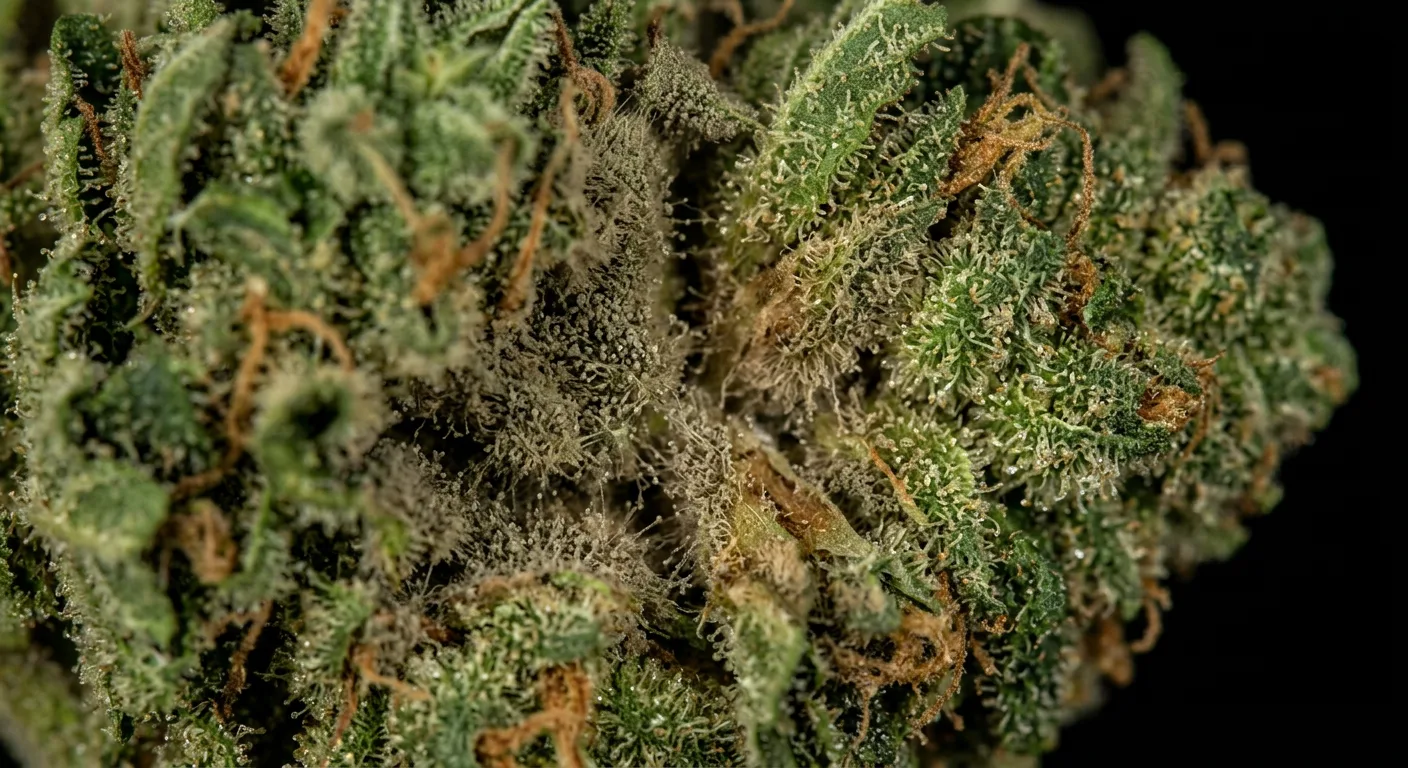
The hidden danger is that mold is not always visible when it begins. At 0.65–0.70 Aw, mycelium can grow invisibly inside a bud's interior for days before any surface sign appears. By the time you see the telltale grey fuzz, the mycotoxin load, including aflatoxins and ochratoxin A, may already be significant. These compounds are heat-stable: they do not burn off when you smoke or vaporize the flower.
- At Aw 0.65–0.70: Xerophilic (low-moisture-tolerant) molds begin colonizing; no visible signs yet
- At Aw 0.70–0.75: Aspergillus species activate; spore production begins within 48–72 hours
- At Aw 0.75–0.80: Botrytis cinerea fully active; visible grey bloom within days
- At Aw 0.80+: Multiple pathogen species competing; harvest loss becomes likely within one week
Never seal cannabis in an airtight container, mason jar, vacuum bag, or mylar pouch, without first confirming Aw is below 0.65. A jar does not protect against mold; it creates the sealed, humid environment that accelerates mold growth if free moisture is already present.
Another overlooked risk above 0.65 Aw is bacterial proliferation. While most cannabis pathogens are fungal, certain bacteria, particularly Pseudomonas and Enterobacter species, can grow at Aw levels above 0.90. These are rarely the cause of total crop failure but contribute to off-smells, slimy surfaces, and potential health concerns for medical consumers.
What Happens Below 0.55 Aw: Over-Dried Buds and Lost Terpenes
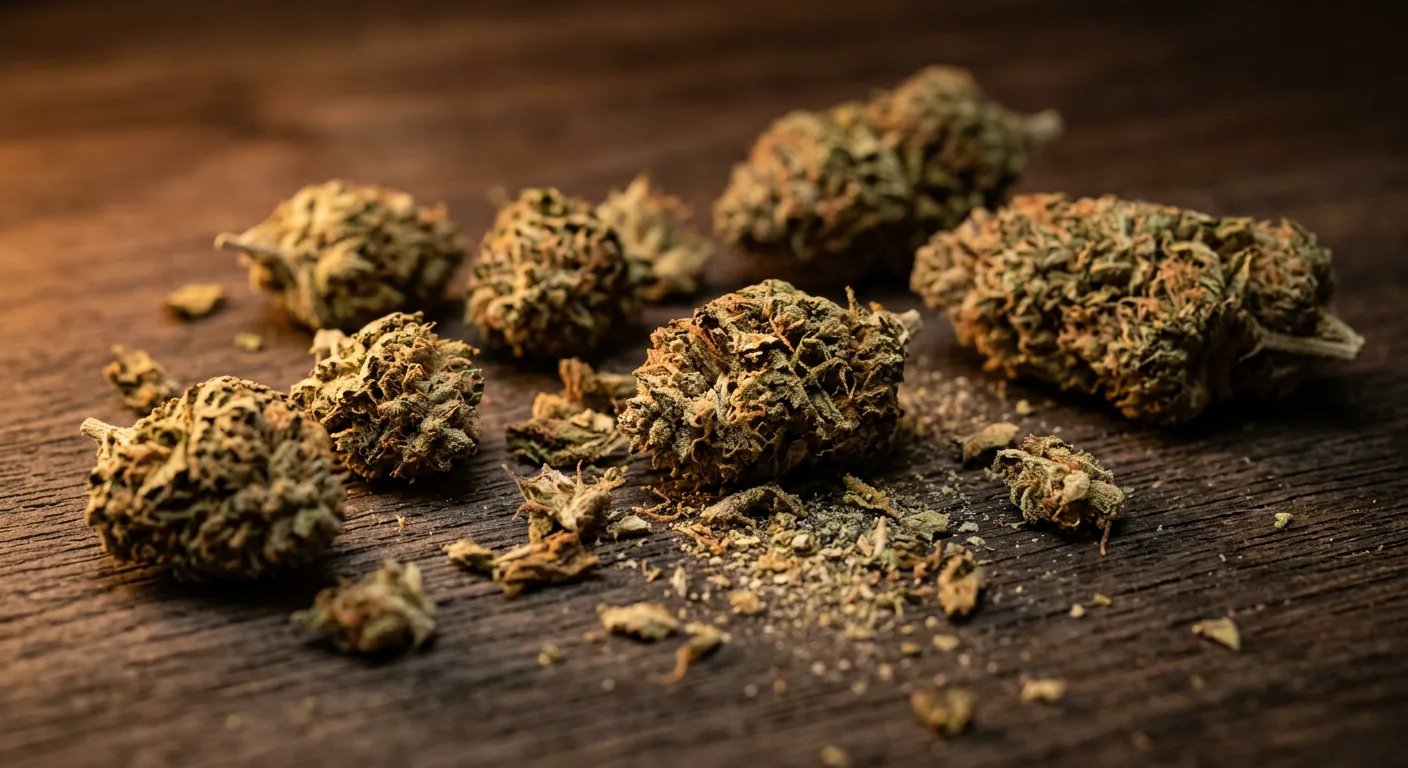
Growers often assume that drier is always safer. Below 0.55 Aw, cannabis is technically mold-proof, but the cost to quality is severe. Terpenes are volatile aromatic compounds with low boiling points and a strong tendency to evaporate from the bud surface into surrounding air. At very low water activity, the plant cell walls that normally hold terpene-rich resin in place become brittle and porous, accelerating terpene off-gassing dramatically.
Studies on aromatic plant materials show that terpene retention drops sharply below 0.50 Aw as cell structure collapses. For a cannabis cultivar like Super Lemon Haze, whose entire value proposition is an intense citrus terpene profile, dropping below 0.55 Aw during long-term storage can strip the cultivar of the aroma and flavor that made it worth growing in the first place.
- Harsh smoke: Over-dried cannabis burns hot and fast, producing acrid, throat-scratching smoke with reduced flavor
- Crumbling texture: Buds below 0.50 Aw disintegrate when handled, making grinding messy and wasteful
- Lost terpenes: Monoterpenes like limonene, myrcene, and pinene evaporate rapidly from desiccated plant matter
- Reduced potency perception: Without supporting terpenes to enhance the entourage effect, the same THC percentage delivers a noticeably blunter experience
- Electrostatic issues: Extremely dry kief and trichomes become electrostatically charged and stick to everything, reducing yield from grinding
If your cannabis reads below 0.55 Aw, rehydration is possible. Place a slightly damp (not wet) food-safe paper towel folded around the outside of the bud, not touching it, inside a sealed jar for 1–2 hours, then re-test. Alternatively, add a 62% Boveda pack to the jar for 24–48 hours. Move slowly, adding too much moisture too fast can push Aw above 0.65.
Why Mason Jar Curing Works: The Chemistry of Burping
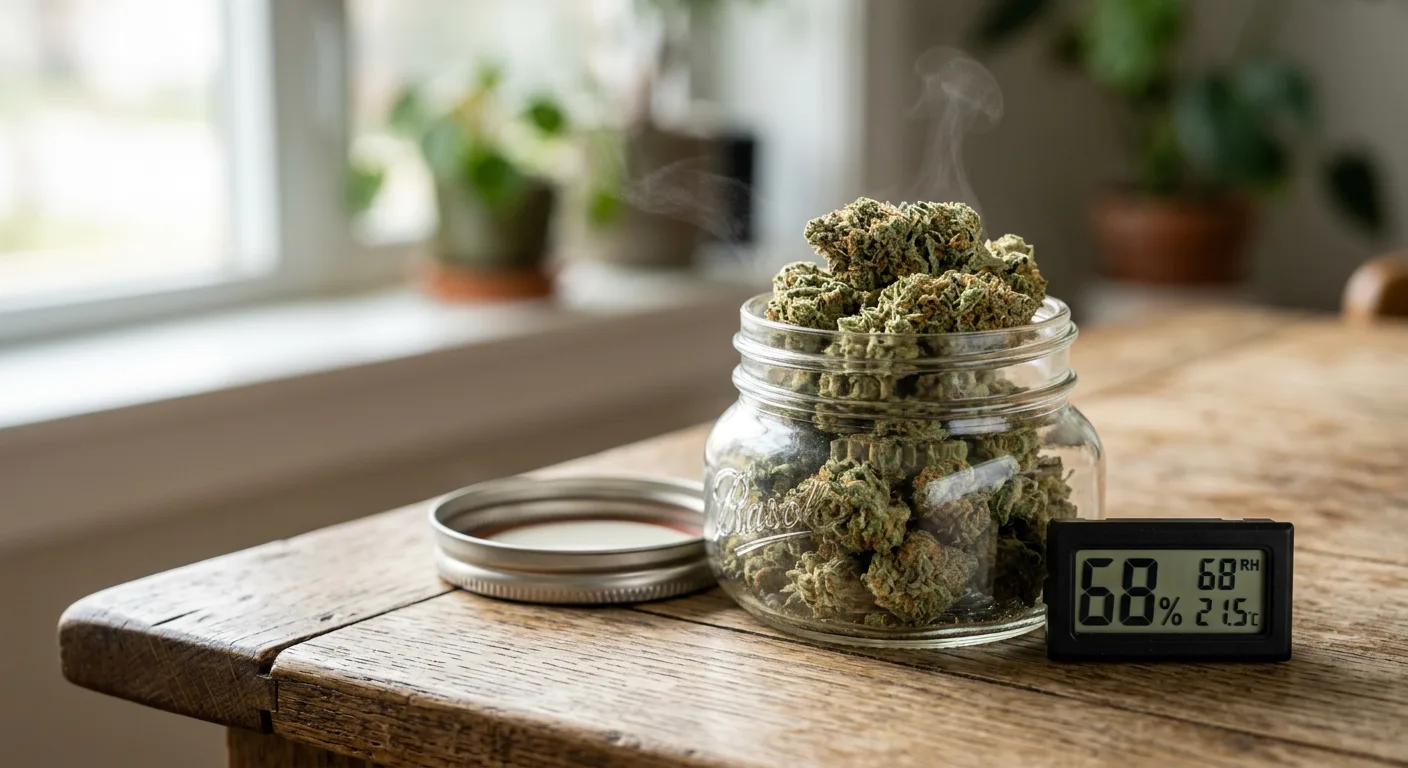
The traditional mason jar cure works because of a physical process called moisture equilibration. When freshly dried cannabis is placed in a sealed jar, moisture that remains locked inside the bud's cell walls slowly migrates outward, driven by the vapor pressure gradient between the interior of the plant tissue and the headspace air in the jar. This migration of moisture from bound to free form is the curing process at its chemical level.
Burping, opening the jar for 10–20 minutes once or twice daily during early curing, releases the accumulated water vapor before it re-condenses on bud surfaces and raises Aw too high. Without burping, the headspace humidity climbs rapidly toward 80–90% RH, which corresponds to an Aw of 0.80–0.90 at the bud surface: prime mold territory. Burping resets the vapor pressure gradient and allows the next wave of moisture to migrate outward safely.
The characteristic 'grassy' smell of freshly jarred cannabis comes from the breakdown of chlorophyll and the volatilization of low-quality green-note compounds like hexanol and hexanal. As curing progresses and free moisture drops, these compounds dissipate and the true terpene profile of the cultivar (the fruity, earthy, or floral notes) becomes dominant. This transition happens most efficiently in the 0.60–0.65 Aw range.
A critical point for home growers: the bud's external feel is not a reliable indicator of Aw. A bud can feel dry on the outside, passing the stem-snap test, while still holding significant free moisture deep inside dense calyxes. This is why growers who rely only on tactile testing seal buds at Aw 0.68–0.72 without realizing it, and discover mold 10–14 days later. See our complete guide to mason jar curing and burping schedules for day-by-day Aw targets.
Burping works because it vents accumulated water vapor before it reconcentrates and raises surface Aw above the danger threshold. It is passive Aw management, but without a meter, you are doing it blind.
Humidity Packs and Aw: Buffering, Not Just Moistening
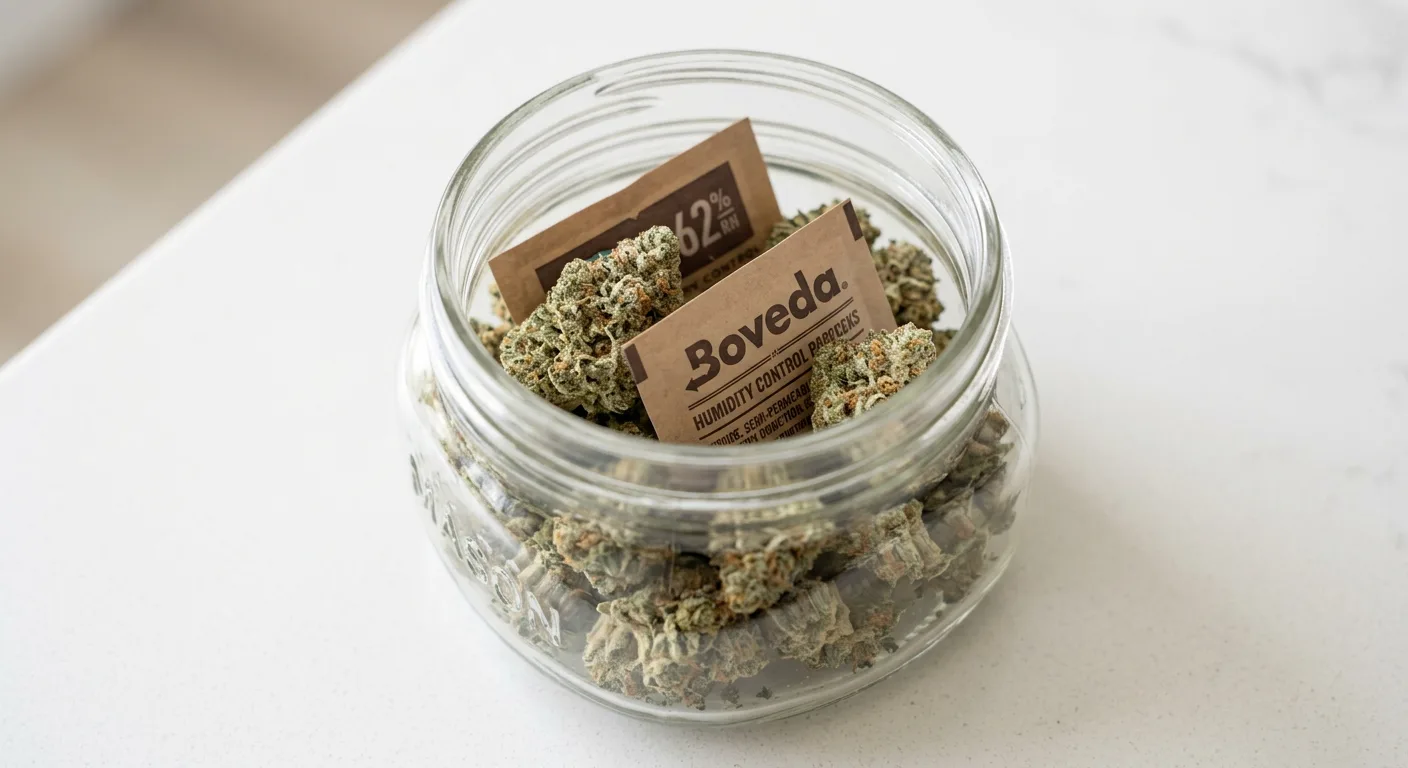
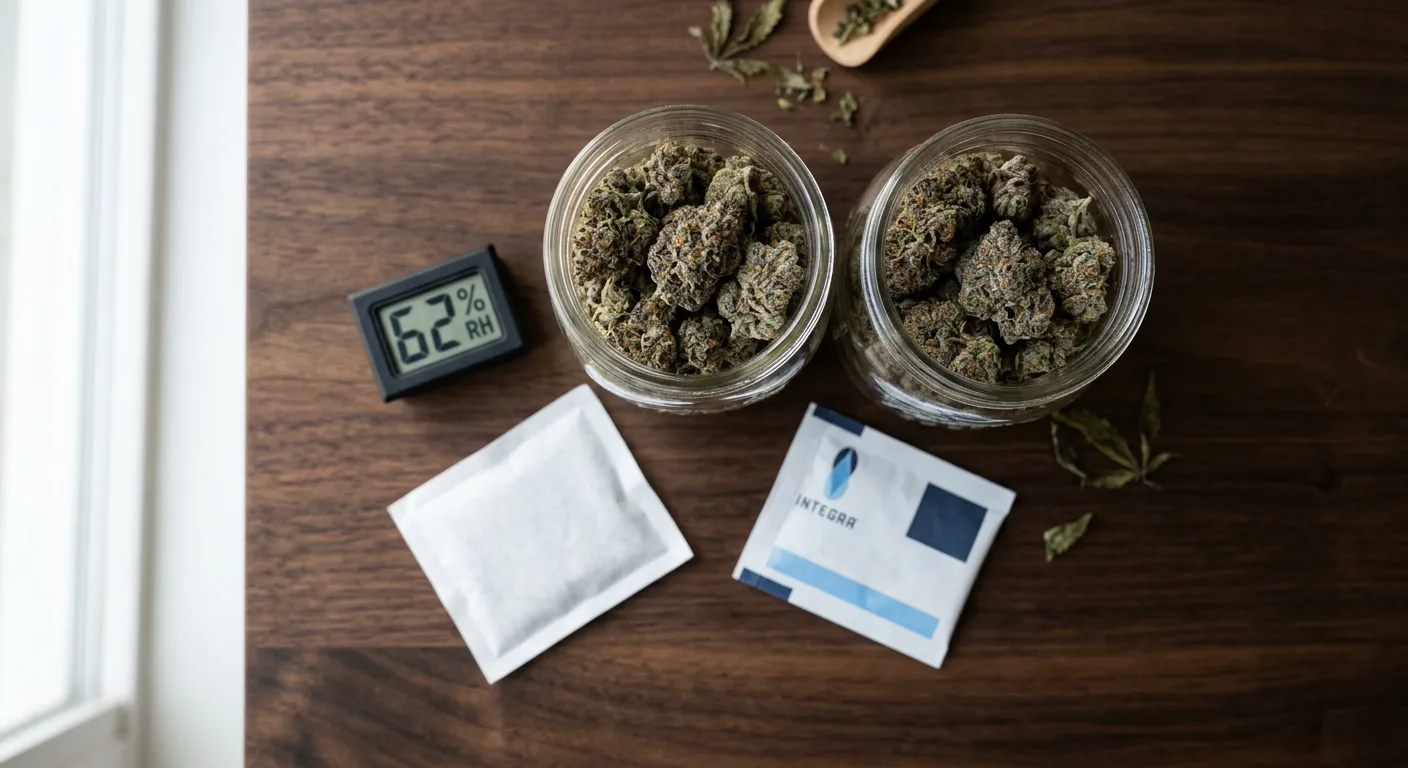
Boveda 62% and Integra Boost 62% are described on their packaging as humidity control packs, but that description undersells their actual mechanism. These packs function as two-way Aw buffers. They release moisture when the jar environment drops below the target Aw (equivalent to 62% ERH) and absorb excess moisture when Aw climbs above it, passively maintaining equilibrium without any intervention from the grower.
The 62% variant corresponds to a target Aw of approximately 0.62, sitting precisely in the middle of the ASTM D8196 safe zone. This is not a coincidence: these packs were engineered with cannabis storage in mind. The salt-solution chemistry inside the pack (a saturated salt slurry) maintains a fixed vapor pressure in the sealed container through an established physical law called Raoult's Law.
- Boveda 58%: Targets Aw ≈ 0.58, good for very long-term archival storage where terpene loss is less critical than absolute mold prevention
- Boveda 62%: Targets Aw ≈ 0.62, the most popular choice, ideal for regular-use storage and maintaining smoking quality
- Integra Boost 62%: Similar target Aw, uses a different buffering agent and includes a color-change indicator card to show when the pack is exhausted
Humidity packs are maintenance tools, not rescue tools. If you seal cannabis at Aw 0.75 and drop in a Boveda pack, the pack cannot absorb enough moisture quickly enough to prevent mold. The pack is sized for buffering small deviations from the target, not correcting a major moisture imbalance. Always verify Aw is below 0.65 before sealing and adding a pack.
Read our full comparison of Boveda vs. Integra Boost humidity packs to understand which format, size, and RH rating is right for your storage container size and strain type.
Cannabis Water Activity Meters: Home Grower Options vs. Lab Bench Units
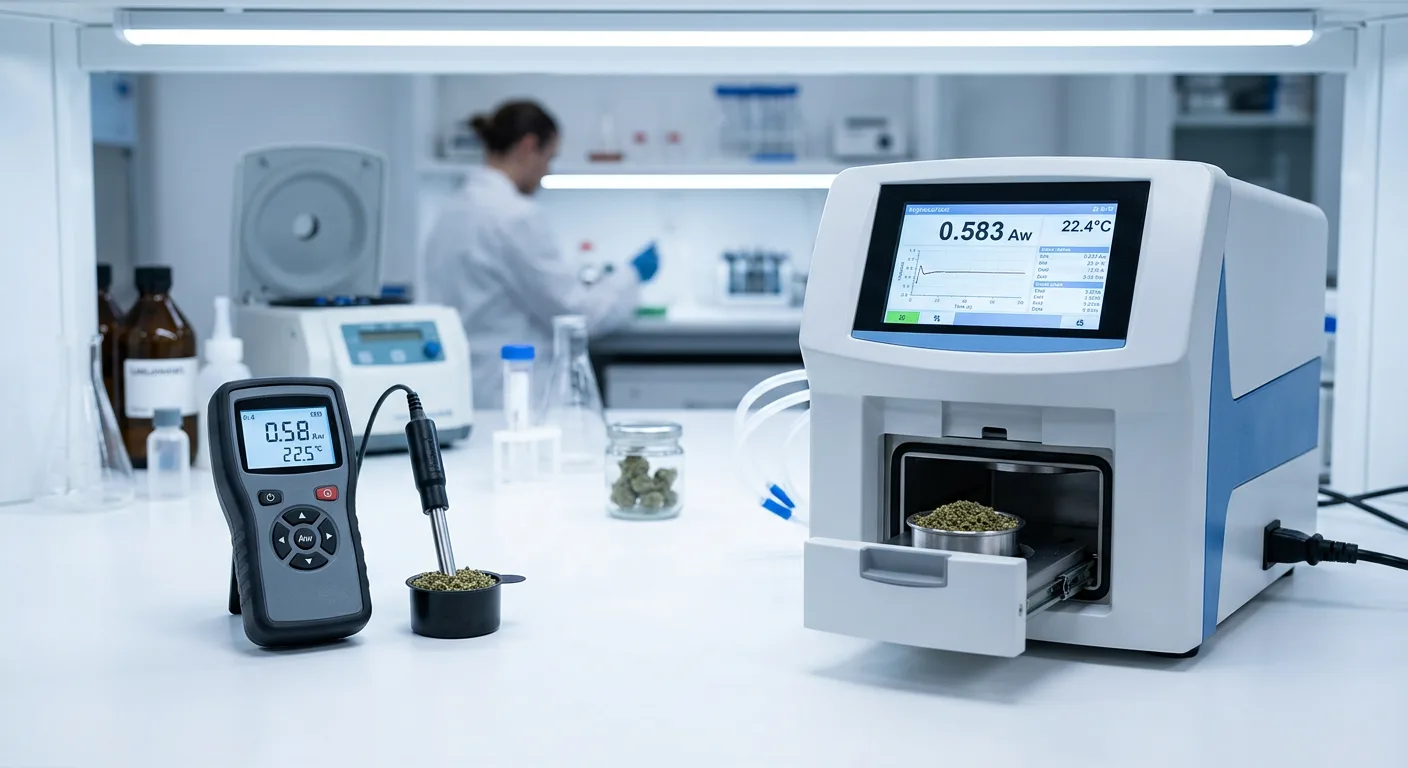
Until recently, water activity meters cost $1,000–$5,000 and lived exclusively in commercial food science and pharmaceutical labs. The explosion of the regulated cannabis industry created demand for affordable field units, and the market responded. Home growers now have genuine options in the $80–$200 range that are accurate enough for practical curing decisions.
Affordable Home Grower Meters ($80–$200)
The entry-level category has improved dramatically in quality and accuracy. These units typically measure Aw within ±0.005–0.015 of true value, sufficient precision to distinguish between 0.60 and 0.67 with confidence.
- Pawkit by Meter Group (now AQUALAB Lite): ~$130–$150. Pocket-sized, reads in 5 minutes, accuracy ±0.015 Aw. The most widely recommended unit in cannabis cultivation communities. Battery-powered and portable.
- Rotronic HygroPalm with HC2-AW probe: ~$180–$220. Accuracy ±0.005 Aw with temperature compensation. Slightly more technical but more precise than the Pawkit.
- Sato DP-70: ~$80–$100. Less precise (±0.02 Aw) but functional for growers who simply want to confirm they are in the 0.55–0.65 range vs. dangerously above it. A reasonable entry point.
Commercial Lab Bench Units ($1,000–$5,000+)
These units use chilled mirror dew point technology or capacitance sensors with temperature-controlled sample chambers, achieving accuracy of ±0.001–0.003 Aw. They measure faster (2–5 minutes vs. 5–15 for portable units) and are required for ASTM D8196 compliance in commercial cannabis labs.
- AQUALAB 4TE: ~$3,500–$4,500. The industry standard in cannabis compliance labs. Dew point sensor, ±0.003 accuracy, prints reports directly.
- Novasina ms1: ~$2,000–$3,000. Capacitance-based, widely used in European cannabis markets.
- Freund Turan TDL: ~$1,200–$1,800. Mid-range option favored by craft producers scaling from home to commercial.
| Meter | Price Range | Accuracy (±Aw) | Read Time | Best For |
|---|---|---|---|---|
| Sato DP-70 | $80–$100 | ±0.020 | 10–15 min | Budget home grower |
| AQUALAB Lite / Pawkit | $130–$150 | ±0.015 | 5–10 min | Serious home grower |
| Rotronic HygroPalm | $180–$220 | ±0.005 | 5–8 min | Advanced home / micro-commercial |
| Freund Turan TDL | $1,200–$1,800 | ±0.003 | 3–5 min | Craft commercial producer |
| AQUALAB 4TE | $3,500–$4,500 | ±0.003 | 2–4 min | Compliance lab / dispensary |
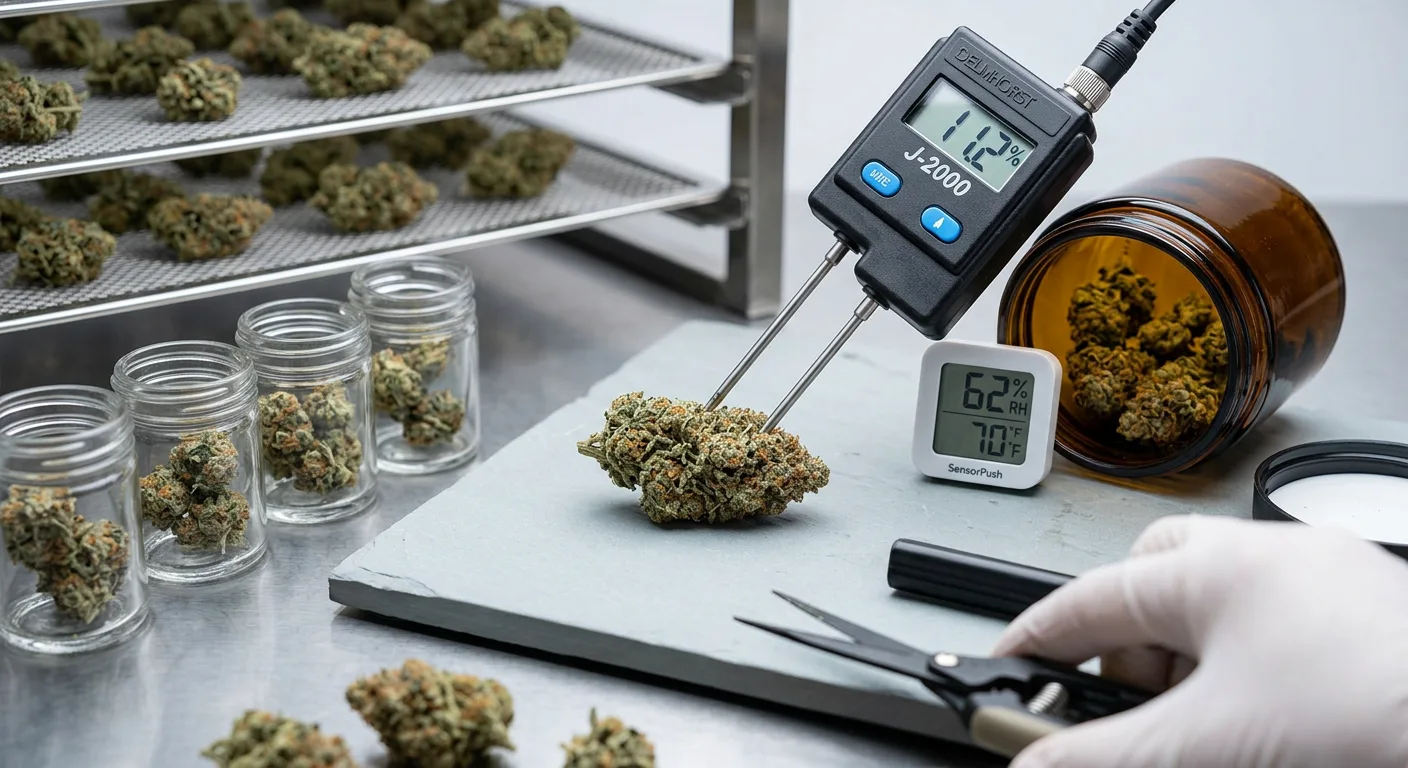
When testing cannabis Aw with a home meter, always use the smallest bud sample that fills the sensor cup, about 3–5 grams is ideal. Allow the meter to reach stable equilibrium before recording the reading; rushing this step introduces error. Test 3 samples from different parts of the batch and average the results for best accuracy.
Aw Reading to Corrective Action: The Practical Reference Table
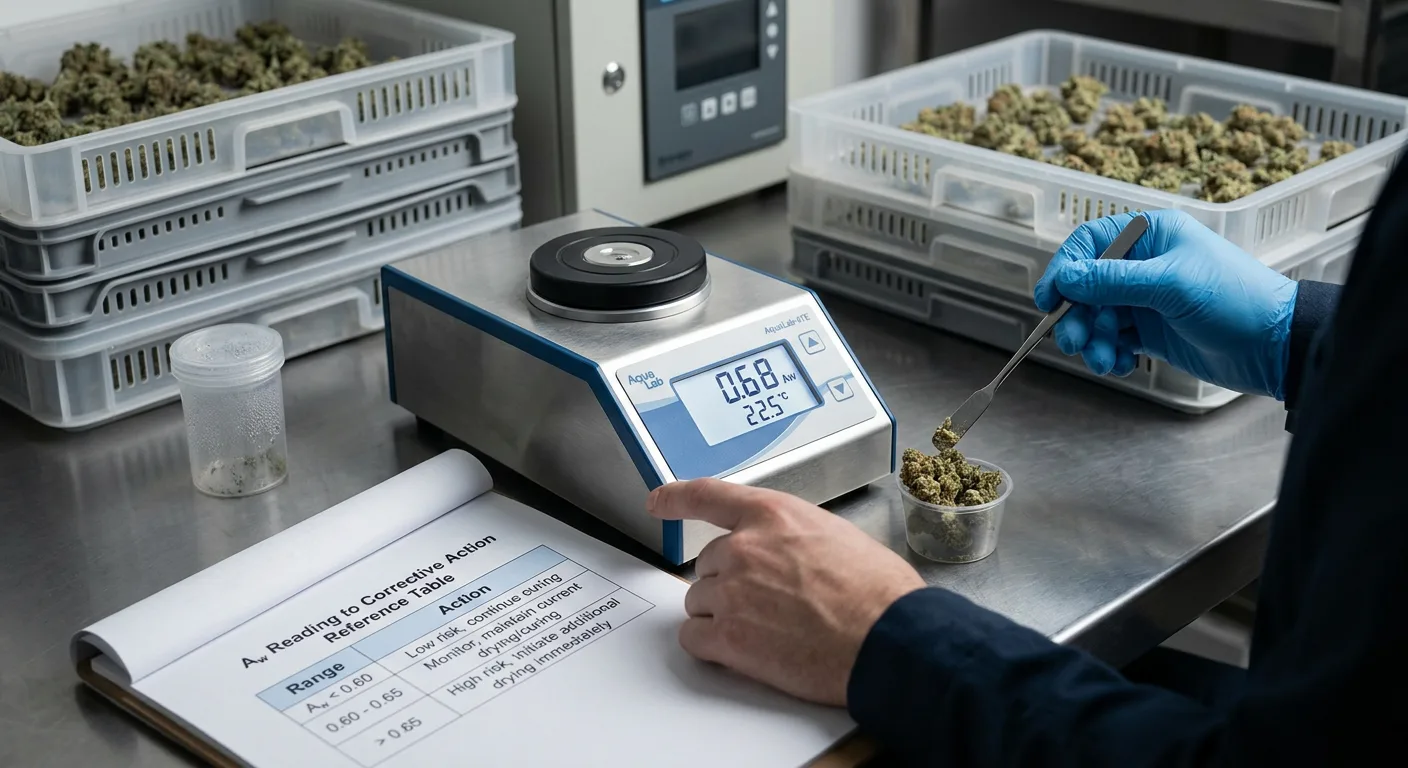
Understanding what a specific Aw number means for your cannabis, and exactly what to do about it, is where the science becomes actionable. The table below translates meter readings into clear corrective steps for any stage of curing or storage.
| Aw Reading | What It Means | Risk Level | Corrective Action |
|---|---|---|---|
| Below 0.50 | Severely over-dried; cell structure collapsed | No mold risk, but quality loss is severe | Rehydrate slowly using a 62% Boveda pack in a sealed jar; re-test every 12 hours |
| 0.50–0.54 | Over-dried; terpenes actively escaping | Low mold risk, high quality degradation risk | Add 62% humidity pack; seal jar; re-test in 24 hours |
| 0.55–0.65 | SAFE ZONE, ideal cured cannabis | Negligible mold risk; terpenes preserved | Seal container; add 62% Boveda for maintenance; store cool and dark |
| 0.65–0.70 | Marginally high, mold germination threshold approaching | Low-moderate mold risk | Open jar; burp for 30–60 minutes; re-test before resealing; do not add humidity pack yet |
| 0.70–0.75 | Dangerously moist, Aspergillus activation zone | High mold risk | Open jar immediately; spread buds on clean surface in controlled environment (65°F, 45% RH); dry for 4–8 hours; re-test before resealing |
| Above 0.75 | Critical, active mold growth likely occurring | Very high mold risk; mycotoxin risk | Inspect every bud for visible mold; discard any compromised material; emergency dry remaining buds; consider full harvest loss if widespread |
Test Before You Seal
After initial drying (when small stems snap rather than bend), test Aw before jarring. Target 0.60–0.65 Aw at this stage: it will drop slightly during curing as remaining bound moisture equilibrates.
Test at Day 3 and Day 7
Free moisture continues migrating outward for 7–14 days after jarring. Aw often rises slightly in the first 3 days even on well-dried buds. Burp and re-test; adjust if Aw climbs above 0.65.
Final Test Before Long-Term Seal
At day 14–21, test one final time. If Aw is stable at 0.55–0.65 across two readings taken 24 hours apart, the cure is complete. Add a 62% Boveda pack and seal for storage.
Test Again at Month 1 and Month 3
Water activity can drift during long-term storage, especially if temperature fluctuates. A quick Aw check at 30 and 90 days confirms your storage conditions are holding the target range. See our long-term cannabis storage guide for full protocols.
Water Activity and Long-Term Cannabis Storage
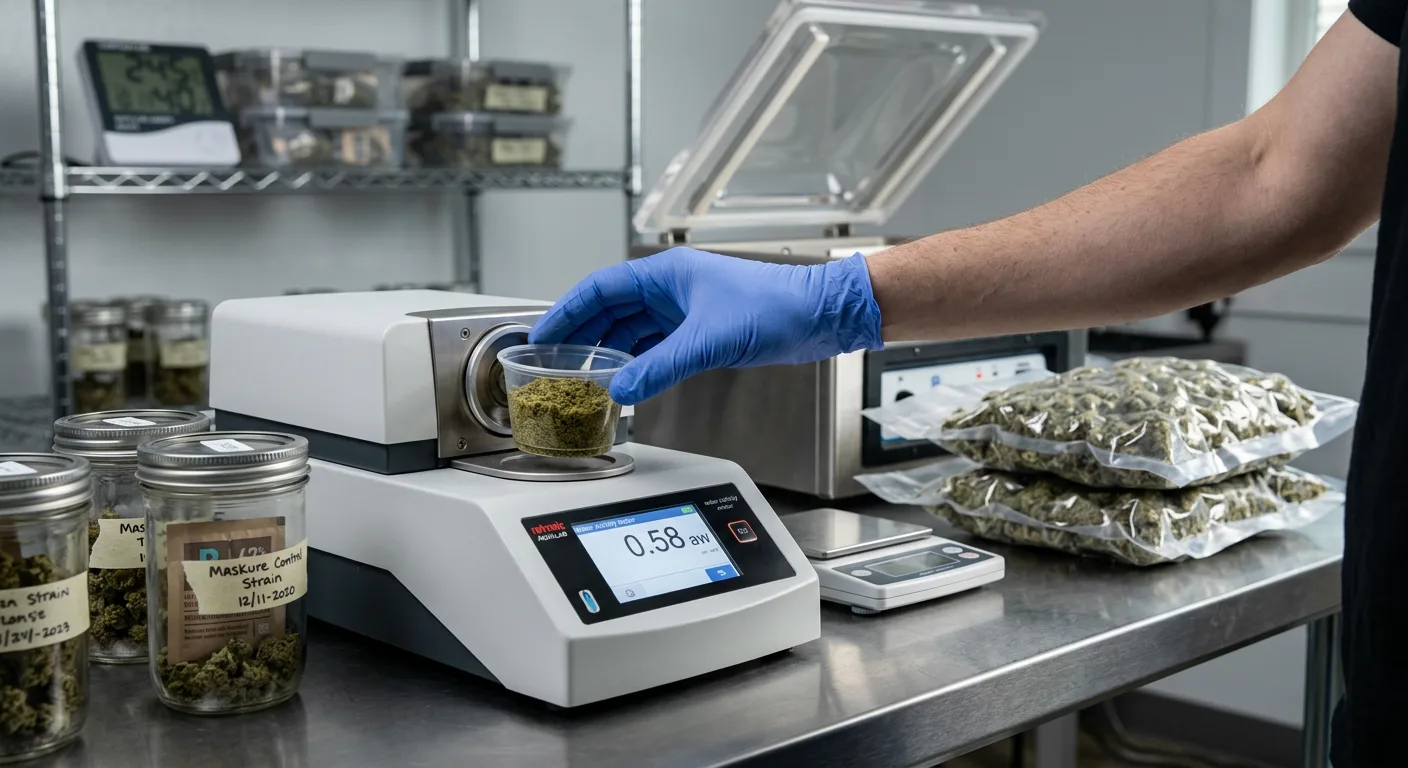
Once your cannabis reaches the 0.55–0.65 Aw safe zone, the battle is not over: it is simply on pause. Long-term storage introduces new variables that can destabilize Aw over months and years. Temperature is the primary culprit: as temperature rises, the vapor pressure of water increases, which means the Aw of a sealed sample can shift even without any actual change in moisture content.
At 77°F (25°C), a cannabis sample at Aw 0.62 may read Aw 0.64, still safe. But if that same sample is stored in a space that regularly reaches 86°F (30°C), the effective Aw experienced at the surface can approach 0.66–0.68, nudging into risk territory. This is why commercial cannabis storage standards specify both an Aw range and a temperature range, typically 60–70°F (15–21°C) with fluctuations of no more than ±5°F.
- Store sealed jars at 60–70°F (15–21°C) in a dark location
- Avoid locations with daily temperature swings exceeding 10°F
- Use airtight glass (mason jars) or nitrogen-flushed mylar bags for multi-month storage
- Include a 62% Boveda pack in every storage vessel larger than 500ml
- Re-test Aw at 30, 90, and 180 days for harvests stored beyond 3 months
- Keep containers away from UV light: cannabinoids degrade under UV even through glass
- Label every container with strain name, harvest date, and last verified Aw reading
For cannabis stored beyond 6 months, say, a large harvest from a high-yielding cultivar like Northern Lights x Big Bud, vacuum sealing after reaching target Aw dramatically reduces the oxygen-driven degradation of THC to CBN that causes potency loss over time. Vacuum does not remove the need for Aw control; it adds another layer of preservation on top of it.
Water activity is a dynamic property, not a one-time measurement. Temperature changes, container integrity failures, and humidity pack exhaustion can all drift Aw out of the safe zone during storage. Build a testing schedule into your long-term storage routine.
Our complete guide to keeping your harvest potent for 12+ months covers the full environmental and chemical factors that interact with water activity during extended storage.
Genetics That Cure Evenly: Starting the Process Right
Water activity management during curing is not just about the post-harvest process: it starts with the genetics you choose. Dense, rock-hard, indica-dominant buds with thick calyxes hold moisture in their interiors differently than open, airy sativa buds. Strains with naturally high resin content and uniform bud structure tend to cure more evenly because moisture migrates outward at a consistent rate from every part of the flower, rather than drying fast on the outside while holding moisture in the core.
Uneven curing, where some parts of a bud reach 0.58 Aw while the interior stays at 0.72, is the specific scenario responsible for mid-jar mold events. The outside feels dry and passes every visual check, but the interior is still in the danger zone. This is a genetics and grow-environment issue as much as a curing technique issue.
- OG Kush Feminized (26% THC), dense, resinous structure with consistent moisture content across buds; cures reliably to even Aw
- Purple Kush Feminized (27% THC), compact indica buds with relatively uniform density; responds well to slow, measured curing
- White Widow Feminized (25% THC), classic genetics known for robust resin coverage and forgiving post-harvest handling
- Northern Lights x Amnesia Haze Feminized (24% THC), balanced hybrid with moderate bud density that cures at a predictable rate
- Gorilla Glue #4 (well-known industry strain, ~28% THC), extremely resinous but can hold moisture deeply; watch Aw carefully at days 3–5
- Wedding Cake (well-known industry strain, ~25% THC), dense, frosted calyxes; benefits significantly from Aw testing before final seal
Genetics that produce large, airy buds, many sativa-dominant and equatorial varieties, actually tend to cure to their target Aw faster because moisture has less distance to travel from interior to exterior. Sour Diesel Feminized (24% THC) is a classic example: open bud structure that dries and cures more uniformly than a compact kush, making it more forgiving for growers still developing their curing technique.
If you consistently struggle with uneven curing, mold in the center of buds while the outside seems fine, consider whether your grow environment is creating fluffy-outside, dense-inside bud development. VPD management during late flowering directly affects bud density and moisture distribution. Our VPD for Cannabis guide covers how to dial in late-flower vapor pressure for optimal bud structure. You can also use our VPD calculator to find your ideal temperature-humidity combination for every growth stage.
Choosing stable, well-documented genetics reduces the variability in your post-harvest process. When you know how a cultivar behaves, how quickly it dries, how dense its buds are, how its resin profile affects moisture binding: you can anticipate where Aw will land after drying and adjust your curing timeline accordingly, rather than reacting to surprises.
Frequently Asked Questions
What water activity should cannabis be?
Cannabis should have a water activity (Aw) between 0.55 and 0.65 for safe, shelf-stable storage. This range, established by ASTM D8196, prevents all known cannabis mold pathogens from growing while keeping terpenes intact and smoke smooth. Above 0.65 introduces mold risk; below 0.55 causes harsh, crumbling buds and accelerated terpene loss.
How do you test water activity of cannabis at home?
Use an affordable portable Aw meter such as the AQUALAB Lite (formerly Pawkit) or Rotronic HygroPalm, both available for $130–$220. Place a 3–5 gram sample in the meter's sensor cup, seal it, and wait 5–15 minutes for the reading to stabilize. Test three samples from different parts of your batch and average the readings. Never rely on feel alone, internal Aw can differ significantly from surface dryness.
What is the difference between water activity and moisture content in cannabis?
Moisture content (usually expressed as % by weight) measures the total amount of water in the sample, both free and bound. Water activity measures only the free, mobile water that mold and bacteria can access. Two cannabis samples can share the same moisture content percentage but have very different Aw values and therefore very different mold risk profiles. Aw is the more meaningful measurement for safety.
Can humidity packs control water activity in cannabis?
Yes, within limits. Two-way humidity packs like Boveda 62% or Integra Boost 62% stabilize the equilibrium relative humidity inside a sealed container, which directly corresponds to a target Aw of approximately 0.62. They buffer small deviations from the target in both directions. However, they cannot rapidly correct cannabis that was sealed too wet (above 0.65 Aw). They are maintenance tools, not emergency rehydration or drying solutions.
Why did my 'perfectly cured' cannabis still grow mold in a jar?
The most common reason is that the cannabis was sealed at an Aw above 0.65, even though the surface felt dry and the stem snapped. Dense buds hold significant free moisture in their interiors that is invisible to touch and does not register on a surface hygrometer reading. The sealed jar then creates a closed, humid microenvironment where that internal moisture equilibrates outward and raises surface Aw into mold territory. Testing Aw with a meter before sealing is the only reliable prevention.