You harvested exactly on time. The cure looked textbook. But six weeks later, you crack the jar and the smell is half of what it was — flatter, duller, almost generic. That is terpene degradation cannabis growers know all too well, and yet almost nobody explains the actual mechanism behind it.
This guide does exactly that. You will learn which compounds disappear first and why, how each stage from drying through long-term storage strips your buds of aroma, and what specific actions — temperature targets, container choices, humidity levels — make the difference between terpenes that last a year and ones that vanish in a month.
The Chemistry Behind Terpene Degradation Cannabis Growers Need to Understand
Terpene degradation cannabis happens through four primary chemical processes: volatilization (evaporation), oxidation, photo-degradation, and enzymatic breakdown. Understanding which process dominates at each post-harvest stage tells you exactly where to intervene.
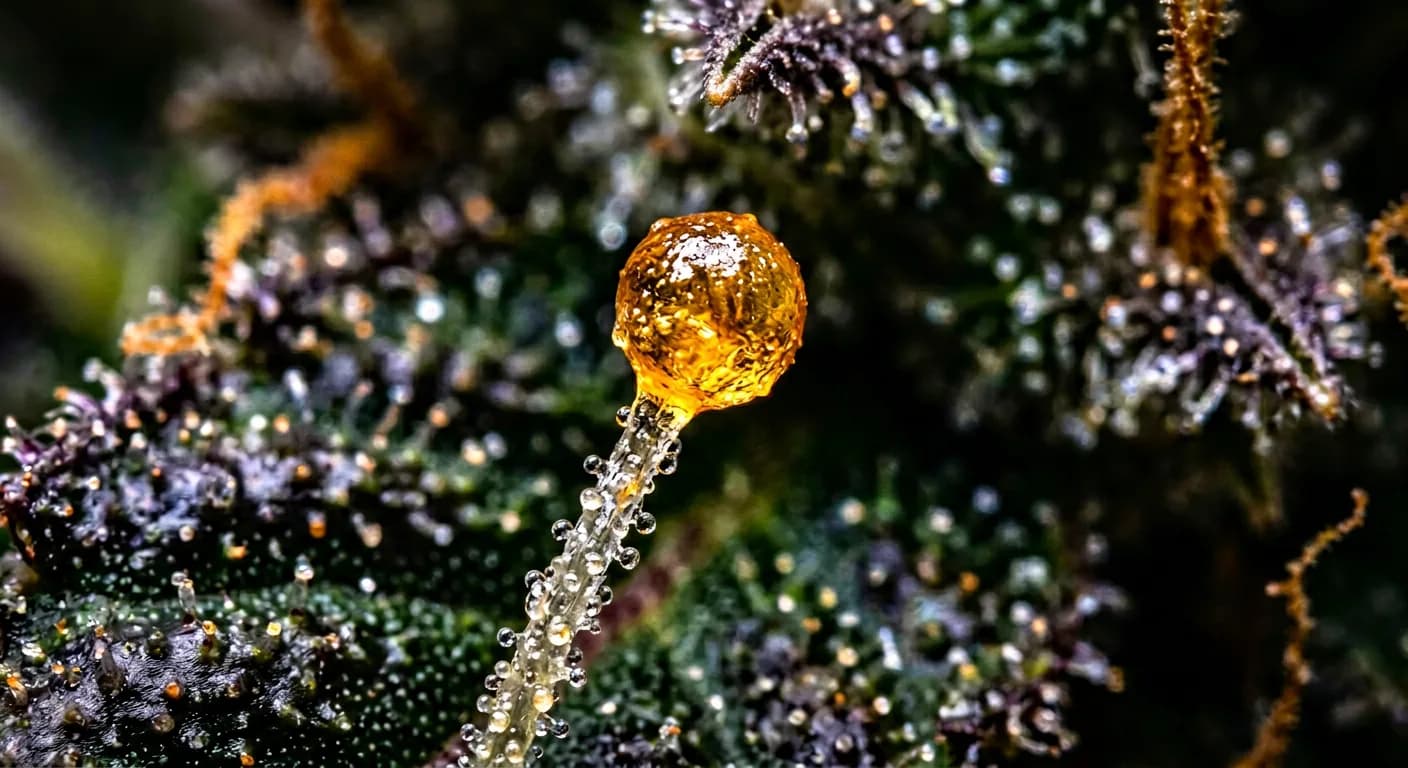
Terpenes are volatile organic compounds (VOCs) produced in the secretory cells of trichomes. Their volatility — the very quality that gives cannabis its aroma — also makes them inherently unstable once the living plant can no longer replenish them. Visit our complete cannabis terpene chart for a full reference on every major compound and its properties.
Boiling Points by Terpene: Why Some Aromas Disappear First
Each terpene has a specific boiling point — the temperature at which it transitions from liquid to vapor and leaves the bud entirely. But significant volatilization begins well below that threshold. Think of it like water evaporating at room temperature: it happens slowly but continuously, long before 100°C.
| Terpene | Aroma Profile | Boiling Point | Volatility Class | Degrades First At |
|---|---|---|---|---|
| Alpha-Pinene | Pine, sharp, forest | 155°C | Monoterpene — very high | Drying phase (>20°C room temp) |
| Beta-Pinene | Woody, fresh, herbal | 166°C | Monoterpene — very high | Drying phase |
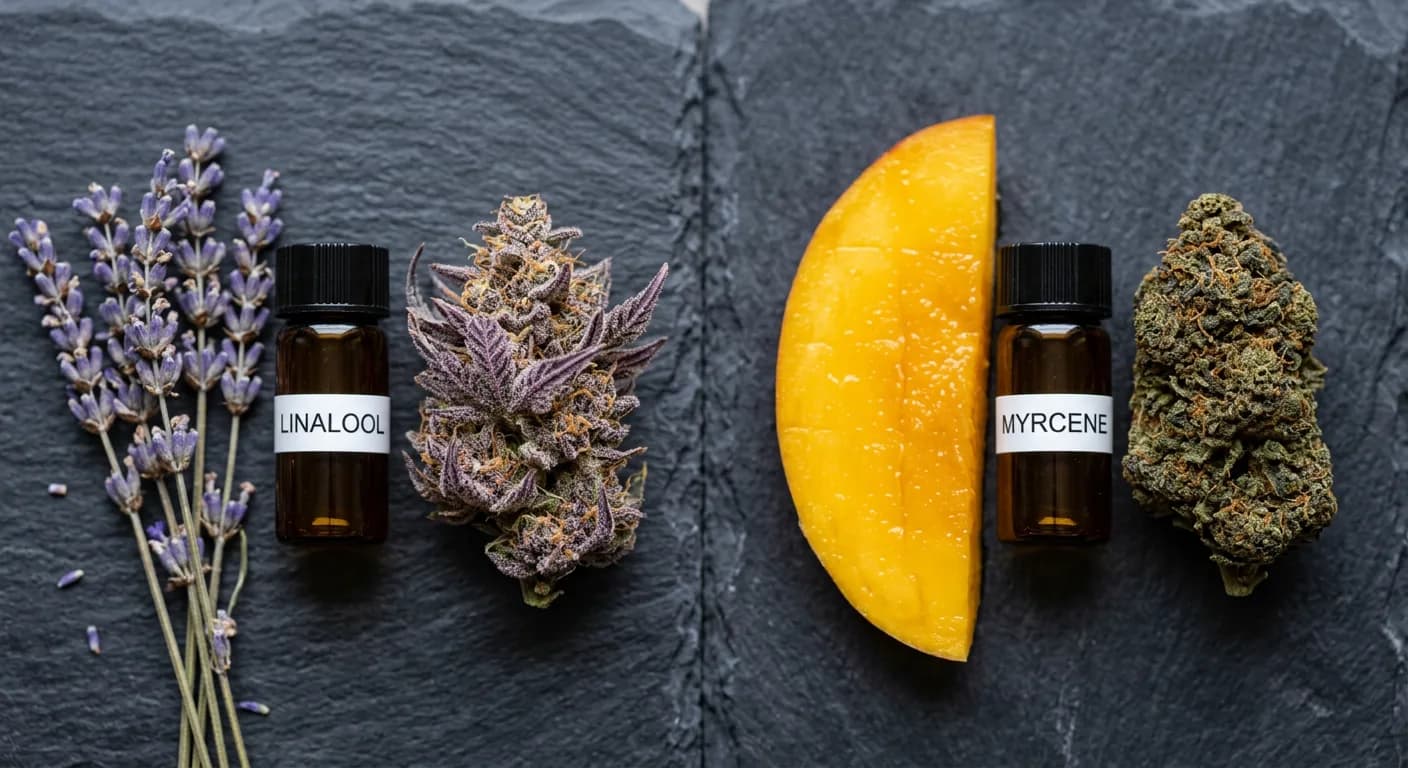
| Myrcene | Earthy, musky, mango | 167°C | Monoterpene — high | Drying phase / early cure |
| Limonene | Citrus, lemon, orange | 176°C | Monoterpene — high | Warm drying (>21°C) |
| Terpinolene | Floral, fresh, piney | 186°C | Monoterpene — moderate-high | Mid-cure / warm storage |
| Linalool | Lavender, floral, spice | 198°C | Monoterpene — moderate | Extended warm storage |
| Beta-Caryophyllene | Spicy, pepper, wood | 130°C (steam) | Sesquiterpene — moderate | High-temp drying / vaping |
| Humulene | Earthy, hoppy, herbal | 106°C (steam) | Sesquiterpene — moderate-low | Combustion / very high temps |
Science note: Monoterpenes (single isoprene unit, C10) are universally more volatile than sesquiterpenes (double isoprene unit, C15). This is why limonene and pinene — the bright, top-note aromas — always fade faster than caryophyllene and humulene, which persist longer and dominate older, degraded cannabis. Learn more in our complete pinene grower's guide.
Oxidation and Photo-Degradation
Beyond simple evaporation, terpenes oxidize when exposed to oxygen. Alpha-pinene, for example, oxidizes into compounds like pinocarvone and myrtenol — molecules with dramatically different (and less pleasant) smell profiles. This is a separate process from evaporation and occurs even in sealed containers if oxygen is present.
UV light adds a third mechanism: photolysis. High-energy UV wavelengths break the molecular bonds in terpene chains directly, converting intact aromatic compounds into degradation products. This happens even through clear glass at room temperature with standard indoor lighting.
Terpene degradation is not a single process — it is volatilization, oxidation, and photolysis happening simultaneously. Each requires a separate countermeasure. Controlling temperature alone is never enough.
Terpene Loss During Drying: The Phase That Destroys the Most Aroma
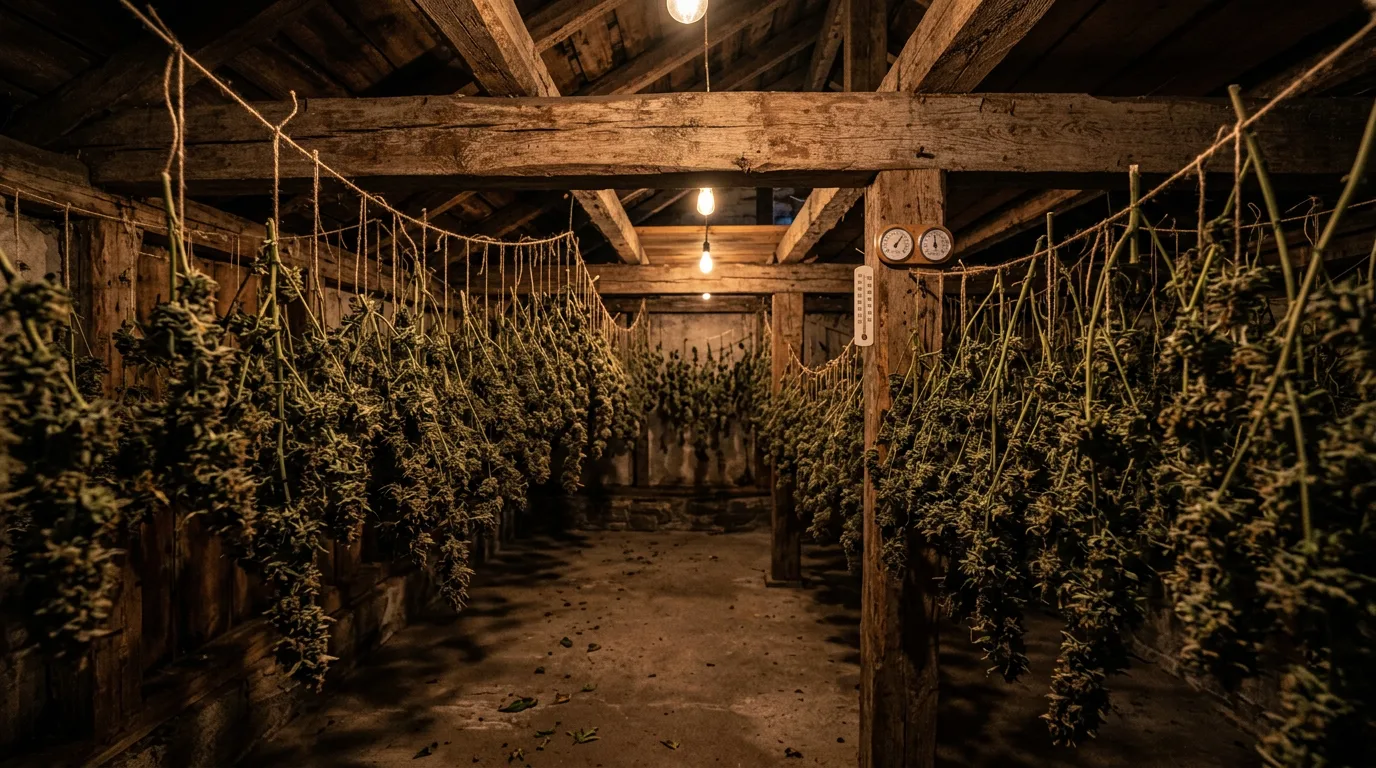
The drying phase is where the majority of terpene degradation cannabis growers experience actually begins. Up to 40% of total terpene content can be lost in a poorly managed dry — more than any other single post-harvest phase. The combination of heat, airflow, and time creates the perfect conditions for monoterpene evaporation.
The core problem is simple physics: warm, moving air accelerates evaporation of any volatile compound. Cannabis drying rooms that run at 24–27°C (75–80°F) with aggressive fans are essentially terpene extraction chambers pointed in the wrong direction.
What Happens Above 70°F (21°C) During Drying
At temperatures above 70°F, the lightest monoterpenes — alpha-pinene, beta-pinene, limonene, and myrcene — volatilize at measurably higher rates. These are exactly the compounds responsible for bright, fresh, top-note aromas: the citrus punch of a Sour Diesel, the pine snap of an OG Kush, the fruity top notes of a Tangerine Haze.
- Alpha-pinene (bp 155°C): Fastest to evaporate at room temperature — detectable loss begins within 24 hours at 24°C+
- Limonene (bp 176°C): Significant loss when drying temperature exceeds 21°C, especially with high airflow
- Myrcene (bp 167°C): Moderately volatile — loses quickly at warm temps but partially survives cool slow drying
- Linalool (bp 198°C): More stable — retains better through drying but vulnerable in long warm cures
- Beta-caryophyllene: Relatively stable through drying, often the dominant terpene in over-dried buds
Caution: Using a dehumidifier or space heater directly in a drying room to speed up the process can raise temps to 27–32°C (80–90°F). At these temperatures you will lose the majority of your monoterpene content within 3–5 days, leaving behind only the heaviest sesquiterpenes. The bud may still smell, but it will smell wrong — flat and skunky instead of complex and layered.
The Slow, Cool Dry: Target Parameters
Research and experienced cultivators consistently point to the same target window for terpene-preserving drying: 60–65°F (15–18°C) with 55–60% relative humidity and minimal direct airflow over the buds. At these conditions, drying takes 10–14 days — which is exactly the point.
- Temperature: 60–65°F (15–18°C) — slows monoterpene volatilization dramatically
- Humidity: 55–60% RH — prevents case-hardening while keeping moisture gradients gentle
- Airflow: Gentle circulation to prevent mold, but never direct fan blast on buds
- Light: Complete darkness — UV begins degrading terpenes within hours even at low intensity
- Duration: 10–14 days — slow water exodus preserves terpene-bearing resin glands
Hang whole branches rather than individual buds during drying. The larger mass slows the drying rate naturally, and the stem acts as a water reservoir that moderates humidity around the flower. This passive technique alone measurably improves final terpene retention compared to bucked-and-racked drying.
For a deeper breakdown of the moisture science behind this process, see our guide on water activity in cannabis curing — specifically the 0.55–0.65 Aw safe zone where terpene preservation and mold prevention overlap.
Jar Curing and How It Protects Remaining Terpenes
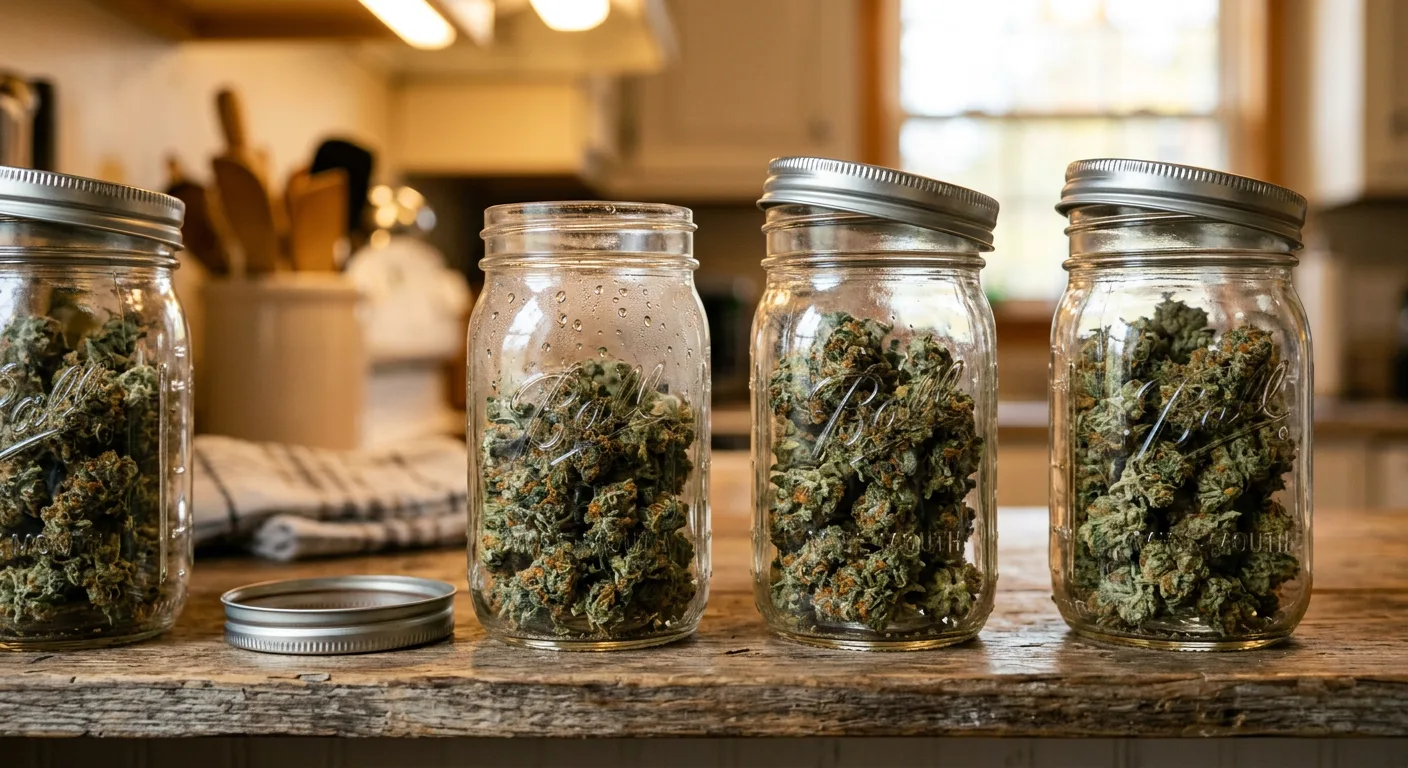
Anaerobic jar curing is the single most impactful thing a home grower can do to protect terpenes after drying. By sealing dried cannabis in an airtight glass container, you create an environment where oxygen is limited, temperature is stable, and terpene vapor accumulates inside the jar rather than escaping into open air.
The sealed atmosphere inside a curing jar becomes saturated with terpene vapor over time, which actually slows further evaporation through a partial pressure effect — the vapor-saturated air reduces the chemical gradient that drives evaporation. This is fundamentally different from open-air drying, where fresh air constantly sweeps away volatilized terpenes.
The Burping Schedule and Its Terpene Implications
Burping — briefly opening jars to exchange gas — is necessary to remove CO2 produced by microbial activity and to prevent anaerobic fermentation. But every burp is also a terpene-release event. The goal is to burp enough to manage moisture without over-ventilating.
- Days 1–7: Burp 2x daily for 15–20 minutes — high residual moisture requires active gas exchange
- Days 8–14: Burp 1x daily for 10 minutes — moisture stabilizing, terpene saturation building
- Days 15–21: Burp every 2 days for 5–10 minutes — mainly monitoring, minimal loss
- Day 21+: Burp 2–3x per week, then weekly — cure is largely complete, minimal exchange needed
- Long-term storage: Seal airtight, add humidity pack, minimize opening
Science note: During curing, enzymatic processes continue breaking down chlorophyll (improving smoothness) while remaining terpenes redistribute and homogenize through the bud mass. A properly cured bud at week 4 often smells more complex than the same bud at day 1 of cure — not because terpenes were added, but because the volatile profile has shifted as harsh green compounds degrade and subtle aromatic terpenes become more perceptible. Our small harvest curing guide covers this process in practical detail.
Glass vs. Plastic for Curing
Glass is the only recommended material for terpene-preserving curing. Plastic containers — even food-grade HDPE — have measurable gas permeability that allows slow terpene loss over weeks. Plastic also carries electrostatic charge that attracts and physically holds trichome heads to container walls.
- Borosilicate glass (mason jars): Zero permeability, non-reactive, ideal — wide-mouth Ball or Kerr jars are the standard
- Food-grade plastic: Acceptable short-term (<2 weeks), poor for long-term due to permeability and static
- Metal tins: Good seal if airtight, but metal can impart flavor over time — suitable for 1–3 month storage
- Silicone: Not recommended — high gas permeability, terpenes diffuse through material directly
Storage Degradation: A Timeline of Terpene Loss
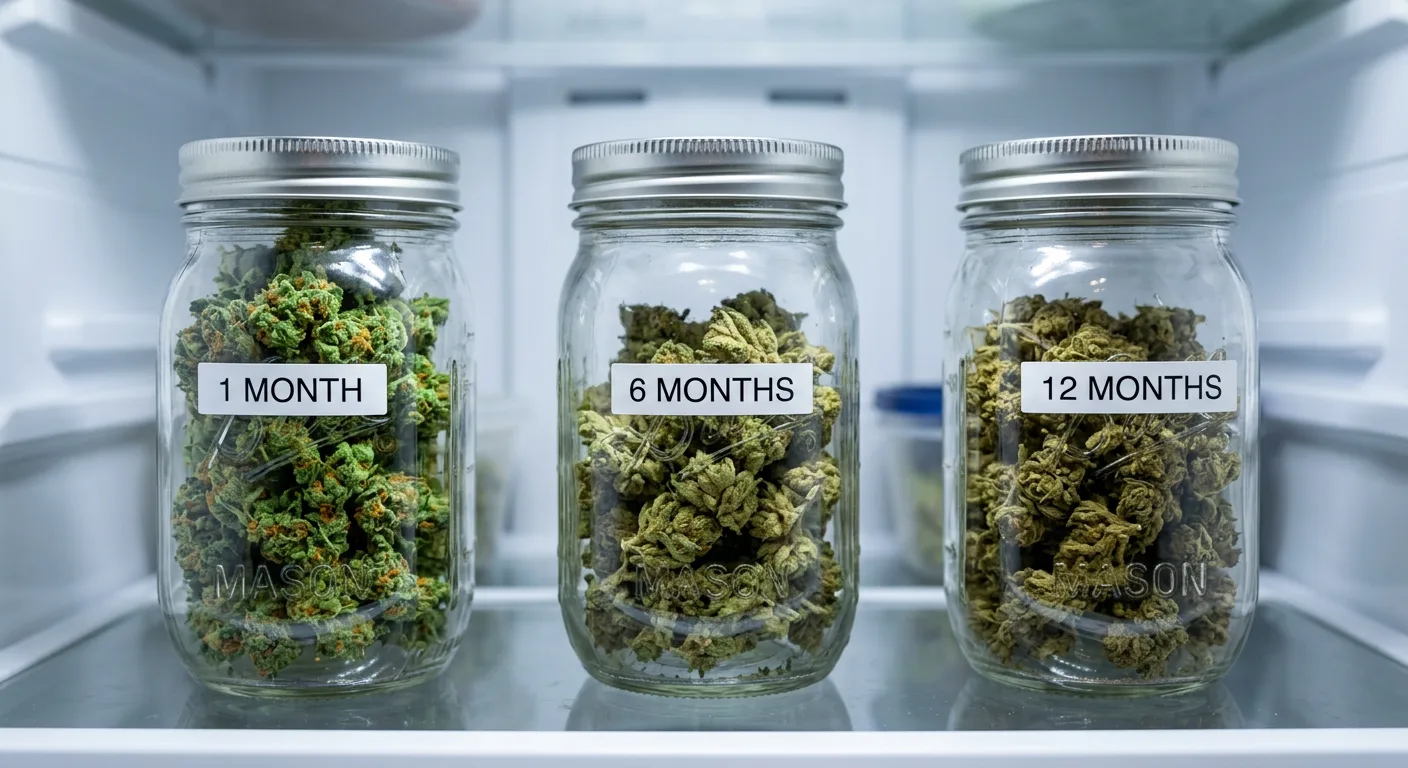
Once curing is complete, the long game begins. How you store cannabis determines whether you are smoking the same product in six months or a ghost of it. The three main variables are temperature, oxygen exposure, and light — and their effects compound each other multiplicatively, not additively.
The data below synthesizes findings from multiple independent cannabis storage studies and terpene stability research. Percentages represent approximate terpene content remaining relative to post-cure baseline.
| Storage Method | Temp Range | 1 Month | 3 Months | 6 Months | 12 Months | Container |
|---|---|---|---|---|---|---|
| Room temp, clear glass, light exposure | 20–25°C | ~85% | ~65% | ~45% | ~30% | Clear glass jar |
| Room temp, opaque container, dark shelf | 20–25°C | ~92% | ~78% | ~62% | ~45% | Amber glass / tin |
| Refrigerator, sealed, dark | 2–8°C | ~97% | ~90% | ~83% | ~75% | Airtight amber glass |
| Freezer, vacuum-sealed, dark | -10 to -18°C | ~99% | ~96% | ~93% | ~91% | Vacuum-sealed glass |
| Room temp, zip-lock plastic bag | 20–25°C | ~80% | ~55% | ~35% | ~20% | Plastic bag |
The difference between a zip-lock bag in a warm room and a vacuum-sealed jar in the freezer is roughly 70 percentage points of terpene retention at 12 months. Every single storage decision compounds. The jar choice, temperature, and light exposure are not separate issues — they are the same issue.
Does Freezing Cannabis Preserve Terpenes?
Yes — freezing is the most effective method for long-term terpene preservation, but it comes with two risks that must be managed. First, trichome heads become extremely brittle below 0°C. Any agitation — shaking, rough handling, even vibration from nearby appliances — will physically shatter trichomes and release their terpene content as aroma you can smell but no longer consume. Handle frozen cannabis as if it is glass.
Second, and critically: condensation. Every time a cold container moves from freezer to room temperature, water vapor from the air condenses on and inside the container. If you open it while cold, that moisture deposits directly onto your buds. The fix is simple — allow the sealed container to reach full room temperature before opening. This typically takes 30–45 minutes for a standard mason jar.
For multi-month freezer storage, portion your harvest into small single-session containers before freezing. Each time you thaw and open a large jar you introduce a fresh dose of oxygen and risk condensation. Small portions let you open only what you need, leaving the rest undisturbed in the freeze.
See our comprehensive guide on long-term cannabis storage for the full protocol, including humidity pack integration for refrigerator and room-temperature storage.
Light and UV Exposure: The Silent Terpene Killer
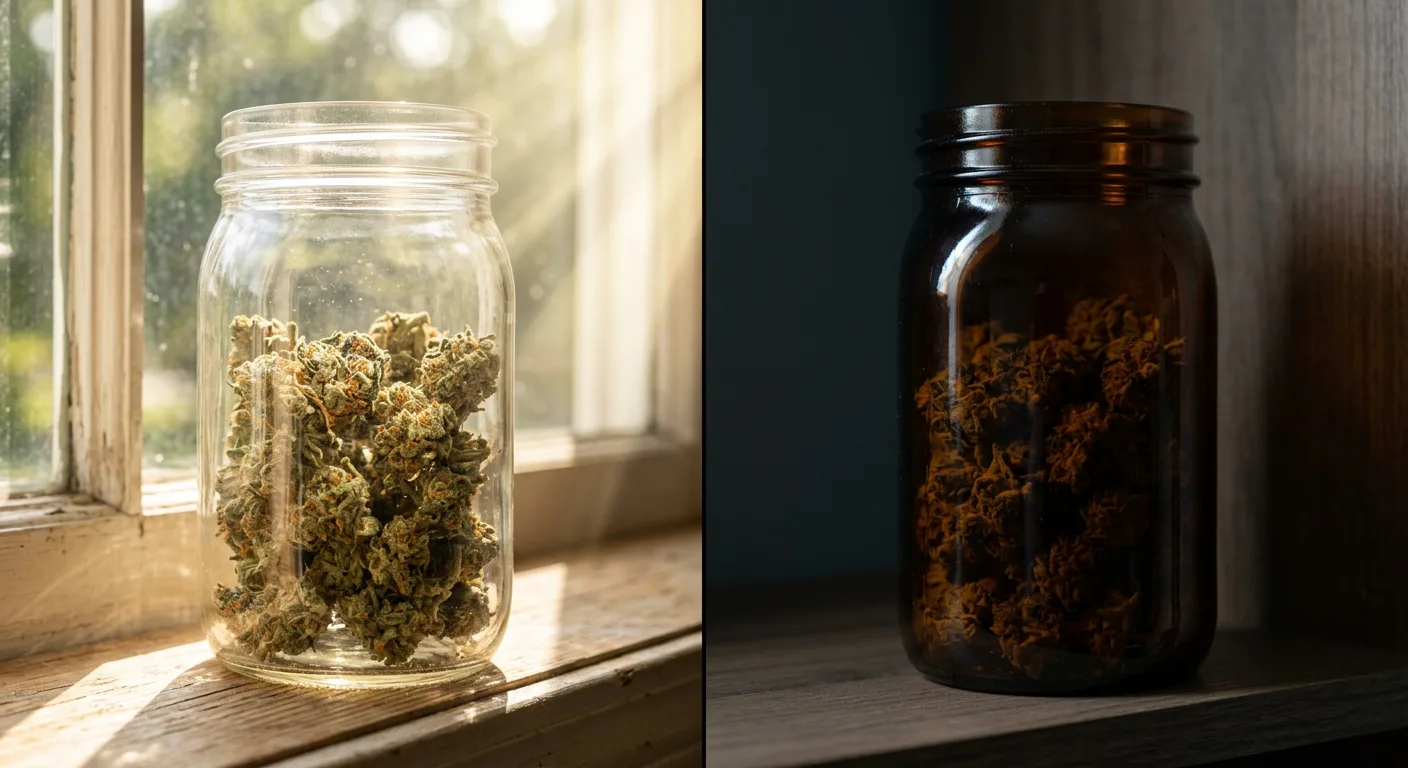
UV light is arguably the most underestimated factor in terpene degradation, because unlike heat or air exposure, its effects are invisible in real time. You do not smell terpenes leaving the jar when a UV photon breaks a molecular bond — you just open it six weeks later and wonder why the aroma is flat.
Terpene photo-degradation primarily occurs in the UV-A (315–400 nm) and UV-B (280–315 nm) wavelength ranges. Standard glass transmits roughly 75–90% of UV-A radiation, meaning a clear glass jar on a windowsill offers almost no UV protection. Even indoor fluorescent and LED lighting emits low-level UV that causes measurable degradation over weeks.
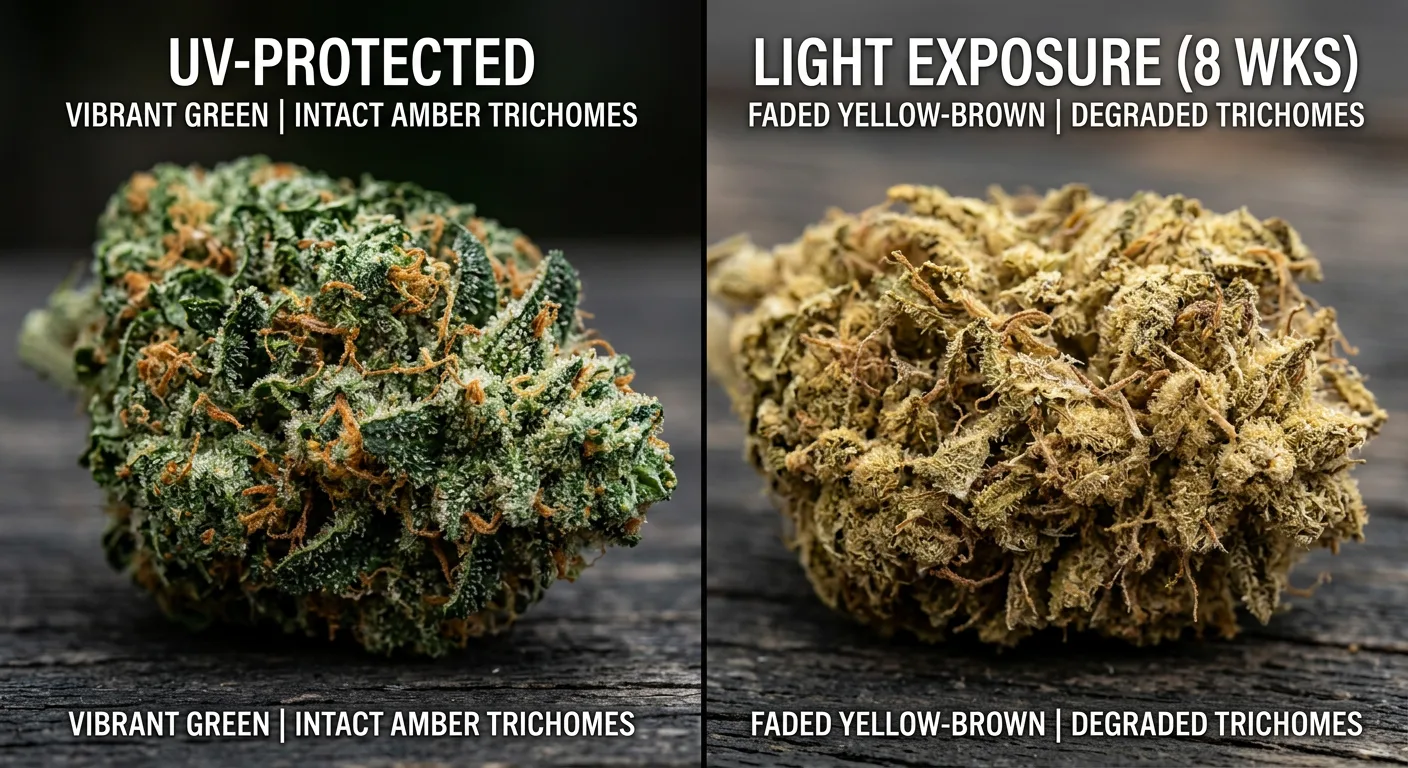
Container Comparison: Opaque vs. Clear Glass vs. UV-Blocking Glass
- Clear glass jar: Transmits ~85% UV-A — essentially no protection. Only acceptable if stored in complete darkness
- Amber glass (UV-blocking): Blocks 90–99% of UV-A and UV-B — the standard for pharmaceutical storage and ideal for cannabis
- Opaque metal tin: 100% light block — excellent protection, zero UV transmission, slight flavor risk long-term
- Black UV-blocking plastic: Effective light block but plastic permeability remains a concern
- Miron violet glass: Blocks all UV and visible light except violet/far-red spectrum — marketed specifically for botanical preservation, measurably effective
Caution: Storing cannabis in clear glass jars is only safe in a completely dark environment — a drawer, cabinet, or opaque bag. Most home growers keep jars visible for convenience. Every hour of ambient light exposure, including from standard LED room lighting, contributes to cumulative terpene and cannabinoid degradation.
For a complete storage container comparison that includes humidity management, see our breakdown of humidity packs for cannabis storage.
Terpene Loss During High-Temperature Vaping vs. Low-Temp Consumption
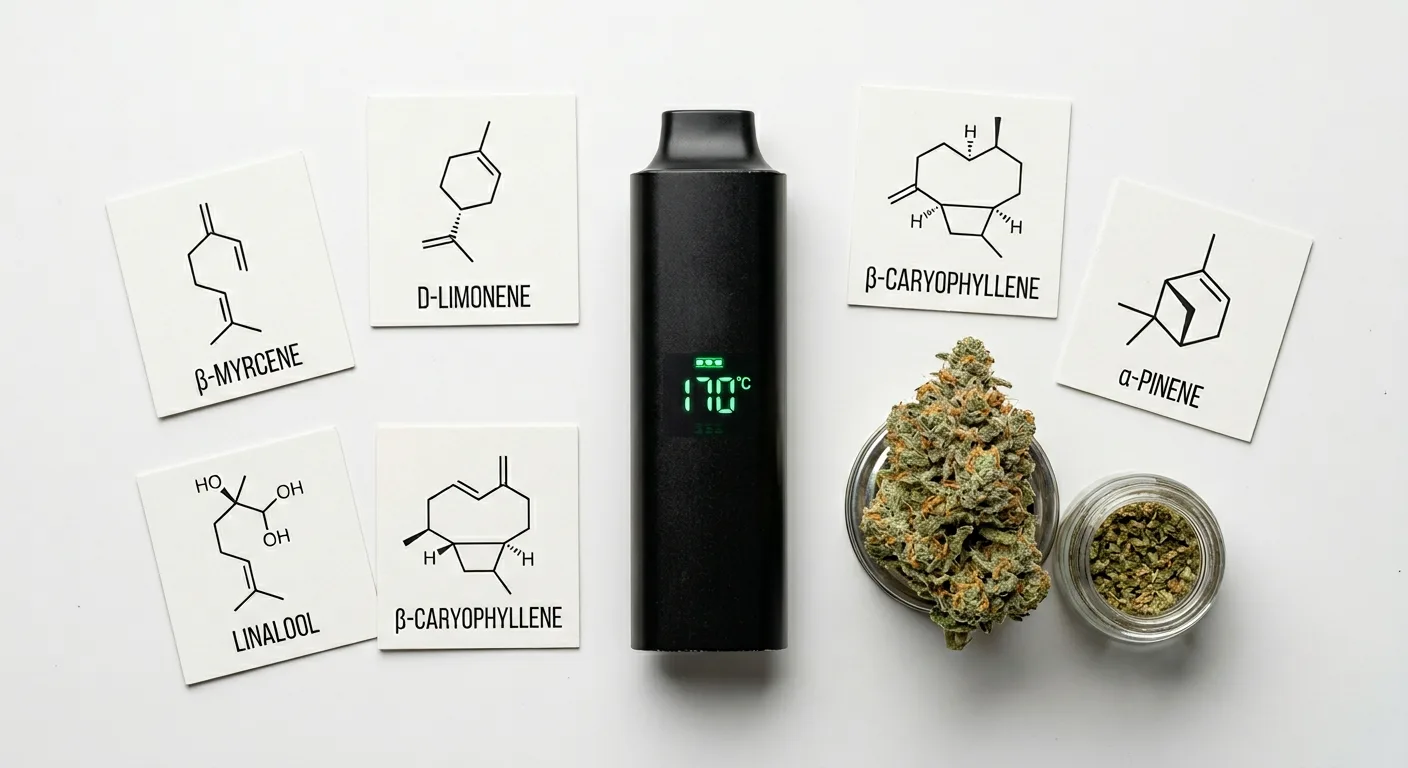
Understanding terpene boiling points gives you a direct, practical advantage at the consumption stage. Most of the terpenes discussed in this guide boil between 155°C and 200°C — which means a vaporizer set to that range will volatilize and deliver them as intended, while combustion above 230°C incinerates the majority before you can inhale them.
This is the fundamental science behind low-temperature vaping, and it is not marketing language — it is thermodynamics.
The Temperature Zones and What They Deliver
| Temperature Range | What It Activates | Terpene Delivery | Experience Profile |
|---|---|---|---|
| 140–160°C (low) | Lightest terpenes, partial THC | Excellent — pinene, myrcene, limonene | Highly aromatic, mild effects, flavor-forward |
| 160–185°C (optimal) | Full terpene range, full THC/CBD | Excellent — full spectrum delivery | Balanced potency + full aroma profile |
| 185–210°C (high) | Cannabinoids fully activated, heavier terpenes | Moderate — lighter terpenes already gone | Stronger effects, reduced aroma complexity |
| 210–230°C (very high) | Maximum cannabinoid extraction | Poor — majority of terpenes destroyed | Harsh, dense vapor, less nuanced effect |
| 230°C+ (combustion) | Smoke — full combustion | Minimal — terpenes largely incinerated | Smoke flavor dominates, effect driven by cannabinoids only |
The 160–185°C window is the terpene delivery sweet spot. At this range, you are above the boiling point of all primary cannabis terpenes but well below combustion temperature. This is why the same strain can smell and feel dramatically different smoked versus vaped at low temp — the terpene-driven entourage effect is simply not fully available through combustion.
Why Terpene-Driven Effects Are Diminished at High Temperatures
The entourage effect — the synergistic interaction between cannabinoids and terpenes — requires both components to be present in the inhaled vapor simultaneously. When combustion destroys 70–80% of terpene content before it reaches you, the cannabis experience becomes essentially cannabinoid-only: THC dominates without the nuanced modulation that linalool, myrcene, and caryophyllene provide.
Research on beta-caryophyllene specifically is instructive here. As a CB2 receptor agonist, it contributes anti-inflammatory and analgesic modulation to the overall effect. But beta-caryophyllene's steam distillation point is only 130°C — it will be among the first compounds to volatilize at low vaping temps and among the first to combust and degrade at high temps. Low-temperature vaping captures it; smoking largely loses it.
For the full science on caryophyllene and its CB2 activity, read our guide to best caryophyllene strains for inflammation.
High-Terpene Genetics Worth Protecting: Choosing Strains That Start Strong
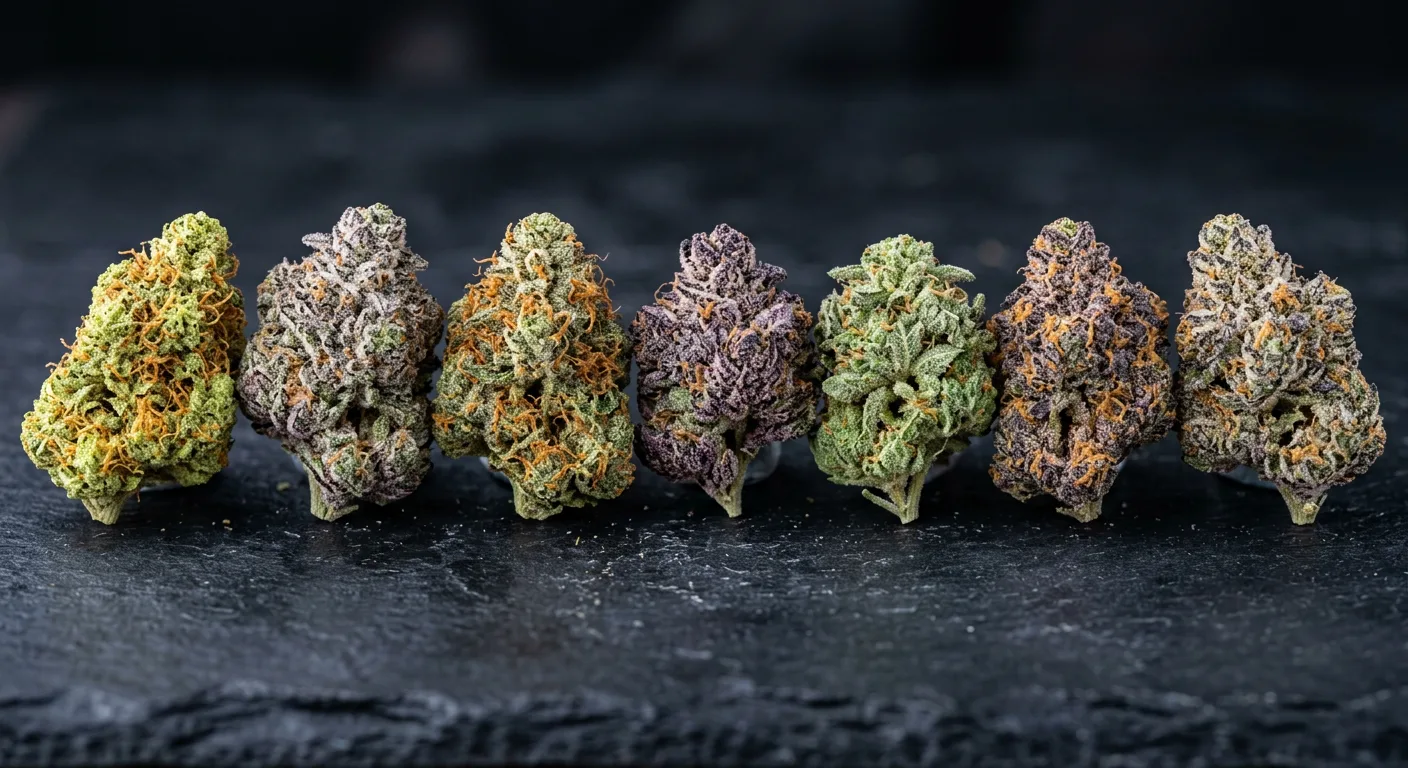
All the preservation techniques in this guide deliver maximum benefit only if your starting material has high terpene density to begin with. Genetics determine the ceiling — cultivation and post-harvest practices determine how close to that ceiling you get.
Terpene production is fundamentally genetic. Some cultivars produce 3–5% total terpene content by dry weight; others produce under 0.5%. That gap cannot be bridged by curing technique. Choosing high-terpene genetics is the first and most impactful terpene decision you make.
What Makes a Strain High in Terpenes
- Trichome density: Terpenes are produced and stored in glandular trichomes — strains with dense capitate-stalked trichomes produce more total terpene mass
- Genetic heritage: Haze lineages typically excel in monoterpene production (limonene, terpinolene); Kush genetics dominate in myrcene and caryophyllene; tropical landraces often produce rare sesquiterpene profiles
- Harvest timing: Terpene production peaks at or just before peak THC — harvesting too late allows terpene degradation even on the plant as trichomes begin oxidizing. See our guide on when to harvest for maximum potency
- Late-flowering stress response: Moderate environmental stress in the final two weeks of flower (slight UVB supplementation, temperature differentials) can upregulate terpene biosynthesis
High-Terpene Strain Examples Worth Growing
In terms of well-known, widely respected high-terpene cultivars, the following consistently rank among the most aromatic and terpene-rich available:
- Gelato — Dense caryophyllene and myrcene profile, sweet and creamy, extremely terpene-rich in late flower
- Zkittlez — Exceptional limonene and linalool expression, tropical fruit notes, high terpene density in trichomes
- Wedding Cake — Rich myrcene, caryophyllene, and limonene profile; consistently tests high on terpene lab reports
- Gorilla Glue #4 — Distinctive myrcene and caryophyllene-forward profile, extremely resinous, excellent terpene-to-trichome ratio
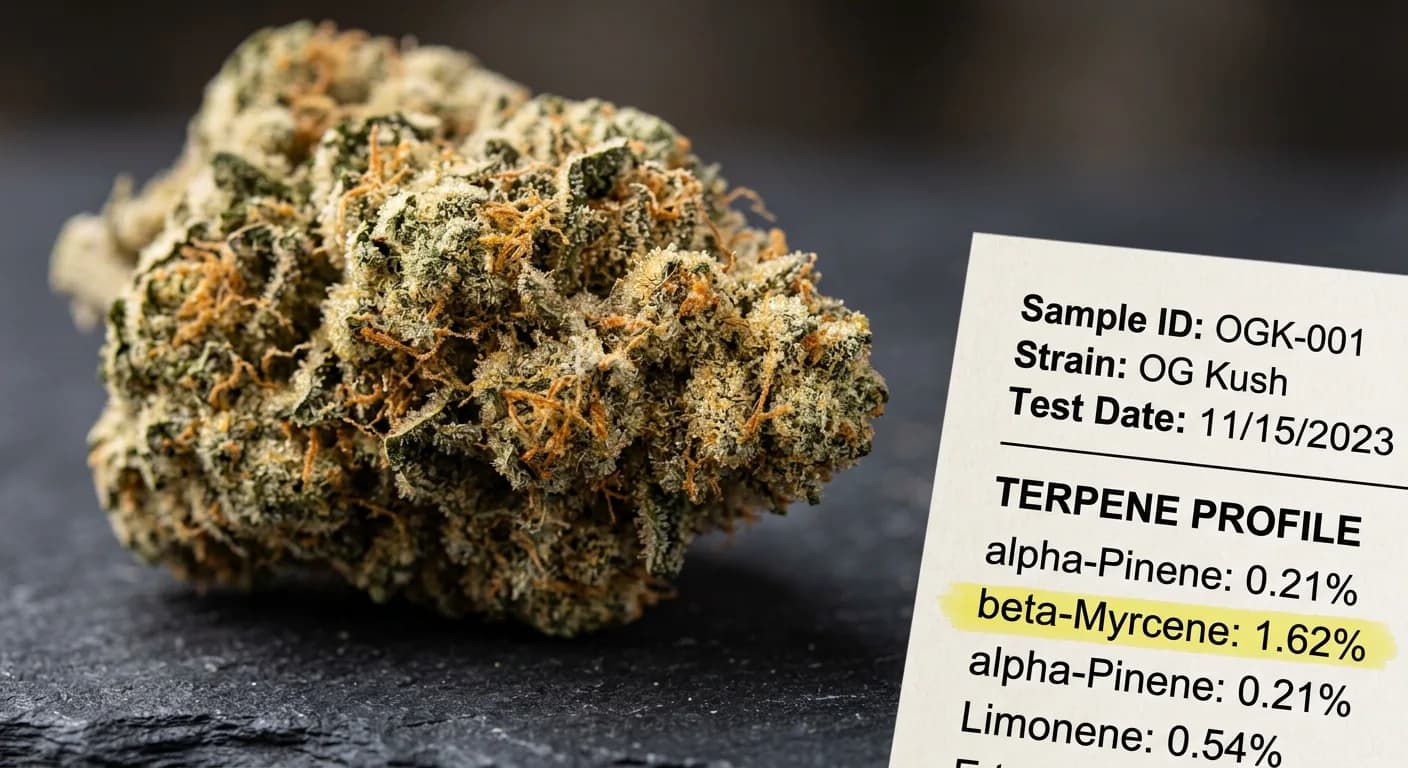
- OG Kush (26% THC) — The defining myrcene + limonene + caryophyllene profile that defines the Kush terpene category; one of the most studied and recognized aromatic chemotypes in cannabis
- Sour Diesel (24% THC) — Exceptional limonene and terpinolene expression, the gold standard for citrus-forward top-note terpene profiles
- Super Lemon Haze (23% THC) — Dominant limonene expression from its Lemon Skunk lineage, intensely aromatic and notably terpene-rich through cure
- White Widow (25% THC) — Renowned for exceptional resin and terpene production; a benchmark strain for trichome density and complex aromatic profile
- Papaya (25% THC) — Tropical terpene profile with notable myrcene and exotic sesquiterpene content, highly aromatic through full cure
- Northern Lights x Amnesia Haze (24% THC) — Combines the earthy myrcene base of Northern Lights with Haze's complex terpinolene and limonene top notes for layered, persistent aroma
When comparing strains for terpene potential, look for lab-tested COA (Certificate of Analysis) data showing total terpene percentage alongside the cannabinoid panel. Anything above 2% total terpenes by dry weight is considered high-terpene. Our guide to reading cannabis COA reports shows you exactly how to interpret this data.
The Complete Terpene Preservation Protocol: Step-by-Step
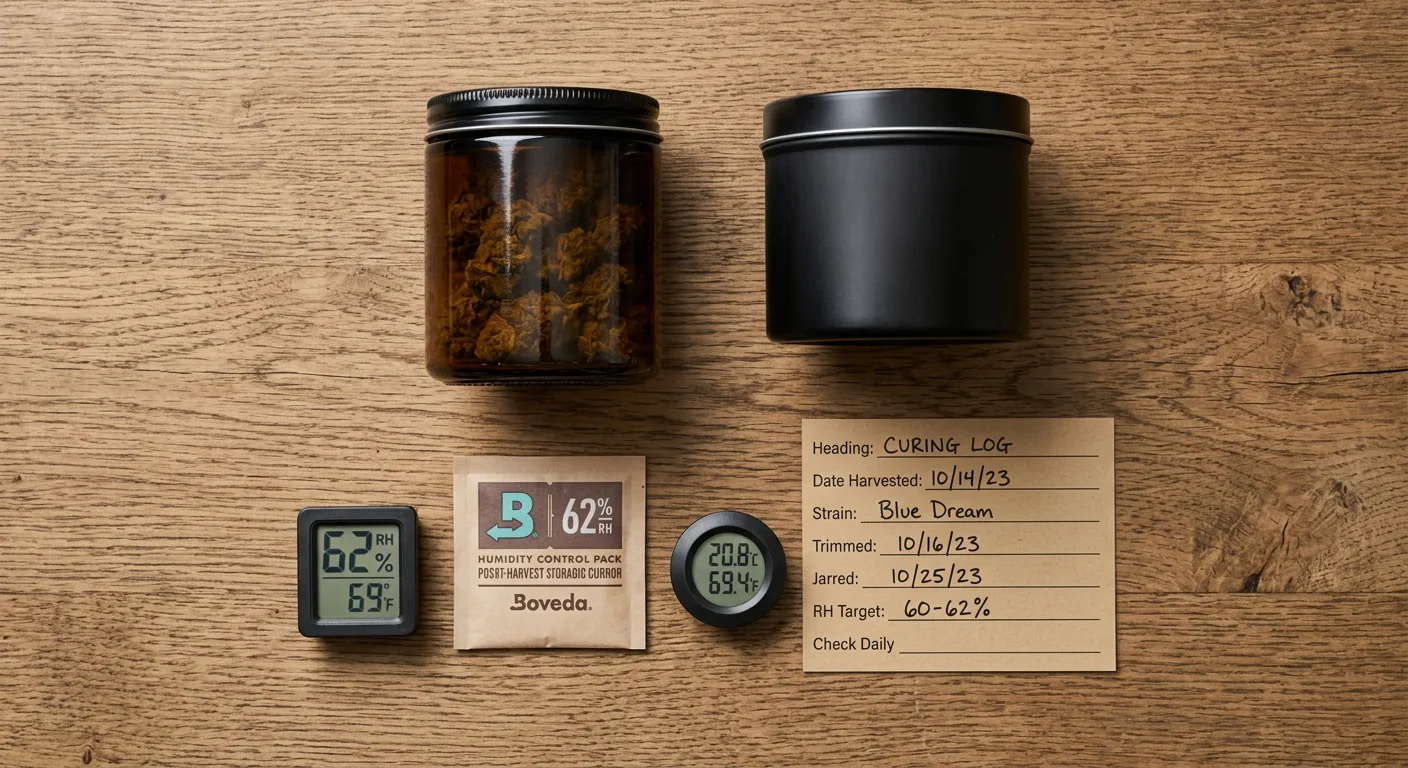
Every principle in this article maps to a specific, actionable step. The following protocol synthesizes the science into a chronological workflow from harvest through storage — the exact process that separates terpene-rich end product from aromatic mediocrity.
Harvest at Peak Trichome Maturity
Use a jeweler's loupe or USB microscope to confirm 70–90% cloudy trichomes with some amber transition. Harvesting before this point means fewer terpenes were synthesized. Harvesting past it means terpene oxidation has already begun on the plant. See our guide on harvesting too early for what to look for.
Trim Wet or Dry — But Minimize Bud Handling
Every time you handle buds, you rupture trichomes and release terpenes. Wet trimming removes excess leaf matter immediately; dry trimming is gentler on trichomes because they are not yet at peak brittleness. Either method works — the rule is minimum mechanical stress, maximum care.
Dry at 60–65°F (15–18°C), 55–60% RH, Complete Darkness
Hang whole branches in a dark room with gentle passive circulation. Target 10–14 days. Check daily for mold. The bud is ready when the smaller stems snap cleanly rather than bending. Never use direct fan airflow over buds, never exceed 70°F, and never expose to light during this phase.
Cure in Amber Glass Mason Jars at 62% RH
Fill jars to 70–80% capacity. Add a 62% Boveda or Integra Boost humidity pack. Store in a dark cabinet or drawer at room temperature. Follow the burping schedule: 2x daily for week 1, 1x daily for week 2, every 2 days for week 3, then weekly. Minimum cure duration: 3–4 weeks. Optimal: 6–8 weeks.
Long-Term Storage: Match Method to Timeline
For consumption within 3 months: sealed amber glass jar in a dark, cool cabinet works well. For 3–6 months: refrigerator in sealed amber glass with humidity pack. For 6–12+ months: vacuum-sealed glass in the freezer, portioned into single-session containers. Never use plastic bags for storage beyond 2 weeks.
Consume at the Right Temperature
For full-spectrum terpene delivery, vape at 160–185°C. If using a dry herb vaporizer, start at the lower end of the range and step up — the first few draws at 160°C deliver the most aromatic, terpene-forward vapor. Save higher temperatures for the end of the session when the more volatile terpenes have already been consumed.
- Dark, cool, airtight storage at every stage
- Amber or opaque glass — never clear glass in ambient light
- Temperature below 70°F during drying, cure, and storage
- Humidity pack in every long-term storage jar (62% RH)
- Minimum handling — open jars only when necessary
- Freeze for 6+ month storage with vacuum seal and no agitation
- Low-temp vape (160–185°C) for maximum terpene delivery
- Start with high-terpene genetics — the ceiling is genetic
To ensure your seeds have the genetic foundation to produce exceptional terpene profiles from the start, explore our full cannabis terpene chart to match strain profiles to your target aroma and effect.
Signs Your Terpenes Have Already Degraded
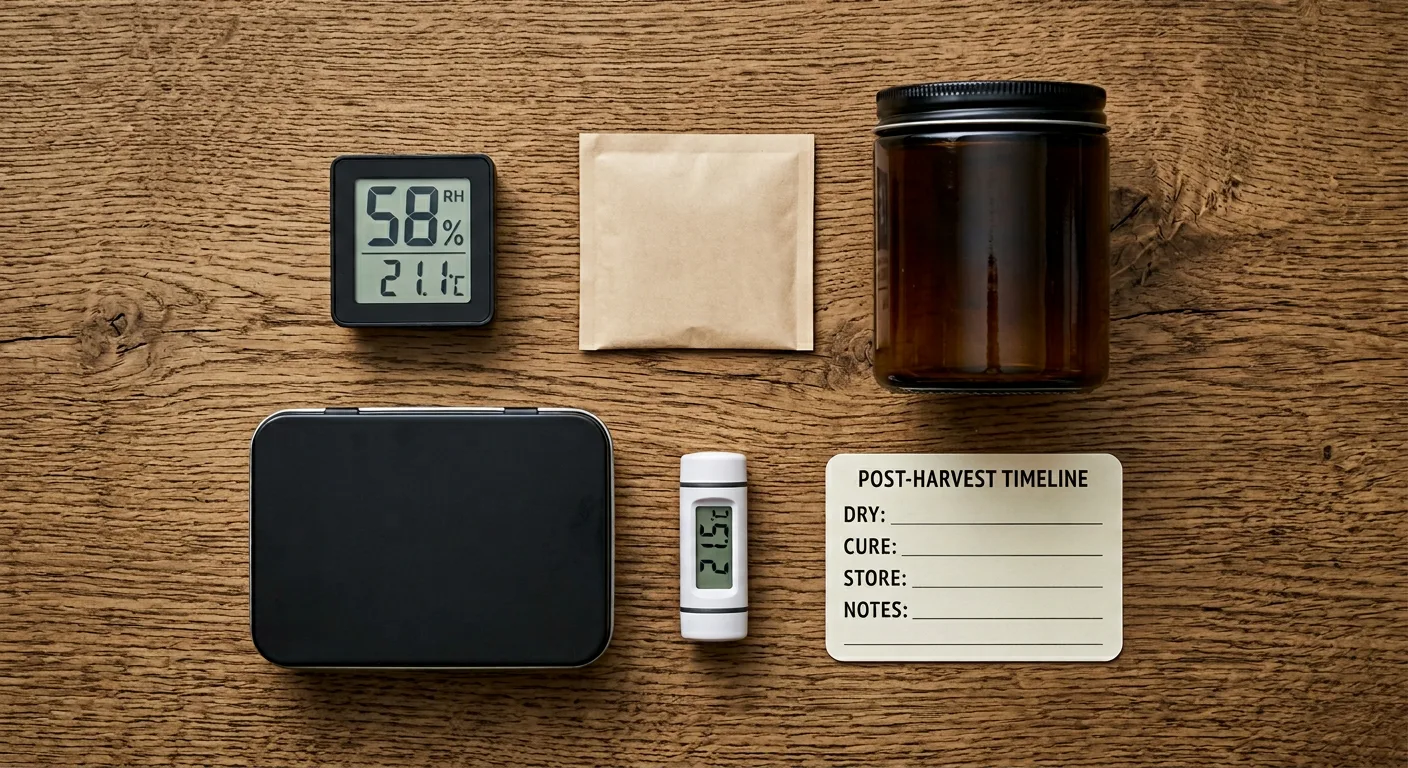
Knowing the degradation stages helps you assess existing stock and calibrate your current storage approach. Terpene loss is not binary — it happens in predictable stages that produce recognizable sensory changes.
Progressive Degradation Indicators
- Loss of top notes (early degradation, weeks 2–6 at room temp): Citrus, pine, and fresh herbal aromas fade first — this is limonene and pinene volatilizing. The bud still smells like cannabis but less complex
- Flat, skunky smell (mid degradation, months 2–4): Monoterpenes are mostly gone, leaving primarily caryophyllene and humulene — earthy, skunky, one-dimensional
- Hay or grass smell (over-dried or late degradation): Chlorophyll breakdown without sufficient terpene presence — this often indicates drying too fast or too hot
- Dry, crumbly, dusty texture: Trichome heads have ruptured or dried out — physical sign of extensive terpene loss
- Color shift to brown or tan: Oxidative degradation of terpenes and cannabinoids — UV exposure is a common cause
- Reduced effect complexity: If the experience feels blunt and undifferentiated compared to fresh material, the entourage effect is compromised by terpene loss
If your cannabis smells mostly like generic skunk or hay rather than the strain's characteristic profile, the top-note monoterpenes are already gone. You cannot reverse terpene loss — but you can stop further degradation immediately by switching to proper storage conditions. The heavier sesquiterpenes may still be present and functional.
If you suspect your bud has also suffered from moisture-related curing issues alongside terpene loss, our guide to fixing over-dried or ammonia cannabis covers rescue protocols for compromised batches.
Frequently Asked Questions
At what temperature do cannabis terpenes evaporate?
Different terpenes evaporate at different temperatures. Caryophyllene begins volatilizing around 130°C during steam distillation. Myrcene boils at 167°C, limonene at 176°C, and linalool at 198°C. Significant terpene loss begins well below boiling point — even at room temperature (20–25°C), the most volatile monoterpenes like alpha-pinene slowly off-gas over weeks, which is why cool storage is so critical.
How long before cannabis terpenes fully degrade?
At room temperature in a sealed glass jar away from light, terpene levels can drop 15–30% within 3 months and up to 55% within 12 months. Refrigerator storage slows loss to roughly 10–20% over 12 months. Freezer storage in vacuum-sealed glass preserves the most, with losses under 10% over 12 months when stored correctly with no thaw-refreeze cycles.
Does freezing cannabis preserve terpenes?
Yes — freezing is the most effective long-term terpene preservation method. At temperatures below 0°C, terpene volatilization slows dramatically. The key risks are condensation damage during thaw cycles and trichome brittleness from agitation. Always let frozen cannabis return to full room temperature before opening the container, and handle frozen material with extreme care to avoid shattering trichomes.
Why does my cannabis lose smell over time?
Terpene evaporation, oxidation, and photo-degradation all cause cannabis aroma to fade. The lightest, most volatile terpenes — like alpha-pinene and limonene — off-gas first, stripping bright citrus and pine top notes. Warmth, light exposure, air contact, and low humidity all accelerate this process. Switching to airtight, opaque, cool storage dramatically slows the loss.
Does low-temperature vaping preserve terpene-driven effects compared to smoking?
Yes. Vaping at 160–185°C targets the boiling points of most primary cannabis terpenes without destroying them. Combustion above 230°C incinerates the majority of terpenes before they can be inhaled. Low-temp vaping delivers noticeably more aromatic, flavor-rich vapor and preserves the terpene-driven entourage effect that modulates the overall cannabis experience. The same strain vaped at 170°C versus smoked will produce distinctly different sensory and effect profiles.