Your grow room climate control strategy has to shift with the seasons — the same tent that ran a perfect 77°F / 55% RH in April can hit 92°F in a July attic or crash to 58°F in a January basement. Most grow guides hand you one generic chart and walk away. This one is built around the four real scenarios home growers actually face: a tent that overheats in summer, a basement that runs cold in winter, arid-climate air that strips humidity below 20%, and swampy summers where RH refuses to drop under 70%. We'll cover the cannabis temperature humidity targets by stage, then walk through fixes — starting with the free and cheap ones before you spend money on new equipment.
Why Climate Control Makes or Breaks Your Grow
Cannabis is fussier about air than most houseplants. Push the tent above roughly 78°F as a seedling and you can trigger heat stress, root issues, and terpene loss; climb past 84°F in late flower and you start burning off the resin you spent months building [6]. Drop below 60°F and growth stalls; a freeze can kill the plant outright [2]. Humidity is the other half of the equation — uncontrolled RH is how mold, bud rot, and powdery mildew take a harvest from you in 48 hours [4][5].
On the commercial side, MoCannTrade reports that choosing the right HVAC system over a mismatched one can deliver "a 30% increase in post-harvest crop yield vs. other system options" [3]. That number doesn't translate perfectly to a 4x4 tent, but the principle does: climate is a yield multiplier, not a background variable.
Temperature and humidity aren't two knobs — they're one system. Every fix for one affects the other, which is why seasonal strategy matters more than any single piece of gear.
The Core Parameters: Temperature, Humidity, VPD, Airflow
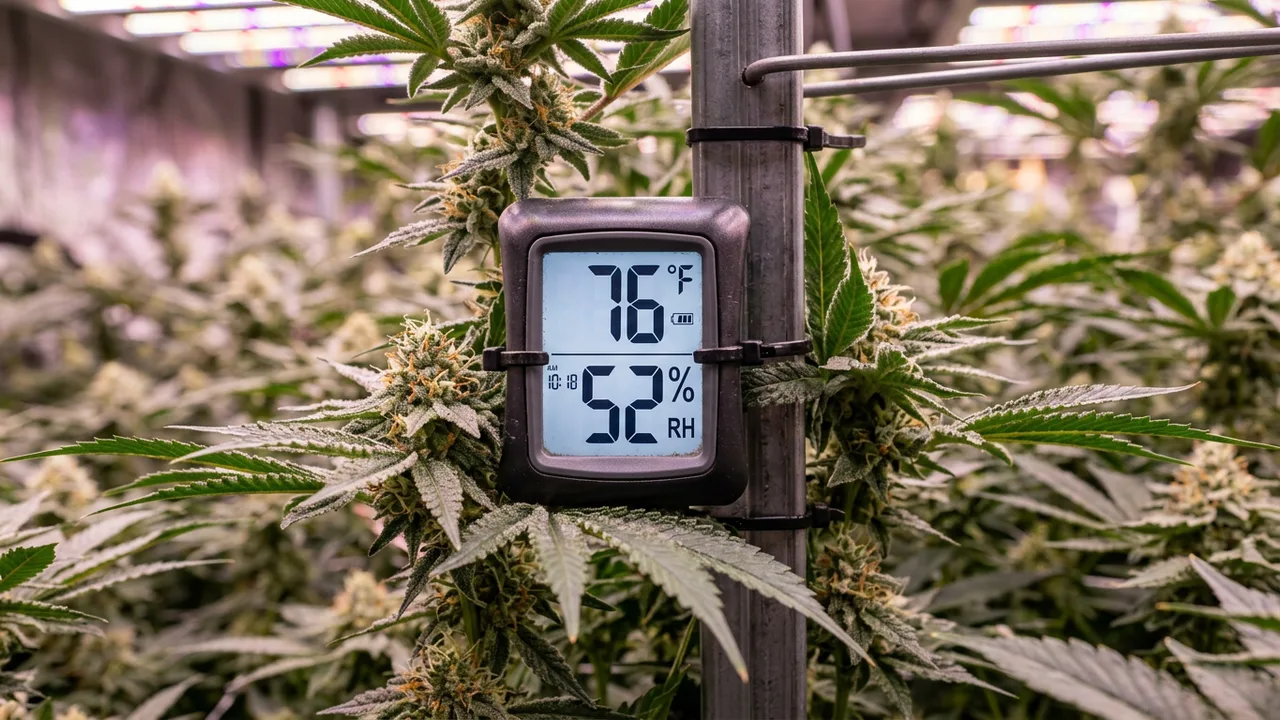
Before we get into seasonal fixes, lock in the four numbers that matter.
- Temperature: 65-80°F (18-26°C) is the overall ideal envelope, with slight stage variation [4][6][7].
- Relative humidity: 40-70% is the broad working range, tightened by stage [4][5].
- VPD: 0.8-1.1 kPa in veg, 1.0-1.5 kPa in flower [4][7]. Use our VPD calculator to dial this in.
- Airflow: constant gentle movement across the canopy plus active extraction — the vehicle that makes the other three numbers real.
Grow Weed Easy puts it simply: "Cannabis plants like a temperature similar to humans, or a little warmer – not too dry, not too humid." [2] That's the shorthand. The rest of this article is the long form.
Stage-by-Stage Climate Chart
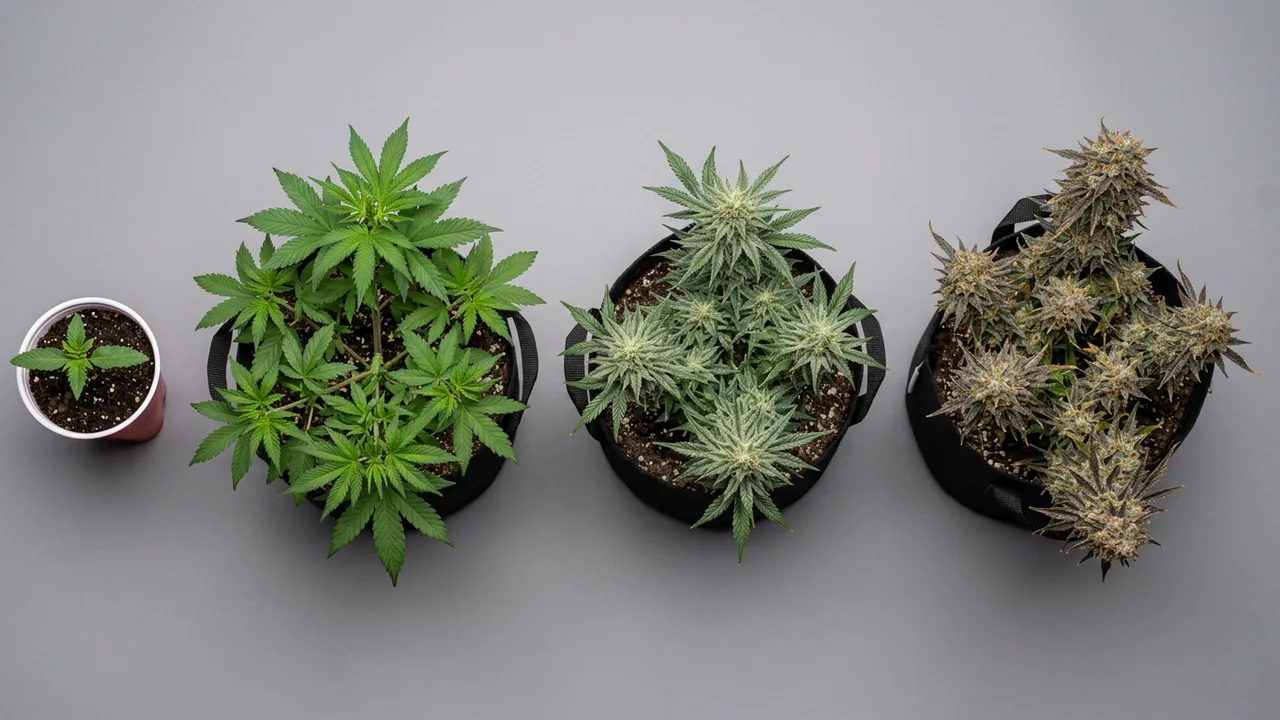
There's honest disagreement between sources on exact stage targets, so we're presenting both the Spider Farmer and Gorilla Grow Tent chart side-by-side rather than silently picking.
| Stage | Temp (Day) | Temp (Night) | RH | VPD |
|---|---|---|---|---|
| Seedling (S11) | 70-85°F | 65-80°F | 75-85% | 0.4-0.8 kPa |
| Seedling (S12) | 75-80°F | — | 65-75% | 0.4-0.8 kPa |
| Vegetative | 70-85°F | 60-75°F | 45-70% | 0.8-1.1 kPa |
| Flowering | 65-84°F | 60-75°F | 35-50% | 1.0-1.5 kPa |
| Late Flower (final 1-2 wks) | 64-75°F | 60-68°F | 30-40% | 1.2-1.5 kPa |
Seedling humidity sits somewhere in the 65-85% band depending on which source you trust [6][7]. Vegetative pulls 50-70% RH [7] at 70-85°F [2][6][7]. Flower drops to 40-50% [7] or 35-45% [6]. Late flower is the deliberate 30-40% squeeze [6].
A 5-10°F drop between lights-on and lights-off during veg simulates natural day/night cycles and supports healthy development [7]. Don't fight the dip — engineer it.
Understanding VPD and the Leaf-Temperature Adjustment
VPD (vapor pressure deficit) is how thirsty the air is. It combines temperature and humidity into one number that predicts transpiration — and transpiration drives nutrient uptake. Ideal ranges are 0.8-1.1 kPa in veg and 1.0-1.5 kPa in flower [4][7], with seedlings at a gentler 0.4-0.8 kPa [7].
Here's the nuance most growers miss: leaf temperature runs 2-5°F cooler than ambient air because transpiration cools the leaf surface [7]. Your sensor reads air temp, but the plant experiences leaf temp. If you're calculating VPD from a probe mounted three feet above the canopy in still air, you're off by a measurable margin. For precision, subtract about 3°F from your air reading when plugging into a VPD formula, or use an infrared thermometer pointed at a fan leaf.
Our printable VPD chart by stage bakes that leaf offset in.
How to Cool a Grow Tent in Hot Summer (>85°F)
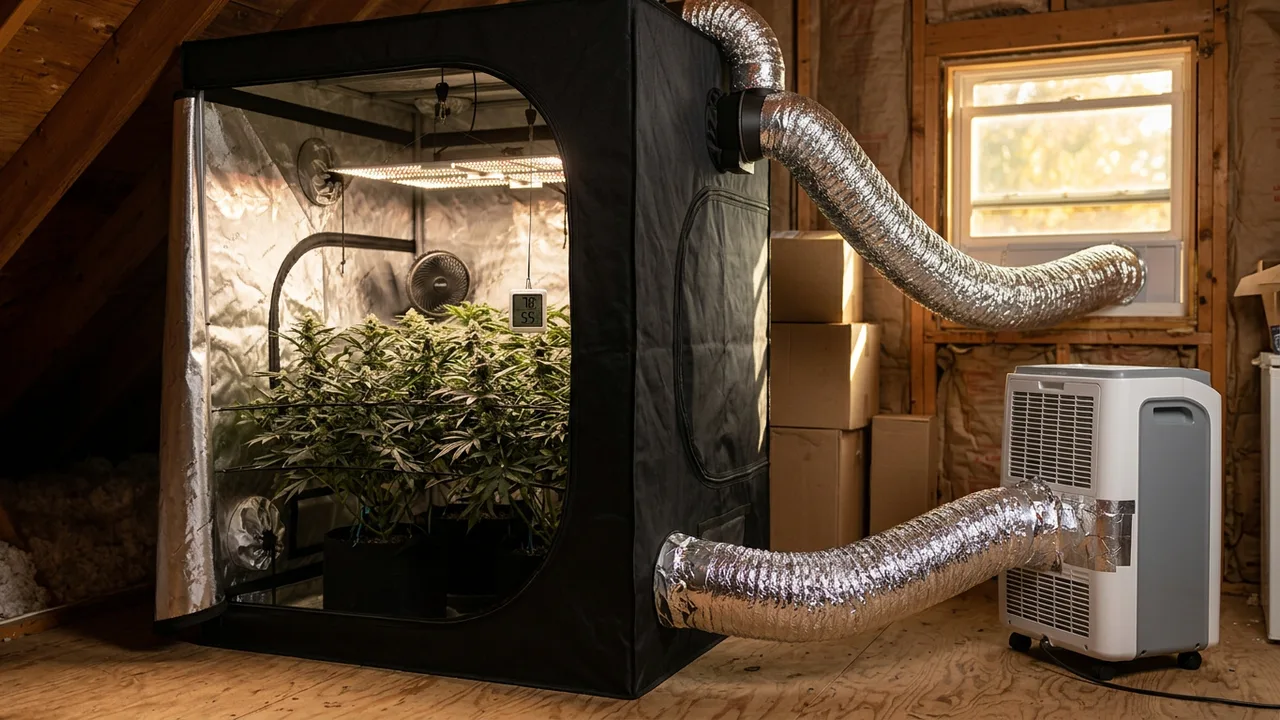
Summer is where most home grows fall apart. Your LEDs dump heat, the attic or garage bakes by noon, and the tent climbs past 85°F every afternoon. Work through these fixes in order — cheapest first.
Free and Low-Cost Fixes (Try These First)
Flip to lights-at-night
Run your lights from, say, 8 PM to 8 AM so peak heat output happens during the coolest ambient hours. This single change can knock 5-10°F off peak tent temps without spending a dollar. It works for both veg (18/6) and flower (12/12) [5].
Raise the light and dim it
Most modern LEDs have dimmers. Dropping from 100% to 75% drops heat proportionally. Lift the fixture an extra 4-6 inches while you're at it — you'll trade a sliver of PPFD for much cooler canopy temps.
Duct the light heat out
If you run air-cooled hoods or a fixture with a heat-sink top, run dedicated ducting that pulls hot air off the light and directly out of the room, separate from your main extraction. This keeps heat from mixing into the canopy air at all.
Upgrade your inline fan
Undersized extraction is the #1 summer failure. If your carbon filter is restricting an already weak fan, you're cooked — literally. Our CFM sizing guide walks through the math.
Frozen water bottle trick
For small tents, a 2-liter frozen bottle placed in front of your circulation fan drops canopy temps 2-4°F for a couple hours. Rotate three bottles. It's a band-aid, but it keeps seedlings alive during a heat wave.
Equipment Upgrades When Free Fixes Aren't Enough
If the tent still runs above 85°F after the steps above, it's AC time. Window ACs and mini-splits work in any climate [2]. Size for your room volume plus a 20% cushion for light heat. An evaporative (swamp) cooler is tempting because it's cheap, but it only works when ambient humidity is under 30% [2] — useless in most of the US in summer.
Strains also matter. If you're in a climate that fights you every July, lean toward heat-tolerant genetics with sativa-leaning vigor. Super Lemon Haze and Sour Diesel tolerate warmer rooms better than dense indica structures. Gelato, Zkittlez, and Wedding Cake (popular picks we don't carry) also handle heat reasonably well.
Never let flowering-stage cannabis sit above 84°F for extended periods. Terpene loss and resin degradation accelerate sharply, and late-flower buds become susceptible to foxtailing and airy structure [6].
How to Warm a Cold Basement Grow (<65°F in Winter)
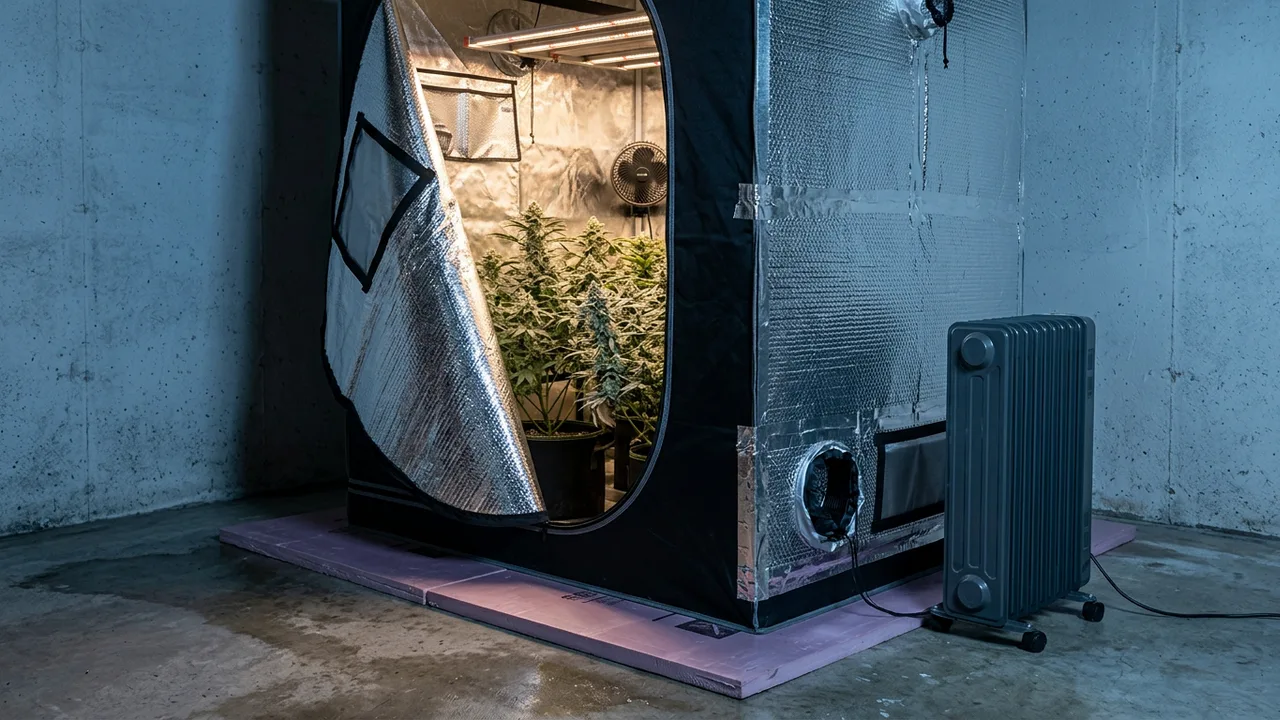
The opposite problem: a concrete-floor basement in January that barely breaks 60°F. Below 60°F, growth slows dramatically; a freeze can kill the plant [2]. The fix is a layered system — seal first, then add gentle heat.
Seal and Insulate Before Heating
A basement tent loses heat through the floor and thin walls faster than it loses heat through the tent fabric. Before you buy a heater:
- Put a 2-inch foam insulation board under the tent — concrete is a massive heat sink.
- Wrap the outside of the tent with reflective Mylar-bubble insulation if the room itself is cold.
- Seal gaps around the tent's intake/exhaust ports when the fan cycles off to stop cold infiltration.
- Use a seedling heat mat under fabric pots or solo cups — this alone can raise root-zone temps 5-8°F.
Heater Sizing and Placement
Oil-filled radiator heaters are our preferred choice for grow rooms: no open element, no sudden dry-out, silent, and thermostatically controlled. Rough sizing: ~10 watts per square foot of room (not tent) as a baseline, doubled if the room is uninsulated. A 700-1000W oil heater keeps most basement grow rooms above 68°F even when ambient is 55°F.
Place the heater outside the tent, heating the room that feeds the intake. Pulling pre-warmed air in is cleaner than stuffing a heater next to the plants, where hot spots and dry-out are real risks.
Also think about day/night differential. You want lights-on warmer than lights-off by 5-10°F [7]. In winter that often happens naturally — your heater thermostat just has to keep nights above 60°F while the lights handle the daytime rise.
Cold-resistant strains are your friend in a basement grow. Northern Lights x Big Bud, Purple Kush, and Hindu Kush-lineage plants evolved in mountain climates and tolerate the low 60s better than most modern hybrids.
Keep Humidity Up in a Dry Winter Grow (Arid Climate)
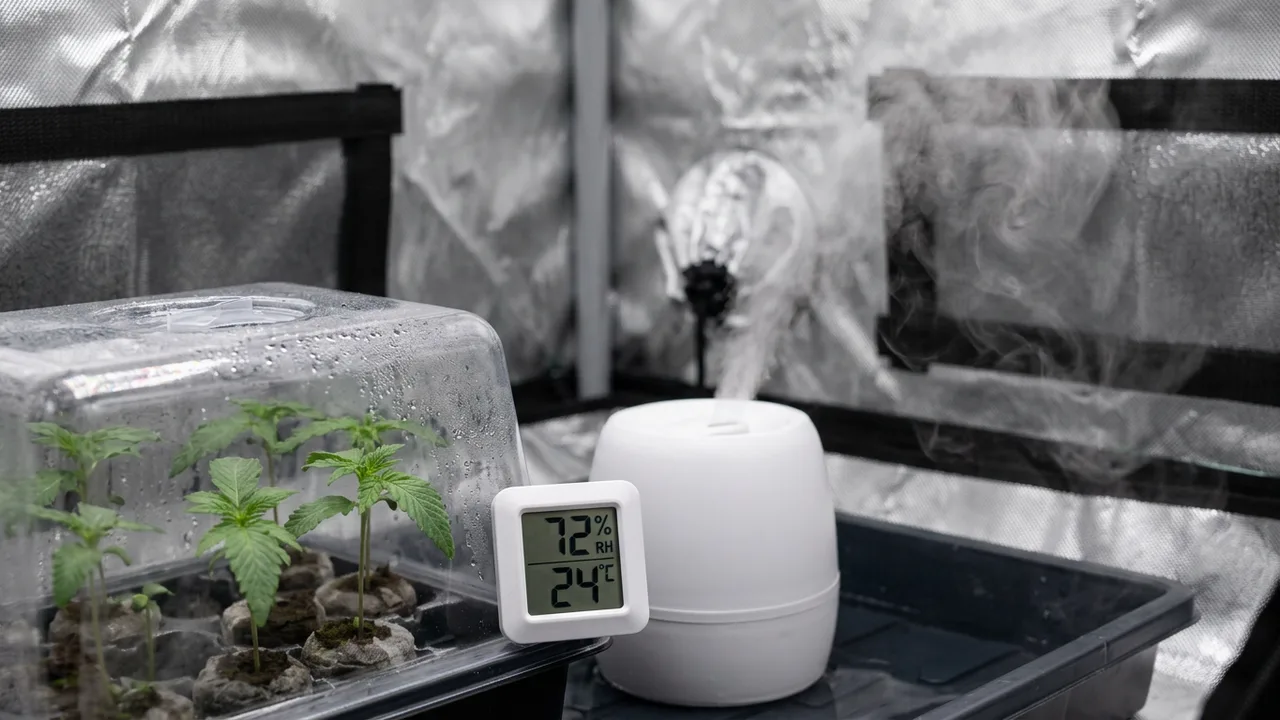
Forced-air heating plus winter air can crash indoor RH to 15-20%. That's brutal for seedlings that want 65-85% RH [6][7] and stressful even for mid-flower plants. Cheap fixes first.
Passive Humidity Boosts
- Wet towels on the tent floor: re-wet daily; adds 5-10% RH to a 4x4 at near-zero cost.
- Open trays of water with sponges: more surface area = more evaporation. Place near the intake fan path.
- Humidity domes for seedlings: standard propagation domes hold 80%+ RH without any powered gear.
- Reduce extraction: if your inline fan runs 100% duty cycle, it's yanking moisture out as fast as you add it. Put it on a controller and cycle it.
Humidifier Sizing
When passive isn't enough, ultrasonic humidifiers are the standard. Rough sizing for home tents:
| Tent Size | Humidifier Output | Tank Size |
|---|---|---|
| 2x2 | 1-2 L/day | 3-4 L |
| 4x4 | 3-5 L/day | 5-6 L |
| 5x5 or larger | 6+ L/day | commercial unit |
Use distilled or RO water — tap water minerals leave white dust on leaves and clog the nebulizer. Pair the humidifier with a controller (Inkbird-style) so it cuts off at your target RH instead of running blind.
Seedlings are the hardest stage in a dry winter grow. Sources disagree on exact RH — Gorilla Grow Tent recommends 65-75% [7] while Spider Farmer pushes 75-85% [6]. We aim for the middle (70-80%) with a humidity dome and bump up if leaf edges look crispy.
Fighting High Humidity in a Swampy Climate (>70% RH)
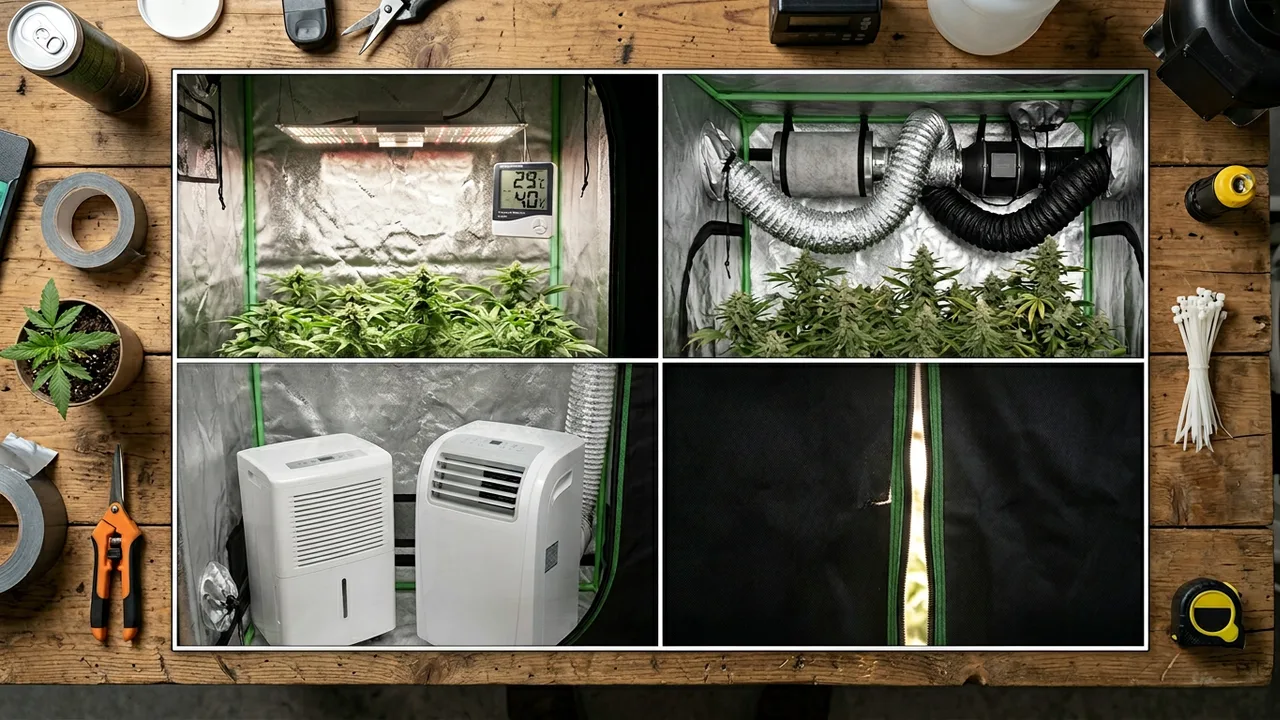
Gulf Coast, Pacific Northwest, tropical summers — some of you fight the opposite war. Flowering plants at 70%+ RH are a mold timer, and the last thing you want after 9 weeks of work is a bud-rot outbreak in week 8 [4][5].
Extraction and Airflow Come First
Before buying a dehumidifier, make sure your tent is actually moving air. A sealed, stagnant tent traps moisture from transpiration regardless of the dehumidifier's capacity. Upgrade extraction CFM, add a second oscillating fan at canopy level, and make sure air moves under the canopy (where bud rot starts) not just over the tops. See our full air circulation guide and mold prevention protocol.
Dehumidifier Sizing (and the Heat Trap)
A properly sized dehumidifier is non-negotiable in humid climates. Plan on pints-per-day output based on tent size and transpiration load — our dehumidifier sizing guide has the full math.
But here's the commercial-scale failure mode that also bites small growers: portable dehumidifiers emit warm air. MoCannTrade's article on climate control puts hard numbers on it: "when the portable dehumidifiers are in operation, the air temperature leaving those units is 25°F warmer than the air getting sucked in. This causes the rooftop air conditioners to turn on and try to remove that excess room heat and then quickly turn off again when their task has been completed. They are two competing forces." [3]
Translation for home growers: if your tent has both a dehumidifier and an AC, they will fight. The dehumidifier adds heat; the AC reacts; the AC's cooling coil condenses water that the dehumidifier then has to remove again. You get short-cycling, higher power bills, and unstable conditions. Solutions: use AC dehumidify mode (AC units dehumidify while cooling — two birds); use an integrated dehumidifier/mini-split system; or place the dehumidifier in the room feeding the tent, not inside the tent itself.
In late flower, dropping RH to 30-40% for the final 1-2 weeks is a deliberate tactic — it encourages resin production and protects against bud rot [6]. If you can't hit those numbers in a humid climate, consider harvesting a few days early rather than losing the crop to mold.
Common Climate Control Failures (and How to Avoid Them)
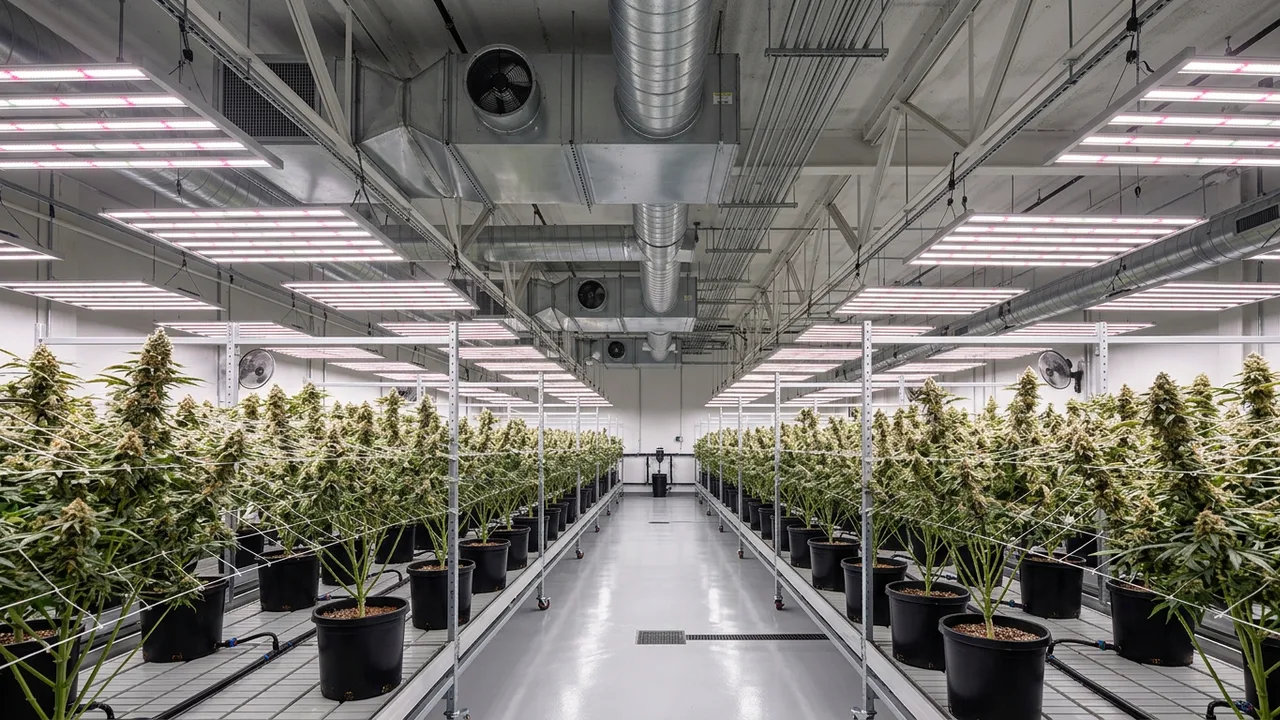
After years of reader questions, these are the recurring failures we see — and they're almost always fixable without new equipment.
- Hygrometer placed 2 feet above canopy — reads ambient, not plant zone. Move it to canopy height.
- One sensor only — no night-time reading. Use a min/max logger.
- Dehumidifier in tent, AC in room, both fighting [3]. Put dehumidifier in feed room.
- Extraction fan running 100% duty cycle in winter — strips humidity you just added. Use a controller.
- Evaporative cooler in 60% RH summer — won't evaporate, won't cool [2].
- No day/night temp differential — flat 24/7 temps stress plants that expect 5-10°F dip [7].
- Sealed tent, no fresh air — CO2 depletes and humidity climbs. Even sealed rooms need air exchange.
- Ignoring leaf-temp offset — air reads 78°F, leaves run 73-76°F, VPD calculation is 10% off [7].
Scaling Up: Commercial HVAC and the Energy Question
If your home grow evolves into a 10x10 or a dedicated room, climate control stops being a tent accessory and becomes the central engineering problem. Purpose-built grow HVAC (integrated dehumidification + cooling) delivers stability that bolt-together consumer gear can't match, and MoCannTrade reports growers seeing up to 30% post-harvest yield increases vs. mismatched systems [3].
There's also a sustainability angle worth acknowledging. A 2025 life cycle assessment published in the Cell Reports Sustainability journal found that indoor cannabis cultivation is highly energy-intensive and a significant greenhouse gas contributor, and that shifting to outdoor cultivation could trim industry emissions by up to 76% [1]. That's not a knock on indoor growers — most of us grow indoors out of legal or climate necessity — but it's a reason to size equipment honestly, use efficient LEDs, and not run AC at 65°F when 72°F would work just as well.
Strain Selection as Climate Strategy (2026 Picks)
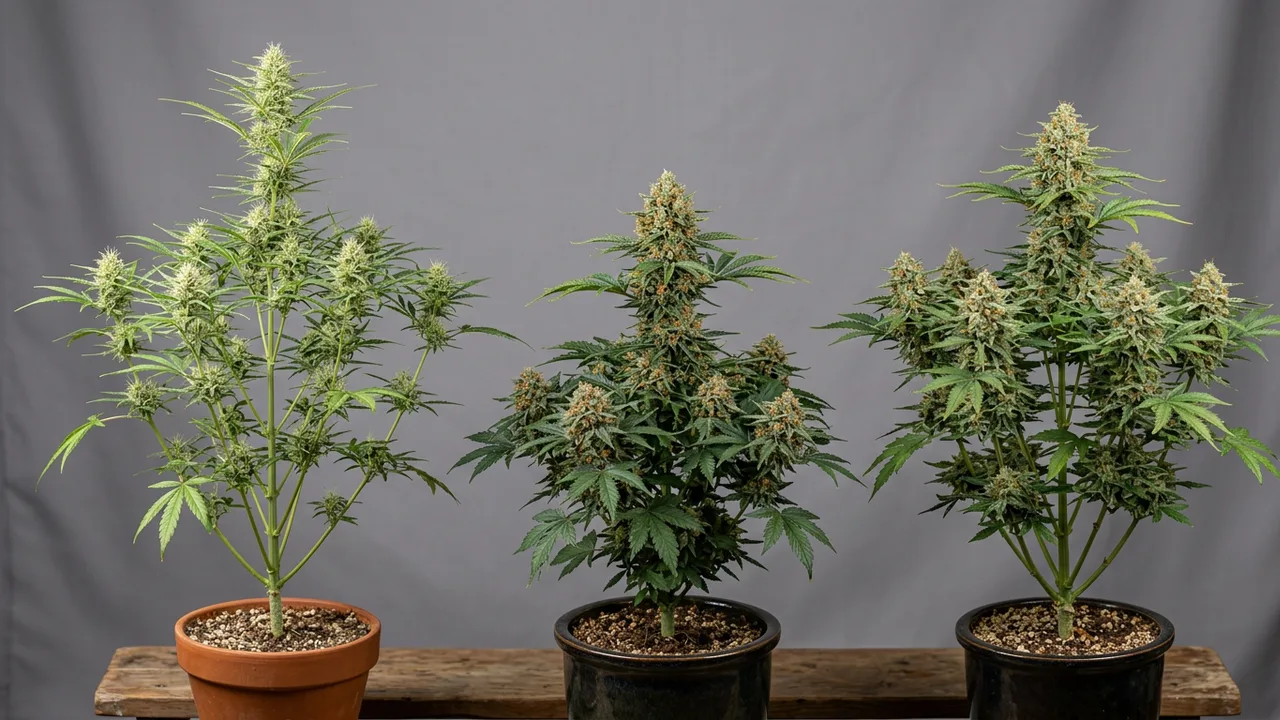
Genetics is the cheapest climate tool you have. Instead of fighting a hot attic with a $400 mini-split, pick strains that don't care. Instead of crashing humidity for a mold-prone Kush, pick a loose-structured sativa that handles 55% RH in flower.
- Hot-climate tolerant: Super Lemon Haze, Sour Diesel, Malawi Gold, Swazi — sativa-heavy genetics with open bud structure.
- Cold-climate tolerant: Northern Lights x Big Bud, Purple Kush, White Widow — mountain and northern lineages.
- Mold-resistant for humid climates: Durban Poison, Frisian Dew (strains we don't carry but worth seeking out), plus Super Skunk and Swiss Cheese.
- Forgiving for first-timers: see our beginner strain picks.
Popular names worth considering alongside our catalog: Gorilla Glue (GG4), Wedding Cake, Gelato, Zkittlez, and Runtz — all widely available and all with known climate tolerances documented in grower communities.
The Seasonal Climate Control Checklist
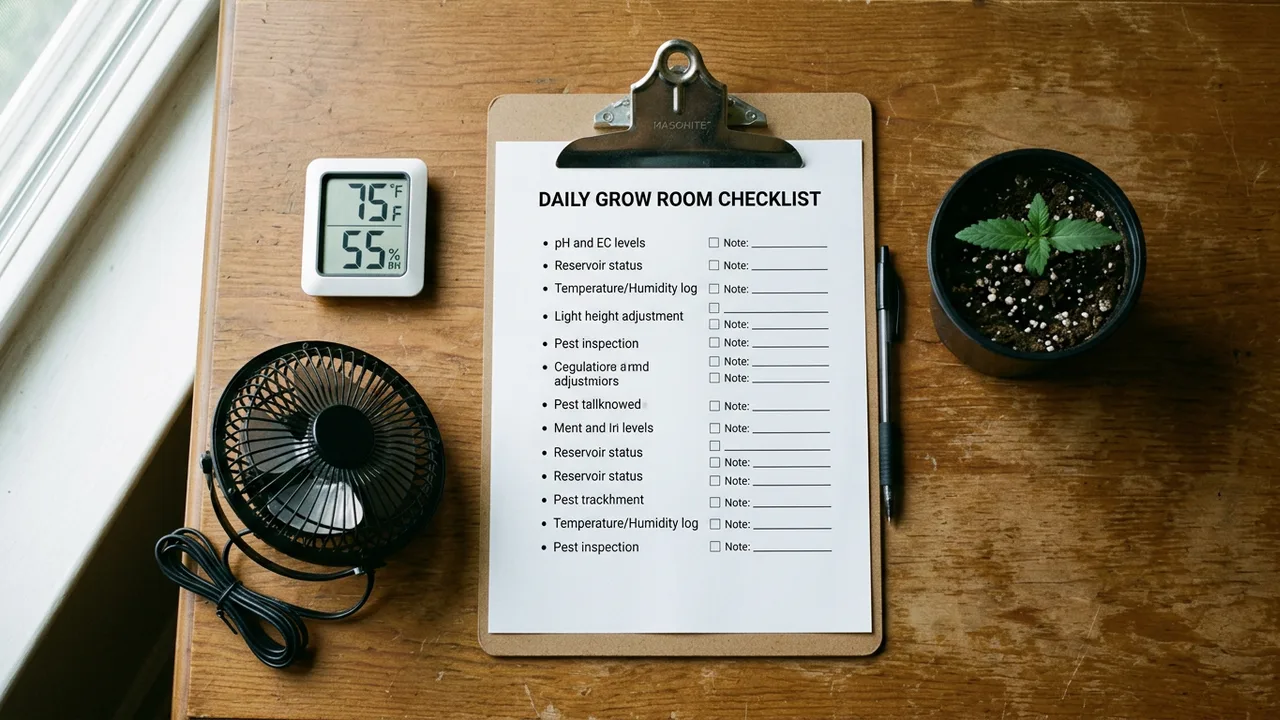
Print this and tape it to the grow room wall.
- Hygrometer at canopy height, logging min/max 24/7
- Day target: 70-80°F veg, 65-78°F flower
- Night target: 60-68°F, 5-10°F below day
- RH: 65-80% seedling, 50-60% veg, 40-50% flower, 30-40% last 2 weeks
- VPD: 0.8-1.1 veg, 1.0-1.5 flower (adjust for 3°F leaf offset)
- Inline fan sized and on a controller, not 100% duty
- Dehumidifier placed to NOT fight the AC
- Lights-at-night schedule in summer
- Heater + insulation sized for worst winter night, not average
- Strain genetics matched to climate before any gear upgrade
Frequently Asked Questions
What temperature is too hot for a grow tent?
Above 85°F is the warning zone; above 84°F in late flowering risks terpene loss and resin degradation [6]. Seedlings can show heat stress above 78°F [6]. Target 70-80°F day temps and act fast if you see canopy readings over 85°F.
How cold is too cold for cannabis?
Below 60°F (15°C) growth slows or stalls, and freezing temperatures can shock or kill plants [2]. Keep lights-off temps above 60°F and root-zone above 65°F for best results.
Do evaporative coolers work for grow tents?
Only in dry climates. Evaporative (swamp) coolers rely on water evaporation, which only happens efficiently when ambient humidity is below 30% [2]. In humid summers they don't cool and they add moisture you don't want. Use AC instead.
Can I run a dehumidifier and AC at the same time?
Yes, but they can fight. Portable dehumidifiers discharge air about 25°F warmer than intake, which triggers AC short-cycling [3]. Place the dehumidifier in the feed room rather than inside the tent, or use an AC unit in dehumidify mode (most modern units have this setting) to combine both functions.
Should I drop humidity in late flower?
Yes — dropping RH to 30-40% in the final 1-2 weeks of flowering encourages resin production and protects against bud rot [6]. This is a deliberate tactic, not a mistake. Just don't drop it so fast you stress the plant into hermie-ing.
Why does my hygrometer read different from my controller?
Sensor placement, calibration drift, and airflow all cause disagreement. Place your reference hygrometer at canopy height in moving air, and calibrate it annually with a salt-test kit. Remember that leaf surfaces run 2-5°F cooler than ambient air due to transpiration [7] — so leaf-level conditions differ from air readings.
What's the ideal VPD for cannabis?
0.4-0.8 kPa for seedlings, 0.8-1.1 kPa in vegetative growth, and 1.0-1.5 kPa during flowering [4][7]. Adjust for the leaf-temperature offset (leaves run 2-5°F cooler than air) when calculating from sensor readings [7]. Use our VPD calculator to simplify.
How much does climate control affect yield?
On the commercial side, MoCannTrade reports up to 30% post-harvest yield gains when switching from mismatched HVAC to a purpose-built system [3]. Home results vary, but climate stability — not hitting peak numbers, but avoiding wild swings — is consistently reported as a major yield driver.
For deeper dives, see our guides on humidity control and VPD ranges, temperature by stage, and complete tent setup. Written by the DSS Genetics team. All seeds backed by our germination guarantee.
Sources & References
This article was researched and fact-checked using 7 verified sources including 1 peer-reviewed study, 1 industry source, 5 community resources.
- Energy-intensive indoor cultivation drives the cannabis industry’s expanding carbon footprint - ScienceDirect — sciencedirect.com/science/article/pii/S2590332225000053 [Research]
- Cannabis Temperature Tutorial | Grow Weed Easy — growweedeasy.com/temperature [Industry]
- MoCannTrade | The Ultimate Indoor Grow Room Climate Control Showdown — mocanntrade.org/articles/the-ultimate-indoor-grow-room-climate-control-showdown [Community]
- Cannabis Climate Control – Complete Guide for Indoor Growers - DryGair — drygair.com/blog/cannabis-climate-control-guide-indoor [Community]
- DIY Grow Room Climate Control Systems for Cannabis - Cannabis Growers Blog — theseedconnect.com/blog/grow-room-climate-control [Community]
- What is the Best Temperature and Humidity for a Grow Room? — spider-farmer.com/blog/what-is-the-ideal-temp-and-humidity-for-your-grow-tent [Community]
- Grow Room Temp and Humidity Chart: The Complete Guide to Perfect Environmental Control — gorillagrowtent.com/blogs/news/grow-room-temp-and-humidity-chart [Community]