In November 1996, California voters passed Proposition 215 by a margin of 55.6% to 44.4% — and quietly rewrote American history. Nobody predicted that a single state ballot measure would set off a 30-year chain reaction that would reshape law, medicine, agriculture, and the daily lives of tens of millions of Americans. The complete cannabis legalization timeline that followed is one of the most dramatic policy transformations in modern US history.
This article is your definitive, regularly updated reference for that transformation. Whether you want to understand how we got here, track what's happening right now in 2026, or figure out which states will legalize next — you'll find it all below, with real dates, vote percentages, and grower-specific insights that no static infographic can provide.
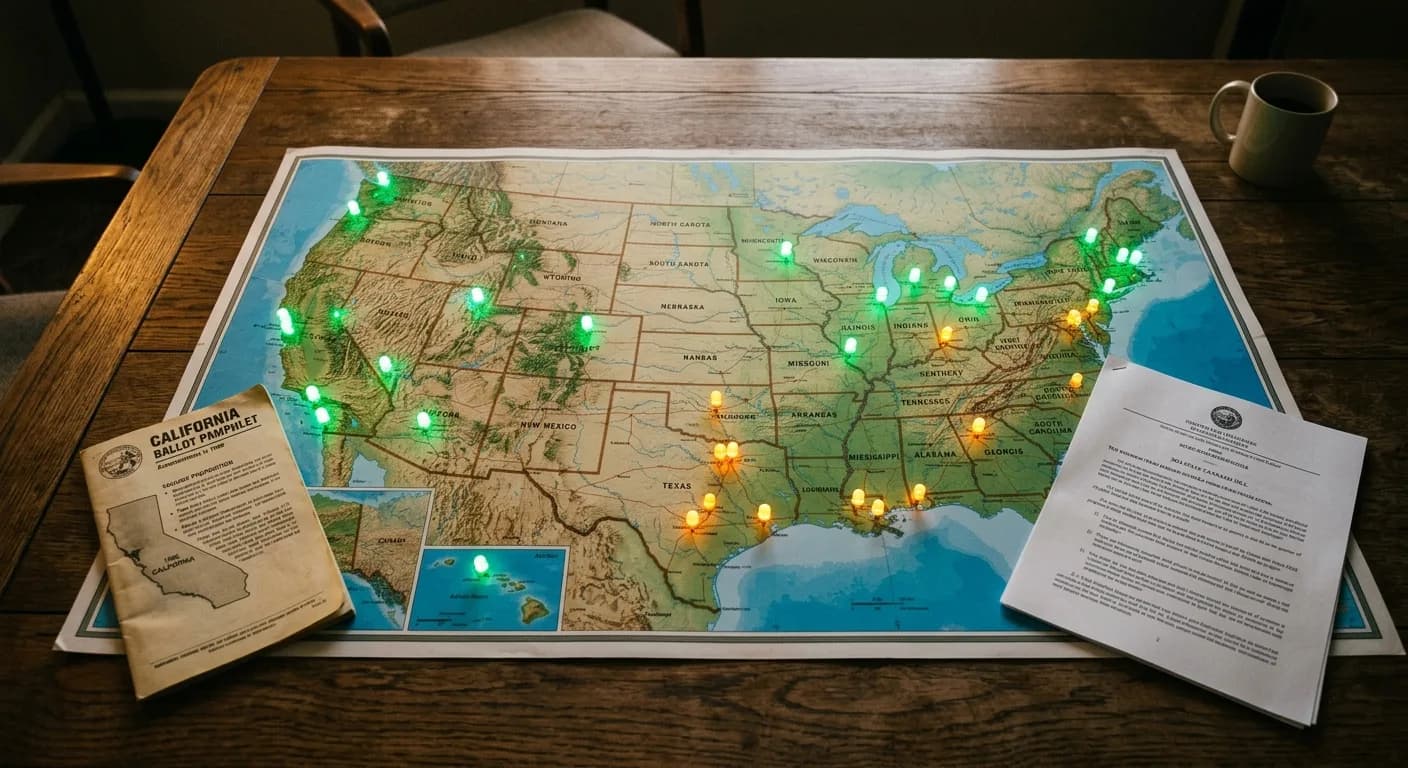
As of mid-2026, 24 states plus Washington D.C. allow recreational adult-use cannabis. At least 5 states have active 2026–2027 legalization efforts. The policy landscape is shifting faster than at any point since 2012 — and federal rescheduling proceedings are adding a new layer of complexity.
Where It All Started: The Medical Marijuana Era (1996–2011)
Before Colorado and Washington made history with recreational cannabis in 2012, the groundwork was laid across 16 states and D.C. through medical marijuana programs — some passed by voters, others through state legislatures. Understanding this era is essential to understanding why the recreational wave happened so fast afterward.
California's Proposition 215: The First Domino (1996)
California's Prop 215, also known as the Compassionate Use Act, passed with 55.6% of the vote on November 5, 1996. It allowed patients with a doctor's recommendation to possess and cultivate cannabis for personal medical use. This was the first time any US state had broken with federal law on cannabis in a meaningful, permanent way.
What made Prop 215 groundbreaking wasn't just the policy — it was the strategy. Advocates framed it around compassion for seriously ill patients, side-stepping the culture-war baggage that had killed previous efforts. That framing — medical first, recreational later — became the playbook for the next two decades.
The Medical Wave: 1998–2011
After California, the medical legalization movement built steadily but not quickly. In the 15 years between Prop 215 and recreational legalization in 2012, here's what happened:
- 1998: Oregon, Washington, and Alaska pass medical measures (Alaska's was later overturned, then reinstated)
- 1999: Maine passes a medical program via ballot
- 2000: Hawaii becomes the first state to legalize medical cannabis through the legislature (not a ballot measure)
- 2004: Montana and Vermont add medical programs
- 2006: Rhode Island joins via legislature
- 2007: New Mexico passes the first state law creating a regulated medical dispensary system
- 2008: Michigan passes a medical measure with 63% approval — the highest margin yet
- 2010: Arizona, D.C., and New Jersey add medical programs
- 2011: Delaware passes a medical law through the legislature
Political scientists call the 1996–2011 period the 'normalization phase.' Each state that passed a medical program without catastrophic consequences made it easier for the next state's advocates to argue that the sky wouldn't fall. By 2011, 16 states and D.C. had working medical programs, giving voters in recreational states a track record to point to.
By the time Colorado and Washington began organizing their 2012 recreational campaigns, roughly 40 million Americans lived in states with medical cannabis access. Public polling had shifted dramatically: Gallup's 2011 survey showed 50% national support for legalization — the first time it had crossed the 50% threshold in the poll's history.
The Landmark Moment: 2012 and the Recreational Revolution
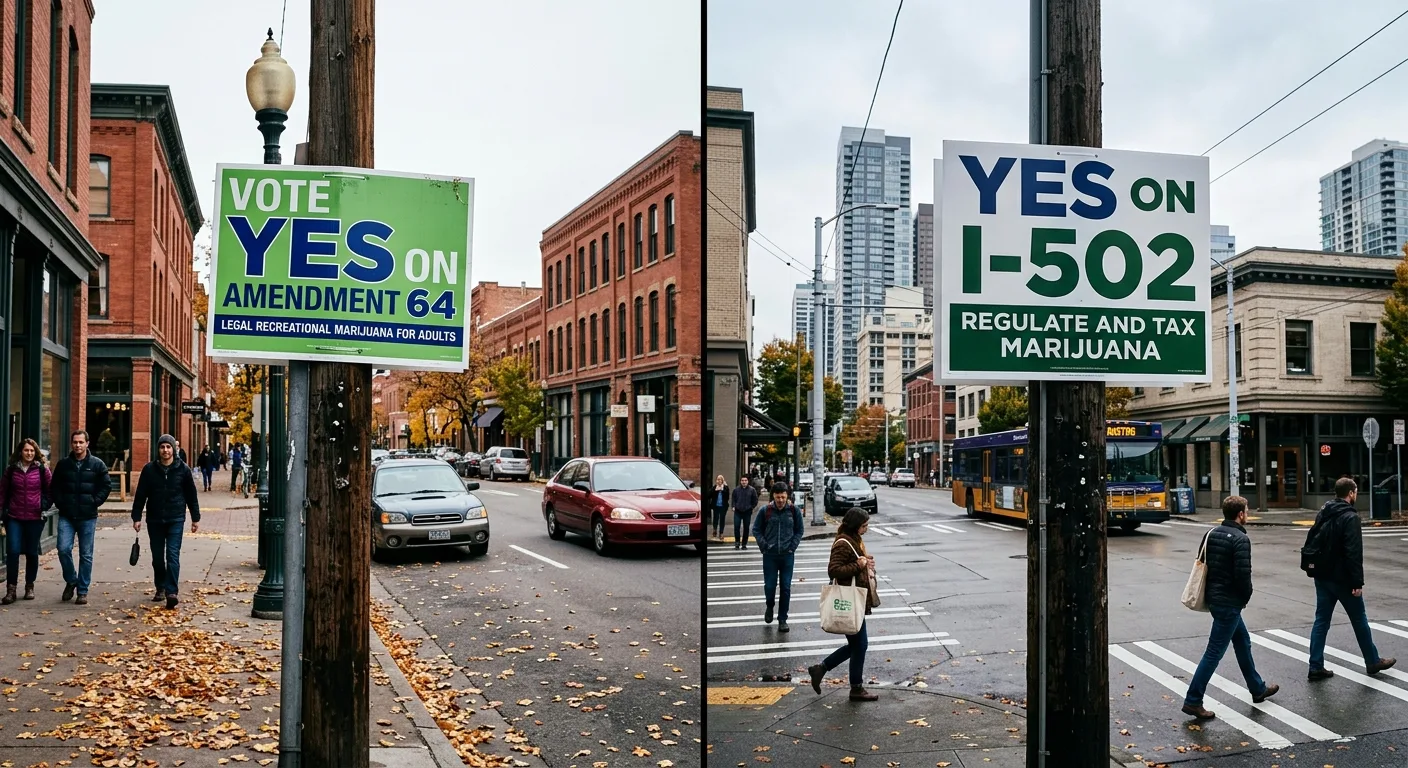
The 2012 recreational revolution began when Colorado's Amendment 64 and Washington's Initiative 502 both passed on Election Night 2012, making them the first jurisdictions in the world to legalize recreational cannabis for adults. These twin victories fundamentally changed the political calculus for every state that followed.
Colorado Amendment 64: November 6, 2012
Colorado's Amendment 64 passed with 55.3% of the vote, legalizing possession of up to 1 ounce for adults 21 and over, home cultivation of up to 6 plants per adult (3 mature), and the creation of a regulated commercial market with a 15% excise tax. Colorado's first recreational dispensary sales began January 1, 2014 — New Year's Day was chosen deliberately, for maximum symbolic impact.
For home growers, Colorado's model set a critical precedent: the right to grow your own was written into the amendment from day one. That wasn't an accident — cultivator advocates fought hard to include it, knowing it was essential for rural communities without easy dispensary access.
Washington Initiative 502: November 6, 2012
Washington's I-502 passed with 55.7% of the vote — nearly identical to Colorado's margin. But Washington took a notably different approach to home cultivation: it prohibited personal grows entirely, a trade-off made to win over law enforcement endorsements. Washington's model proved that you could pass recreational legalization without home grow rights, but it also created a persistent tension that advocates have fought to resolve ever since.
“The night Colorado and Washington passed their recreational measures, every cannabis advocate in the country understood: the dam had broken. This was no longer a question of if — only when.”
Complete Cannabis Legalization Timeline: Year-by-Year State Table
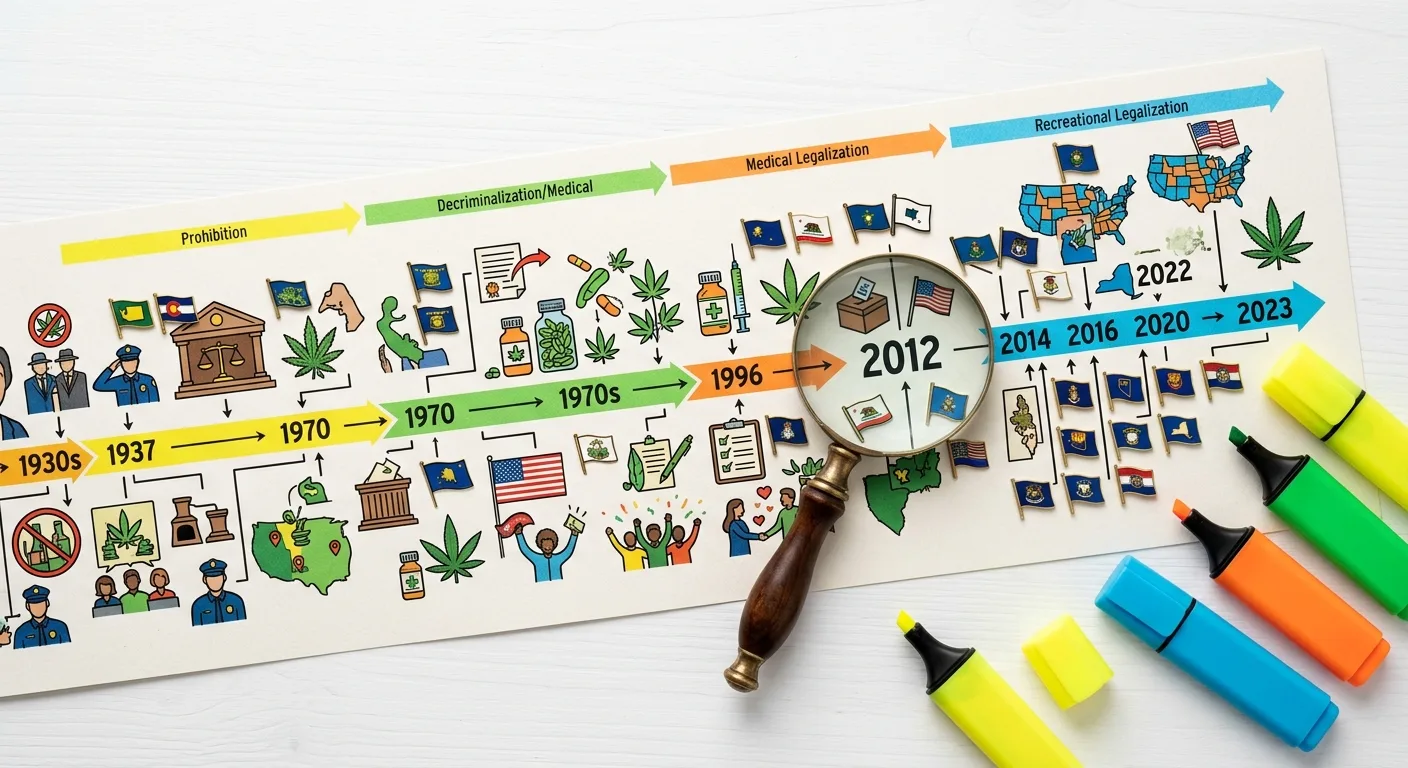
The following table covers the complete state-by-state cannabis legalization timeline for both medical and recreational programs. It is updated regularly as new states act. Each entry includes the mechanism (ballot or legislature), the approval margin where applicable, and key provisions for home cultivators.
| Year | State | Type | Mechanism | Vote / Margin | Home Grow Allowed? |
|---|---|---|---|---|---|
| 1996 | California | Medical | Ballot (Prop 215) | 55.6% | Yes (medical) |
| 1998 | Oregon | Medical | Ballot (Measure 67) | 54.7% | Yes (medical) |
| 1998 | Washington | Medical | Ballot (I-692) | 59% | Yes (medical) |
| 1998 | Alaska | Medical | Ballot (Measure 8) | 58.2% | Yes (medical) |
| 1999 | Maine | Medical | Ballot | 61.4% | Yes (medical) |
| 2000 | Colorado | Medical | Ballot (Amendment 20) | 54.3% | Yes (medical) |
| 2000 | Hawaii | Medical | Legislature | N/A | Yes (medical) |
| 2000 | Nevada | Medical | Ballot | 65.2% | Yes (medical) |
| 2004 | Montana | Medical | Ballot (I-148) | 62% | Yes (medical) |
| 2004 | Vermont | Medical | Legislature | N/A | Limited |
| 2006 | Rhode Island | Medical | Legislature | N/A | Yes (medical) |
| 2007 | New Mexico | Medical | Legislature | N/A | No |
| 2008 | Michigan | Medical | Ballot (Prop 1) | 63% | Yes (medical) |
| 2010 | Arizona | Medical | Ballot (Prop 203) | 50.1% | Limited |
| 2010 | D.C. | Medical | Legislature | N/A | No |
| 2010 | New Jersey | Medical | Legislature | N/A | No |
| 2011 | Delaware | Medical | Legislature | N/A | No |
| 2012 | Colorado | Recreational | Ballot (Amend. 64) | 55.3% | Yes — 6 plants (3 mature) |
| 2012 | Washington | Recreational | Ballot (I-502) | 55.7% | No |
| 2013 | Illinois | Medical | Legislature | N/A | No |
| 2014 | Alaska | Recreational | Ballot (Measure 2) | 53.2% | Yes — 6 plants |
| 2014 | Oregon | Recreational | Ballot (Measure 91) | 56.1% | Yes — 4 plants |
| 2014 | D.C. | Recreational | Ballot (Init. 71) | 70.1% | Yes — 6 plants (no sales) |
| 2016 | California | Recreational | Ballot (Prop 64) | 57.1% | Yes — 6 plants |
| 2016 | Maine | Recreational | Ballot (Question 1) | 50.3% | Yes — 3 plants |
| 2016 | Massachusetts | Recreational | Ballot (Question 4) | 53.7% | Yes — 6 plants |
| 2016 | Nevada | Recreational | Ballot (Question 2) | 54.5% | Yes — 6 plants (25+ miles from dispensary) |
| 2018 | Michigan | Recreational | Ballot (Prop 1) | 56% | Yes — 12 plants |
| 2018 | Vermont | Recreational | Legislature (H.511) | N/A | Yes — 2 mature plants |
| 2019 | Illinois | Recreational | Legislature (HB 1438) | N/A | Limited (medical patients only) |
| 2020 | Arizona | Recreational | Ballot (Prop 207) | 60.1% | Yes — 6 plants |
| 2020 | Montana | Recreational | Ballot (I-190) | 56.9% | Yes — 2 plants |
| 2020 | New Jersey | Recreational | Ballot (Public Q1) | 67.1% | No |
| 2020 | South Dakota | Recreational | Ballot (Amend. A) | 53.2% | Yes (later overturned by courts) |
| 2021 | New Mexico | Recreational | Legislature (HB 2) | N/A | Yes — 6 plants |
| 2021 | New York | Recreational | Legislature (MRTA) | N/A | Yes — 3 mature plants (6 total) |
| 2021 | Virginia | Recreational | Legislature (HB 2312) | N/A | Yes — 4 plants |
| 2022 | Connecticut | Recreational | Legislature (SB 1201) | N/A | Yes — 6 plants (3 mature) |
| 2022 | Rhode Island | Recreational | Legislature (H 7593) | N/A | Yes — 6 plants (3 mature) |
| 2023 | Delaware | Recreational | Legislature (HB 1/HB 2) | N/A | No |
| 2023 | Maryland | Recreational | Ballot (Question 4, 2022) | 67.2% | Yes — 2 plants |
| 2023 | Minnesota | Recreational | Legislature (HF 100) | N/A | Yes — 8 plants (4 mature) |
| 2023 | Missouri | Recreational | Ballot (Amend. 3, 2022) | 53% | Yes — 6 plants |
| 2024 | Ohio | Recreational | Ballot (Issue 2, 2023) | 57% | Yes — 6 plants |
If you're a home grower, the 'Home Grow Allowed?' column is your most important reference. Always verify current plant limits with your state's cannabis regulatory authority — plant limits have been amended post-passage in several states, including Michigan and Connecticut.
The Acceleration Wave: 2018–2022 and the Domino Effect
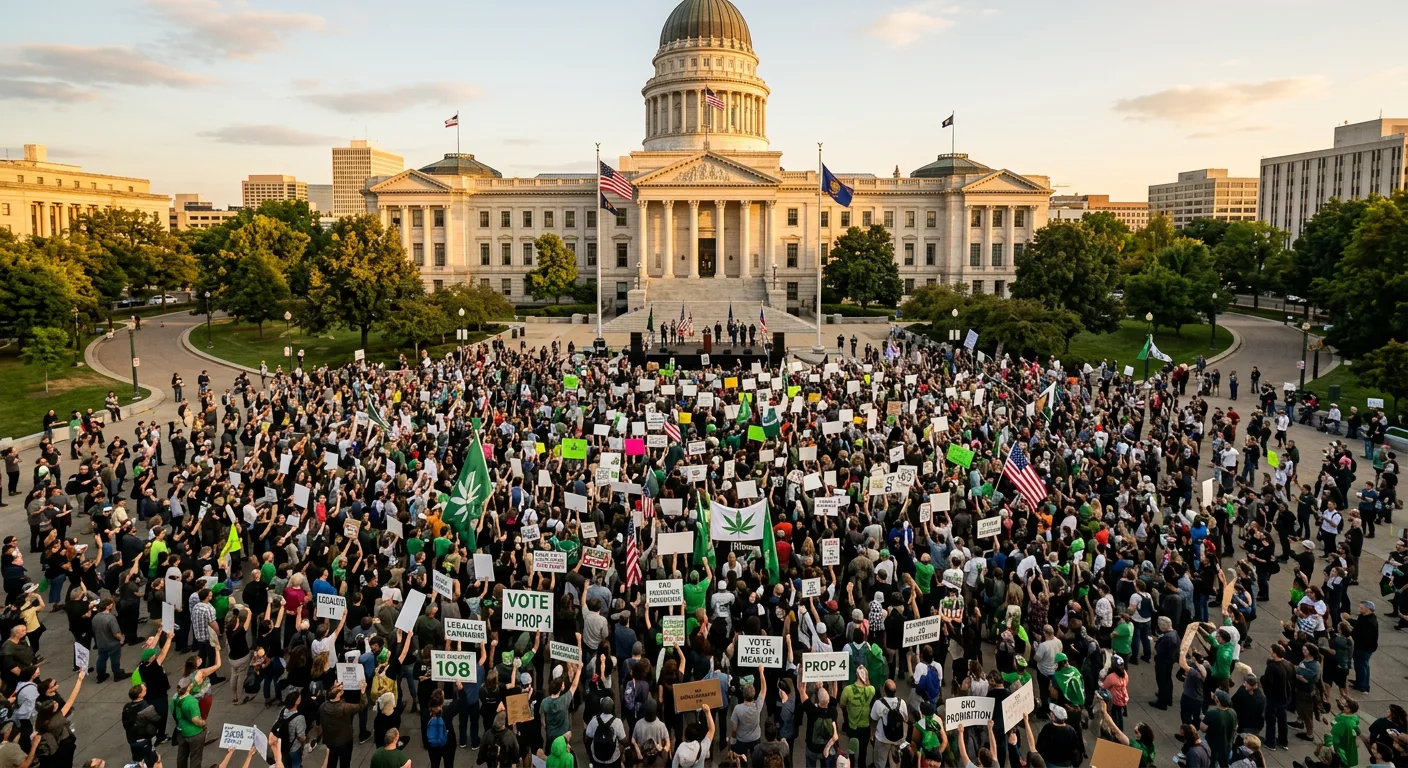
The period from 2018 to 2022 saw the fastest sustained expansion of cannabis legalization in US history. Eight states legalized recreational use in just four years — a pace that would have seemed impossible before 2012. This acceleration wasn't random. It was the result of three converging forces: maturing medical programs providing political cover, neighboring-state influence normalizing the idea, and a generational shift in voter attitudes.
Why the Pace Suddenly Doubled
Michigan's 2018 ballot measure marked the first time a Midwestern state voted for recreational legalization — a region that had been assumed to be too conservative. Michigan passed with 56%, a strong margin. Vermont's simultaneous legislative legalization showed that you didn't even need a ballot measure; lawmakers could act directly when political will existed.
Between 2019 and 2022, seven more states followed — and notably, more of them acted through legislatures than through ballot measures. This is significant: it suggests cannabis legalization had become mainstream enough that elected officials no longer needed the political cover of a public vote to act.
- Illinois (2019) — First state to legalize entirely through the legislature without a prior ballot measure, with a comprehensive social equity framework
- Arizona (2020) — Passed with 60%, the strongest recreational ballot margin at that time
- New Jersey (2020) — Passed with a remarkable 67% approval, showing coastal state support was overwhelming
- New York (2021) — Legislative route, with some of the nation's most detailed social equity provisions
- Virginia (2021) — First Southern state to legalize recreational cannabis
- Connecticut and Rhode Island (2022) — Both used legislative routes, consolidating the Northeast as a fully legal region
“Virginia's 2021 legalization was the most politically significant domino of the post-2012 era. When a Southern state with a complex racial history chose to legalize with explicit social equity provisions, it changed what advocates thought was possible below the Mason-Dixon line.”
The 2018–2022 wave moved legalization from 'coastal progressive' to 'broadly American.' States as politically different as Montana, New Mexico, and New Jersey all legalized in the same two-year window. The common thread wasn't politics — it was adjacent-state influence, maturing medical programs, and tax revenue arguments that resonated across party lines.
All 24 Recreational States: Current Status as of 2026
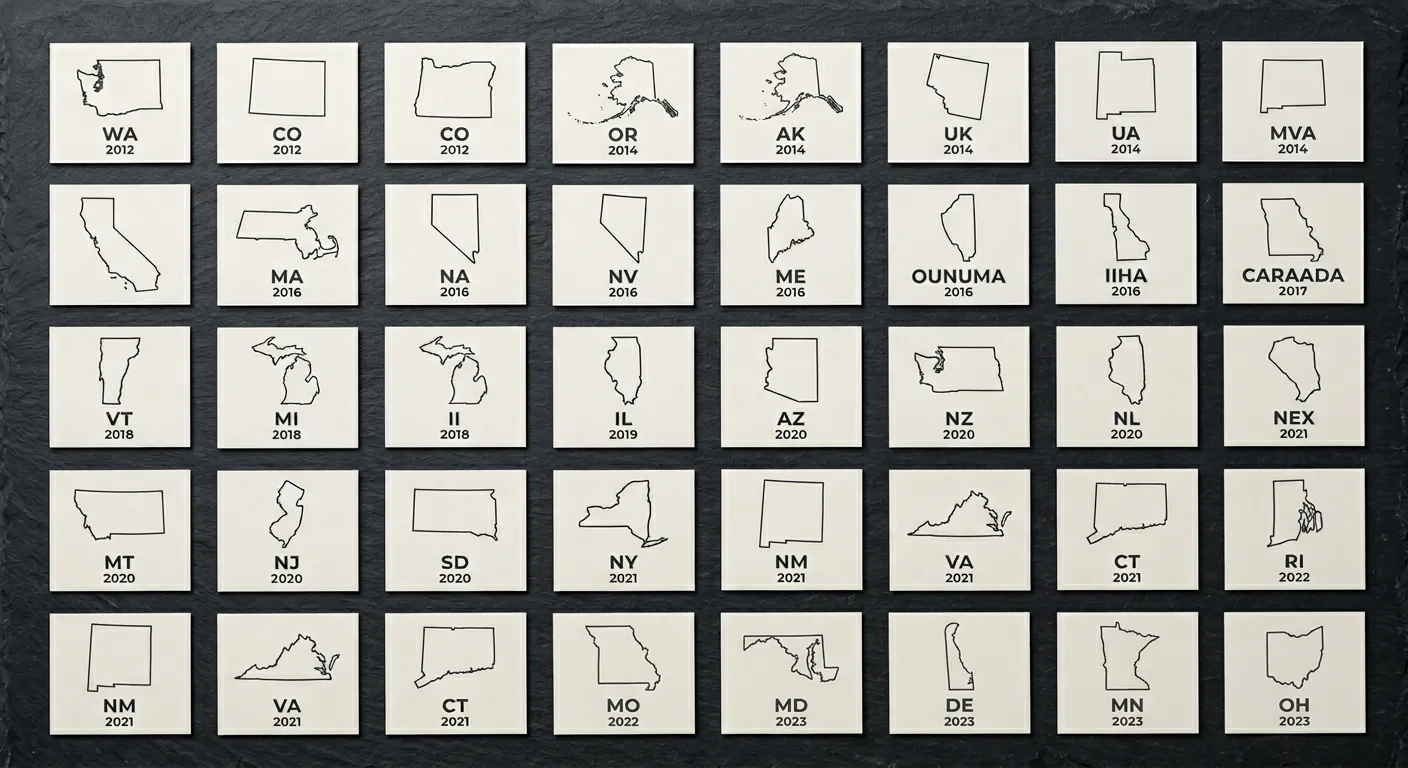
As of mid-2026, 24 states plus Washington D.C. have active adult-use recreational cannabis programs with retail sales underway or formally authorized. Here is the complete current list with key data for each state.
The 24 recreational states are: Alaska, Arizona, California, Colorado, Connecticut, Delaware, Illinois, Maine, Maryland, Massachusetts, Michigan, Minnesota, Missouri, Montana, Nevada, New Jersey, New Mexico, New York, Ohio, Oregon, Rhode Island, Vermont, Virginia, and Washington, plus the District of Columbia (retail sales still prohibited by Congress despite legalization).
Grower-Relevant Highlights by State
- Michigan allows the most generous home cultivation — up to 12 plants per adult household, with no restriction on the number of adults who can grow simultaneously
- Minnesota allows 8 plants total (4 mature) per adult — one of the most recently passed and grower-friendly programs
- California allows 6 plants per adult but local jurisdictions can still ban cultivation — check your county ordinances
- Washington still prohibits home cultivation despite being one of the first recreational states — a 12-year-old anomaly that advocates continue to challenge
- New Jersey and Delaware both prohibit home growing despite full recreational programs
- Vermont limits adults to just 2 mature plants — the most restrictive of any home-grow state
- Ohio (2024) allows 6 plants but requires them to be in a locked space not visible from public areas
Home cultivation rights are NOT automatic when a state legalizes recreational cannabis. Washington, New Jersey, and Delaware all have adult-use programs but prohibit home grows. Always verify your state's specific cultivation rules before starting a home garden — possession charges for illegal home grows still occur in legal states.
What's Coming Next: 2026–2027 States to Watch

The next wave of cannabis legalization is building across at least five states, with 2026 and 2027 ballot cycles already taking shape. Each state has a distinct political pathway, a different obstacle profile, and a different likelihood of success. Here's the definitive breakdown of the states most likely to legalize next.
Florida: The Biggest Prize — 2024 Failure and the 2026 Retry
Florida's 2024 Amendment 3 was the most-watched cannabis ballot measure in US history — and it nearly made it. The measure received 55.9% support, falling just short of Florida's 60% supermajority threshold for constitutional amendments. More Floridians voted yes on cannabis legalization in 2024 than had voted yes on many previous state winners.
Advocates immediately began organizing a 2026 retry. Florida requires 891,589 valid petition signatures to get a measure on the ballot, and cannabis advocates began collecting signatures within weeks of the 2024 result. The 2026 Florida measure is the single most consequential cannabis vote on the horizon — Florida has 22 million residents and would instantly become the largest legal cannabis market in the southeastern United States.
Key challenges for 2026: Governor Ron DeSantis actively campaigned against Amendment 3, and the state legislature has placed additional obstacles on citizen ballot initiatives. Advocates are also exploring a legislative route, though Republican supermajorities in both chambers make that path narrow.
Pennsylvania: The Legislative Route
Pennsylvania has a mature medical program (launched 2018) and a Democratic governor in Josh Shapiro who has publicly supported legalization. The legislature is divided — Republicans control the state Senate while Democrats hold the House — creating a classic split-chamber standoff. Multiple bills have advanced through committee in 2024 and 2025, but none have reached a floor vote in the Senate.
Pennsylvania is the most likely state to achieve legalization through legislative compromise rather than a ballot measure, particularly if the economic argument (bordering New Jersey and New York, both fully legal) continues to drain tax revenue across state lines. Analysts estimate Pennsylvania loses $500 million or more in annual cannabis tax revenue to neighboring legal states.
New Hampshire: The 'Live Free or Die' Paradox
New Hampshire is the only New England state without recreational cannabis — a significant anomaly given that it borders Vermont, Massachusetts, and Maine, all of which are fully legal. The state legislature passed a recreational cannabis bill in 2024 only to see it vetoed by then-Governor Chris Sununu. With new governor Kelly Ayotte taking office in 2025, advocates face a similarly skeptical executive.
New Hampshire does not have a citizen initiative process for constitutional amendments, which means legalization requires either gubernatorial cooperation or a ballot measure through a different mechanism. The libertarian streak in the state's Republican Party creates an unusual coalition — some conservative legislators have supported legalization on personal freedom grounds.
North Carolina: The Southern Wildcard
North Carolina doesn't yet have a medical cannabis program — making it one of a dwindling number of states with no legal cannabis access whatsoever. However, a medical cannabis bill passed the state Senate in 2023 with bipartisan support before stalling in the House. If North Carolina passes medical legalization in 2025–2026, it would set up a predictable trajectory toward recreational legalization within the following decade.
North Carolina's large population (10.7 million), research universities, and growing Research Triangle tech economy give it a different political character than its neighbors — and polling shows 70%+ support for medical cannabis and 55%+ for recreational access among state residents.
Hawaii: The Tropical Near-Miss
Hawaii legalized adult-use cannabis through the legislature in 2024 — technically making it a 2024 story — but retail sales won't begin until mid-2026 at the earliest due to the regulatory buildout timeline. Hawaii is worth watching because its home cultivation provisions are generous: up to 10 plants per household, with no requirement to be near a dispensary. For home growers, Hawaii's program is among the most permissive in the nation.
If you live in a 'watching' state like Florida or Pennsylvania, this is the ideal time to research home growing inside your home under existing law, build your knowledge base, and choose genetics that will thrive in your regional climate. Check our free grow planner to start mapping your first legal grow season now.
The Trump Factor: Federal Signals and State-Level Momentum in 2026
The Trump administration's relationship with cannabis is more nuanced than its public posture suggests — and understanding that nuance matters enormously for projecting what happens next at both federal and state levels. As of April 2026, the administration has sent several distinct signals that create both opportunities and risks for the cannabis legalization movement.
What the Administration Has Done (and Not Done)
The Biden administration initiated DEA rescheduling proceedings in 2024, proposing to move cannabis from Schedule I to Schedule III of the Controlled Substances Act. As of spring 2026, the Trump administration has not reversed this proceeding — a decision that reflects both political pragmatism (the majority of Americans support some form of legalization) and the influence of medical cannabis patients who voted for Trump in significant numbers.
The administration has also explicitly stated it will not direct federal resources toward prosecuting state-legal cannabis activity — consistent with a Rohrabacher-Blumenauer-style protection that has been renewed annually in appropriations bills. Medical cannabis patients received the strongest protection language, with the administration framing medical access as a states' rights issue.
What This Means for Pending State Actions
The federal posture matters for state legalization in two distinct ways. First, financial: cannabis businesses in legal states still cannot access federal banking because cannabis remains technically federally illegal — the SAFE Banking Act has never passed. Second, political: federal inaction removes the fear of federal crackdown that once scared swing-state voters away from recreational measures.
- Rescheduling to Schedule III (if finalized) would not legalize cannabis federally but would allow tax deductions under IRS Code 280E — potentially transforming the economics of state-legal markets
- SAFE Banking Act passage (still pending) would allow cannabis businesses normal banking access, stabilizing regulated markets and boosting tax revenues that advocates use to sell legalization
- No federal enforcement threat against state-legal growers has materialized under the current administration — a meaningful de facto protection
- International treaty obligations remain a complicating factor for full federal legalization — something the administration has pointed to as a reason for caution
“The Trump administration's approach to cannabis is best described as 'strategic neglect' — neither aggressively protecting nor aggressively prosecuting, while allowing state-level experiments to continue. For advocates, that's just enough oxygen to keep the movement alive.”
2026–2027 could be a genuinely pivotal period for federal cannabis policy regardless of which party leads. Rescheduling proceedings, banking reform, and record-high public support (currently 70%+ in Gallup polling) are converging in a way that makes meaningful federal movement more likely than at any point since cannabis was placed on Schedule I in 1970.
The Federal-State Divergence Problem: How States Navigate the Gap
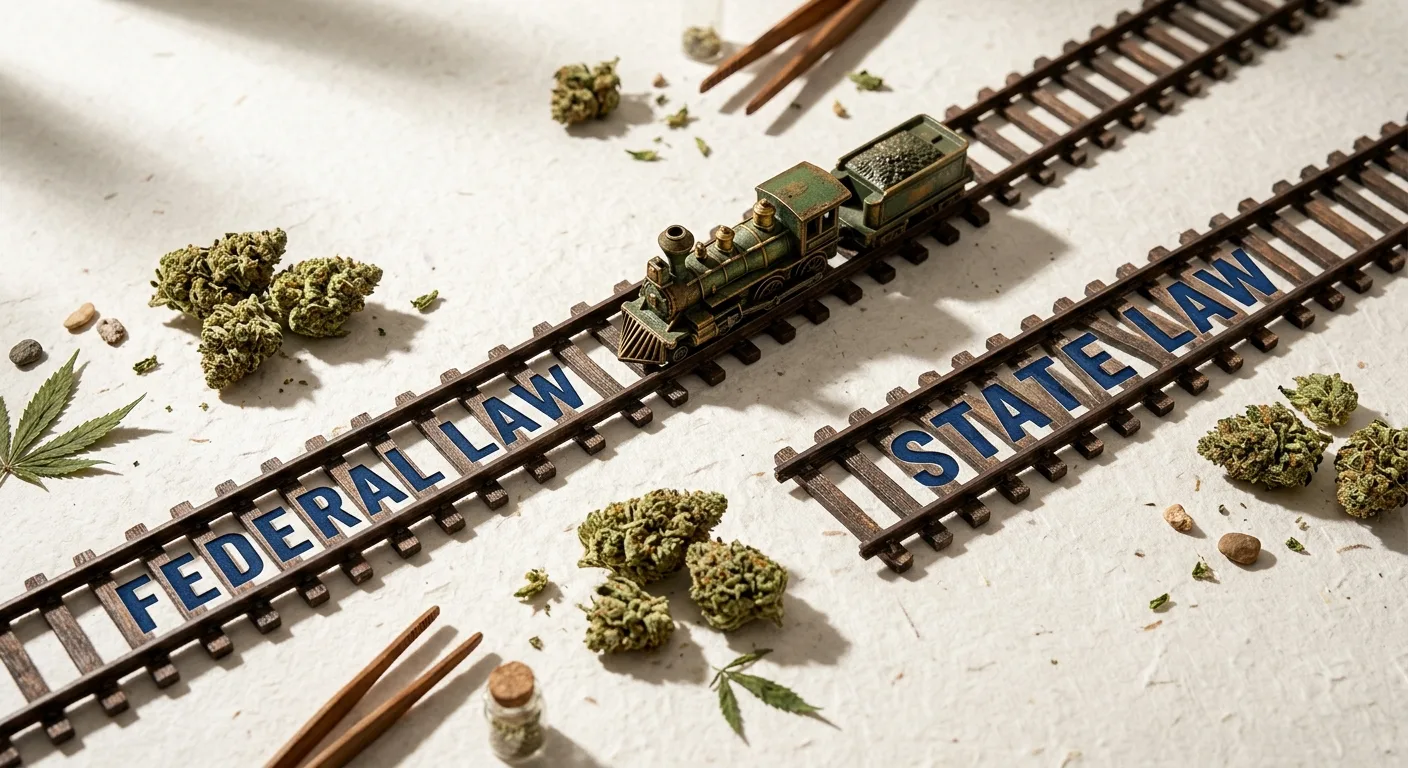
The core tension in American cannabis policy is this: 24 states plus D.C. have created legal markets, but federal law still classifies cannabis as a Schedule I controlled substance with no accepted medical use. This contradiction creates a specific set of practical problems that every state cannabis program has had to solve — or work around.
Banking and Financial Services
Because cannabis is federally illegal, most banks — which are federally regulated — refuse to serve cannabis businesses. This forces many dispensaries and cultivators to operate as cash businesses, creating security risks, tax complexity, and a significant barrier to market growth. The Credit Union National Association estimated in 2023 that fewer than 800 of the nation's 10,000+ financial institutions were willing to serve cannabis businesses.
States have responded with creative workarounds: California and Colorado created state-chartered banking programs, and some states have directed state employees to manage cannabis tax collection in cash. But none of these solutions is as efficient as simply having normal banking access — which requires federal legislative action.
Interstate Commerce Restrictions
Even between two neighboring legal states, moving cannabis across state lines is a federal felony. This means Oregon's oversupply cannot legally relieve California's occasional shortages, and a cannabis company licensed in Colorado cannot ship product to a neighboring legal state. Each state market is legally isolated — a situation that artificially limits market efficiency and keeps cannabis prices higher than they would be under normal interstate commerce.
This also affects seeds and genetics directly. Our guide on cannabis seed legality in 2026 covers how the federal-state gap creates specific risks for seed buyers and breeders that are separate from — and sometimes more complex than — state-level possession laws.
How States Manage the Gap in Practice
- State-only licensing: All state cannabis licenses are state-issued, with no federal component
- Seed-to-sale tracking: State tracking systems like METRC create a complete chain of custody that keeps product documented from cultivation through retail sale
- Cash-tax protocols: Colorado, California, and others have established drop-off sites for cannabis tax payments in cash
- Interstate compacts: Oregon, Nevada, and California have explored future frameworks for interstate commerce pending federal permission
- Home cultivation: States that allow home growing create a category of cannabis activity that largely falls below the threshold of any practical federal enforcement concern
The DEA's Section 781 provisions — discussed in detail in our DEA Section 781 explainer — add another layer to the federal-state divergence problem specifically for seed genetics. The 2025 appropriations bill language affects how cannabis genetics can move across borders, with implications that could outlast current state legalization trends.
Pattern Analysis: What Makes a State Likely to Legalize?
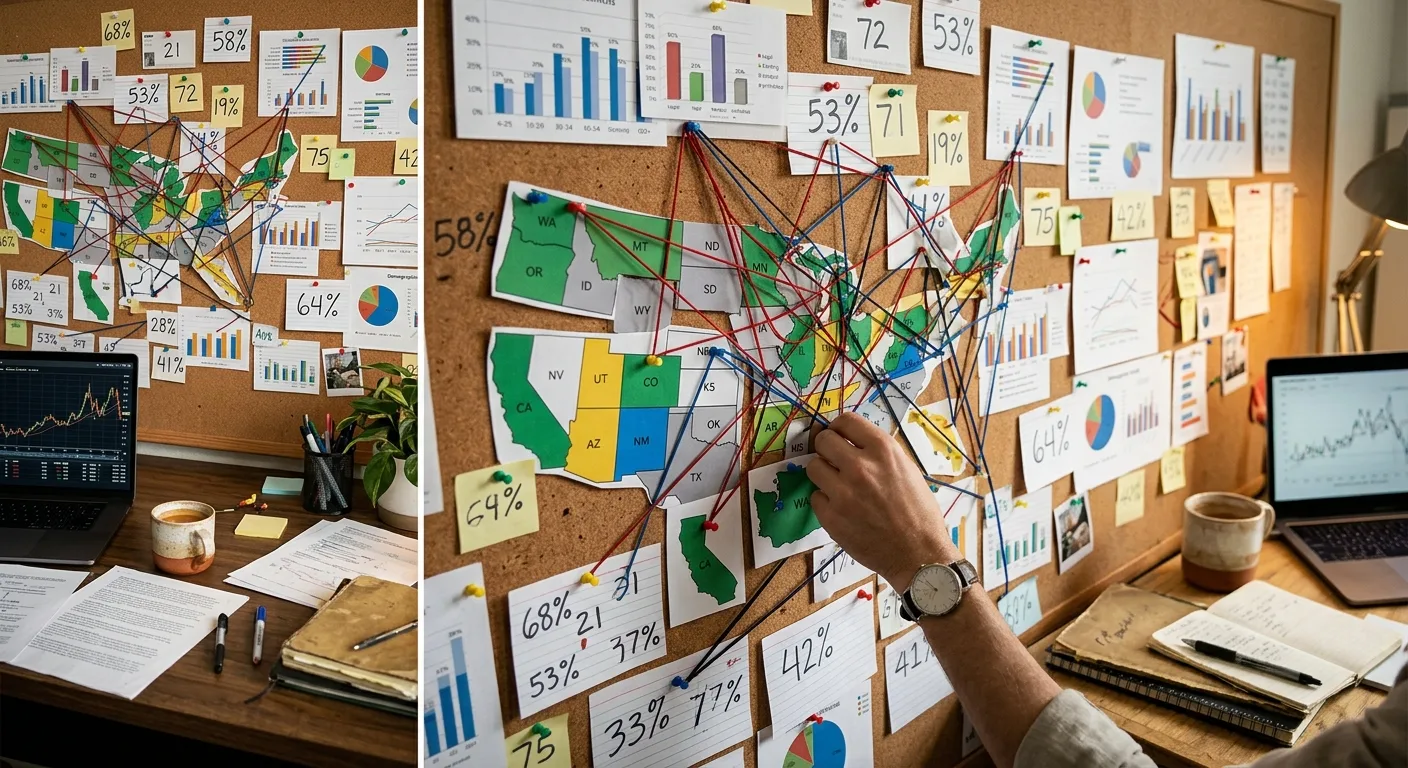
After 30 years of state-by-state legalization, predictable patterns have emerged. Researchers and advocates now use a fairly reliable set of indicators to forecast which states are most likely to legalize — and in roughly what timeframe. Understanding these patterns helps growers, advocates, and investors anticipate where the map will change next.
The Six Most Predictive Indicators
Based on the outcomes of every state that has legalized between 1996 and 2025, these six factors consistently predict legalization likelihood:
Medical Program Age
States with medical programs older than 5 years are dramatically more likely to legalize recreationally. Every single recreational state had a medical program first — except Vermont, which had a very small program. The average gap between medical and recreational legalization is 8.4 years.
Neighboring State Influence
The 'border effect' is real and measurable. When a neighboring state legalizes, cross-border traffic of legal cannabis immediately begins, and residents of the non-legal state see both the tax revenue they're missing and the lack of catastrophic consequences. Pennsylvania's border with New Jersey and New York is a textbook example of this pressure in action.
Voter Demographics
States where more than 35% of voters identify as liberal or libertarian-leaning independent tend to reach the threshold for ballot success. Urbanization level matters more than raw state political affiliation — even states with Republican majorities can legalize when metro areas represent a large share of total votes (Montana in 2020 is the clearest example).
Ballot Initiative Access
States with citizen initiative processes (about 26 states) can bypass hostile legislatures entirely. States without this mechanism — like North Carolina, Texas, and Georgia — depend on legislative action, which requires sympathetic governors and chamber majorities simultaneously, a much harder alignment to achieve.
State Budget Pressure
Revenue arguments move swing voters and moderate lawmakers. Colorado generated over $1.8 billion in cumulative cannabis tax revenue through 2023 — directed to schools, law enforcement, and public health. States with tight budgets and border revenue leakage (Pennsylvania, New Hampshire) feel this pressure most acutely.
Polling Trajectory
Most states legalize when sustained polling shows 55%+ support. Momentum matters as much as current level — a state at 52% trending upward is closer to legalization than a state stuck at 54% for five years. Florida's 55.9% 'no' result (but yes vote) shows how important the specific ballot threshold rule is.
States Meeting the Most Criteria (2026 Assessment)
| State | Medical Program Age | Border Pressure | Ballot Access | Budget Pressure | Poll Support | Overall Probability |
|---|---|---|---|---|---|---|
| Florida | 10 years | Moderate | Yes (60% threshold) | Moderate | 56% | High (2026 attempt) |
| Pennsylvania | 8 years | Very High | No (legislature only) | Very High | 59% | High (legislative) |
| New Hampshire | 0 years (medical pending) | Very High | Limited | High | 61% | Moderate |
| North Carolina | 0 years | Moderate | No | Moderate | 55% | Low–Moderate |
| Nebraska | Medical just passed (2024) | Low | Yes | Low | 51% | Low |
| South Carolina | 0 years | Low | No | Low | 48% | Very Low |
What This Means for Home Growers: Rights, Risks, and Opportunities
The cannabis legalization timeline isn't just a political story — it's a practical roadmap for home cultivators. Each wave of legalization has expanded the legal right to grow your own cannabis, and understanding where that right currently stands (and where it's heading) is essential for anyone planning a home garden in 2026 or 2027.
The Current State of Home Grow Rights
Of the 24 recreational states, approximately 18 allow home cultivation with varying plant limits. The range runs from Vermont's 2-mature-plant minimum to Michigan's generous 12-plant-per-adult allowance. States that prohibit home growing despite recreational legalization — Washington, New Jersey, Delaware, and Illinois (for non-medical patients) — tend to be states where law enforcement buy-in was critical to passing the original measure.
Home cultivation rights are expanding, not contracting. Michigan's 12-plant limit is the highest of any state. Minnesota's 8-plant limit for its 2023 program reflects a newer generation of legalization that has moved past the 6-plant default that was standard in 2012–2016 measures. As laws mature, home cultivation limits have generally been expanded rather than restricted — a positive trend for cultivators.
Choosing Seeds for a Legal Home Garden
If you're in one of the 18 states that allow home cultivation — or you're in a state likely to legalize soon and planning ahead — choosing the right genetics is the most important decision you'll make. Legal home grows have a specific advantage over illicit cultivation: you can focus entirely on quality rather than concealment, which opens up options for high-yielding varieties that require more vertical space or a longer flowering period.
For indoor home growers in legal states, high-THC feminized photoperiod strains give you the most control over yield and potency. OG Kush Feminized (26% THC) is a classic home garden choice — manageable plant size, legendary potency, and a forgiving grow profile that suits first-time legal growers. Purple Kush Feminized (27% THC) is another top performer for indoor legal gardens, with short, dense structure ideal for the 6-plant limits most states allow.
If you're newer to cultivation or working with limited space, autoflower varieties remove the light-cycle management requirement entirely. Skywalker OG Autoflower (23% THC) finishes in 8–9 weeks from seed, making it possible to complete two full grow cycles within a single calendar quarter — a significant advantage in states with plant-count rather than harvest-weight limits.
For growers in states with generous plant limits like Michigan (12 plants), a mixed approach — some feminized photoperiod plants for maximum yield, some autoflowers for continuous harvest — delivers the most efficient use of your legal plant count. Consider pairing Northern Lights x Big Bud Feminized (20% THC, heavy yields) with Amnesia Haze Autoflower (17% THC, fast finish) for a complementary rotation.
Other well-regarded options worth considering include Wedding Cake (widely available, ~25% THC, excellent resin production), Gorilla Glue #4 (20–25% THC, one of the most forgiving plants for beginners), and Gelato 33 (20–25% THC, exceptional flavor profile). These popular industry strains can be found from multiple breeders and complement any home garden lineup.
Use our free yield estimator to calculate how much your home grow could produce under your state's plant limits. Most 6-plant legal limits can yield 4–8 ounces per plant under good LED lighting — well over a pound per cycle from a legal home setup. Use our grow cost calculator to see how quickly a home garden pays for itself versus dispensary prices.
Seed Acquisition in 2026: What Legal Home Growers Need to Know
The legal landscape for acquiring cannabis seeds has become more complex in 2025–2026 due to the Section 781 provisions in the federal agriculture appropriations bill. For a full breakdown of how this affects seed buyers, see our detailed guide on DEA Section 781 and cannabis seeds and our comprehensive 2026 seed legality guide.
The short version: purchasing seeds for legal home cultivation in a state that permits home growing remains a practical reality for most growers, but the federal legal framework continues to create complexity around interstate commerce of seeds and genetics. Staying informed about these provisions is an important part of responsible legal home cultivation in 2026.
Planning Your First Legal Grow
If you're in a state that allows home cultivation and haven't started yet, now is the best time to build your foundational knowledge. Our resources can help you at every stage:
- Start with our complete indoor grow tent setup guide for a step-by-step visual introduction
- Choose the right soil with our beginner soil guide
- Understand light cycles with our autoflower vs photoperiod comparison
- Track your environment with the VPD calculator for optimal humidity and temperature
- Diagnose any problems early with our plant diagnosis tool
- Calculate your nutrients precisely with the nutrient calculator
The cannabis legalization timeline ultimately matters most to growers because of what it determines about your right to cultivate. Each state that legalizes brings another population of potential home growers into the fold — and each additional legal market creates more normalized demand for quality genetics, better growing knowledge, and the kind of community infrastructure that makes cultivation more accessible to everyone.
How to Use This Article as a Living Reference
This article is designed to be updated quarterly as new state actions occur, ballot measures advance or fail, and federal policy evolves. The cannabis legalization timeline is not a settled historical document — it's an active, ongoing story with new chapters expected in November 2026 (Florida and potentially one or two other state ballots) and throughout 2027 legislative sessions.
The most useful way to follow along is to bookmark this page and note the sections most relevant to your situation: home growers should track the home cultivation column in the state table; advocates and policy watchers should follow the 'States to Watch' section; and anyone interested in the federal picture should check the Trump administration section after major federal cannabis news events.
For the most current information on seed legality specifically — an area where federal law is changing faster than state recreational policy — our complete 2026 seed legality guide is updated on the same quarterly schedule and covers the intersection of home grow rights and seed acquisition law in every state.
Cannabis law changes rapidly at both state and federal levels. Always verify current rules with your state's official cannabis regulatory authority before cultivating, purchasing, or transporting cannabis or cannabis seeds. This article reflects conditions as of mid-2026 and will be updated quarterly — but individual circumstances may require legal consultation.
Frequently Asked Questions
How many US states have legalized recreational cannabis as of 2026?
As of 2026, 24 states plus Washington D.C. have legalized recreational cannabis. Colorado and Washington were the first in 2012, and Ohio was the most recent to begin retail sales in 2024. Hawaii's retail market is launching in 2026 following its 2024 legislative legalization.
Which states are most likely to legalize cannabis in 2026 or 2027?
Florida is the most likely 2026 candidate — it received 55.9% approval in 2024, just short of its 60% threshold, and advocates are running a 2026 retry. Pennsylvania is the most likely legislative legalization, driven by border pressure from New Jersey and New York. New Hampshire, North Carolina, and Nebraska round out the states with meaningful momentum.
How long does it typically take a state to legalize cannabis after starting a medical program?
The average gap between a state's first medical cannabis law and recreational legalization is 8.4 years, based on all states that have completed that progression. California took 20 years (1996 to 2016); Michigan took 10 years (2008 to 2018); Colorado took 12 years (2000 to 2012). States that take the legislative route instead of ballot measures can sometimes move faster.
Does the Trump administration's stance affect state cannabis legalization in 2026?
Indirectly, yes. The administration has continued Biden-era DEA rescheduling proceedings and maintained protections for medical cannabis programs, removing the threat of federal crackdown that previously deterred swing-state voters. However, it has not pursued aggressive federal cannabis reform, meaning state-by-state progress remains the primary pathway to expanded access.
Can I legally grow cannabis at home even if my state just legalized?
Not automatically — home cultivation rights vary by state and are explicitly written into (or excluded from) each state's legalization law. Of the 24 recreational states, roughly 18 allow home growing with plant limits ranging from 2 to 12 plants per adult. Washington, New Jersey, Delaware, and Illinois (for non-patients) prohibit home cultivation despite full recreational programs. Always check your state's specific statute before starting a home garden.