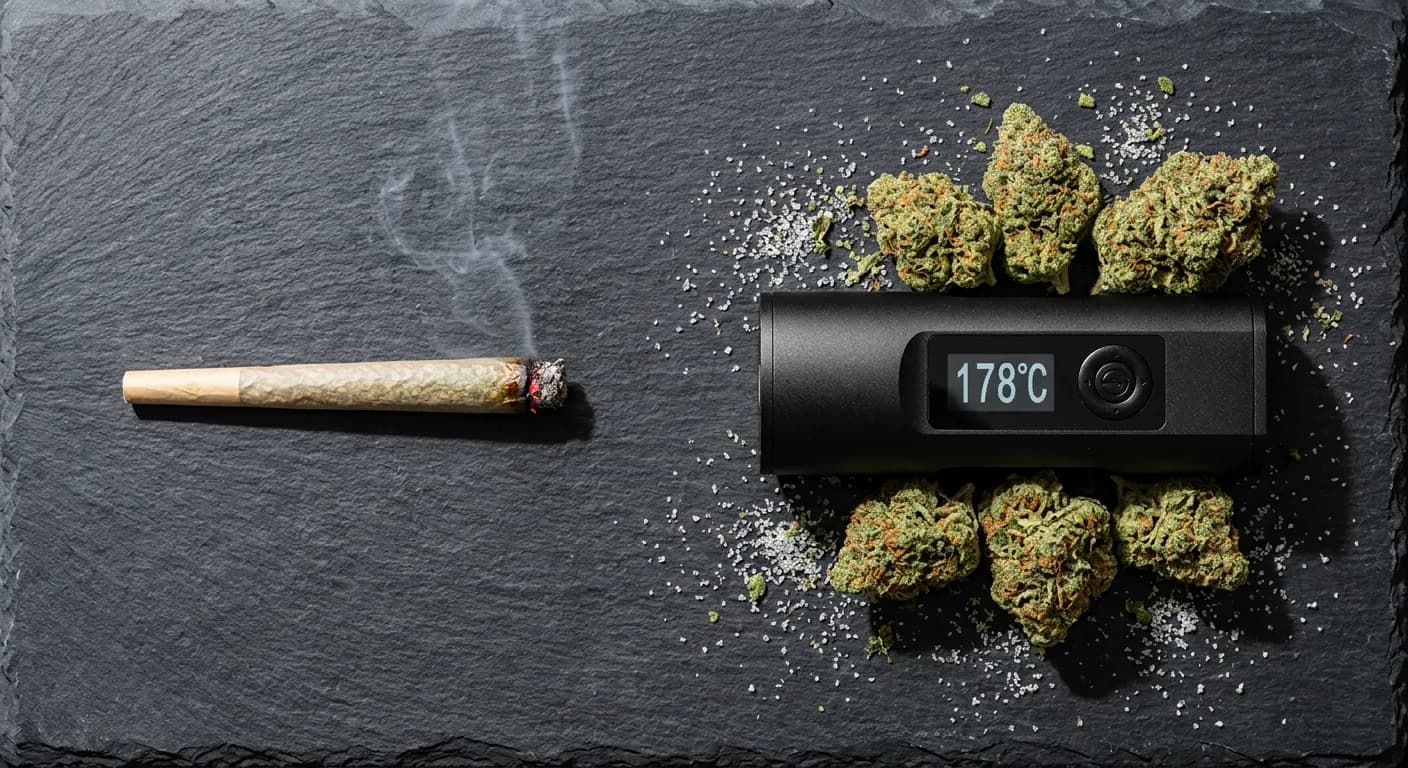
You spent four months growing, flushing, drying, and curing your harvest to a perfect 10–12% moisture content. You followed the small-batch curing guide to the letter. The terpene profile is exactly what you wanted — fruity, complex, and loud. Then you roll it into a joint, light it, and expose everything inside to 900°C of open combustion.
The question of vaporizing vs smoking cannabis isn't just a health debate. For home growers, it's a question of whether the work you put into terpene preservation actually makes it to your palate — or whether it burns away before you taste it. This guide answers that question with temperature data, real chemistry, and a practical vape temperature map you can use tonight.
*Per a 2007 study in the journal Chemistry & Biodiversity comparing combustion vs. vaporization cannabinoid delivery efficiency.
What Combustion Actually Does to Your Cannabis
When you light a joint, the cherry at the tip reaches temperatures between 900°C and 1,100°C. At the draw point — where the smoke travels through unburned material — temperatures range from 400°C to 700°C. Every terpene, flavonoid, and minor cannabinoid in your flower was synthesized to survive at plant-level temperatures, not furnace-level ones.
What Burns Away Instantly
Terpenes have boiling points between 155°C and 220°C. When your flower hits 900°C+, every terpene molecule in the combustion zone is destroyed in milliseconds. The aromatic complexity you built through careful curing — the myrcene, the limonene, the pinene — doesn't survive the flame.
- Myrcene — boiling point 167°C (destroyed instantly above ~250°C)
- Limonene — boiling point 176°C
- Linalool — boiling point 198°C
- Caryophyllene — boiling point 130°C (most volatile, first to go)
- Humulene — boiling point 106°C
- Terpinolene — boiling point 186°C
What Combustion Creates
Beyond destroying what's good, combustion creates compounds that weren't in your flower at all. Incomplete combustion of organic material generates a predictable set of byproducts that enter your lungs with every draw.
| Byproduct | Source | Concern Level |
|---|---|---|
| Carbon monoxide (CO) | Incomplete carbon combustion | High — displaces oxygen in blood |
| Benzene | Aromatic ring breakdown at high temp | High — classified carcinogen |
| Polycyclic aromatic hydrocarbons (PAHs) | Organic matter + heat | High — linked to DNA damage |
| Acrolein | Glycerol combustion | Moderate — airway irritant |
| Ammonia | Nitrogen in plant matter | Moderate — respiratory irritant |
| Hydrogen cyanide | Nitrogen + carbon combustion | Moderate at smoking doses |
What the Respiratory Evidence Actually Says
The research on smoking cannabis and lung health is genuinely mixed, and it's worth being honest about that. Heavy, long-term cannabis smoking is associated with increased rates of chronic bronchitis, excess phlegm production, and airway inflammation. However, unlike tobacco, cannabis smoking has not been consistently linked to lung cancer in epidemiological studies — though the carcinogens present suggest the risk isn't zero.
A 2012 study published in JAMA found that smoking up to one joint per day for seven years was not associated with adverse effects on lung function (FEV1 or FVC) — though higher use was. The honest conclusion: smoking cannabis is not the same risk profile as tobacco, but it's also not a clean delivery method by any standard toxicological measure.
Science note: Cannabis smoke contains many of the same combustion byproducts as tobacco smoke. The key difference is that most cannabis users smoke far fewer sessions per day than tobacco smokers smoke cigarettes — so cumulative exposure is typically much lower. Frequency matters as much as method.
How Dry Herb Vaporizers Work
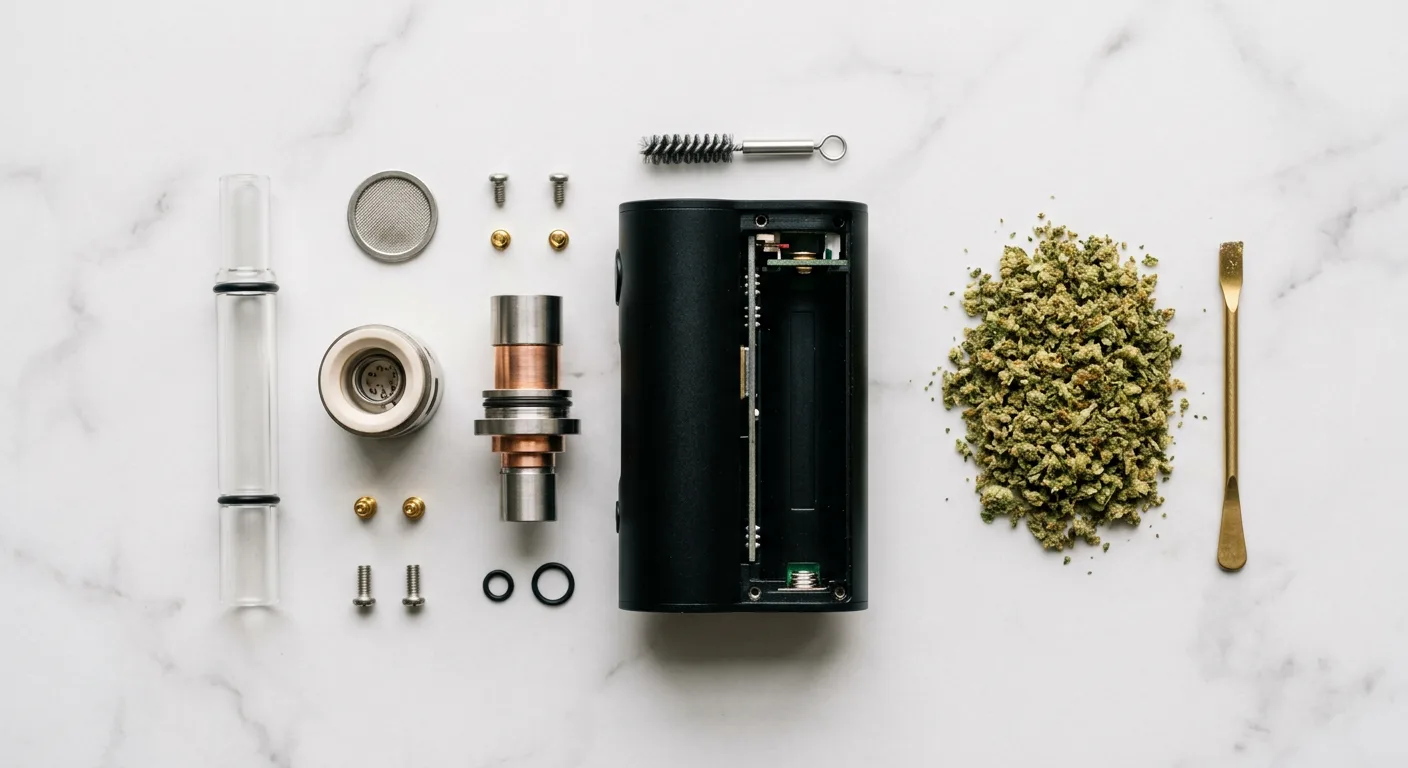
Dry herb vaporizers heat cannabis to a target temperature below the point of combustion — typically between 160°C and 230°C — releasing cannabinoids and terpenes as vapor without burning the plant material. The mechanism determines how evenly and efficiently that heat is applied.
Conduction vs. Convection Heating
These are the two core heating methods used in dry herb vaporizers, and they produce noticeably different experiences — especially for terpene preservation.
| Feature | Conduction | Convection |
|---|---|---|
| How it heats | Direct contact between herb and hot surface | Hot air passes through herb |
| Heat-up time | Fast (20–40 seconds) | Slower (45–90 seconds) |
| Temperature control | Less precise | More precise |
| Terpene preservation | Good | Excellent |
| Even extraction | Moderate (stir recommended) | High |
| Risk of scorching | Higher | Very low |
| Typical price range | $30–$150 | $150–$450+ |
| Best for | Portability, budget | Flavor, medical use |
Grower's tip: If you've put serious work into your terpene profile through careful drying and curing — see our guide on water activity and curing science — a convection vaporizer is the only consumption method that lets that work fully express itself. Conduction is fine, but hot spots can selectively destroy your most volatile terpenes.
Why Vaporizers Don't Produce Smoke
Smoke is the product of combustion — a chemical reaction between organic compounds and oxygen at high temperatures that creates new molecular byproducts. Vaporizers never reach combustion temperature, so that chemical reaction doesn't happen. What you inhale is a mixture of vaporized cannabinoids, terpenes, and water vapor — not combustion gases.
This is why vapor looks different from smoke: it's thinner, dissipates faster, and carries far less particulate matter. It's also why vaped cannabis smells less — the aromatic cloud is smaller, less persistent, and doesn't contain the same tar-carrying combustion particles that cling to surfaces and fabrics.
The Cannabis Vaporizer Temperature Guide Growers Actually Need
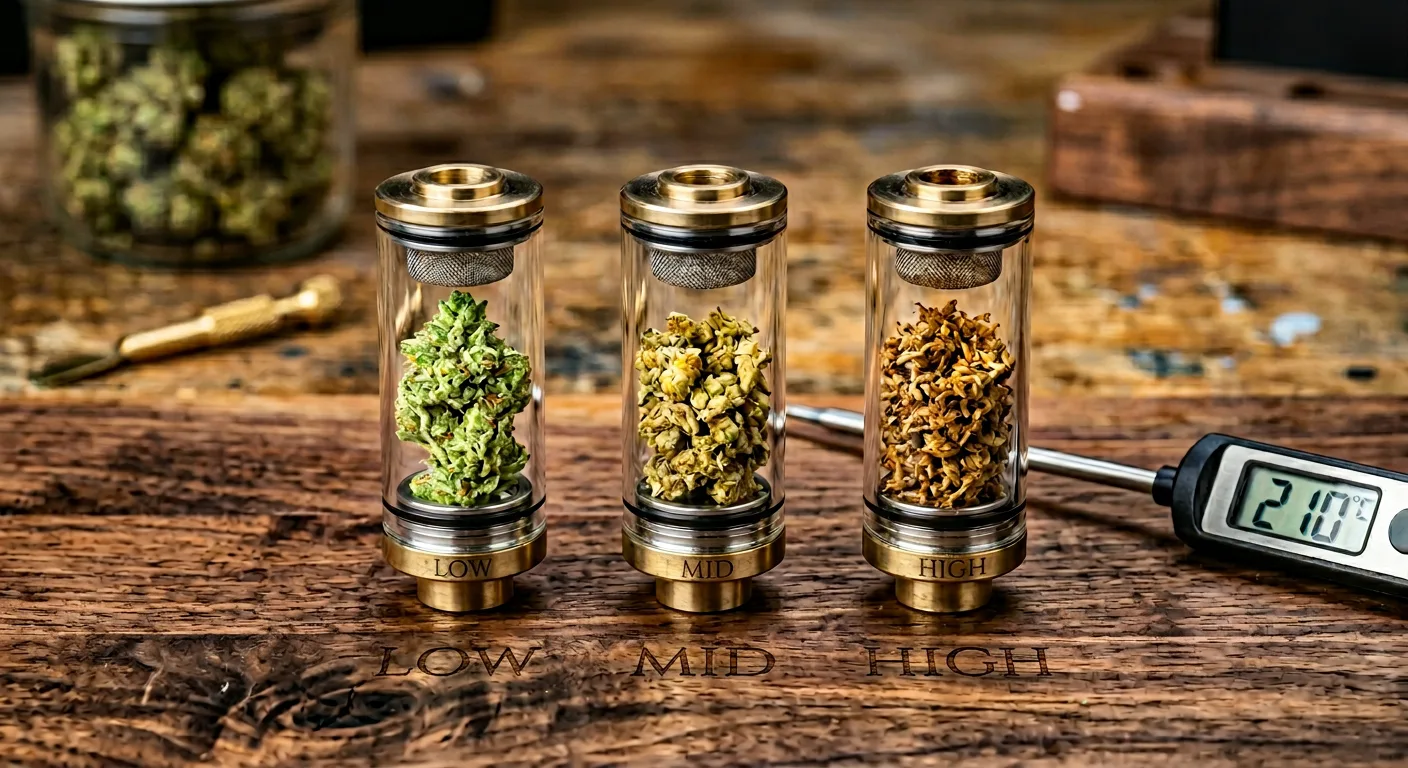
The best temperature to vape cannabis depends on what you want from the session — flavor, potency, sedation, or clear-headedness. Different temperatures release different compounds because every terpene and cannabinoid has its own boiling point. Understanding this lets you dial your experience the same way you dialed your grow.
Low Temperature: 160°C – 180°C — Flavor & Clarity
This range is where terpene hunters live. At these temperatures, the most volatile terpenes vaporize cleanly before THC reaches full conversion. You'll taste the strain's actual character — the citrus of a Super Lemon Haze, the diesel of a Sour Diesel, the tropical complexity of a Papaya — in a way that smoking never allows.
- THC begins vaporizing at 157°C but output is modest at 160°C
- CBD starts vaporizing around 160–180°C
- Effects are clear-headed, functional, and light
- Vapor is thin and smooth — easy on the throat
- Best for: daytime use, flavor exploration, microdosing, new users
- Terpenes active: caryophyllene (130°C), humulene (106°C), myrcene (167°C), limonene (176°C)
The 160–175°C range is the "terpene window" — where flavor peaks and psychoactive intensity is still moderate. If you've grown a terpene-rich strain and want to actually taste what you grew, start here.
Mid Temperature: 180°C – 200°C — Balanced Effect
This is the most-used range for experienced vapers. THC is fully active, CBD extraction is strong, and most terpenes are still present. The experience is full and balanced — noticeably more potent than the low range, but not the heavy body-load of high-temperature sessions.
- THC and CBD both vaporize efficiently in this range
- THCV (appetite suppression, energizing) releases around 220°C — not yet active here
- Effects: euphoric, creative, social, full-spectrum
- Vapor is denser and more visible
- Best for: evening use, recreational sessions, most medical applications
- Terpenes active: linalool (198°C), terpinolene (186°C), all lower-boiling terpenes
High Temperature: 200°C – 220°C — Full Extraction
At this range, you're extracting everything the flower has — including minor cannabinoids that only appear in trace amounts but shift the character of the effect significantly. CBN, which forms as THC degrades with heat, becomes active around 185°C but accumulates more at higher temperatures. This is where the sedative, body-heavy effect profile comes from.
- CBN (sedative, sleep-promoting) becomes more active
- THCV (energizing, appetite-suppressing) reaches boiling point ~220°C
- CBC (anti-inflammatory) vaporizes around 220°C
- Terpene flavor is reduced — most volatile terpenes already extracted in earlier draws
- Vapor is thick and warm — can be harsh without water filtration
- Best for: sleep, pain management, end-of-day sessions, medical users targeting CBN
Caution: Above 230°C, dry herb vaporizers risk combustion. You'll know it's happened if your chamber produces smoke instead of vapor, or if the material chars black rather than toasting brown. Staying under 225°C keeps you firmly in vaporization territory.
Complete Terpene Boiling Point Reference
| Terpene | Boiling Point | Flavor/Effect | Temp Zone |
|---|---|---|---|
| Humulene | 106°C | Earthy, woody, appetite-suppressing | Low |
| Caryophyllene | 130°C | Spicy, peppery, CB2 activity | Low |
| Myrcene | 167°C | Musky, tropical, sedating | Low–Mid |
| Limonene | 176°C | Citrus, mood-lifting, anxiolytic | Low–Mid |
| Terpinolene | 186°C | Floral, fresh, mildly sedating | Mid |
| Linalool | 198°C | Lavender, calming, anti-anxiety | Mid |
| Pinene | 155°C | Pine, alertness, memory retention | Low |
| Ocimene | 50–75°C | Sweet, herbal, antiviral | Ultra-low (ambient) |
For a deeper dive into individual terpenes, see our guides on humulene, pinene, and caryophyllene. Understanding your strain's terpene lab report — explained in our COA reading guide — makes temperature selection far more intentional.
Does Vaping Cannabis Feel Different Than Smoking?
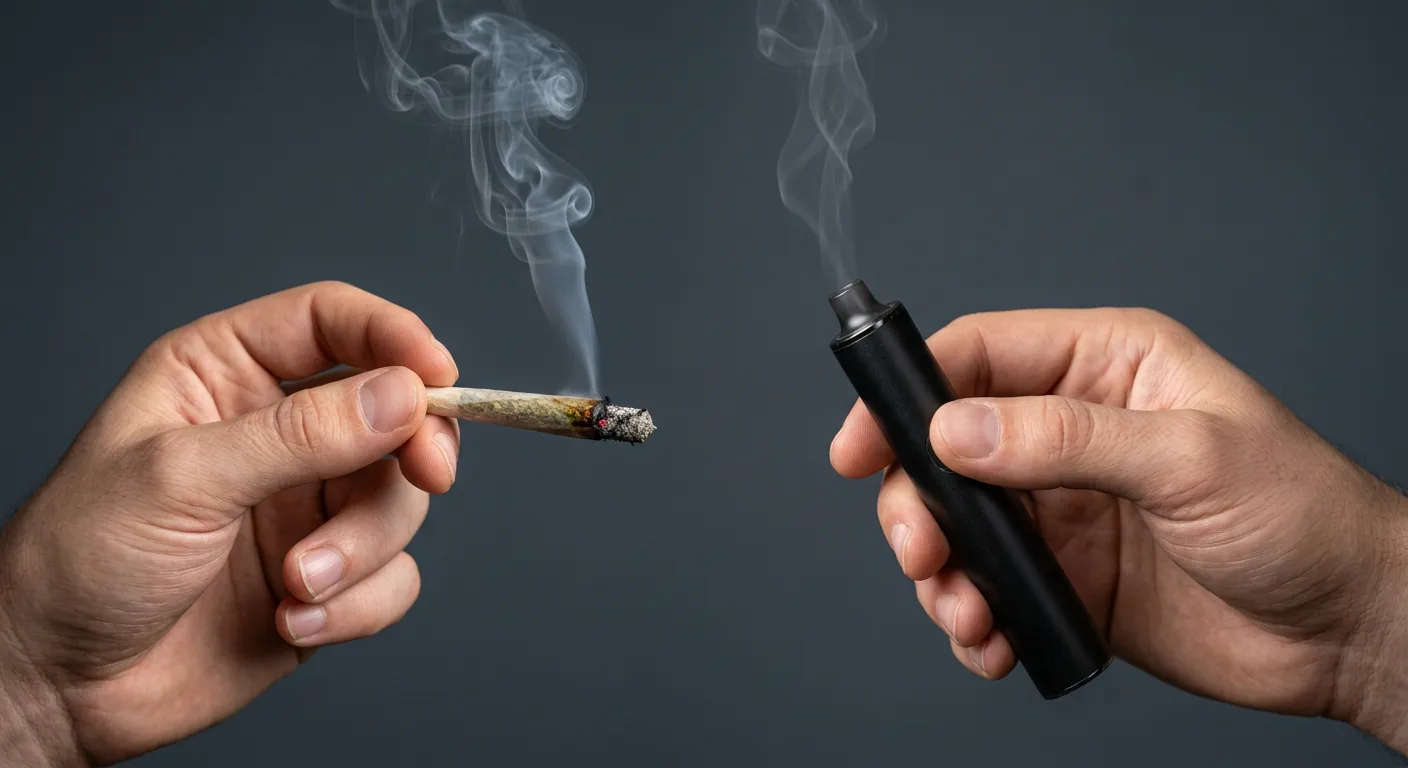
Vaporizing vs smoking cannabis produces noticeably different effect profiles, and this isn't purely subjective. The difference comes from three real factors: the compounds that survive the delivery method, the speed of onset, and the absence of combustion byproducts interacting with your bloodstream.
The Effect Profile Comparison
| Factor | Vaporizing | Smoking |
|---|---|---|
| Onset speed | 60–90 seconds | 30–60 seconds (hotter = faster absorption) |
| Terpene contribution to effect | High — full entourage effect possible | Low — most terpenes destroyed |
| Throat/lung harshness | Low to moderate (temp-dependent) | High — smoke is inherently irritating |
| Effect character at same THC dose | Cleaner, more cerebral, strain-distinct | More blunt, less strain-specific nuance |
| Duration | Comparable, possibly slightly shorter | Comparable |
| CO in bloodstream | Negligible | Measurably elevated |
| Flavor | Strain-specific, complex | Generic smoke flavor dominates |
Does Vaping Weed Get You Less High Than Smoking?
This is one of the most-searched questions about vaping cannabis, and the honest answer is: not less high, but differently high — and sometimes more efficiently high. A 2018 study from Johns Hopkins Medicine found that people who rarely used cannabis experienced significantly stronger effects from vaporized cannabis than smoked cannabis at equivalent doses, suggesting vapor delivers cannabinoids more efficiently to the lungs.
The perception that vaping gets you "less high" often comes from first-time vapers using low temperatures (160–170°C) where THC output is intentionally modest. Dial up to 195–210°C with a quality convection device and that perception quickly changes. The high feels different — more terpene-influenced, less carbon-saturated — but it's not weaker.
Vaping doesn't get you less high — it gets you differently high. The effect is more strain-specific, more terpene-forward, and at equal doses, often more efficient. Users moving from smoking to vaping often need to reduce their dose, not increase it.
Why Some Users Report Cleaner Cognitive Effects
Carbon monoxide from combustion binds to hemoglobin and reduces oxygen delivery to the brain — a real physiological effect that happens every time you smoke anything. Vaporization produces negligible CO. Some users who report "clearer" or "less foggy" effects from vaping vs. smoking are likely experiencing this difference in blood oxygenation, not just a placebo effect.
Additionally, the preserved terpene profile matters to cognitive character. Strains high in pinene can actively counteract some of THC's short-term memory effects — but only if the pinene survives delivery. Vaporization preserves it. Combustion destroys it.
ABV Cannabis: The Home Grower's Bonus Round
Already Been Vaped (ABV) cannabis — the brown, spent material left in your vaporizer chamber after a session — is one of the most underutilized resources in home growing. Because vaporization happens below combustion temperature, ABV material still contains residual cannabinoids, primarily THC that wasn't fully extracted plus elevated CBN from the heat exposure.
What's Left in ABV?
The cannabinoid content of ABV depends on your vaporization temperature and session duration. Material vaped at low temperatures (160–175°C) retains more residual THC — sometimes 30–50% of the original content according to informal analyses. Material vaped to completion at 210°C+ retains less, but still contains meaningful CBN and other heat-stable compounds.
- Residual THC (varies — higher from lower-temp sessions)
- CBN (elevated due to heat-induced THC degradation)
- CBD (if present in original flower)
- Some heat-stable terpenes (minimal)
- Decarboxylated — no further activation needed for edibles
How to Use ABV in Edibles
The critical advantage of ABV is that it's already decarboxylated — the heat from your vaporizer has already converted THCA to THC. You don't need to decarb it again before using it in edibles. This makes it the simplest edible ingredient a home grower can work with.
Collect and Store
Store ABV in an airtight glass jar away from light. Dark ABV (vaped at high temp) has less potency; light tan ABV (low temp) has the most residual cannabinoids.
Water Cure (Optional but Recommended)
ABV has a strong, bitter, earthy flavor. Soaking it in warm water for 24–72 hours (changing water every few hours) removes water-soluble bitter compounds while preserving fat-soluble cannabinoids. Dry thoroughly before use.
Infuse into Fat
Blend directly into butter, coconut oil, or any fat-based ingredient at a low simmer (85–90°C). The already-decarboxylated cannabinoids bind to fat molecules readily. Use our edible dosage calculator to estimate potency before portioning.
Use in Recipes
ABV butter or oil works in any recipe that calls for infused fat. Start with a low dose — ABV potency is unpredictable without lab testing — and wait the full 90 minutes before redosing.
Grower's tip: High-THC strains like Quantum Kush (30% THC) or Purple Kush (27% THC) produce ABV with significantly more residual potency than lower-THC varieties. If you're growing specifically for ABV edibles as a secondary use, start with higher-THC genetics.
Combustion Methods Compared: Joint vs. Bong vs. Pipe
If you're going to smoke, the method still matters. Different combustion formats deliver meaningfully different temperatures, filtration levels, and byproduct profiles — even though none of them avoid combustion's core chemistry.
Side-by-Side Combustion Comparison
| Method | Avg. Inhale Temp | Water Filtration | Terpene Survival | Byproduct Level | Best For |
|---|---|---|---|---|---|
| Joint | ~125–175°C at lips | None | Low (paper burns, tip cherry hits 900°C+) | Highest — full smoke, paper combustion adds acrolein | Social, convenience |
| Blunt | ~125–175°C at lips | None | Low | Highest — tobacco leaf adds nicotine, extra combustion byproducts | Social |
| Pipe/One-hitter | ~100–150°C at lips | None | Low | High — unfiltered, but smaller volume per draw | Discrete, fast |
| Bong (no ice) | ~60–90°C at lips | Partial (water) | Low–Moderate (water cools and filters) | Moderate — water removes some particulates and water-soluble compounds | Smoothness, home use |
| Bong (with ice) | ~35–55°C at lips | Partial + cooling | Moderate (some terpenes condense in water) | Moderate — cooler temp reduces some byproducts | Smoothness, heavy sessions |
| Gravity bong | Variable, often high | Partial | Low | High — concentrated smoke delivery | Maximum dose delivery |
Does Water Filtration Actually Help?
Yes — but with an important trade-off. Water in a bong does remove some water-soluble combustion byproducts and cools the smoke significantly, which reduces airway irritation. However, water also captures water-soluble terpenes, meaning some of the flavor compounds that survived combustion get stripped out before they reach your lungs.
The net effect: bongs are physically smoother and probably marginally less harmful per draw than unfiltered pipes or joints, but they're still delivering combustion byproducts and sacrificing terpene flavor. They're not a vaporizer substitute — they're a more comfortable combustion delivery system.
Science note: A 2000 NORML/MAPS study tested water pipes vs. unfiltered smoking and found that while water filtration did remove some harmful compounds, the ratio of tar to THC actually worsened with water filtration — meaning you might get less THC relative to the toxins compared to a joint. This study is frequently misread; the correct takeaway is that neither method is clean, not that bongs are worse than joints in absolute terms.
Does Vaping Weed Smell Less?
Yes — vaporizing cannabis produces significantly less odor than smoking, and the odor that is produced dissipates much faster. This is one of the most practical advantages of vapor over smoke for home growers who want discretion. The vapor cloud is smaller, carries less aromatic particulate, and doesn't penetrate fabrics and surfaces the way combustion smoke does.
Smoke smell is persistent because combustion creates sticky aromatic particles that cling to surfaces, clothing, and hair. Vapor is mostly water vapor and volatile aromatic compounds — it disperses quickly and doesn't leave the same residue. In a well-ventilated room, vapor odor is typically undetectable within 10–20 minutes. Smoke odor can linger for hours.
- Vapor dissipates in 10–30 minutes in ventilated spaces
- Smoke can persist for 2–4+ hours indoors
- Neither is completely odorless — both produce terpene volatiles
- Low-temperature vaping (160–170°C) produces the thinnest, least-odorous vapor
- Higher temperatures produce denser, more aromatic vapor
Is a Vaporizer Worth It for Home Growers?
For a home grower who has put real effort into producing quality cannabis, a vaporizer is arguably the single highest-return accessory purchase you can make. The investment in a quality device — particularly a convection vaporizer — directly translates the work you did in drying, curing, and terpene preservation into an experience you can actually taste and feel.
Practical Verdict Cards by Use Case
🌿 Flavor Chasing: Convection vaporizer, 165–178°C. This is the only consumption method that lets your terpene profile actually express itself. If you grew a citrus-forward strain like Super Lemon Haze (23% THC) or a tropical cultivar like Tangerine Haze (18% THC), vaping at low temp is the only way to taste what you grew.
💊 Medical / Therapeutic Use: Convection vaporizer, 185–210°C (temp-adjusted to target compound). Vaporization avoids combustion byproducts entirely and allows precise temperature control to target specific cannabinoids. For users interested in CBD, CBN, or full-spectrum effects, mid-to-high temp vaping is far more controllable than any combustion method. See our best strains for pain or best strains for insomnia guides for strain selection.
🎉 Social Sessions: Joint or bong if smoke is acceptable; portable vaporizer if discretion matters. Joints are culturally embedded in social cannabis culture and that's fine — understanding what you're trading (terpenes, byproducts) lets you make an informed choice. A quality portable vaporizer like an Arizer or Storz & Bickel Crafty+ can absolutely hold its own socially.
🤫 Discretion: Vaporizer wins decisively. Lower odor, faster dissipation, no combustion smoke. Low-temperature vaping is the most discrete consumption method available for dry herb — the vapor is thin, the smell is faint and brief, and there's no combustion odor to cling to clothing or furnishings.
What to Look for in a Dry Herb Vaporizer
- Convection or hybrid heating (better terpene preservation than pure conduction)
- Precise digital temperature display (not just low/med/high settings)
- Ceramic or glass air path (metal air paths can add off-flavors)
- Replaceable/cleanable screens (residue buildup degrades flavor)
- Temperature range that reaches at least 220°C for full extraction
- Reputable brand with warranty and replacement part availability
Grower's pairing tip: Match your vape temperature to your strain's dominant terpene. OG Kush (26% THC) is myrcene-dominant — start at 170°C to capture that earthy musk before pushing to 190°C for full cannabinoid release. A diesel-forward strain like New York Power Diesel (24% THC) expresses best at 175–185°C where its complex terpene profile peaks.
Terpene-Forward Strains Worth Preserving Through Vaporization
Not every strain rewards the precision vaporization offers equally. High-terpene cultivars — those with complex, layered aromatic profiles — gain the most from a vape-first approach. The strains below are particularly worth treating carefully at the consumption stage because their terpene profiles are genuinely distinctive.
Strains With Terpene Profiles Worth Protecting
| Strain | THC | Terpene Character | Best Vape Temp | Notes |
|---|---|---|---|---|
| OG Kush | 26% | Myrcene, limonene, caryophyllene — earthy, citrus, fuel | 170–190°C | Iconic terpene stack loses nuance in combustion |
| Super Lemon Haze | 23% | Limonene-dominant — bright citrus, energetic | 175–185°C | Limonene shines at 176°C; start low to taste it |
| Papaya | 25% | Myrcene, ocimene — tropical, sweet, mango | 165–180°C | Ocimene is ultra-volatile; catch it at lowest temps |
| White Widow | 25% | Caryophyllene, pinene — spicy, piney, classic | 160–185°C | High caryophyllene content detected at 130°C+ |
| Gorilla Glue #4 | ~26% | Caryophyllene, myrcene, limonene — earthy, pine, chocolate | 175–195°C | Industry benchmark for terpene complexity |
| Sour Diesel | 24% | Myrcene, limonene, caryophyllene — diesel, citrus, fuel | 175–190°C | Diesel character preserved better in vapor than smoke |
| Gelato | ~20–25% | Caryophyllene, limonene, myrcene — sweet, dessert, fruity | 170–185°C | Sweet dessert terpenes destroyed instantly by combustion |
| Tangerine Haze | 18% | Limonene, terpinolene — orange, tropical, haze | 175–190°C | Terpinolene peaks at 186°C — mid temp hits it perfectly |
To learn more about preserving your harvest's terpene quality from the cure jar all the way to the vaporizer, see our guide on long-term cannabis storage and our humidity pack comparison. Also, for sleep-focused terpene selection check out our linalool vs myrcene for sleep guide.
The Final Verdict: Vaporizing vs Smoking Cannabis
After reviewing the temperature data, the terpene chemistry, and the real-world effect differences, the honest conclusion is straightforward — but nuanced enough to respect both methods.
| Category | Winner | Why |
|---|---|---|
| Terpene preservation | ✅ Vaporizer (clear) | Combustion destroys terpenes at 900°C+; vapor captures them at 155–220°C |
| Flavor quality | ✅ Vaporizer (clear) | Strain-specific taste is only accessible through vapor |
| Respiratory byproducts | ✅ Vaporizer (clear) | No combustion = no CO, benzene, or PAHs |
| Potency efficiency | ✅ Vaporizer (slight) | More cannabinoid delivery per gram in controlled studies |
| Effect character | ✅ Vaporizer (for nuance) | Full entourage effect; strain-specific cognitive profile |
| Discretion | ✅ Vaporizer (clear) | Less odor, faster dissipation, no combustion smoke |
| ABV reusability | ✅ Vaporizer only | Spent material is already decarbed and edible-ready |
| Social ritual | 🤝 Draw (personal preference) | Joints carry cultural weight that vaporizers don't replicate |
| Convenience / cost of entry | ✅ Smoking (slight) | Rolling papers cost cents; quality vaporizers cost $150–$400+ |
| Temperature control | ✅ Vaporizer (clear) | Precise targeting of cannabinoid and terpene boiling points |
If you're a home grower who has invested real time and care into your harvest, the calculus is clear: vaporization is the consumption method that respects that investment. Combustion is like spending three months making a fine wine and then boiling it before you drink it — the alcohol survives but everything that made it interesting is gone.
That doesn't mean you can never roll a joint. It means you should know what you're trading when you do. And when you want to actually taste what you grew — dial a convection vaporizer to 170°C, load your best bud, and let the terpenes do what they were always meant to do.
Frequently Asked Questions
Does vaping weed smell less than smoking?
Yes, significantly. Vapor from a dry herb vaporizer contains fewer aromatic particles than smoke, dissipates much faster (10–30 minutes vs. several hours for smoke), and doesn't embed into fabrics or surfaces. Low-temperature vaping (160–175°C) produces the thinnest, least-odorous vapor. Neither method is completely odorless, but vaporizing produces far less persistent smell.
Is a vaporizer worth it for weed?
For home growers who care about flavor and terpene preservation, yes — a quality dry herb vaporizer is the highest-return accessory purchase you can make. A convection vaporizer in the $150–$300 range will preserve the terpene profile that months of careful growing and curing produced. It also delivers cannabinoids more efficiently per gram and produces ABV material that can be used in edibles.
What temperature should I vape weed at?
For flavor and clarity, use 160–178°C. For balanced THC/CBD with good terpene retention, use 180–200°C. For maximum cannabinoid extraction including CBN and CBC, use 200–220°C. Never exceed 230°C in a dry herb vaporizer — above this point, combustion becomes likely and you lose the core benefits of vaporization. Match temperature to your strain's dominant terpenes for best results.
Does vaping preserve terpenes better than smoking?
Yes — dramatically better. The combustion cherry of a joint reaches 900°C+, which instantly destroys all terpenes (which boil between 106°C and 220°C). Vaporizers operate within the terpene boiling point range, releasing them as inhalable vapor without destroying them. This is why vaped cannabis tastes strain-specific while smoked cannabis tastes primarily like smoke.
Can I use already vaped cannabis (ABV) in edibles?
Yes, and it's one of the best home grower bonuses from switching to vaporization. ABV cannabis is already decarboxylated by the heat from your vaporizer session, meaning you can infuse it directly into butter or oil without a separate decarbing step. Potency varies — light tan ABV (from low-temp sessions) retains more THC than dark brown ABV (high-temp sessions). Water-curing ABV before use reduces its bitter flavor significantly. Use our edible dosage calculator to estimate your dose.