You're holding a seed packet. The label says 26% THC, feminized, 8-week flower, legendary genetics — and you have absolutely no idea if any of it is true. Learning how to read cannabis seed packaging is one of the most underrated skills in growing, yet almost nobody teaches it properly.
This guide fills that gap completely. You'll learn to decode every element on a seed packet — from feminized labels and F1/S1 notation to THC percentages, lineage claims, flowering windows, and the subtle signals that separate trustworthy breeders from marketing noise. By the end, you'll walk into any seed purchase with clear eyes.
Before we dive into genetics, if you're brand new to seeds altogether, our cannabis germination guide covers everything from cracking the shell to your first sprout — worth bookmarking alongside this article.
The Anatomy of a Cannabis Seed Packet: Every Element Explained
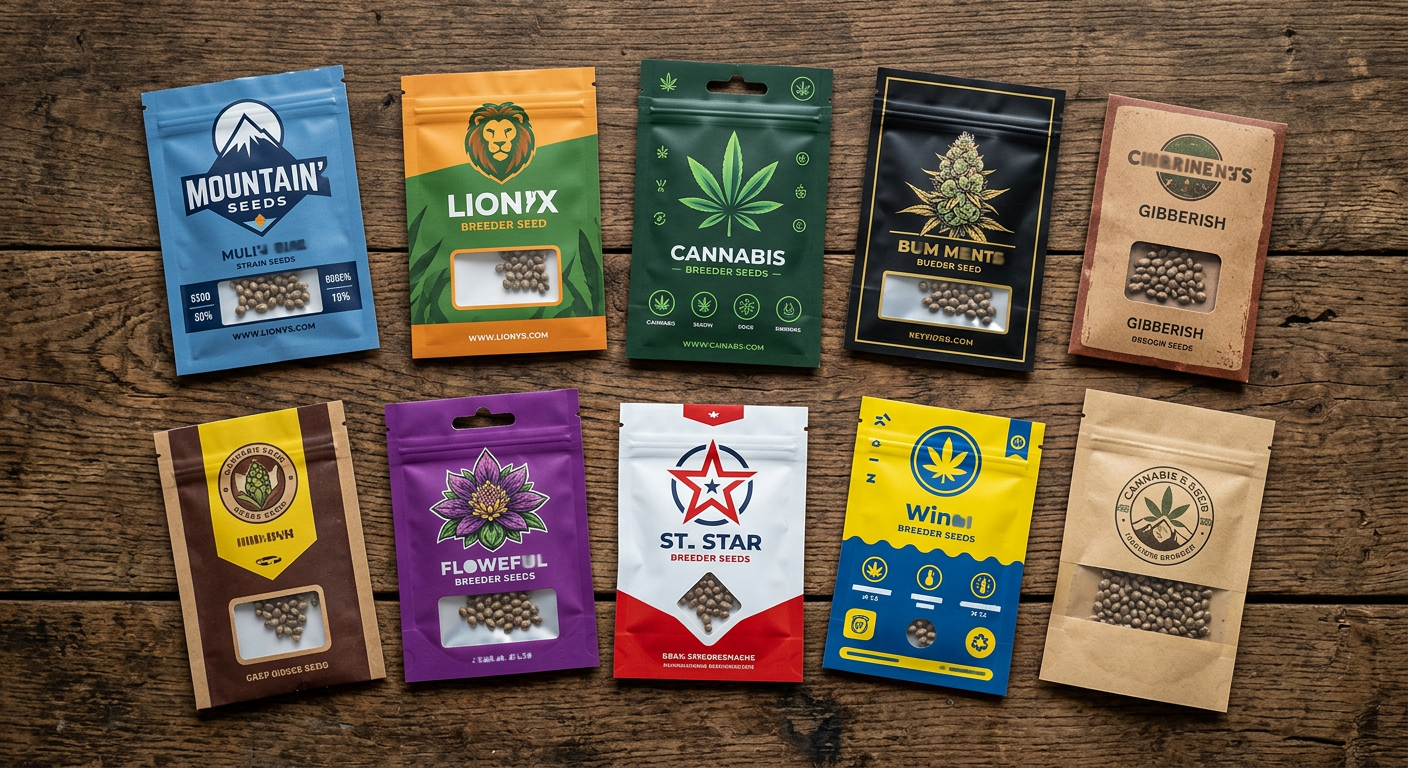
A seed packet contains 8–12 distinct data points, and each one tells you something different about what you're buying. Reading them in isolation gives you fragments — reading them together gives you a full picture of genetics, quality, and realistic expectations.
Here's every element you'll find on a standard cannabis seed packet, annotated:
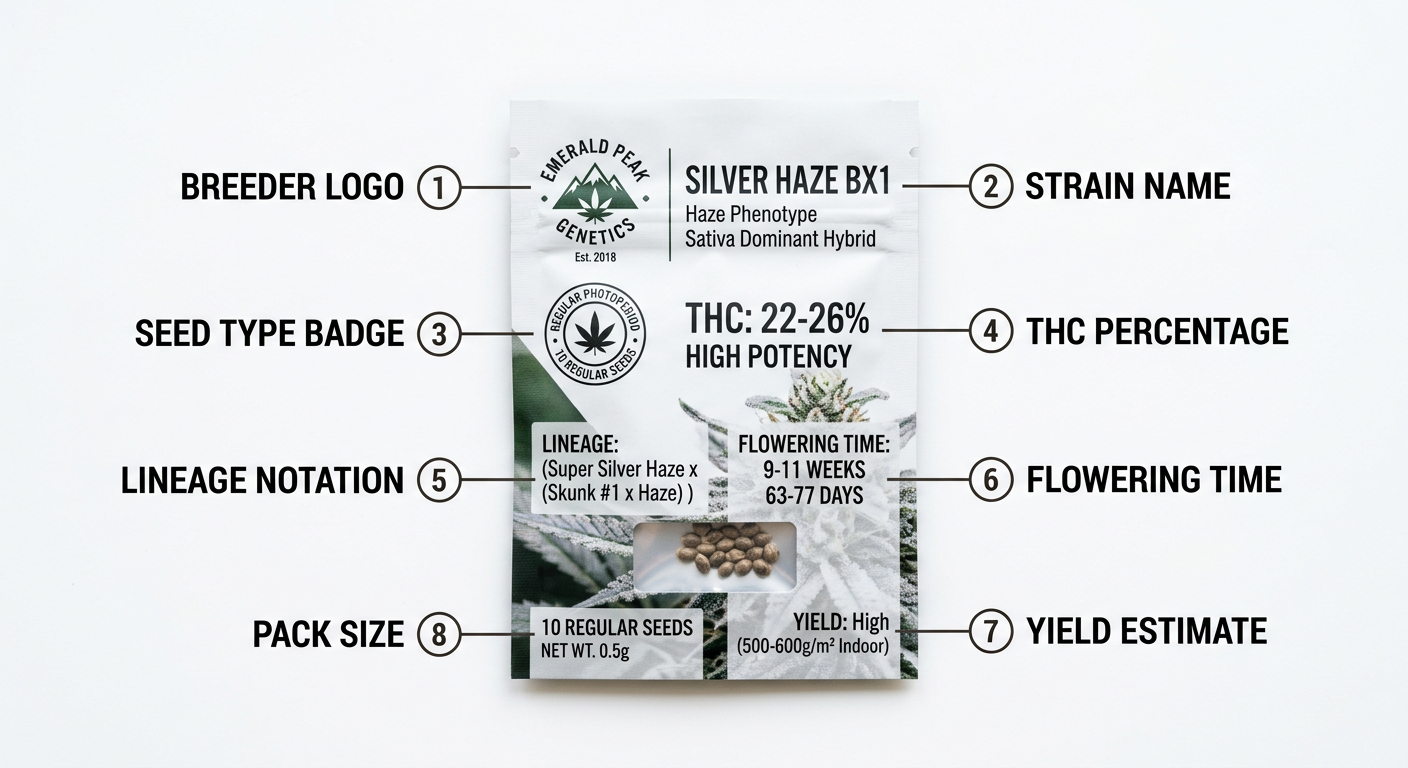
Strain Name
The marketing face of the product. Strain names are not legally protected or standardized, so the same name can mean very different genetics across breeders. Always cross-reference the name with the lineage listed below it — if the name and lineage don't match the strain's known history, that's your first flag.
Breeder Name or Logo
The single most important credibility signal on the packet. A named breeder with a documented history is accountable for what's inside. Anonymous or white-label packaging — where no breeder is credited — almost always means repackaged bulk seeds with no quality control behind them.
Seed Type Badge
This tells you whether the seeds are feminized, regular, or autoflower. Each type has completely different growing requirements and expected outcomes. We cover this in detail in the next section — it's one of the most misunderstood labels on the market.
Generation Notation
Labels like F1, F2, S1, or IBL describe the genetic history of the seed. This is the data most first-time buyers skip — and the one experienced growers scrutinize most carefully. A strain listed as F1 versus F3 will behave very differently in your grow room.
THC / CBD Percentage
A potency estimate, not a guarantee. These numbers come from lab tests on plants grown under ideal controlled conditions. Your environment, technique, and harvest timing will all affect the actual result. More on the math in Section 4.
Lineage / Parent Strains
Usually printed as Parent A × Parent B. This is the genetic proof of concept. If a breeder claims legendary genetics but lists no parents — or uses generic terms like 'indica hybrid' — there's no way to verify what you're actually growing.
Flowering Time
Shown as a range in weeks (e.g., 8–10 weeks) for photoperiod strains, or total days from seed to harvest for autoflowers. Always treat these as best-case estimates from the breeder's own test grows — real-world results typically run 1–2 weeks longer.
Yield Estimate
Often listed as grams per square metre (indoor) or grams per plant (outdoor). These numbers assume a perfect environment, expert technique, and an optimal photoperiod. For a realistic yield estimate based on your setup, use the cannabis yield estimator tool.
Pack Size
Standard packs come in 3, 5, or 10 seeds. Some premium breeders offer single seeds. Pack size affects value per seed significantly — always calculate cost-per-seed when comparing options across breeders.
The strain name and THC number are the two most-marketed elements on any packet — and also the two least reliable. The lineage, generation notation, and breeder name tell you far more about what you'll actually grow.
Feminized, Regular, and Autoflower: What the Type Label Really Means
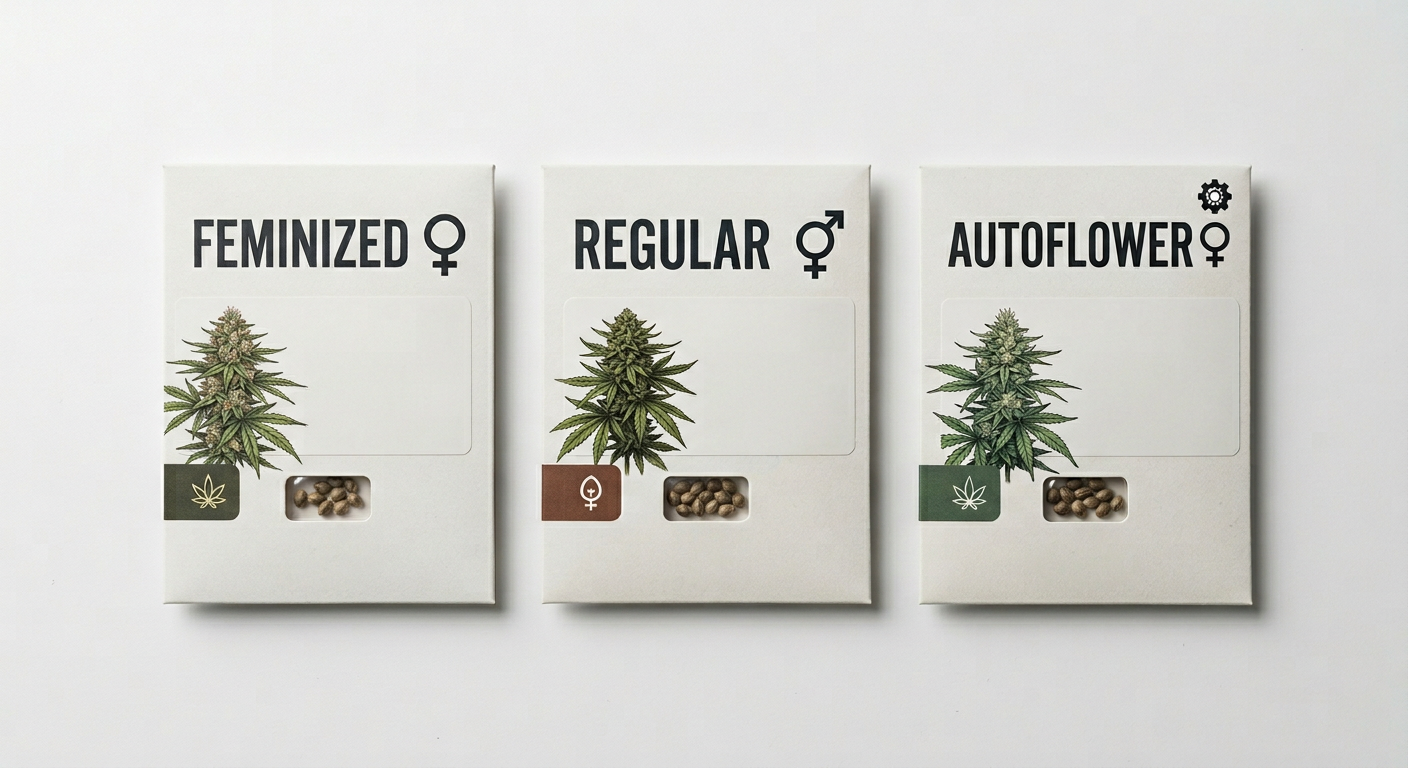
The seed type label is the first practical decision point on any packet. It directly determines your growing process, timeline, and what percentage of your seeds will produce harvestable buds. Get this wrong and no amount of good genetics will save your grow.
| Seed Type | Sex Ratio | Triggered By | Best For | Watch Out For |
|---|---|---|---|---|
| Regular | ~50% male / 50% female | 12/12 light cycle | Breeding projects, cloning mothers | Half your plants won't produce buds |
| Feminized | 99%+ female | 12/12 light cycle | Most home growers | Slight hermaphrodite risk under extreme stress |
| Autoflower | 99%+ female (usually) | Age — no light change needed | Beginners, outdoor, fast harvests | Can't clone reliably; shorter veg window |
What Does Feminized Mean on a Seed Packet?
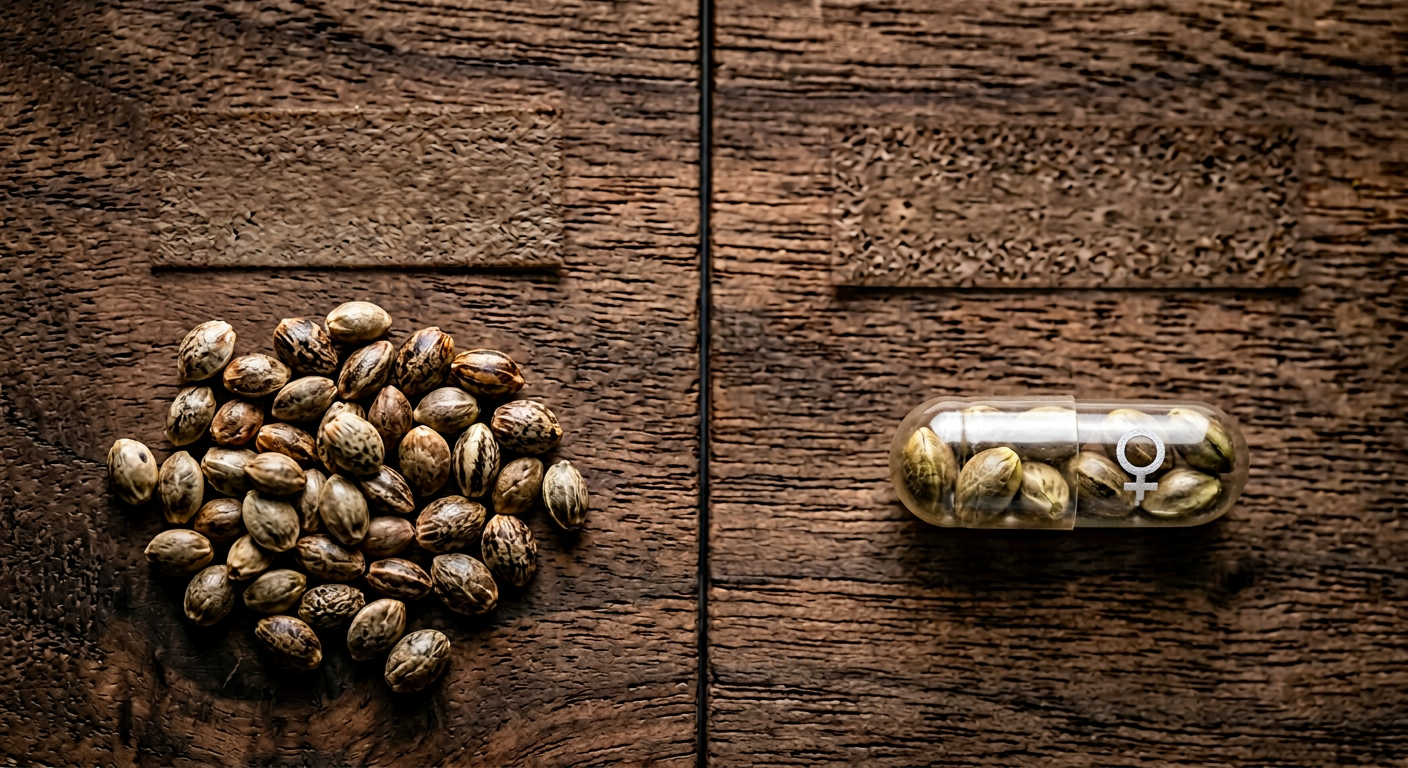
Feminized seeds are produced by forcing a female plant to develop male pollen sacs — usually through colloidal silver or rodelization — then using that pollen to fertilize another female. Because both parents carry only X chromosomes, the resulting seeds are genetically female at a rate of 99% or higher.
For home growers this is hugely valuable: every seed you plant has a near-certain chance of producing buds, with no need to identify and remove male plants mid-grow. Strains like OG Kush Feminized (26% THC) and White Widow Feminized (25% THC) are sold in feminized form precisely because home growers want maximum bud-producing efficiency from every seed.
Pro Tip: 'Feminized' does not mean 'stress-proof.' Under extreme heat, drought, or light interruptions, even quality feminized seeds can throw male flowers (hermaphrodite). The label tells you about genetics — your environment determines how those genetics express.
Autoflower Labels: What the Packet Should Tell You
An autoflower label means the strain carries Cannabis ruderalis genetics, which triggers flowering based on age rather than light cycle. A packet should tell you total days from seed to harvest — typically 70–90 days — not just a flowering window.
If an autoflower packet only lists a flowering window without specifying total days, that's incomplete information. For comparison, strains like Skywalker OG Autoflower (23% THC) and Holy Grail Kush Autoflower (20% THC) both include enough detail on their packaging to set realistic harvest expectations from day one.
For a deeper comparison of how these two types perform across an entire grow cycle, see our autoflower vs photoperiod growing guide.
Cracking the Genetics Code: F1, F2, S1, IBL and What They Mean for Your Grow
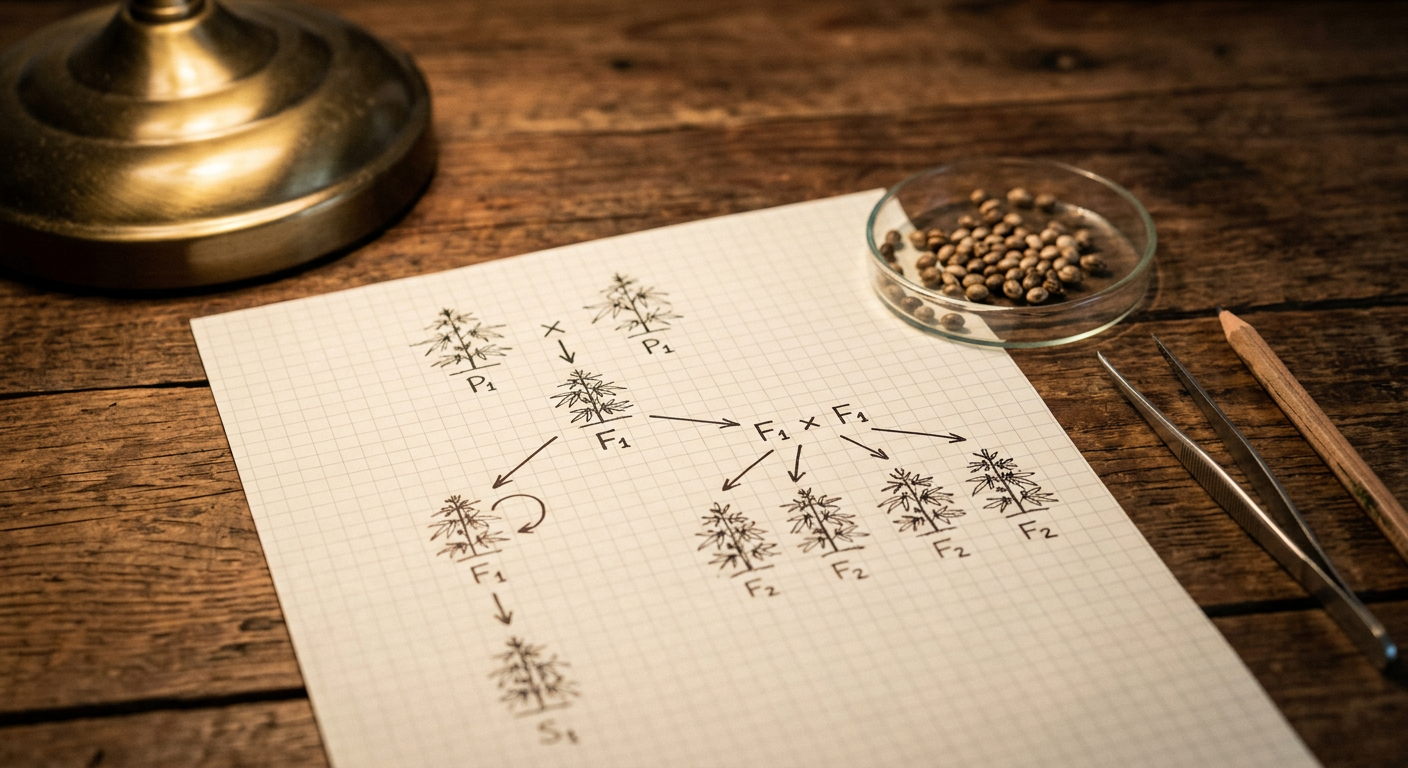
Generation notation is the most technical — and most ignored — section of any seed packet. Understanding it takes less than five minutes but gives you a major advantage in predicting how uniform, stable, and potent your plants will be.
F1: First Filial Generation
F1 seeds are the direct offspring of two different, stable parent strains crossed for the first time. They benefit from hybrid vigour (also called heterosis) — a documented phenomenon where first-generation crosses grow faster, yield more, and show more uniform traits than either parent alone.
F1s are the most predictable seeds you can buy. Every plant in an F1 batch should look and perform very similarly because the genetics haven't started to recombine. If a packet says F1 and lists both parent strains clearly, that's a strong quality signal.
F2 and Beyond: Genetic Variability Increases
F2 seeds are produced by crossing two F1 plants together. At this point, Mendel's laws kick in: the offspring can express any combination of traits from both grandparent strains. An F2 batch will show significantly more variation — some plants leaning heavily toward one parent, others expressing recessive traits.
This isn't necessarily bad. F2 and F3 seeds are often cheaper and can contain exceptional phenotypes that a selective breeder is hunting for. But for a home grower who wants consistency, F1 is almost always the safer choice.
Science Note: Genetic stability follows a predictable curve. F1 generations are typically 95–99% phenotypically uniform. F2 drops to around 75%. By F4–F5 through careful selection, breeders can rebuild stability — that's how inbred lines (IBLs) are created. Understanding this explains why two packets with the same strain name can produce completely different plants depending on their generation.
What Does S1 Mean on Cannabis Seeds?
S1 stands for selfed first generation. A female plant is induced to produce pollen (via colloidal silver or STS) and then fertilizes herself. The resulting seeds are genetically very close to a clone of the mother plant — preserving her specific traits without introducing new genetics from another strain.
S1 seeds are popular for preserving exceptional pheno-hunted cuts. The tradeoff is that they carry a slightly elevated hermaphrodite risk, because the stress-induced pollen process can pass on stress-response tendencies. A reputable breeder will note this on the packaging — an unreliable one won't.
IBL: Inbred Line
IBL (Inbred Line) means the strain has been self-pollinated or brother-sister mated across multiple generations (typically F4–F7) to lock in specific traits. IBLs are highly stable and breed true — plant 10 IBL seeds and all 10 should look nearly identical.
- Classic IBLs include Original Afghani, early Skunk #1, and Haze landraces
- IBLs tend to show less hybrid vigour than F1 crosses — slower growth, lower yields on average
- They're prized by breeders for predictability and as foundation genetics for new crosses
- An IBL label on modern packaging usually indicates serious breeding work behind the strain
For more on how IBLs connect to the history of cannabis genetics, our heirloom cannabis strains guide goes deep on lineage preservation.
THC and CBD Percentages: Why the Numbers Are Always Estimates
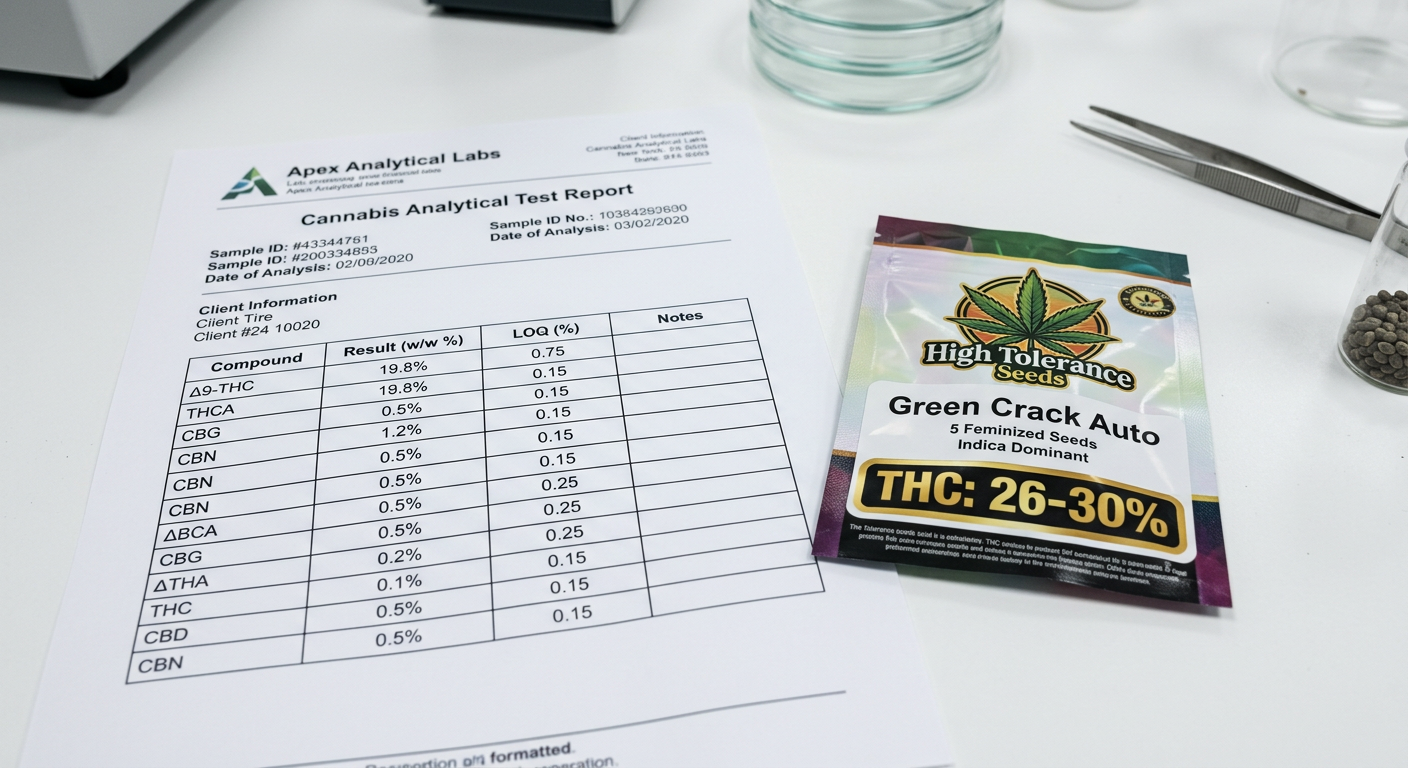
The THC percentage printed on a seed packet is the single most misunderstood number in cannabis retail. It looks precise, it's usually prominently displayed, and it's almost always optimistic. Here's exactly why — and how to use these numbers intelligently instead of taking them at face value.
How Breeders Generate These Numbers
THC percentages on packaging come from lab tests conducted on plants grown under the breeder's own optimal conditions — typically professional lighting, dialled-in nutrients, ideal VPD, and perfect harvest timing. These are best-case results, not average results. Most breeders run 3–5 test plants and use the highest reading.
Real-world home grows almost always produce lower THC than the label. Research and grower data consistently shows home-grown results running 20–40% below the printed figure — a strain labelled at 25% THC might realistically yield 15–20% in a first-time grow setup.
Watch out: Any seed packet claiming THC above 35% without citing a specific, named third-party lab test is almost certainly inflating the number for marketing purposes. Verified 35%+ THC results are exceptionally rare even in professional cultivation. Treat any figure above 30% with healthy scepticism unless documentation is provided.
What a Realistic THC Range Looks Like
Trustworthy breeders show a range rather than a single peak number — something like 18–22% rather than just '26%.' A range acknowledges grow variation and is far more honest about real-world outcomes. Single-number claims with no range or no variance indication are a subtle red flag.
Here's a realistic benchmark table based on common strain categories:
| Strain Category | Realistic Home Grow THC | Breeder Label Range | Notes |
|---|---|---|---|
| Classic Indica (e.g., Northern Lights) | 12–16% | 16–20% | Forgiving, consistent |
| Classic Skunk / Hybrid | 14–18% | 18–24% | Moderate difficulty |
| Modern High-THC (e.g., OG Kush) | 18–22% | 22–28% | Needs dialled environment |
| Haze / Sativa-dominant | 16–20% | 20–26% | Long flower, high ceiling |
| Autoflower | 12–18% | 16–23% | Reduced veg = lower peak |
CBD Percentages: Even More Variable
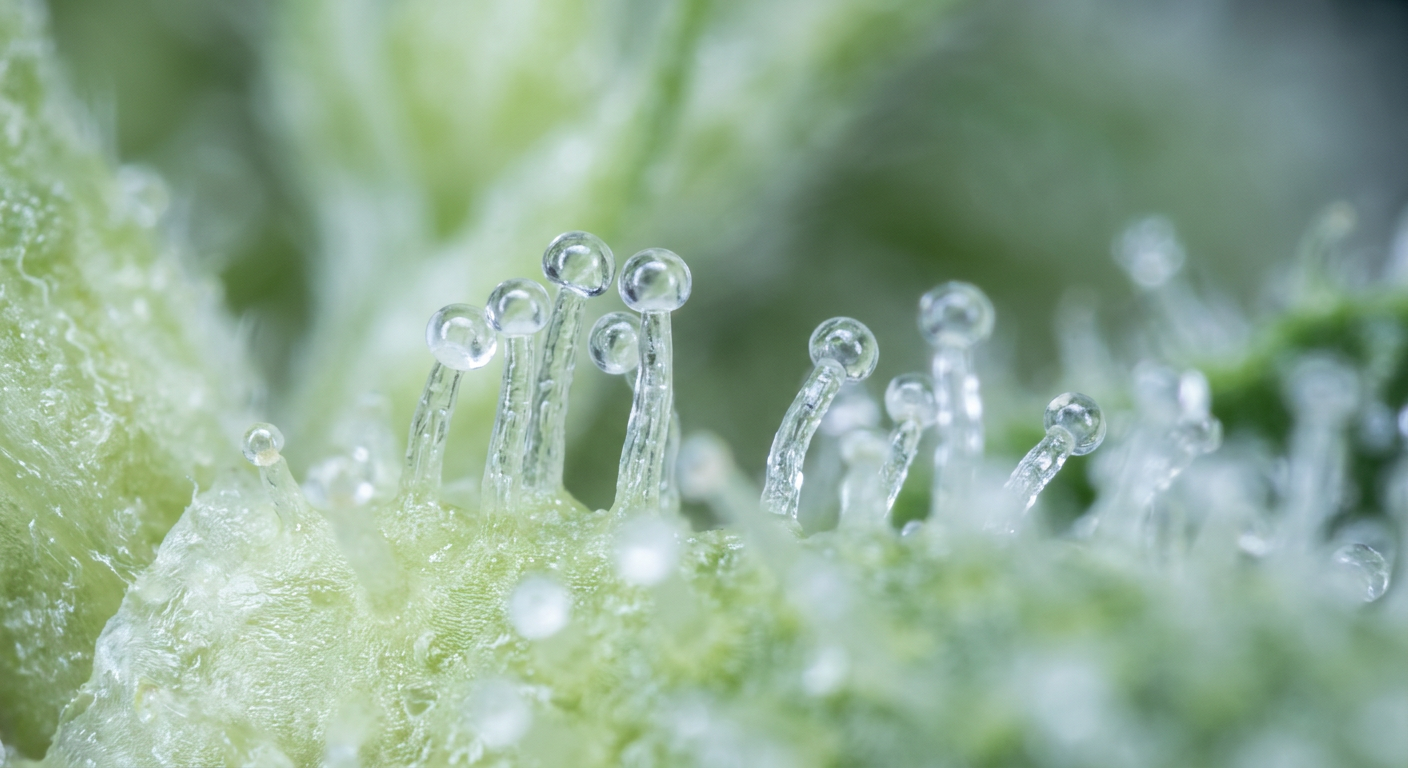
CBD labelling is even less standardized than THC. Many packets list CBD as simply '<1%' for high-THC strains — which is accurate but tells you almost nothing. For medical or CBD-focused cultivation, always look for strains with specific CBD ratios (e.g., 1:1, 10:1 CBD:THC) and ask whether the breeder has independent lab documentation. Our trichome biology guide explains exactly how and where cannabinoids are produced if you want the science behind the numbers.
Flowering Time and Yield Claims: Reading Between the Lines
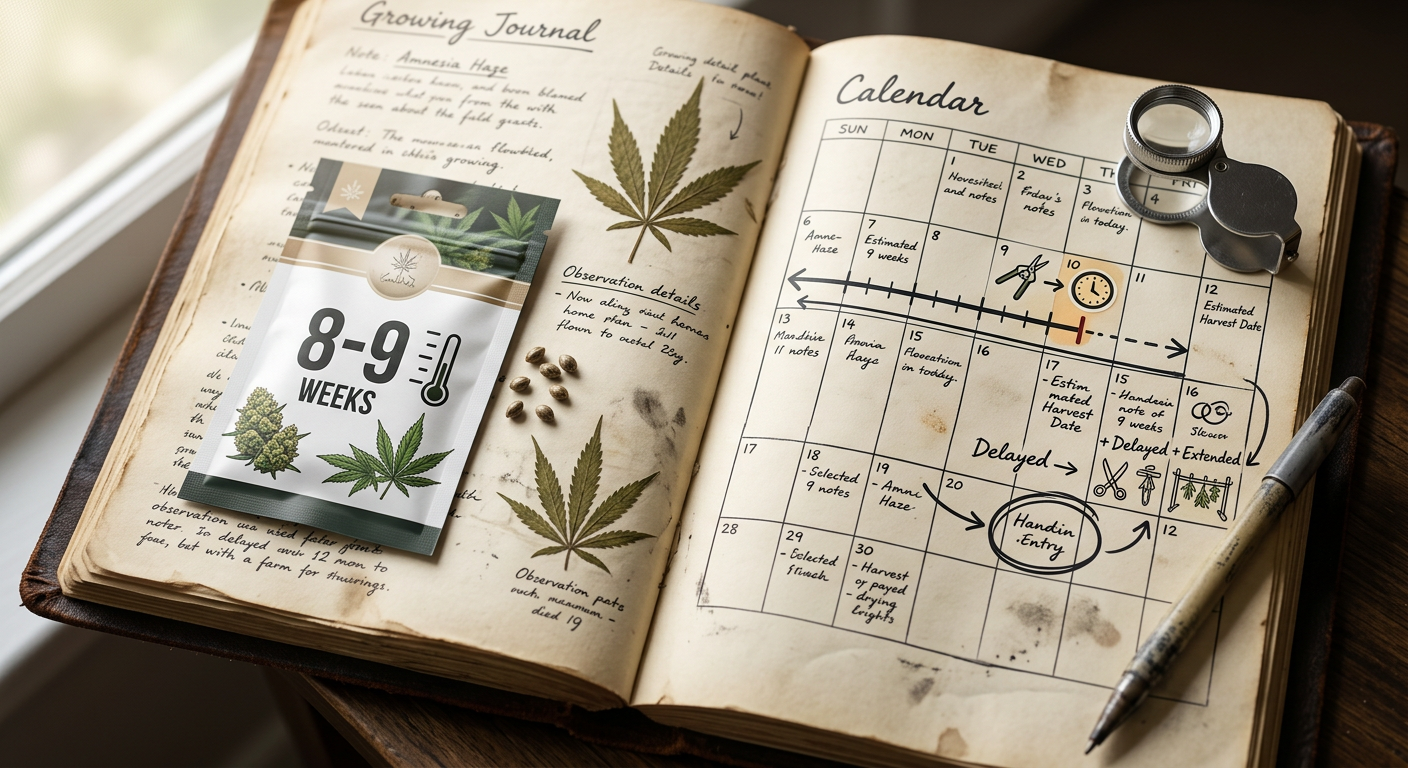
Flowering time and yield are the two growing metrics every grower looks at first — and the two most consistently overstated on seed packets. Knowing how to calibrate these numbers against reality will save you from miscalculated harvests and disappointing yields.
Flowering Time: The Hidden Assumptions
A packet that says '8 weeks' means 8 weeks under the breeder's test conditions — usually 600–1000W HPS lighting, controlled 68–77°F temperatures, optimal nutrients, and a large root zone. Change any of those variables and your timeline shifts.
- LED lighting often extends flower by 5–10 days vs HPS benchmarks
- Temperatures below 65°F slow resin production and extend maturation
- Underfed plants take longer to finish and produce less dense buds
- Sativa-dominant strains labelled '9–10 weeks' routinely run 11–13 weeks outdoors
- High-stress training (HST) can add 1–2 weeks to recovery and total timeline
Pro Tip: Add 10–14 days as a buffer to any breeder's stated flowering time when planning your harvest window. Our free grow planner tool lets you input flowering time and automatically calculates a realistic harvest date with buffer built in.
Yield Claims: The 'Per Square Metre' Problem
Yield estimates in grams per square metre assume a screen-of-green (SCROG) or sea-of-green (SOG) setup, professional lighting intensity (typically 600W+ HPS equivalent), and a full 8-week veg period. Most home grows use 400–600W equivalents with 4–6 weeks of veg in a 60×60cm or 80×80cm tent.
In those realistic conditions, expect 50–60% of the stated yield claim on average. A packet claiming 600g/m² will typically produce 300–400g/m² in a well-managed home tent. For outdoor claims in 'grams per plant,' the variance is even wider — a good outdoor season with a large container and proper feeding can actually exceed the label, while a wet summer in a compact pot will fall far short.
Treat breeder yield claims as the upper ceiling achievable under professional conditions — not the expected result in your tent. Plan conservatively, then refine your technique each cycle to close the gap.
Lineage Claims and Breeder Reputation: How to Verify What's on the Label

Cannabis lineage is where marketing and reality diverge most dangerously. The words 'OG Kush genetics' or 'Haze heritage' on a packet mean nothing without a verifiable chain of custody from parent to seed. Here's how to evaluate lineage claims and breeder reputation with a critical eye.
Reading a Lineage Statement
A legitimate lineage statement looks like: Northern Lights #5 × Big Bud. It names both parent strains specifically. A vague lineage statement looks like: indica/sativa hybrid with OG Kush influence. One is a genetic record. The other is a marketing phrase.
For strains with multiple generations of breeding, you may see extended lineage like: (Skunk #1 × Haze) × Northern Lights. This tells you the F1 cross used to create the second generation, giving you a much clearer picture of the genetic profile. This level of transparency is a strong trust signal from a breeder.
Signals of a Reputable Breeder
- Full lineage listed with named parent strains (not just category labels)
- Generation notation present (F1, F2, S1, IBL)
- Realistic THC range shown, not a single peak number
- Flowering time given as a range, not a single week
- Documented history — breeder has been active for 5+ years with verifiable reviews
- Consistent labelling across multiple strains in their catalogue
- No claims of trademarked or celebrity genetics without verifiable documentation
Strain stability is directly connected to how well a breeder documents and maintains their lines. Our cannabis strain stability guide explains the breeding practices that separate consistent genetics from variable batches.
The 'Clone-Only' Labelling Trap
Some packets claim to be seed versions of famous clone-only strains — cuts that have never been commercially seed-produced. 'True OG,' 'Chemdog,' and certain 'Zkittlez' cuts fall into this category. When you see a seed packet claiming to be a direct seed version of a verified clone-only strain, treat it with extreme scepticism. The genetics may be inspired by or related to the original, but they are almost never identical.
Red Flags on Seed Packaging: 7 Warning Signs to Watch For
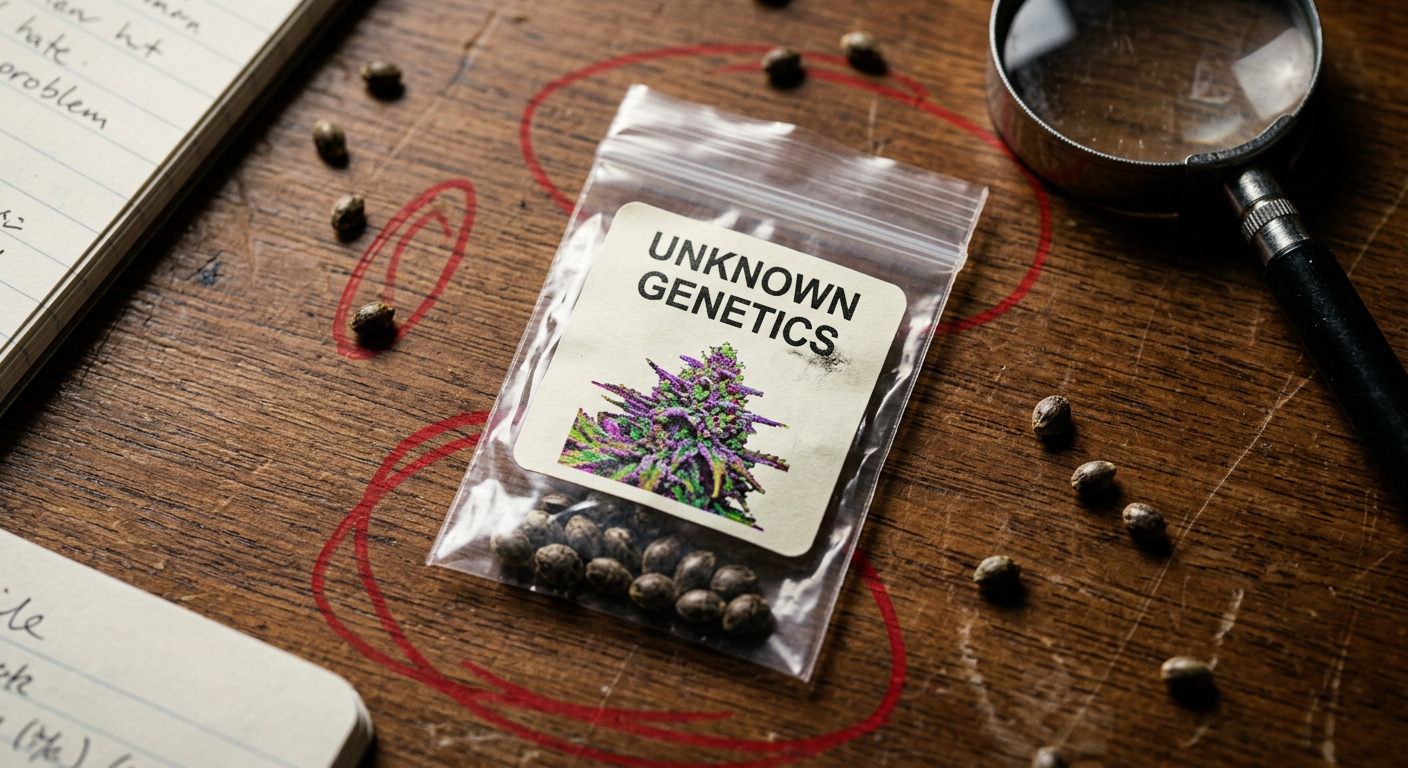
Most growers learn to spot bad seed packaging the hard way — after an underwhelming grow. These seven red flags give you a checklist to run through before any purchase.
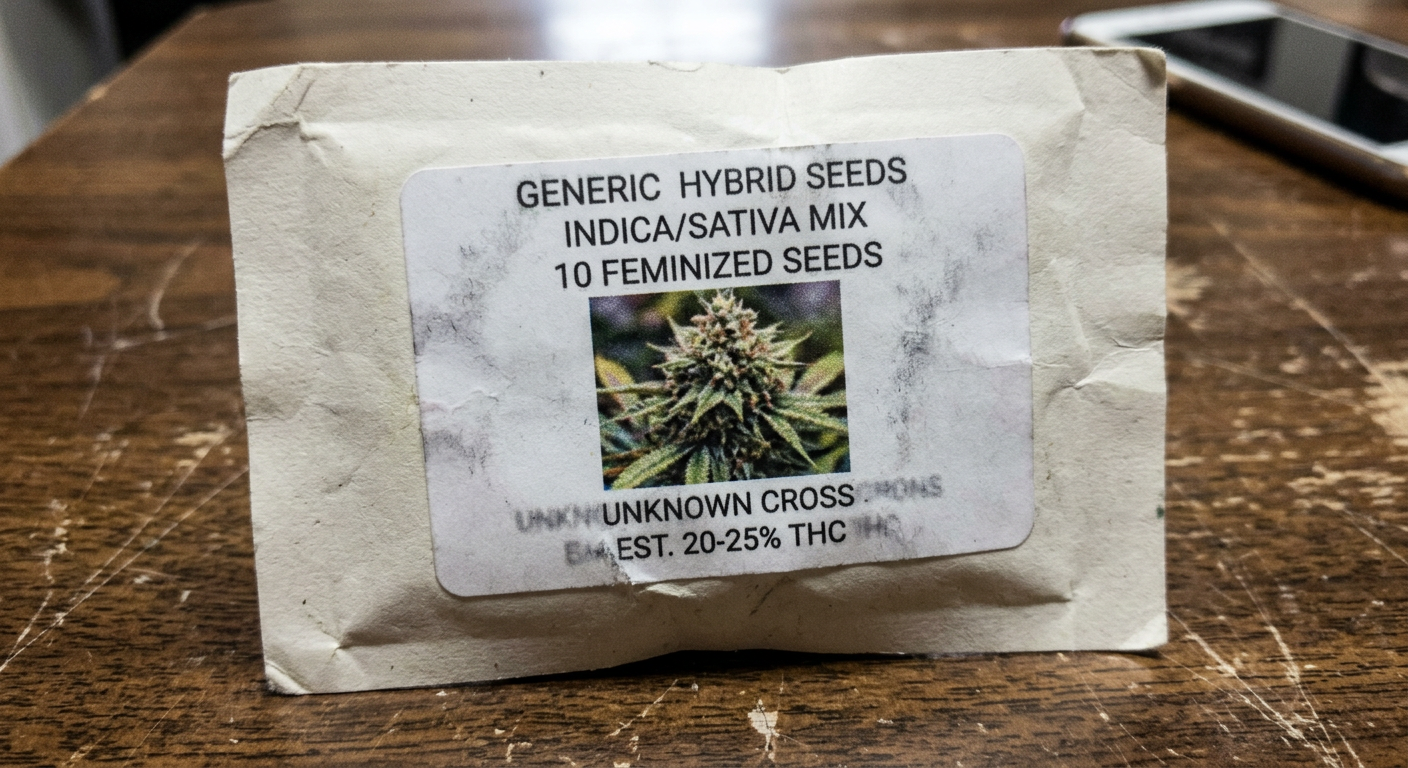
No Breeder Name Listed
Anonymous packaging almost always indicates white-label bulk seeds repackaged under a generic brand. There's no accountability, no breeding history, and no one to contact if germination rates are poor. Skip it.
Vague or Missing Lineage
If the packet says 'potent hybrid' or 'premium genetics' with no parent strains named, there is no genetic information to evaluate. This is either lazy labelling or deliberate obfuscation — neither is acceptable from a quality seed producer.
THC Claims Above 35% With No Lab Citation
Verified 35%+ THC test results are extraordinarily rare even under professional conditions. Any label claiming 36, 38, or 40% THC without citing a specific third-party lab and batch number is almost certainly marketing fiction.
Round, Suspiciously Precise Numbers
Real lab tests produce numbers like 22.4% or 19.7% — not clean round figures like '25% THC' or '30% THC.' Round numbers suggest the figure was chosen for marketing impact rather than derived from actual testing.
No Generation Notation
The absence of F1, F2, S1, or IBL labelling doesn't automatically mean bad seeds — but it does mean you have no information about stability or expected phenotype variation. Premium genetics breeders almost always include this information.
Flowering Time Listed as a Single Number
'8 weeks' with no range ignores natural phenotype variation within any seed batch. Even the most stable F1 crosses will show 5–10 days of variation. A single-number claim suggests testing on a very small sample size or a copy-paste marketing spec.
Professional Photography of Buds Not Grown From Those Seeds
Stock bud photography on packaging is common — and not inherently dishonest. But when the photo shows buds with characteristics (e.g., purple colouration, extreme trichome density) that don't match the strain's documented traits, the packaging is misleading you about what to expect at harvest.
Important: If you've already purchased seeds and are unsure about their quality, the best investment is a solid germination process. Proper technique maximises germination rates even from imperfect seeds. Our cannabis germination guide covers the step-by-step process to give every seed the best possible start.
What Transparent, Trustworthy Seed Packaging Actually Looks Like
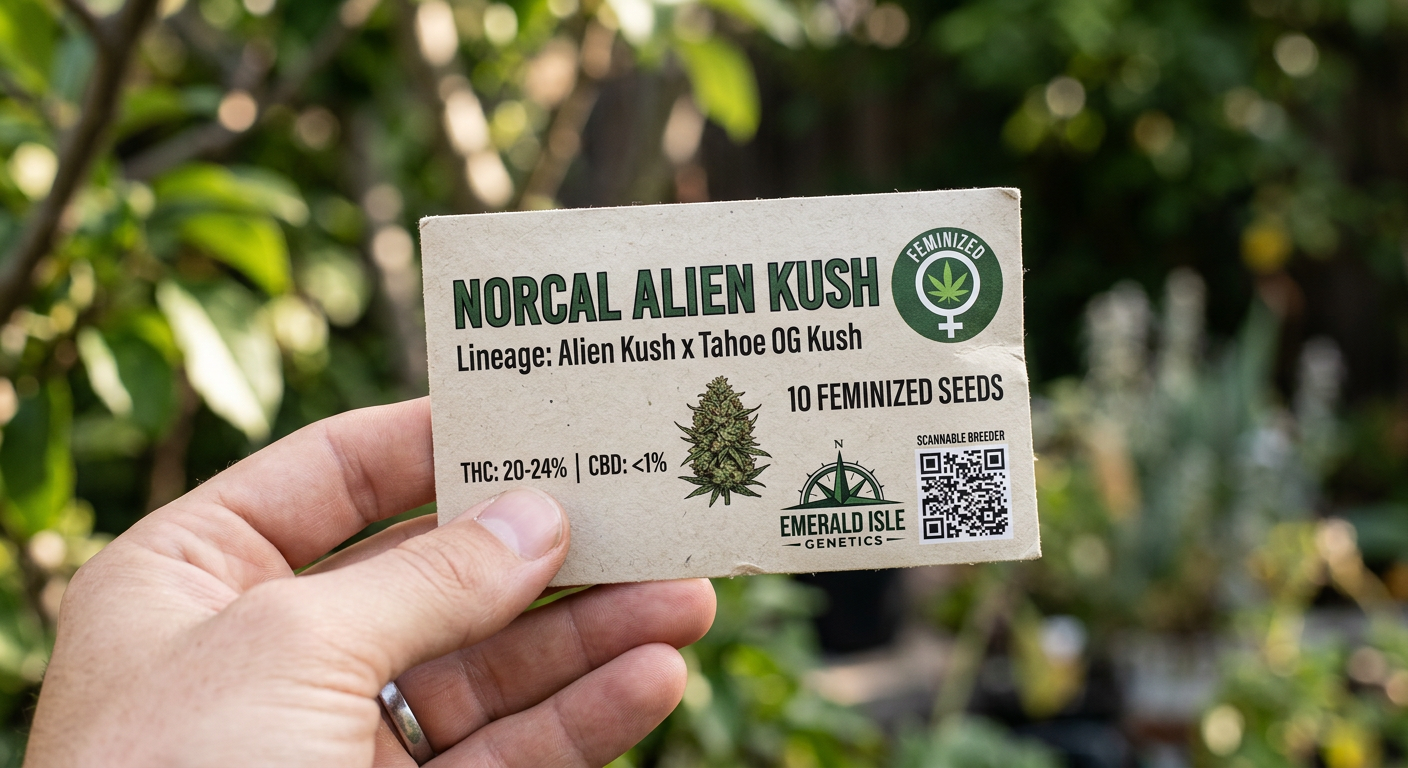
Now that you know what to look for and what to avoid, here's what genuinely transparent seed packaging delivers — and how to use that information as a decision-making framework rather than just a checklist.
The Transparency Checklist
- Strain name matches documented lineage history
- Named breeder with verifiable catalogue and reputation
- Seed type clearly stated: feminized / regular / autoflower
- Generation notation present: F1, F2, S1, or IBL
- Full parent lineage: Strain A × Strain B
- THC range with variance (e.g., 20–24%) not a single peak number
- Flowering time as a range (e.g., 8–10 weeks), not a single number
- Yield estimate clearly marked as g/m² under optimal conditions
- Grow difficulty rating or recommended experience level
- Pack size and seed count clearly stated
How to Use Packaging Information When Choosing Between Strains
Once you can decode a seed packet, you can start making comparative decisions based on genetics and documented performance rather than marketing names. Here's a practical approach:
- Start with type: Feminized photoperiod or autoflower? Match to your light setup first.
- Check generation: F1 for consistency, F2+ for pheno-hunting, IBL for breeding projects.
- Evaluate lineage: Do the parent strains explain the claimed effects and traits? Cross-reference strain history.
- Calibrate THC: Subtract 20–30% from the label for a realistic home-grow estimate.
- Adjust flowering time: Add 1–2 weeks to the stated range for conservative planning.
- Calculate actual yield: Use the yield estimator with your real setup specs, not the packet's ideal-conditions figure.
Transparent Genetics in Practice: Reading Real DSS Listings
Transparent packaging should show its work — and that applies to strain listings just as much as physical packets. For example, Northern Lights × Big Bud Feminized states both parent strains in the name itself — no mystery genetics, no vague indica label. Similarly, Northern Lights × Amnesia Haze Feminized (24% THC) makes the genetic cross immediately clear to any grower evaluating the strain's expected growth pattern and cannabinoid profile.
Strains like New York Power Diesel Feminized (24% THC) carry lineage rooted in Sour Diesel heritage, while Sour Diesel Feminized (24% THC) directly names one of the most documented strain lineages in cannabis history — making verification straightforward for any buyer who knows what to look for.
For newer growers still building their strain knowledge base, high-THC genetics like Quantum Kush Feminized (30% THC) and Purple Kush Feminized (27% THC) are worth evaluating once you've assessed your environmental controls — because achieving high-label THC results consistently requires the environment to match the genetics. Use the VPD calculator to dial in temperature and humidity before pushing high-THC varieties.
Pro Tip: Once you understand seed packaging, your next learning step is understanding what happens after germination — how your seedlings develop, what healthy growth looks like in weeks 1–2, and how to catch problems early. Our cannabis seedling problems visual diagnosis guide is the perfect companion to seed selection.
Beyond the Packet: Planning Your Full Grow
Reading a seed packet is the beginning of the planning process, not the end. Once you've selected a strain based on verified genetics and realistic expectations, map out your full grow before germination. The grow planner lets you input your strain's flowering time, seed type, and setup to generate a complete grow calendar — including veg time, transition, flower window, and projected harvest date.
If you're also calculating the cost of a full cycle, the grow cost calculator lets you factor in seeds, nutrients, electricity, and media to get a true cost-per-gram figure before you start.
A seed packet is a contract between breeder and grower. The more information it provides — lineage, generation, realistic ranges — the more accountability the breeder is taking on. That accountability is exactly what separates premium genetics from bulk mystery seeds.
Quick Reference: Cannabis Seed Packaging Decoder
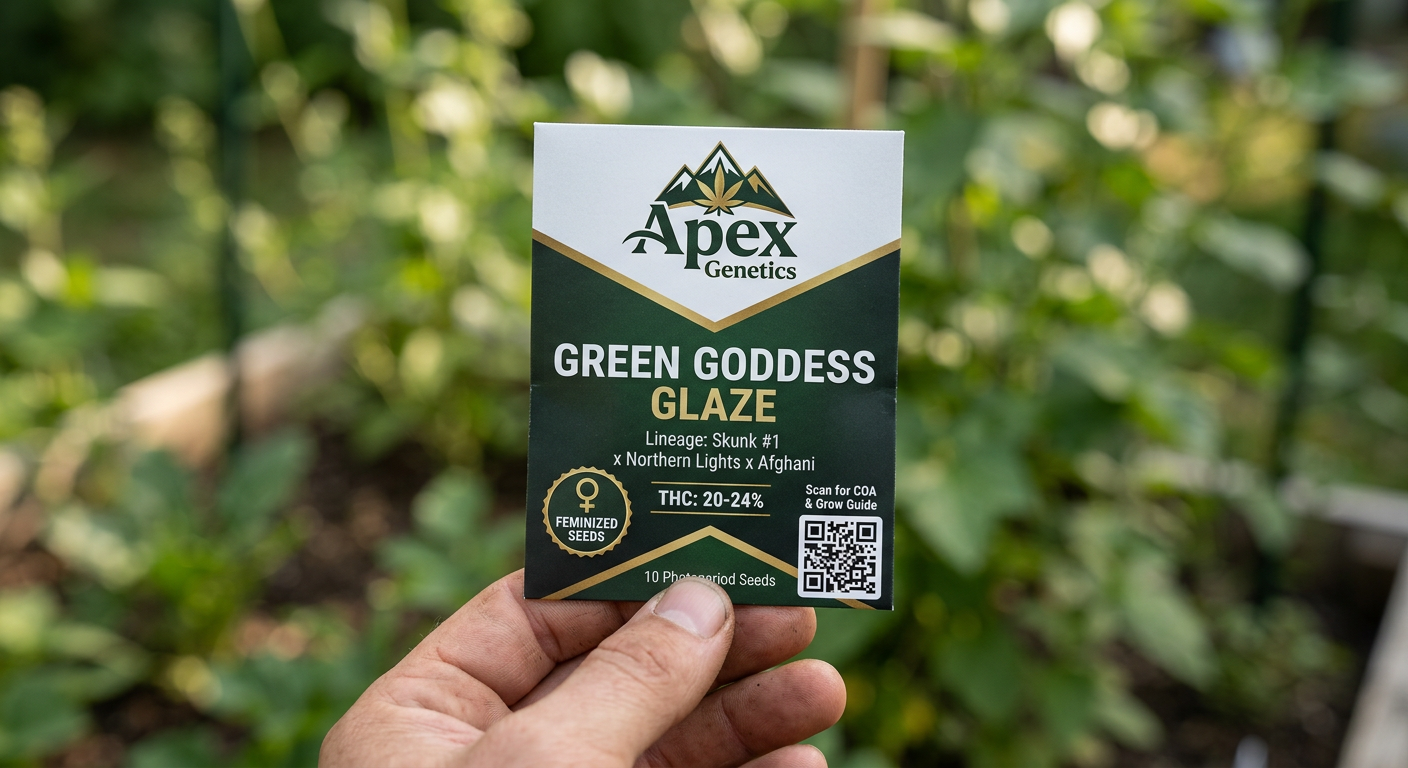
Use this as your final checklist every time you evaluate a new seed packet — whether you're buying online or in person.
| Label Element | What It Tells You | Green Flag | Red Flag |
|---|---|---|---|
| Seed Type | Growing process & sex ratio | Clear badge: feminized/auto/regular | No type listed at all |
| Breeder Name | Accountability & trust | Named breeder with documented history | Anonymous or generic brand |
| Lineage | Genetic proof & trait prediction | Parent A × Parent B explicitly named | 'Hybrid' or 'indica dominant' only |
| Generation | Stability & uniformity | F1, F2, S1, or IBL stated | No generation info at all |
| THC % | Potency estimate | Range with variance (e.g. 20–24%) | Single round number above 30% |
| Flowering Time | Timeline planning | Range in weeks (e.g. 8–10 wks) | Single week, no variance |
| Yield Estimate | Production planning | g/m² with 'optimal conditions' noted | No units or wildly inflated claims |
Armed with this decoder, you can walk through any seed catalogue — physical or digital — and evaluate genetics with confidence. The gap between a successful grow and a disappointing one often starts right here, at the label, before a single seed ever hits water.
When you're ready to move from evaluation to germination, bookmark our complete cannabis germination guide — it covers every method from paper towel to direct soil, with troubleshooting for every common issue your first seeds might throw at you.
Frequently Asked Questions
What does F1 mean in cannabis seeds?
F1 stands for 'first filial generation' — the direct offspring of two genetically distinct parent strains crossed for the first time. F1 seeds benefit from hybrid vigour, making them uniformly fast-growing and highly consistent. They are considered the most predictable seed type for home growers who want reliable, repeatable results across an entire batch.
Are THC percentages on seed packets accurate?
No — they are estimates derived from professional test grows under ideal conditions, not guarantees. Real-world home grows typically produce 20–40% less THC than the figure on the packet. Environmental factors like lighting quality, temperature, humidity, nutrient management, and harvest timing all affect the final cannabinoid content significantly.
What does feminized mean on a seed packet?
Feminized seeds are bred to produce only female plants — the ones that grow harvestable buds. Breeders create them by inducing a female plant to produce pollen using colloidal silver, then fertilizing another female with it. Because both parents carry only X chromosomes, the resulting seeds germinate as female at a rate of 99% or higher under normal growing conditions.
What does S1 mean on cannabis seeds?
S1 means 'selfed first generation' — a female plant was stressed into producing its own pollen, then pollinated itself. S1 seeds preserve the mother plant's specific genetics very closely, almost like a clone in seed form. The main downside is a slightly elevated hermaphrodite risk under stress, because the stress-response tendency can be passed to offspring.
How do I verify cannabis seed genetics from packaging?
Look for four key elements: a fully named lineage (Parent A × Parent B), a generation label (F1, F2, S1, or IBL), a named breeder with a verifiable public history, and a THC range rather than a single inflated number. Cross-reference the strain name and parent strains with documented cannabis databases to confirm the lineage matches known genetic history before purchasing.